.png)
Adults make up about 32% of orthodontic patients in the United States and Canada, and adult treatment is widely accepted, so age alone usually doesn't decide the question. For most adults, the conversation is about gum health, bone support, and a realistic timeline, not whether treatment is still possible.
A lot of people in Delaware bring up braces only after a routine dental visit, usually with the same quiet thought: “Is this still worth doing now?” That's a normal place to start, and it's the right kind of question to ask. Adult orthodontics works differently from teenage orthodontics in a few important ways, and those differences matter more than the birthday on a chart.
Table of Contents
- What It Is More Like to Get Adult Braces Today
- The Biology That Makes Adult Treatment Different
- Comparing Metal, Ceramic, and Invisalign for Adults
- Treatment Timeline and Appointment Rhythm
- Costs, Payment Plans, and Insurance Realities
- Comfort, Eating, and Daily Maintenance
- Your Next Step at Stellar Orthodontics in Delaware
What It Is More Like to Get Adult Braces Today
A patient in North Wilmington might sit in a chair for a cleaning, hear a familiar comment about crowding or bite wear, and finally say the thing they've been putting off for years. That moment usually isn't about vanity. It's about wanting a mouth that works better, looks better, and feels manageable in daily life.
The good news is that adult orthodontics is no longer unusual. By 2023, adults accounted for approximately 32% of orthodontic patients in the United States and Canada, and the adult orthodontic population had increased by more than 40% over the preceding decade (AAO patient numbers at all-time high). That matters because it means adults are not being pushed into a rare category. They're part of a large, established patient group.
What changes first
The biggest change is not the brackets or trays. It's the conversation around the teeth that already have a history. Adults may have fillings, crowns, worn edges, gum recession, or a bite that has been adapting for years. Those details don't rule treatment out, but they do change how the orthodontist plans it.
Practical rule: adult treatment is usually planned around what the mouth can safely support, not around age alone.
Adults also tend to ask better, more specific questions than teens. They want to know how visible the appliance will be at work, whether the bite issue is cosmetic or functional, and how long the day-to-day routine will feel. Those are smart questions, because the adult version of braces has to fit around jobs, childcare, commuting, and real schedules.
That's the main shift. Teen orthodontics often assumes growth is still happening. Adult orthodontics assumes the structure is mature, so the plan has to respect the gums, the bone, and the limits of moving teeth in an already finished mouth. The next step is understanding why that biology matters before choosing an appliance.
The Biology That Makes Adult Treatment Different
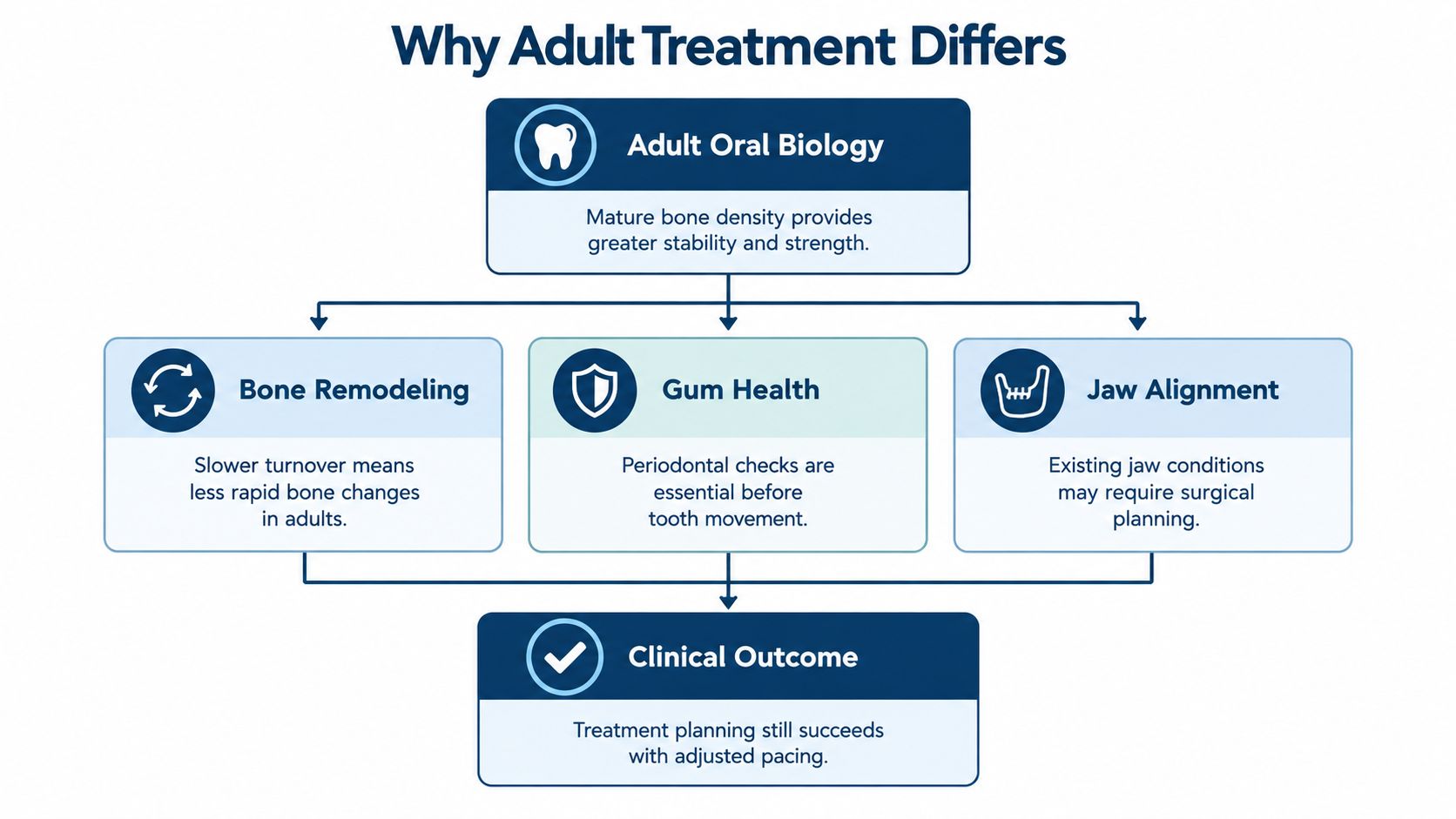
Adult orthodontic care starts with a basic truth, teeth can still move, but the mouth has to be ready for that movement. That's why a consultation looks beyond straightness and into support structures, especially the gums and bone. A systematic review found that orthodontic therapy produced minimal periodontal changes in patients without periodontitis and in patients whose periodontitis had been treated and stabilized, but active untreated periodontal disease increases the risk of further deterioration (periodontal review).
What gets checked before treatment
An orthodontist usually looks at the gums, the bone that supports the teeth, signs of inflammation, recession, and the bite pattern. Radiographs help show what can't be seen in the mirror. That's not overcaution, it's the part of adult care that protects the result before any brackets or aligners are placed.
Adults with healthy support often move through treatment well. Adults with untreated gum disease need a different sequence, because moving teeth through an unhealthy periodontium can make things worse. In that setting, periodontal therapy comes first, then orthodontic movement follows once the tissue is stable.
Why root shape and force matter
There's also a smaller but real issue called orthodontically induced inflammatory root resorption. In plain language, root structure can shorten when certain forces are too heavy or too continuous. An evidence overview of 28 systematic reviews found higher risk with heavy or continuous forces, intrusion, maxillary-incisor torque and retraction, extraction-based mechanics, severe malocclusions, long active-treatment duration, and tooth-anchored expansion (root resorption overview).
That doesn't mean adults can't be treated. It means the orthodontist may choose lighter force, slower pacing, and careful radiographic monitoring when the case calls for it. A calm adult consultation should explain exactly that, because the goal is controlled movement, not dramatic movement.
Clinical takeaway: healthy gums make orthodontic movement more predictable, and heavy force isn't a shortcut.
Adults also need to think about restorations, because a tooth with a crown or a long history of wear may behave differently from an untouched tooth. That's one reason an exam is more useful than guessing based on age. The mouth itself, not the birthday, sets the boundaries.
Comparing Metal, Ceramic, and Invisalign for Adults
Adult patients often want the appliance choice to feel like a lifestyle choice, but it's really a case-planning choice first. Visibility matters, of course, but so do bite correction, movement control, and the amount of discipline the appliance demands each day.
| Adult Brace Options at a Glance | Best For | Visibility | Comfort | Case Complexity Fit |
|---|---|---|---|---|
| Metal braces | Steady, controlled tooth movement and broad case types | Most visible | Can feel bulky at first, then predictable | Strong fit for complex movement |
| Ceramic braces | Adults who want a more discreet fixed option | Less visible than metal | Similar to metal with cosmetic trade-off | Good fit for many fixed-appliance cases |
| Clear aligners | Adults who can follow wear-time closely and want removability | Very low visibility | Smooth surfaces, fewer sharp edges | Best for selected cases, not every bite problem |
The trade-off is simple. Clear aligners can be appealing because they're removable and discreet, but they depend on consistent wear and case suitability. A systematic review and meta-analysis, based largely on adult patients, found aligner-treated cases were more likely than fixed-appliance cases to finish at an unacceptable quality under ABO standards, with a relative risk of 1.6 (aligner quality review).
What that means in real life
That finding doesn't make aligners a bad choice. It means the question isn't, “Are aligners modern?” The actual question is, “Will this case behave well in aligners, and will daily wear be realistic?” A patient with a mild spacing issue may do very well with trays. A patient with more complicated bite correction may need the extra control of fixed braces.
Adults also need to think about attachments, refinements, and whether the proposed goal is mainly cosmetic or truly bite-corrective. That's why appliance choice should be tied to the teeth, not the ad copy. Learn more about adult brace types
Simple rule of thumb: the most discreet option isn't always the most efficient option, especially when the bite is complex.
For many Delaware adults, the best first question is not “Which one looks best?” It's “Which one matches the movement this mouth needs?” That's the level of comparison that saves frustration later.
Treatment Timeline and Appointment Rhythm
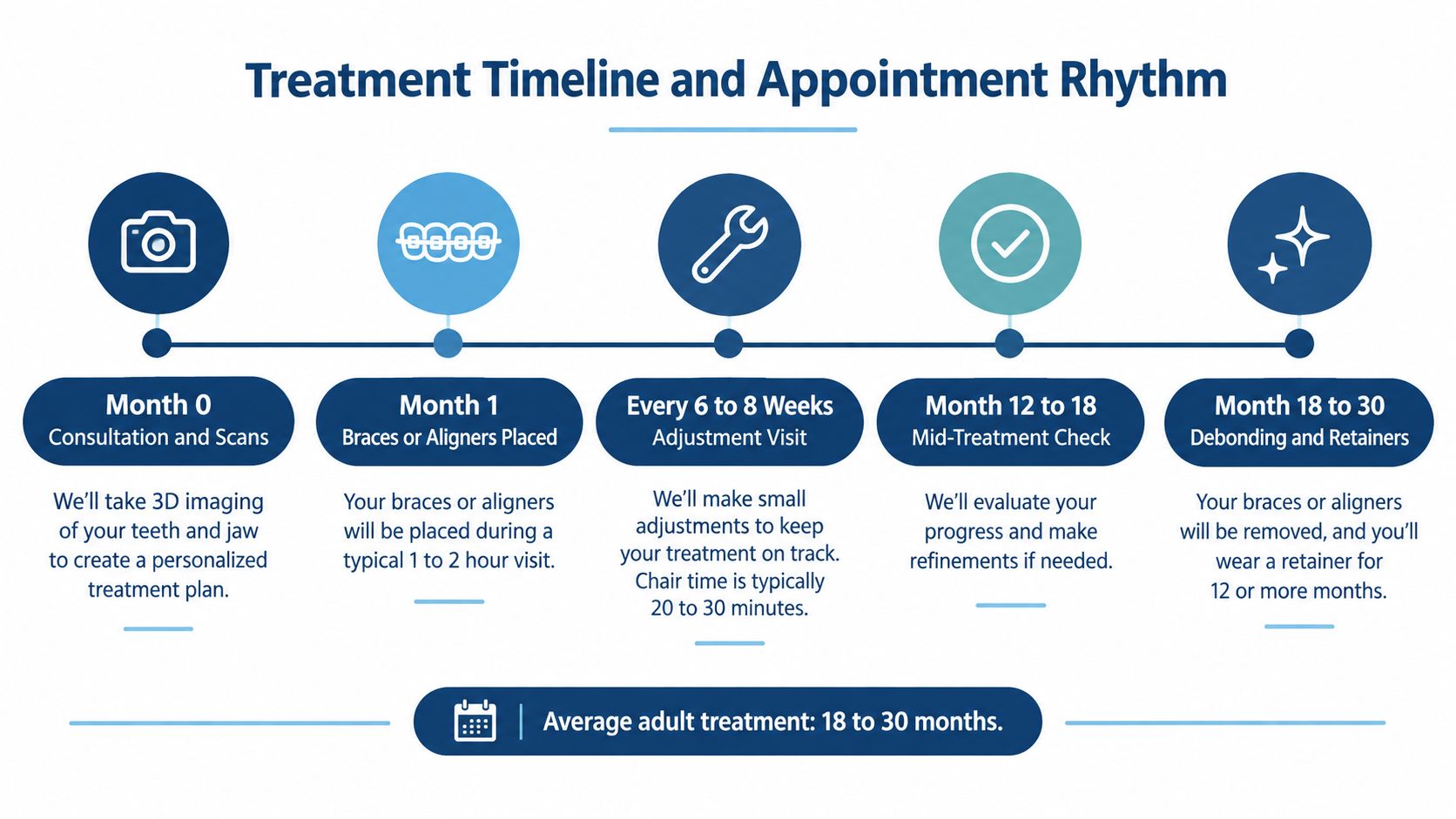
The first thing many adults want to know is how long the process will feel in daily life. The answer depends on the bite, not the birthday. The American Association of Orthodontists notes that braces often take about 12 to 24 months, while mild cases may finish sooner and more complex cases may take longer (AAO braces timeline). That range makes sense because teeth move through living bone, and different movements ask for different amounts of time.
What the calendar usually looks like
A typical start includes photos, scans, and bite records, then the appliances are placed. After that, the visit rhythm becomes part of the routine. Many adult patients come in every 6 to 12 weeks, and the American Association of Orthodontists describes visits about every 6 to 8 weeks as common, depending on the appliance and the stage of treatment.
That schedule helps adults plan around work, childcare, and drives between Delaware communities such as Middletown, Dover, or Millsboro. It also separates a regular adjustment from an extra visit for a broken bracket, a lost aligner, or a periodontal check.
Adults with stable routines often handle treatment well because the calendar is predictable. The tradeoff is that orthodontic care still asks for attention between visits, especially if a patient is managing brushing, flossing, and appliance care at home.
Adults and teens often move at similar speeds
A systematic review found no statistically significant difference in the length of fixed-appliance treatment between adults and adolescents, with an average difference of -0.8 month. In plain language, adult braces do not automatically take longer just because the patient is an adult.
Case complexity still matters. A simple alignment problem may move on a straightforward path, while bite correction, missed wear with aligners, refinements, or coordination with periodontal maintenance can extend the timeline. Read more about adult treatment length
The useful question is not whether adulthood blocks treatment. It is whether the chosen appliance matches the movement the teeth need and the routine the patient can keep.
Costs, Payment Plans, and Insurance Realities
Money is often the second question adults ask after “Will this work for me?” The honest answer is that cost depends on the appliance, the complexity of the bite, and how much of the total is covered by insurance or a payment plan. Adult orthodontics is now a major part of the market, not a side category, which helps explain why so many offices build flexible payment options around it. The average number of adult patients per orthodontist rose from 129 in 2012 to 178 in 2018, a 27.53% increase over six years (adult patient growth review).
What adults should ask about money
A useful financial conversation usually covers four things. First, whether the office accepts the patient's dental insurance. Second, whether monthly payment plans are available. Third, whether flexible spending or health savings money can be applied. Fourth, how the office handles the portion left after insurance.
Adults in Delaware who are comparing visits at North Wilmington, Middletown, West Dover, or Millsboro should ask for a written estimate that separates appliance fees, monitoring, and any additional refinement steps. That helps the treatment plan feel concrete instead of vague.
Good planning question: what part of the total is likely to be covered, and what part will need to be spread out over time?
The important part is that adults don't have to make the financial decision in one jump. A free consultation can turn a broad estimate into a practical monthly picture. Review adult pricing details
How insurance usually fits in
Insurance doesn't decide whether treatment is worth it, but it can lower the out-of-pocket share enough to make the plan easier to start. Coverage varies, especially for adults, so the benefit check matters. A calm office should explain the estimate clearly instead of treating the numbers like a surprise later.
For Delaware families and adults alike, the best next step is to ask what the office can verify before treatment begins. That keeps the decision grounded in facts rather than assumptions.
Comfort, Eating, and Daily Maintenance
The first week is often the part adults notice most. Teeth can feel tender, chewing can feel awkward, and the lips or cheeks may need time to adapt to brackets or trays. That usually reflects new pressure and new surfaces, not a problem with the treatment itself.

What daily life feels like
Fixed braces call for some food changes. Hard, sticky, or crunchy foods can break brackets or bend wires, so adults usually do better when they cut food into smaller pieces and avoid the things that put too much stress on the appliance. Clear aligners change the routine in a different way, because they depend on steady wear and cleaning after meals. The appliance may change, but the goal stays the same, keep the teeth and appliance clean enough that inflammation does not have room to build.
Oral hygiene matters more in adult treatment because the gums are part of the plan, not just the background. Brushing after meals, cleaning around brackets or trays, and following the hygiene steps given by the office all help protect the tissues that support tooth movement.
When to call instead of waiting
A broken bracket, a poking wire, or a lost aligner does not always mean an emergency, but it does mean the office should hear about it. Adults often try to wait until the next visit, especially when work is busy, but that can slow progress if the appliance is no longer doing its job. A quick call can prevent a small problem from turning into extra delay.
Between visits, the routine matters. Keep brackets or trays clean after meals, use wax if a wire or edge irritates the mouth, and wear aligners exactly as directed so they keep the teeth moving as planned. If a tray is lost or a bracket breaks, contact the office promptly instead of hoping it will hold until later.
Keep the habits simple. Clean well, wear what you were told to wear, and report problems early.
Adults who stay steady with those habits usually find treatment less disruptive than they expected. The appliance becomes part of the day, not the focus of it.
Your Next Step at Stellar Orthodontics in Delaware
Age is rarely the deciding factor for orthodontic treatment. Decisions hinge on the condition of the teeth, gums, supporting bone, and bite, plus the patient's goals, schedule, and tolerance for visibility and maintenance (AAO age guidance).
For an adult thinking about braces, the most useful next step is a consultation that looks at the whole picture, not just the smile from the front. That means checking gum health, thinking through appliance choice, and giving a timeline that fits real life instead of guessing.
Stellar Orthodontics offers free consultations with iTero digital 3D scanning at North Wilmington, Middletown, West Dover, and Millsboro. Adults can bring questions about treatment goals, work schedules, and appliance options, then leave with a clear plan for what comes next.
If adult braces are on the mind, Stellar Orthodontics can help sort out what's realistic for the teeth, gums, and day-to-day schedule. Visit Stellar Orthodontics to book a free consultation at one of the Delaware locations and get a treatment plan that fits the mouth, not just the calendar.