
A parent sits beside a teenager who has just finished a series of clear aligners. The front teeth look straighter. The family expected a retainer and a finished smile. Then the orthodontist mentions braces after Invisalign as a possible next phase. That moment can feel confusing and disappointing. It doesn't always mean something went wrong. Sometimes it means one tool handled the first part of the job, and another tool may handle the remaining movement more predictably.
Table of Contents
- Why Some Invisalign Patients End Up Needing Braces
- Clinical Scenarios That Lead to Braces After Invisalign
- Choosing Between Refinement Aligners and Fixed Braces
- What the Timeline From Aligners to Braces Looks Like
- Keeping Results Stable With Retainers After Treatment
- Common Myths About Braces After Invisalign
- Booking a Free Consultation at Stellar Orthodontics
Why Some Invisalign Patients End Up Needing Braces
A Delaware family from Middletown might hear this news at a progress visit. An adult from North Wilmington might hear it after noticing one tooth still looks turned. A parent in West Dover or Millsboro might wonder whether missed aligner wear caused the problem. Those reactions are understandable. Nobody wants treatment to feel endless.
The calmer way to frame braces after Invisalign is as a planned second phase conversation. The first question isn't whether aligners failed. The first question is what movement remains. A tooth may still need rotation. A bite may still need adjustment. A result may have shifted after treatment ended. Those are three different problems, and they don't always have the same solution.
Three Questions Guide the Decision
- What's unfinished: Is a tooth still short of its planned position, or did it move after reaching that position?
- What tool fits: Can additional aligners finish the movement, or do brackets and wires offer better control?
- What's the maintenance plan: How will retainers hold the result once active treatment ends?
Picture building a deck. Framing can be mostly complete while a few boards still need precise cuts. That doesn't make the framing useless. It means the finishing work needs the right tool and a clear plan.
A second phase isn't an automatic verdict on the first phase. It's a response to the specific movement still needed.
Parents and adult patients across Delaware deserve that explanation in plain language. The sections below separate unfinished movement from true relapse and from long term maintenance. That separation makes the next conversation with an orthodontist much easier to follow.
Clinical Scenarios That Lead to Braces After Invisalign
An aligner series works like a planned road trip. Each tray expects teeth to arrive at a small checkpoint. When teeth track well, the next tray fits fully and treatment stays on route. When a tooth lags behind, the tray may sit slightly high or leave a visible gap. That's often called incomplete tracking.
Movements That Can Be Harder to Finish
Some turns on that route are harder for plastic trays to control. A 2024 systematic review comparing aligners and fixed appliances found similar overall outcomes in simpler cases, while rotations and vertical tooth movements remained harder to control with aligners. The same source summarizes a 2025 systematic review and meta-analysis finding superior treatment quality with fixed appliances in extraction cases because of greater control over tooth movement.
A rotated canine offers a simple example. The tray pushes on a rounded surface, which can make turning that tooth feel like turning a doorknob with a loose glove. Vertical movement is another example. Moving a tooth up or down, including intrusion, may need stronger grip than a tray alone provides. Spacing and extraction cases can also need careful three dimensional control so teeth don't tip into a space instead of moving with their roots.
How Clinicians Sort Out the Cause
- Incomplete tracking: The tooth never fully reached the planned checkpoint, so later trays fit less accurately.
- Inadequate wear: Trays weren't worn as directed, so teeth had less time to respond between changes.
- Plan mismatch: The original movement plan underestimated how a tooth, bite, or extraction space would behave.
- Growth related change: A child or teen kept growing, and jaw or tooth positions changed during treatment.
- True relapse: Treatment finished, teeth later shifted, often after retainer wear stopped or became inconsistent.
Those distinctions matter because the fix differs. Mild tracking problems may respond to more aligners. A stubborn rotation may point toward braces on selected teeth or all teeth. Growth changes may need monitoring before a final decision. Relapse raises a different question about retainers after correction.
Parents asking whether crowding affects that choice can also review whether Invisalign works for crowded teeth before a consultation. Helpful questions include which teeth haven't finished moving, whether elastics are needed, and whether braces would cover the full mouth. Clear answers turn a worrying surprise into a specific plan.
Choosing Between Refinement Aligners and Fixed Braces
Refinement aligners are additional or finishing aligners made after the first series. They can suit modest remaining movement when teeth are tracking reasonably well and the patient can wear trays consistently. A 2026 systematic review of refinement in 20 studies linked refinement to treatment complexity, extractions, severe spacing, larger planned movements, and limits in movements such as rotations, intrusion, vertical corrections, and transverse expansion. Needing refinement therefore isn't unusual, especially in complex cases.
Fixed braces bond brackets to teeth and connect them with wires. That setup can grip a tooth more directly for rotation and vertical control. Attachments, elastics, or braces on only selected teeth may also be part of a plan. The choice depends on the movement, not on a simple claim that one appliance always wins.
| Consideration | Refinement aligners | Fixed braces |
|---|---|---|
| Best suited movement | Modest finishing changes that trays can control | Rotations, vertical changes, and complex shifts needing stronger control |
| Removability | Removable for eating and brushing | Bonded in place during active treatment |
| Daily wear demands | Depends heavily on consistent tray wear | Works continuously, though elastics still need cooperation |
| Scope | Usually planned as a finishing series | May involve all teeth or selected teeth |
| Main trade off | Less visible, but missed wear can limit progress | More visible, but doesn't rely on remembering trays |
Questions That Clarify the Recommendation
- Which movement remains: Is it rotation, height, spacing, bite correction, or a mix?
- Why this appliance: What can brackets and wires control here that another tray series may not?
- What changes afterward: Does the second phase alter retainer type or wear instructions?
Families wanting background before that conversation can read about what Invisalign refinements involve and compare that path with braces. A modest gap that needs closing may stay with aligners. A tooth that needs to turn and move vertically may favor braces. Neither answer is automatic.
Practical rule: The remaining movement should drive the appliance choice, not frustration with the first appliance.
That rule also prevents a common misunderstanding. Switching tools doesn't restart treatment from zero in every case. It uses the progress already made, then applies a different kind of control to finish the part that remains difficult.
What the Timeline From Aligners to Braces Looks Like
A second phase usually begins with fresh records rather than guesswork. The orthodontist reviews the earlier plan, examines the bite, and uses digital 3D scanning to capture current tooth positions. That visit answers a basic question. Are teeth unfinished, or did they finish and then shift?
The timeline below shows how braces can fit between an aligner phase and retention.
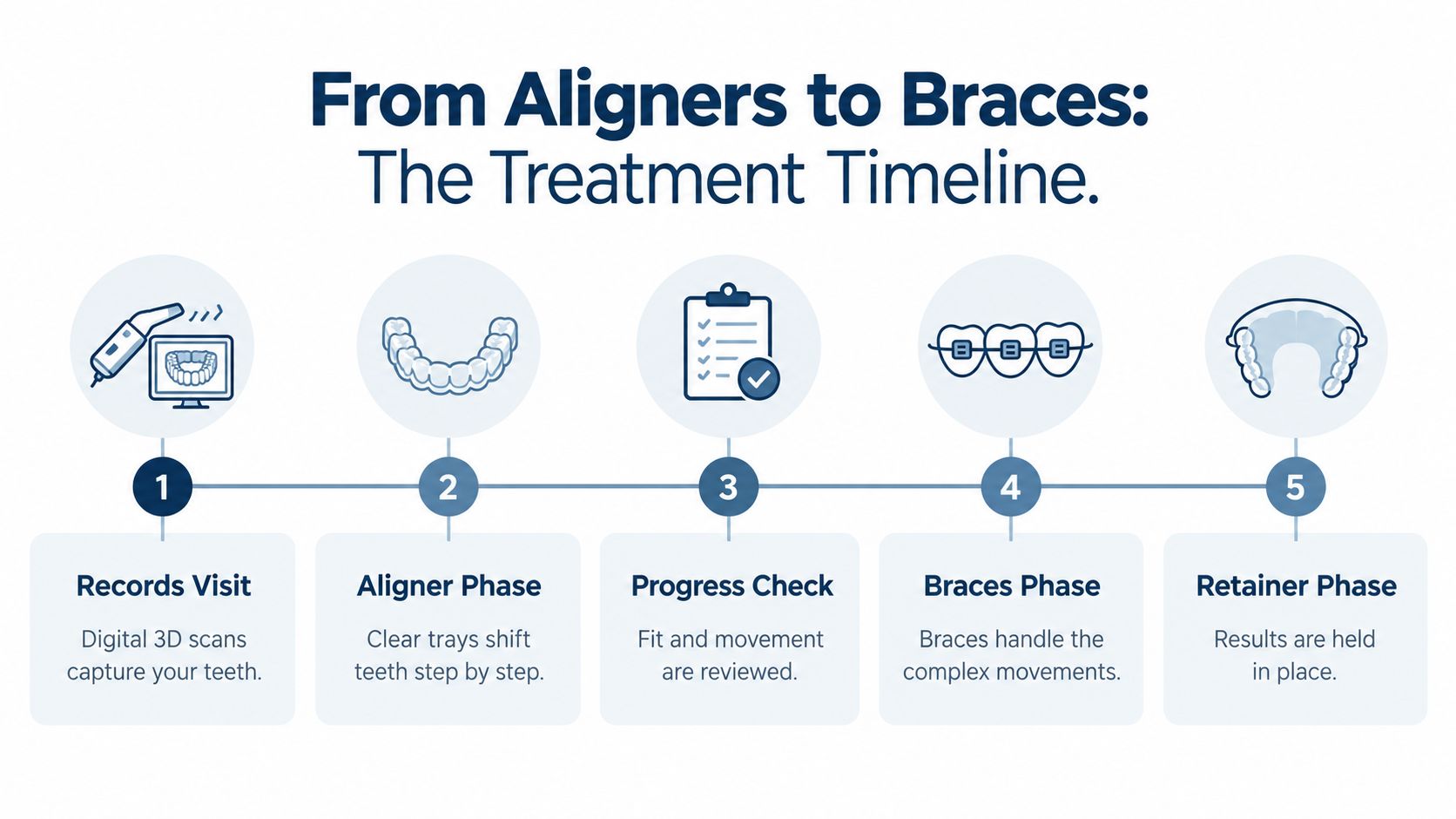
The Usual Sequence
- Records visit: Digital scans and a bite review document where teeth are now.
- Revised plan: The orthodontist explains what remains and why refinement or braces fits.
- Active second phase: Aligners or braces move teeth, with regular check ins to monitor fit and progress.
- Retention transition: Retainers are made or adjusted once teeth reach the revised goal.
Duration varies with the amount and type of movement left. A personal estimate belongs at consultation, after records are reviewed. A generic timeline can't account for growth, extraction spaces, bite needs, or how well teeth tracked earlier.
The long view matters too. Long term observational work from 1988 found that approximately 90% of cases experienced some relapse within 10 to 20 years after active retention ended. That doesn't mean most patients returned fully to their original alignment. It shows that measurable tooth position changes are common over extended follow up.
That finding shouldn't alarm families. It should shape planning. The timeline doesn't end when braces come off. Periodic orthodontic monitoring and retainer use remain part of protecting the result, often well beyond the first months after treatment.
Keeping Results Stable With Retainers After Treatment
Moving teeth is only half the job. After orthodontic movement, the periodontal ligament and gum fibers need time to remodel around new positions. Growth, bite forces, and age related changes can also keep nudging teeth. That's why retention is long term maintenance, not a short finishing step.
The checklist below summarizes the forces that make retainer wear matter.
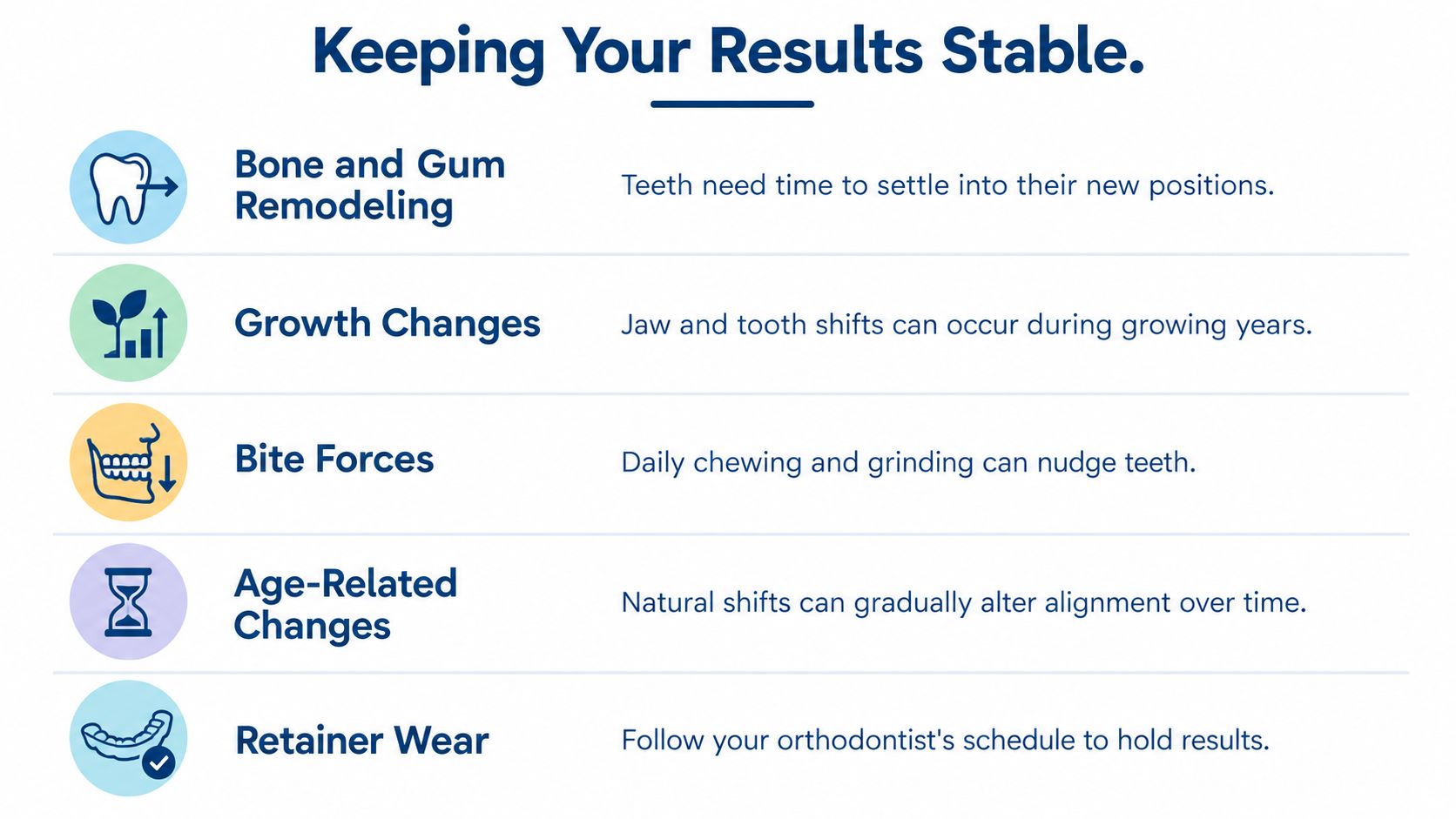
The American Association of Orthodontists guidance on dental retainers describes a common pattern of full time wear for the first few months after active treatment, then transition to nighttime wear. Continued nighttime use may be recommended indefinitely to reduce relapse risk. Individual instructions still matter more than a general pattern.
Evidence doesn't identify one universally superior retainer design. A Cochrane review of retention methods found low to very low certainty evidence overall and reported that differences between part time clear removable retainers and fixed retainers may be small. It also found insufficient high quality evidence that full time thermoplastic wear is more stable than part time wear.
A Simple Retainer Check
- Fit: The retainer should seat fully without force.
- Damage: Cracks or distortion can change how it holds teeth.
- Comfort and cleanliness: Odor or gum irritation deserves prompt attention.
The short video below offers a visual refresher on retainer habits before the next orthodontic visit.
Forcing a tight retainer can move teeth unpredictably or irritate soft tissue. A retainer that stops seating fully is a reason to contact the orthodontist promptly. Families can review retainer options and care basics and ask whether a removable, fixed, or combined approach fits the second phase result.
Common Myths About Braces After Invisalign
Confusion often comes from treating three different issues as one. Finishing unfinished movement isn't the same as correcting relapse. Neither is the same as maintaining a completed result. Keeping those separate clears up the most common myths.
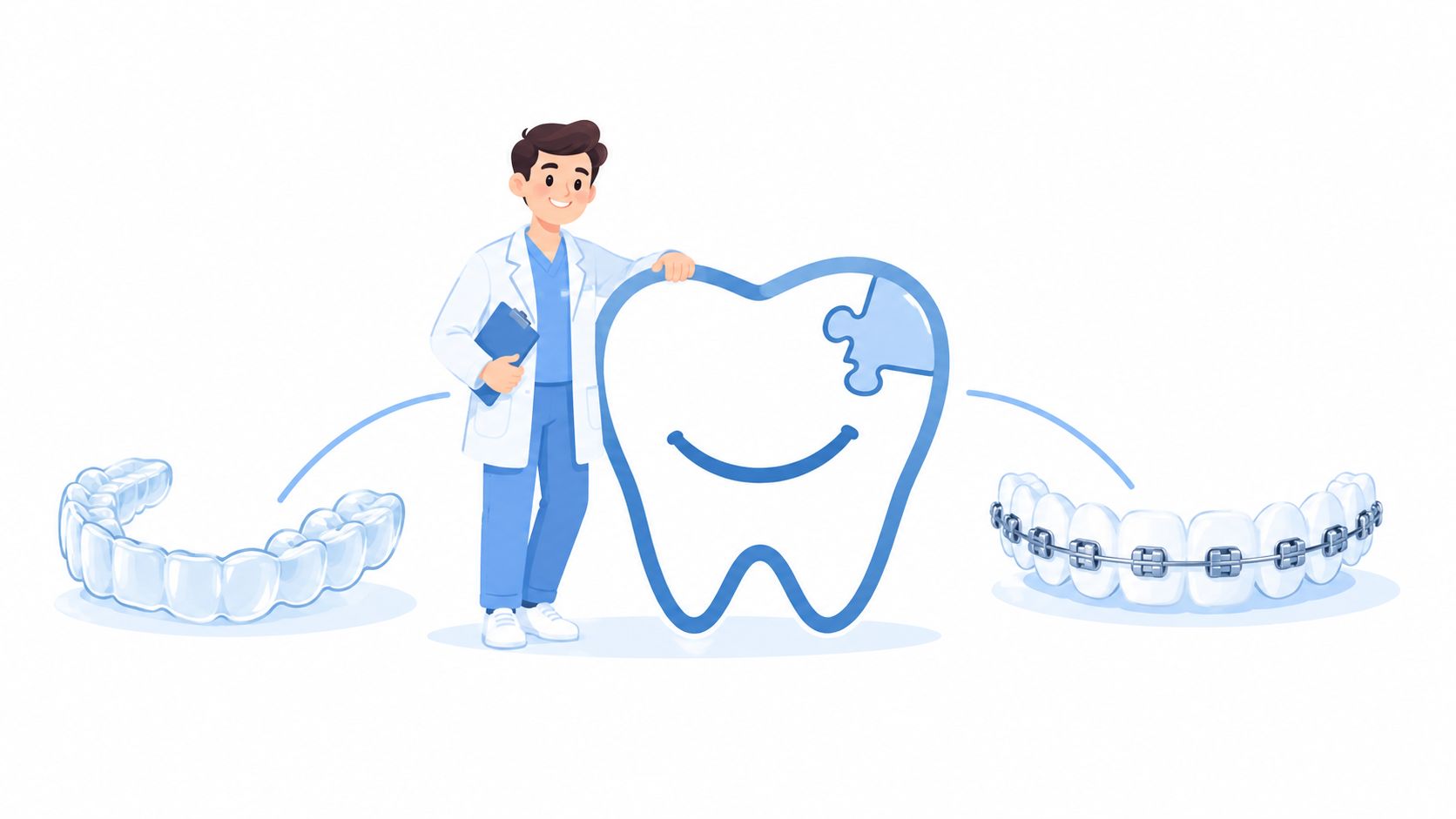
The image below contrasts the two appliances families often compare during that discussion.
Myth One Braces Mean Invisalign Failed
A second phase may reflect movement complexity alone. Rotations or vertical corrections can remain after aligners handled crowding or spacing well. That pattern points to a tool mismatch for the last step, not automatically to a mistake.
Myth Two Braces Permanently Prevent Relapse
Evidence doesn't support that promise. A 2024 systematic review on relapse after aligners and fixed appliances found no clear major difference in post treatment relapse between the two, while noting few studies, moderate or high risk of bias, and limited long term comparisons. A 2025 international expert consensus reached a similar cautious position and described the supporting evidence as low quality.
Myth Three Braces Must Cover Every Tooth
Some plans involve selected teeth only. Others need full braces to control the bite. Parents should ask which teeth need brackets, whether elastics are planned, and how the retainer plan changes afterward.
Braces can finish movement. Retainers protect the finish. Those jobs shouldn't be confused.
That distinction answers the worry behind many consultations. Braces after Invisalign may correct what remains, but no active appliance removes the need for retention afterward.
Booking a Free Consultation at Stellar Orthodontics
A free consultation at Stellar Orthodontics gives families a concrete way to sort unfinished movement from relapse. The visit typically includes a review of existing Invisalign records, an iTero digital 3D scan, and a clear discussion of refinement versus fixed braces. Retention belongs in that same conversation, before active treatment resumes.
Doctors and Delaware Locations
Care is provided by Dr. Robert Park, Dr. Can Nguyen, who is Board Certified by the American Board of Orthodontics, and Dr. Sonal Dave. Families can choose among four Delaware locations.
- North Wilmington: 2304 Concord Pike
- Middletown: 818 Kohl Avenue
- West Dover: 125-2 Greentree Drive
- Millsboro: 26670 Centerview Drive
Bringing current aligner paperwork helps the team compare the original plan with current tooth positions. A written list of questions also helps. Useful topics include which teeth need movement, whether braces would be limited or full, how long the second phase may take, and what retainer schedule follows.
Cost and Coverage Questions
Stellar Orthodontics accepts most major dental insurance and offers monthly payment plans with $0 down. The practice also accepts AmeriHealth Caritas Delaware, Highmark Health Options, Delaware First Health, and CHIP for children and teens under 21. Coverage for a second phase or replacement retainers varies by plan, so benefits should be checked directly rather than assumed.
That practical step matters because cost questions often sit underneath clinical worry. A parent may understand why braces are recommended but still wonder about insurance, payment timing, or whether a bonded retainer repair is covered. Asking those questions early prevents surprises later.
Families in North Wilmington, Middletown, Dover and West Dover, and Millsboro can book a free consultation at the location closest to home. The goal is simple. Leave with a clear explanation of what remains, which appliance fits, and how the result will be maintained.
Families facing braces after Invisalign can get a clear second phase plan, an iTero digital 3D scan, and an honest discussion of refinement, braces, and retainers at Stellar Orthodontics. Parents and adult patients across Delaware are invited to book a free consultation and visit Stellar Orthodontics to choose the North Wilmington, Middletown, West Dover, or Millsboro location that fits best.