.png)
Clear or silver tones are the most popular professional choices for adult braces in Delaware, while white and clear elastics can stain over time. The right choice depends less on age or fashion and more on how visible the braces should look in a workplace, on video calls, or at family events.
An adult patient may leave a first adjustment appointment feeling confident, then pause before a client meeting and wonder whether the braces look too youthful. That concern is common, especially for professionals in North Wilmington, Middletown, Dover, and Millsboro who want treatment to fit naturally into daily life.
The good news is that adult braces colors offer more flexibility than many patients expect. Ceramic brackets, silver ties, clear elastics, and restrained shades can create a polished appearance, while darker or brighter colors can add personality when the setting allows it. Color isn't a minor detail. It affects visibility, maintenance, and how a smile appears in photographs and conversations.
Table of Contents
- Adult Braces Color Choices Are More Discreet Than You Think
- Where Your Braces Color Decision Actually Happens
- Ceramic Braces vs Metal Braces for Adult Patients
- How Elastic Colors Hold Up in Real Adult Life
- Matching Braces Colors to Your Daily Lifestyle
- Start Your Adult Braces Consultation at Stellar Orthodontics
- Common Questions About Adult Braces Colors
Adult Braces Color Choices Are More Discreet Than You Think
Adults sometimes picture braces as a highly visible row of bright colors. That image comes mostly from teen-focused advice, where changing elastic colors can be part of the fun. Adult treatment has a different priority. Many patients want the orthodontic appliance to support a professional image without making treatment feel hidden or uncomfortable.
The American Association of Orthodontists reported about 1.91 million adult patients being treated by its members in 2024, compared with about 1.64 million in 2022. The same organization says one in three orthodontic patients today is an adult. Those figures show why adult preferences now influence appliance design and color conversations across the United States, including Delaware. The American Association of Orthodontists' patient survey provides that broader context.

Professional doesn't mean invisible
A client-facing professional may prefer ceramic brackets with silver or clear ties. A creative worker may choose navy or burgundy for a deliberate accent. Someone who wants the lowest-contrast appearance may prioritize tooth-colored brackets and accept that clear elastics require more attention.
Adult orthodontics has expanded over time, and one industry review reports that adult orthodontic patients increased by more than 40% over the last decade. Historical reporting linked to the AAO also describes 12 million U.S. adults undergoing orthodontic treatment, a 39% increase from 1996. These figures help explain why options such as clear ceramic, silver, and rose-gold looks have become more visible in adult treatment discussions. The adult orthodontics statistics review outlines that history.
Practical rule: The most polished braces color is the one that fits the patient's workplace, eating habits, and comfort with maintenance.
Color anxiety usually becomes easier when the decision is treated as a lifestyle choice rather than a test of personal style. An orthodontic consultation can compare how different brackets and elastics look before a patient commits to treatment.
Where Your Braces Color Decision Actually Happens
“Braces color” describes two separate choices. Confusing them can make the consultation seem more complicated than it is.
First choice, the bracket material
The bracket is the small attachment bonded to each tooth. It works like the frame of a picture, because it stays in place throughout treatment and creates the main visual outline.
- Metal brackets create a visible metallic appearance.
- Ceramic brackets use a tooth-colored or clear material that blends more closely with the teeth.
The bracket material is selected when treatment begins. It isn't usually changed at every adjustment, so adults who care most about discretion should discuss this choice carefully at the initial visit.
Second choice, the elastic ligature
The elastic ligature is the small ring that holds the archwire against the bracket. It works like the matting around a picture. It can be clear, silver, white, or colored, and it can be replaced during adjustment visits.
That flexibility matters. A patient who chooses ceramic brackets isn't locked into transparent elastics forever. If clear ties become stained, the orthodontic team can replace them with fresh ties or use a different shade at a later visit.
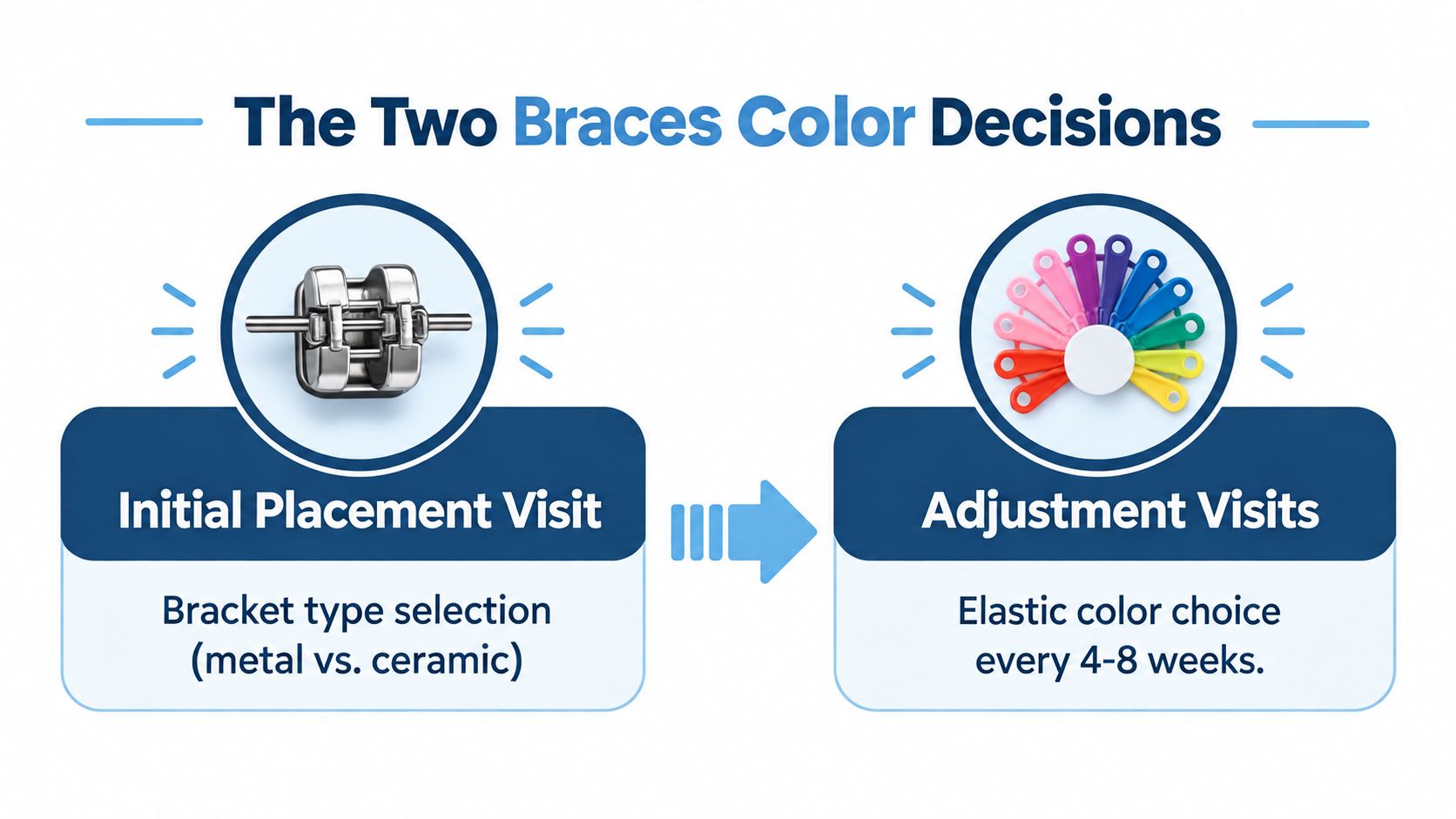
The distinction also helps adults ask better questions. A patient can say, “Which bracket material will look least noticeable?” and separately ask, “Which elastic colors will stay professional between visits?” Those answers may not be the same.
Patients comparing appliance designs can also review types of braces for adults before a consultation. The key is to separate the long-term appliance decision from the changeable color decision.
Ceramic Braces vs Metal Braces for Adult Patients
Ceramic and metal braces can both support orthodontic treatment, but they create different visual and practical experiences. Ceramic brackets generally blend more closely with the teeth, while metal brackets remain more visible and offer a familiar metallic look.
For an adult who presents to clients, records frequent video calls, or prefers a lower-contrast smile, ceramic is often the more discreet starting point. Metal may appeal to patients who place a higher value on durability, broad elastic color flexibility, or a straightforward appearance.
| Feature | Ceramic Braces | Metal Braces |
|---|---|---|
| Visual impact | Tooth-colored or clear brackets are less noticeable | Metallic brackets are more visible |
| Elastic choices | Clear, silver, and selected accent colors can create a subtle look | Broad color flexibility, including clear, silver, and brighter shades |
| Staining risk | The ceramic bracket itself doesn't behave like a clear elastic, but light elastics can discolor | Colored or silver elastics can mask changes more easily than clear ties |
| Durability considerations | Can be slightly more fragile under heavy bite forces | Generally offers a durable bracket option |
| Cost considerations | Typically costs slightly more than metal, depending on the treatment plan | Often has a lower starting cost than ceramic |
| Video-call appearance | Usually produces a lower-contrast look on screen | More visible, especially under strong lighting |
A video call can exaggerate contrast. Bright office lighting, a close camera angle, and a pale elastic can make a bracket system more noticeable than it appears in person. Silver or a restrained darker shade may therefore look more consistent on screen than a clear tie that has picked up pigment.
Adults should avoid choosing based on appearance alone. Bite forces, treatment needs, cleaning habits, and the orthodontist's recommendation all matter. A comparison of ceramic braces versus metal braces can help patients prepare for that conversation.
The practical framework is simple: ceramic suits maximum discretion, while metal suits patients who prioritize durability and elastic flexibility. Neither option is automatically right for every adult.
How Elastic Colors Hold Up in Real Adult Life
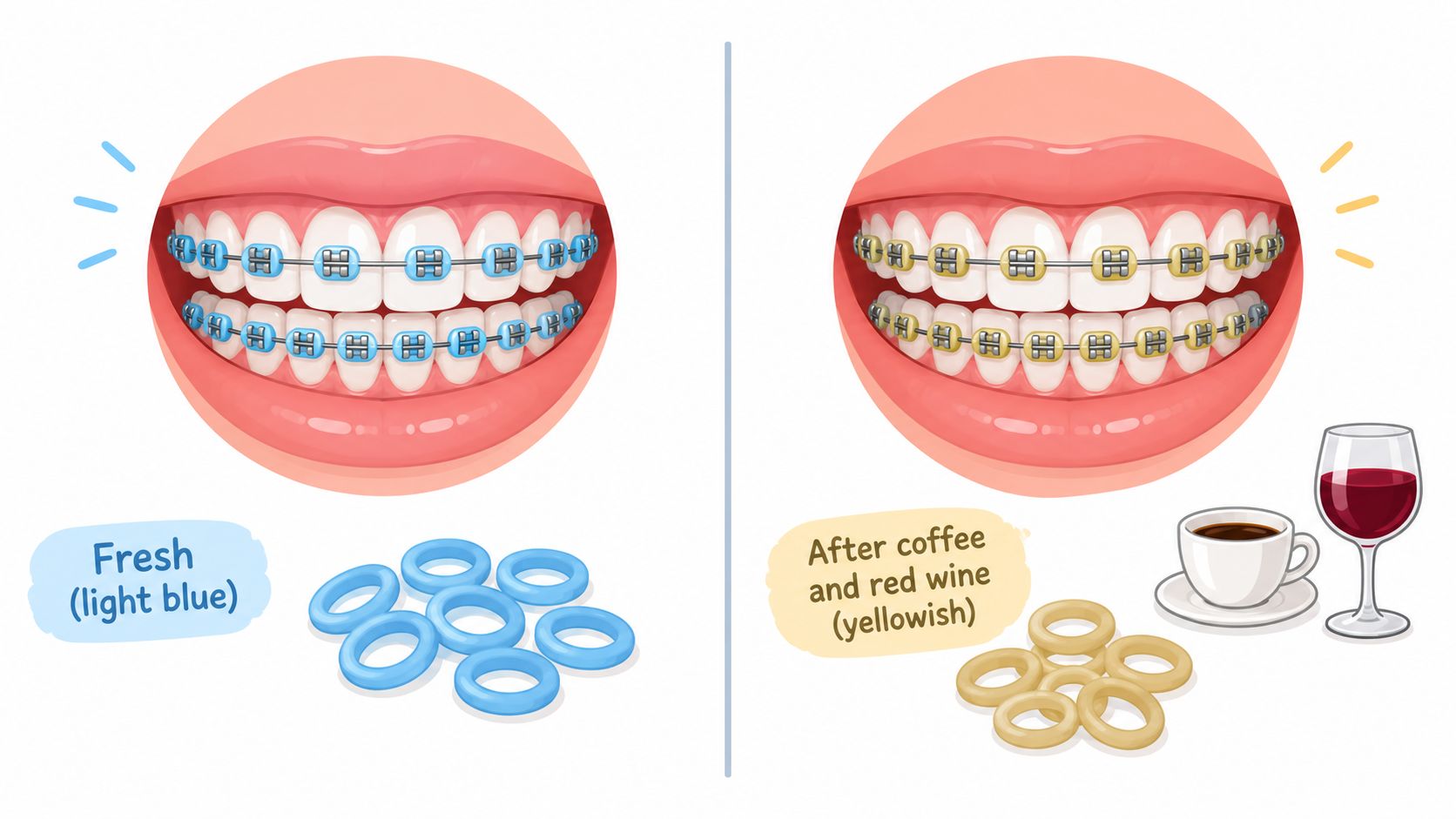
The small elastic rings around the brackets are often the first part of an adult's smile to show color change. Coffee before work, black tea during a meeting, red wine at dinner, and strongly pigmented foods can all affect light-colored elastics.
A split-mouth clinical study of 20 adults tested four commercial esthetic ligature brands. After 30 days, all four showed significant staining. One brand reached the maximum staining score, while the others had a median score of 1. Patients and orthodontists perceived the color change similarly, showing that the shift was visible in ordinary clinical observation, not only under laboratory conditions. The in vivo ligature study reports those findings.
Why clear ties change appearance
Esthetic elastics absorb or retain pigments from oral exposure. Research identifies coffee, tea, and red wine as common contributors, and the effect can increase with time. A laboratory study found the highest staining potential among tested beverages came from black tea, coffee, and wine, in that order. Coca-Cola also produced more staining than distilled water. The clear ligature staining research explains those beverage comparisons.
A separate study of clear elastomeric modules found that coffee caused the greatest color change, followed by red wine and black tea. The aesthetic ligature color study supports the same practical warning. Adults who drink these beverages frequently may prefer silver or a darker metallic shade because those colors hide gradual changes better.
Whitening toothpaste doesn't create a simple solution. Research found that whitening dentifrice may reduce yellowing but introduce a blue shift, so an elastic can change direction visually rather than remain unchanged. The elastomeric ligature review discusses that trade-off.
Clear elastics can look polished on placement day and less neutral later. That doesn't mean the product failed. It means the material responds to the patient's daily environment.
Adults should also follow beverage guidance during treatment. The American Association of Orthodontists warns that sugary and acidic drinks, including soda, fruit drinks, juices, and sports drinks, can damage braces or aligners. It recommends tap water and milk as better choices while appliances are worn. The AAO guide to life during treatment offers that guidance.
A short video can make the difference between a theoretical color choice and a practical one.
Patients wearing ceramic appliances can also review care guidance for ceramic braces before choosing light elastics.
Matching Braces Colors to Your Daily Lifestyle
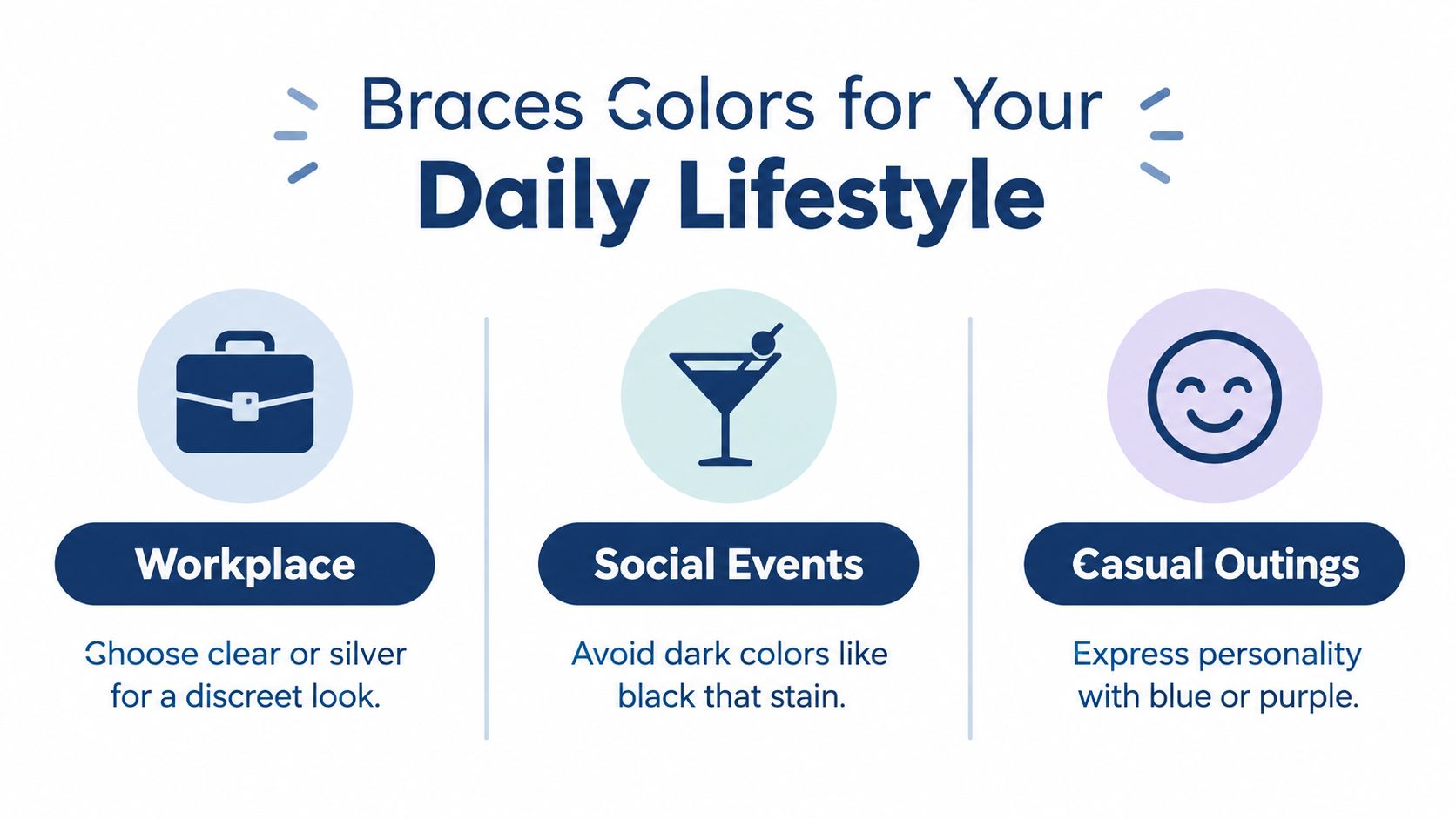
The best adult braces colors depend on where the patient spends time. A professional who leads meetings has different needs from a designer who enjoys a visible accent, and both differ from someone who wants the lowest possible contrast.
Client-facing professionals
A patient who works with clients, patients, students, or executives may want the braces to recede during conversation. Ceramic brackets paired with clear or silver elastics usually create a restrained appearance. Silver can be the easier-maintenance choice when the patient drinks coffee or tea regularly, because subtle staining is less obvious than it is on clear or white ties.
The goal isn't to make the smile look artificial. A consistent, clean appearance usually matters more than finding a perfectly invisible option.
Creative and casual workers
A creative workplace may allow more personality. Navy or burgundy can look intentional without creating the playful effect associated with very bright combinations. Adults can also coordinate a shade with clothing or an event, but the choice should still account for how the color looks against the teeth and bracket material.
Very dark shades may create more contrast than some patients expect. A consultation can help compare the shade in the mouth rather than relying on a color card alone.
Adults seeking minimal visibility
Patients who want braces to blend in should focus on the whole system, not just the bracket. Tooth-colored ceramic brackets, low-contrast elastics, careful cleaning, and regular replacement intervals work together to maintain a subtle appearance.
Adults in North Wilmington, Middletown, Dover or West Dover, and Millsboro often balance workplace expectations with commuting, family schedules, and social events. The most useful consultation question is: “Which option will still look appropriate during the parts of daily life that matter most?”
A useful question: Does the preferred shade still look polished after coffee, under office lighting, and on a video call?
Start Your Adult Braces Consultation at Stellar Orthodontics
Color selection becomes easier when an orthodontic team evaluates the full treatment plan instead of treating elastics as an isolated cosmetic choice. At Stellar Orthodontics, adult patients can discuss metal braces, clear ceramic braces, and Invisalign with Dr. Robert Park, Dr. Can Nguyen, or Dr. Sonal Dave.
The practice offers free consultations at four Delaware locations: North Wilmington, Middletown, Dover or West Dover, and Millsboro. iTero digital 3D scanning can give patients a preview of a potential result before treatment begins, which can make the conversation more concrete for adults comparing discreet options.
Stellar Orthodontics accepts most major dental insurance and offers flexible monthly payment plans with $0 down. The practice also accepts all three Delaware state Medicaid plans, AmeriHealth Caritas Delaware, Highmark Health Options, and Delaware First Health, along with CHIP for patients under 21.
A consultation can focus on practical questions:
- Which bracket material fits the patient's bite and appearance goals?
- Which elastic colors are likely to suit the workplace?
- How should coffee, tea, or other beverages affect the choice?
- Can the team show adult before-and-after examples with similar priorities?
Adult braces decisions are personal. The right provider should explain the trade-offs clearly and help the patient choose with confidence, without pressure.
Common Questions About Adult Braces Colors
Can clear elastics stay stain-free throughout treatment?
Some staining should be expected, particularly for patients who regularly consume pigmented beverages. Replacing the elastics during adjustment visits helps the smile look fresh, while silver or darker metallic tones can reduce the visual impact of gradual color change.
Do dark elastics make teeth look yellower?
Contrast affects perception. Dark colors can draw attention to the brackets, while neutral shades usually create a more restrained adult appearance. Clear and white elastics may also make natural tooth color more noticeable if the ties become discolored.
Do ceramic braces cost more?
Ceramic braces typically cost slightly more than metal braces, although the final amount depends on the treatment plan and coverage. Insurance, monthly payment plans, Medicaid eligibility, and CHIP may affect access and financing options.
Do braces colors change treatment time?
No. Bracket material and elastic color don't determine how long treatment takes. The orthodontist's treatment plan, tooth movement, bite, and patient cooperation guide the clinical timeline.
Stellar Orthodontics offers free consultations, iTero digital 3D scanning, and adult options including clear ceramic braces and Invisalign at four Delaware locations. Visit Stellar Orthodontics to discuss braces colors that fit the patient's workplace, routine, and personal comfort.