
Does turning 14 mean a teenager needs braces, or is it time for a closer look? A birthday alone can't answer whether treatment is necessary, which appliance makes sense, or whether the family can manage the appointments and daily care.
For Delaware families considering braces for 14-year-olds, the best starting point is an examination, not an automatic commitment. A useful plan connects the teen's bite, remaining growth, cleaning habits, preferences, and coverage with a treatment routine the family can realistically maintain.
Table of Contents
- Is Age 14 the Right Time for Braces
- Metal, Ceramic and Invisalign Teen Options Side by Side
- How Long Braces Take for a 14-Year-Old
- What Happens at Placement and Follow-Up Visits
- Daily Habits That Protect Teeth During Treatment
- What Braces Cost and How to Plan for It
- Medicaid and Insurance Coverage for Delaware Teens
- Book a Free Consultation to Plan the Next Step
Is Age 14 the Right Time for Braces
Fourteen is not too late for braces. The U.S. National Library of Medicine explains that braces are typically used between ages 12 and 16, when most baby teeth have been replaced and the jaws are still developing; its overview also notes Cleveland Clinic's favorable 9-to-14 range.
A growing jaw is a little like soft clay that's still easier to shape, although that comparison has limits. Orthodontists can sometimes use remaining growth to help correct certain bite relationships, but they can't reshape every jaw problem with braces alone.
What matters more than the birthday
An orthodontist checks whether permanent teeth have erupted, how much space they have, and how the upper and lower teeth meet. Overbite, underbite, crossbite, remaining jaw growth, and brushing habits all affect the recommendation.
Parents may notice:
- Overlapping front teeth: Teeth appear crowded, rotated, or difficult to clean between.
- Uneven wear: Some biting edges look more worn than others.
- An unfamiliar bite: The teen isn't sure where the teeth should meet comfortably.
- A shifting jaw: The jaw appears to move sideways during opening or closing.
These observations are reasons for an examination, not diagnoses. A photograph or a comparison with a classmate's smile can't establish what treatment is needed.
Starting now versus monitoring
Earlier treatment isn't automatically better. A systematic review of treatment timing found that early treatment isn't broadly superior to later treatment and can add burden and duration, supporting targeted early care rather than automatic early treatment.
Space also deserves careful analysis. The American Academy of Pediatric Dentistry's developing-dentition guidance emphasizes assessing tooth position, available space, and skeletal relationships, with detailed space analysis before extraction decisions.
Removing teeth shouldn't be treated as a shortcut for crowding without a short- and long-term plan. The examination should establish what problem needs correction, whether timing matters, and whether treatment should begin now or the teen should be monitored.
A useful question: What would change clinically if treatment started now rather than after a period of observation?
Metal, Ceramic and Invisalign Teen Options Side by Side
Teen braces and aligner options compared
| Option | Appearance | Removable | Daily Commitment | Good to Know |
|---|---|---|---|---|
| Traditional metal braces | Visible metal brackets and wires | No | Brushing around brackets and keeping adjustment visits | Handles simple and complex bite issues |
| Clear ceramic braces | Tooth-colored brackets with a lower profile | No | Same brushing and visit routine as metal braces | Often chosen for appearance; compare cost and tradeoffs |
| Invisalign Teen clear aligners | Clear, nearly invisible trays | Yes | Wearing trays most of the day and removing them to eat and brush | Works best for mild to moderate cases |
The biggest difference is not how the appliance looks. Fixed braces stay attached; removable aligners rely on the teen putting them back in consistently. Both require an orthodontist's treatment plan and ongoing supervision.
Traditional metal braces use brackets connected by wires to guide tooth movement. They're visible, but they can address a broad range of alignment and bite problems without requiring the teenager to remember to insert an appliance after every meal.
Ceramic braces use tooth-colored brackets within the same basic fixed system. They're a lower-profile choice for a teen who wants less noticeable treatment but doesn't want the responsibility of removable trays.
Invisalign Teen uses a sequence of clear trays, with each tray guiding teeth toward the planned position. Mild to moderate cases are often suitable, but the orthodontist must assess the particular movements and bite correction required.
The choice has to fit an ordinary school day
Braces are like a fixed scaffold that stays put. Aligners are more like a sequence of fitted trays that only work as intended when the teen wears them according to the prescribed schedule.
A teen who regularly misplaces belongings may find removable treatment harder to manage. Another teen may already follow reliable routines and prefer removing trays for meals and cleaning.
The family's comparison should include:
- Appearance: How strongly does the teenager feel about visible brackets?
- Consistency: Can removable trays be worn reliably through school, homework, and activities?
- Bite complexity: Which options can accomplish the movements the orthodontist recommends?
- Sports and activities: What protection, storage, or routine changes will be needed?
- Budget: What is the complete fee for each clinically suitable option?
- Cleaning: Which routine can the teenager carry out thoroughly?
A less noticeable appliance isn't automatically the easier appliance. Fixed braces still demand careful cleaning, while removable trays add responsibility for wear and storage.
The strongest choice is an appropriate appliance the teen can maintain consistently, not the option that looks best in a comparison photograph.
How Long Braces Take for a 14-Year-Old
Typical treatment duration by case type
| Case Type | Typical Duration | What Changes the Timeline |
|---|---|---|
| Mild spacing or crowding | Several months | Only a few teeth need to move |
| Typical teen treatment | About 12 to 24 months | Number of teeth and how much the bite must shift |
| Complex jaw-position case | Several years | Jaw growth, bite relationship and cooperation |
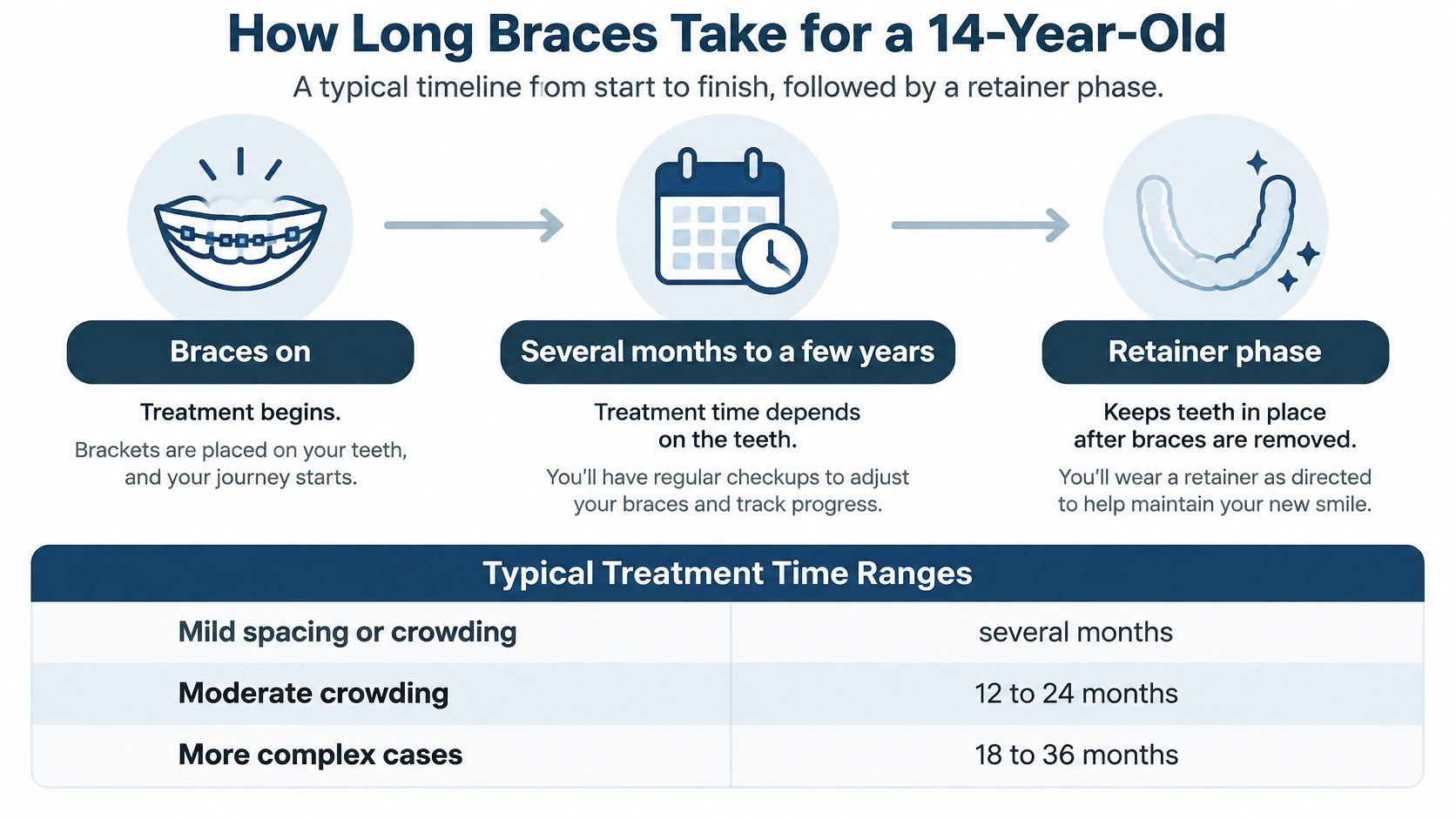
The American Association of Orthodontists' braces guide supports these general ranges, including a common active-treatment period of about 12 to 24 months, with shorter or longer courses according to the problem.
At Stellar Orthodontics, most braces cases finish in 18 to 30 months. That practice-specific expectation and the broader national range describe different groups, so neither should replace an estimate based on the individual teen's examination.
The timeline graphic illustrates active treatment followed by retention.
What the estimate actually includes
Active treatment runs from placement until the braces are removed. During that period, the orthodontist may need to straighten individual teeth, coordinate the dental arches, and improve how the bite fits together.
A teen with limited spacing may need relatively straightforward movement. A teen whose upper and lower teeth don't meet properly may need a longer sequence of corrections, even if the front teeth begin looking straight early.
Appearance doesn't establish completion. Teeth can look aligned before the bite correction is finished.
Remaining growth, appliance condition, attendance, and following prescribed instructions can affect progress. An estimate is therefore a planning tool, not a guaranteed removal date tied to a school event.
The retainer phase belongs in the plan
After removal, a retainer helps maintain the corrected tooth positions. Retention is a separate phase, and the orthodontist should explain the wear schedule and follow-up arrangements before active treatment ends.
A realistic finish date includes completing the planned bite correction, not just reaching a straighter-looking smile.
Families in North Wilmington, Middletown, Dover/West Dover, and Millsboro should request an individualized estimate. Helpful questions include what could extend treatment, which milestones the orthodontist will monitor, and whether the estimate refers only to active braces treatment or also includes retention appointments.
What Happens at Placement and Follow-Up Visits
The visit sequence gives parents and teenagers a practical picture of treatment. Each appointment has a purpose beyond checking whether the front teeth look straighter.
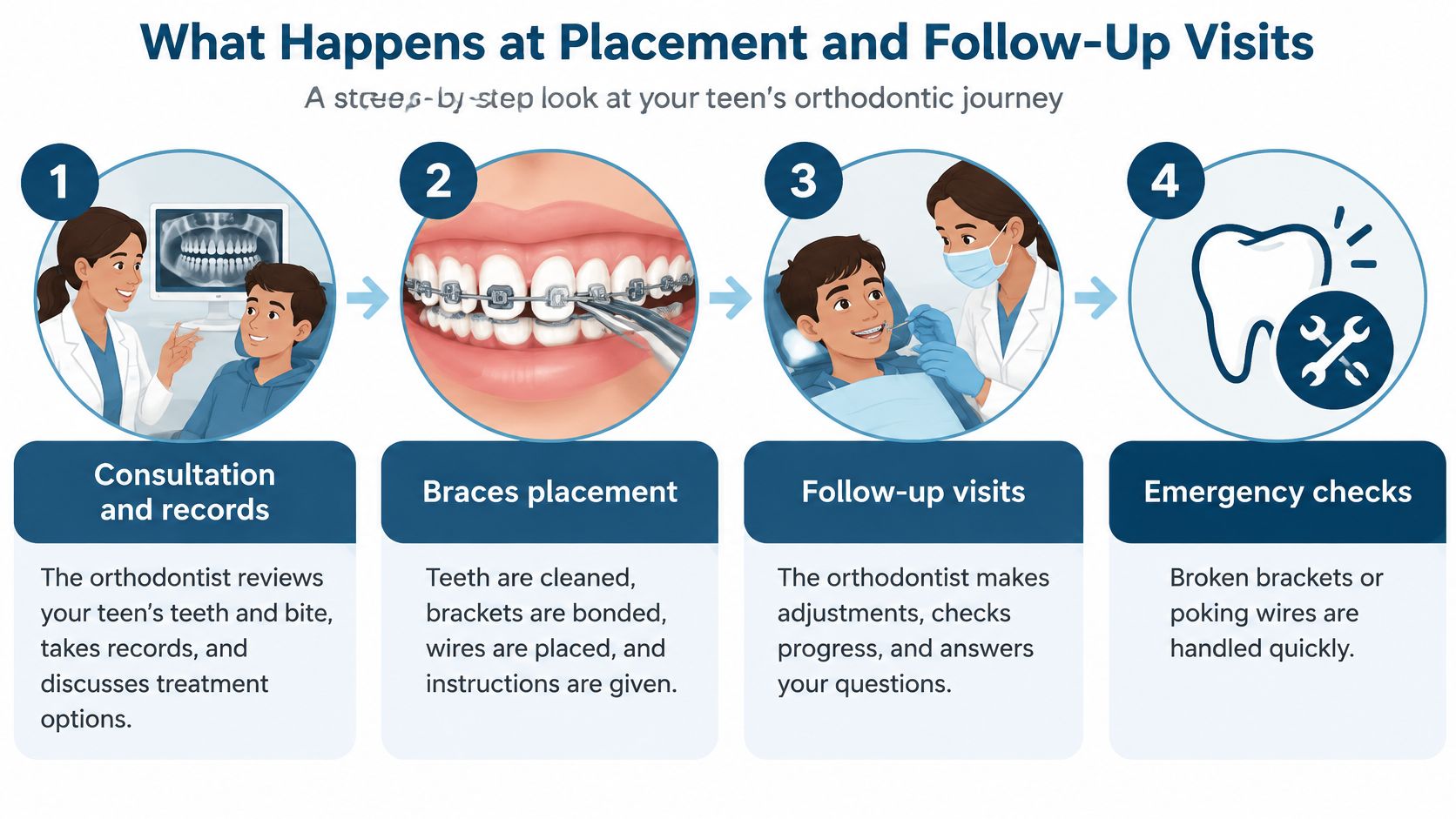
The process graphic outlines the main appointment types.
From examination to removal
Consultation and records. The orthodontist examines the teeth and bite, reviews dental development, and collects the records needed for planning. The family discusses appropriate options and any dental care needed before placement.
Braces placement. At Stellar Orthodontics, placement is a 60-to-90-minute appointment in which brackets are bonded to the front of each tooth and the first archwire is placed. The family also receives instructions for cleaning, eating, and handling appliance irritation.
The first days. Some soreness and unfamiliar pressure are normal as the teenager adjusts. Softer foods can make eating easier initially, while significant or persistent pain should prompt a call to the office.
Adjustment visits. The American Association of Orthodontists' treatment guide describes visits typically scheduled every six to ten weeks. The orthodontist checks progress and adjusts or changes components when needed to continue the planned movement.
Elastics when prescribed. Some patients need small elastic bands to help correct how the upper and lower teeth meet. The teenager should follow the prescribed placement and wear instructions rather than adding extra elastics or changing the pattern.
Repairs when something loosens. A broken bracket or poking wire deserves a call rather than waiting automatically for the next appointment. The office can explain whether a repair visit is needed and what temporary comfort measures are appropriate.
Removal and retention. Once the planned correction is complete, the brackets and wires are removed. Retainers and their instructions become the focus of ongoing care.
Keeping visits workable
Each follow-up is like a tune-up that helps keep a car on its planned route. Missed appointments, loose brackets, cavities, and gum problems can interrupt that route and delay progress.
A shared calendar can include travel time, school absences, and the adult responsible for transportation. Involving the teenager in scheduling also makes the appointments easier to understand as part of treatment rather than unexplained interruptions.
Before leaving each visit, the family should know the next appointment date and any instructions that have changed.
Daily Habits That Protect Teeth During Treatment
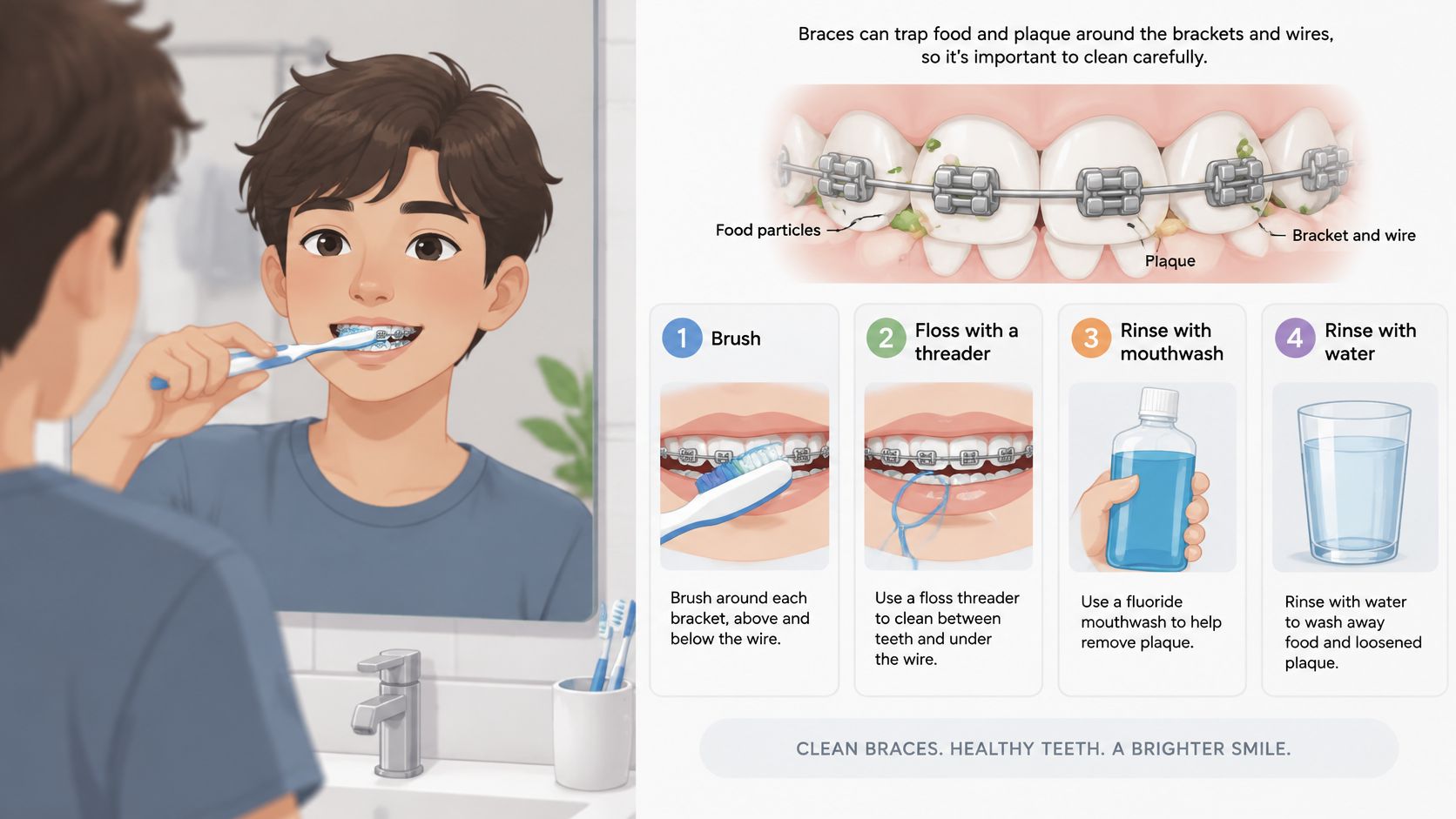
Brackets and wires create extra places for food and plaque to collect around enamel. Cleaning therefore needs to reach above, below, and between the brackets, not just the easily visible tooth surfaces.
The cleaning image shows how a teenager can approach the areas around fixed braces.
A routine that reaches the hidden areas
Brush after meals with fluoride toothpaste. Bedtime brushing alone leaves food caught around brackets during the day. A small school cleaning kit makes after-lunch care more practical.
Angle the brush around each bracket. Bristles should reach above and below the bracket and along the gumline. Looking closely in a mirror helps the teen spot areas that were missed.
Clean between teeth daily. A floss threader can guide floss beneath the wire, while a suitable interdental brush can reach accessible spaces around the appliance. Parents considering another cleaning aid can review the guide to using a water flosser with braces and discuss the teen's technique at an appointment.
Reduce frequent sugar and acid exposure. Sugary drinks, sticky snacks, and acidic foods deserve particular attention between meals. Water is a practical everyday drink, and prolonged sipping of sweetened beverages should be discouraged.
Continue routine dental cleanings. The general dentist still checks for cavities, gum problems, and preventive needs. Orthodontic appointments don't replace those visits.
The following video provides an additional visual demonstration of cleaning around braces.
Why white spots deserve attention
The American Academy of Pediatric Dentistry's adolescent oral-health guidance emphasizes hygiene and routine dental examinations during orthodontic treatment to prevent enamel demineralization. White-spot lesions are areas of mineral loss that can appear opaque and may remain visible after braces are removed.
Preventing those marks is preferable to considering cosmetic repair later. A phone reminder after lunch, supplies kept together, and a short cleaning checklist can help the teenager build a repeatable habit without turning every evening into an argument.
What Braces Cost and How to Plan for It
Average U.S. cost by braces type in 2024
| Braces Type | Average U.S. Cost (2024) |
|---|---|
| Traditional metal braces | $6,343 |
| Ceramic braces | $5,834 |
| Clear aligners | $5,108 |
These 2024 national averages, from CareCredit figures reported by Becker's Dental, are $6,343 for metal braces, $5,834 for ceramic braces, and $5,108 for clear aligners; they aren't age-specific prices or a quote for a Delaware teenager.
The averages offer a budgeting reference, not a reliable ranking of what the same patient would pay for each option. Clear aligners also represent a different treatment approach from fixed braces, so the table shouldn't be read as a like-for-like comparison of identical cases.
Turning an average into a complete estimate
The actual fee reflects the recommended treatment, case complexity, and expected course of care. Insurance or approved Medicaid benefits can change the family's responsibility, but those benefits should be verified rather than assumed.
A written estimate should explain what the fee includes. Records, adjustments, repairs, removal, and retainers deserve explicit discussion so that an attractive headline price doesn't leave important questions unanswered.
Families can use the Delaware braces cost guide to prepare for that conversation.
Questions that make quotes easier to compare
- Total fee: What is the complete treatment price before benefits or financing?
- Included services: Are diagnostic records, scheduled visits, repairs, and retainers included?
- Payment schedule: What is due initially, and when are later payments due?
- Insurance limits: Does the policy use an annual or lifetime orthodontic maximum?
- Extended treatment: What happens financially if treatment takes longer than estimated?
- Monthly arrangements: What are the term, total repayment amount, and applicable conditions?
Budgeting rule: A manageable monthly payment matters, but the complete financial agreement matters more.
A lower monthly amount can reflect a longer repayment period rather than a lower total fee. Families should compare the complete obligation and clarify what happens if insurance changes or treatment must transfer after a move.
The consultation is where a national average becomes a meaningful estimate for the teenager. Parents should leave with a written treatment recommendation, an explanation of benefits still awaiting confirmation, and a clear distinction between treatment charges and financing terms.
Medicaid and Insurance Coverage for Delaware Teens
Medically necessary braces may be covered for eligible Delaware teens. Delaware First Health's dental benefits information states that medically necessary orthodontic work, including braces, is covered for members under 21 with no copay; Delaware Medicaid provides eligible children's dental care through age 20, and Highmark Health Options Delaware also lists braces and retainers for that age group.
A child enrolled in DSHP or CHIP can qualify for Medicaid braces, subject to eligibility, medical necessity, and authorization requirements. The EPSDT benefit runs through age 20. Enrollment alone doesn't mean every orthodontic recommendation is automatically approved.
The approval checklist
- Confirm eligibility: Identify the teen's current plan and verify active enrollment.
- Complete pre-authorization: Ensure the necessary records are submitted before treatment begins.
- Keep written approval: Save the authorization and details of the approved treatment.
- Report changes promptly: Notify the plan and office about changes in coverage, address, or contact information.
When pre-authorization is approved, Medicaid covers complete diagnostic records, traditional fixed metal braces, scheduled adjustment visits, repairs to broken brackets or wires during treatment, appliance removal, and the initial set of retainers.
Families shouldn't assume that clear aligners have the same coverage. Aligner coverage isn't established by the benefits information cited here and needs direct confirmation. The Delaware Medicaid orthodontic coverage guide offers further preparation for the approval conversation.
Access involves more than paperwork
National figures in the CareQuest Institute adolescent dental-care report show that only 50.9% to 53.8% of Medicaid-enrolled children ages 10 to 14 received any dental treatment, depending on the year. Those figures concern dental care generally, not braces approval, but they underscore why access planning matters.
Families should identify reliable transportation, workable appointment times, and a backup adult for school-day visits. After a move or insurance change, contacting the office promptly is safer than allowing treatment to lapse without a plan.
Stellar Orthodontics offers a free Medicaid braces evaluation at all four offices. Parents can raise coverage questions when booking and bring the current insurance card and any authorization correspondence.
For families considering Cherry financing, applicants must be 18 or older, so a parent or legal guardian applies for a patient under 18. Financing eligibility is separate from Medicaid approval and shouldn't be confused with a covered benefit.
Book a Free Consultation to Plan the Next Step
A sound decision about braces starts with understanding the teenager's needs, not matching the treatment a friend received. The family should leave an evaluation knowing what needs correction, why the recommended timing makes sense, and which responsibilities belong to the teen and parent.
The final decision checks
- Clinical fit: Has an orthodontist examined the bite and explained whether treatment should begin or monitoring is appropriate?
- Everyday fit: Can the teen manage the appliance, cleaning routine, and practical demands?
- Financial fit: Are the total fee, coverage decision, and payment arrangements clear before treatment begins?
Stellar Orthodontics offers free orthodontic consultations in North Wilmington, Middletown, Dover/West Dover, and Millsboro, including free Medicaid braces evaluations at all four offices. Families can bring insurance or Medicaid information, the teen's questions, and a rough outline of school, sports, work, and transportation commitments.
A short written question list can make the visit more useful. Parents can request an individualized estimate for timing and fees, clarify what is included, and discuss any concerns about maintaining appointments or home care.
Stellar Orthodontics also offers monthly payment plans for braces and Invisalign. The financial conversation should focus on a sustainable arrangement for the complete course of care, not pressure to begin immediately.
A consultation is an opportunity to replace uncertainty with a clear recommendation. It doesn't require a family to arrive already knowing which appliance is best.
Stellar Orthodontics offers free consultations to help Delaware families understand whether braces are appropriate for their teenager and what treatment would involve. Families can visit Stellar Orthodontics to book at a convenient location and discuss their teen's bite, coverage, and next steps.