
If teeth already look straighter, does that mean Invisalign can finish everything braces started? Not necessarily. The visible edges of the teeth tell only part of the story. Root position, remaining spaces, and the way the upper and lower teeth meet can still need careful correction.
For Delaware families considering a switch from braces to Invisalign, the most useful questions concern the movements that remain and the patient's ability to wear removable trays consistently. Appearance matters, but it shouldn't decide whether a treatment plan can finish predictably.
Table of Contents
- Braces and Invisalign at a Glance
- Which Cases Suit Aligners and Which Need Braces
- How a Switch From Braces to Invisalign Works
- Treatment Time and Retention After Either Option
- Daily Wear, Cleaning and Staying on Track
- Choosing for a Child, Teen or Adult
- What Braces and Invisalign Cost
- Book a Free Consultation to Choose Your Path
Braces and Invisalign at a Glance
What changes when a patient moves from braces to Invisalign? The appliance changes how the remaining tooth movements are delivered, while the movements still needed help determine which option is suitable. A tray can be less noticeable and removable, but those features do not make it the right tool for every case.
In a 2024 study of 303 orthodontic patients, the Journal of Clinical and Diagnostic Research found no significant difference in overall satisfaction between conventional fixed braces and Invisalign, with p=0.989. Similar satisfaction does not mean the appliances can handle every movement equally. It means that satisfaction by itself does not settle the clinical choice.
Braces and Invisalign compared on core factors
| Factor | Braces (metal or clear ceramic) | Invisalign clear aligners |
|---|---|---|
| Appliance | Brackets and archwires bonded to the teeth | Removable plastic trays, changed every one to two weeks |
| Daily wear | Worn all day and night, with no removal | At least 20 hours per day unless the orthodontist says otherwise |
| Control of complex movements | More consistent rotation and torque control | Less predictable for root control, bodily movement, and extraction closure |
| Typical active treatment | Most braces cases at Stellar finish in 18 to 30 months | Adults often finish in 6 to 18 months |
| Cleaning | Brush and floss carefully around brackets and wires | Remove trays for brushing and flossing, and clean the trays separately |
| Overall satisfaction | Similar in the study described above | Similar in the same study |
| Retention after treatment | Retainer nightly in year one, then alternate nights, when prescribed | Same retention advice applies |
The FDA's clear dental aligner guidance describes changing aligners every one to two weeks, wearing them for at least 20 hours daily unless directed otherwise, and treatment lasting approximately six to 18 months in some cases. For braces, the typical range for most cases at Stellar is 18 to 30 months. The NHS Inform's orthodontics guidance gives a general orthodontic range of 18 to 24 months, which is not a case-specific estimate.
What the comparison means in daily life
Fixed braces stay attached during meals, sleep, school, and work. Aligners can be removed, so the patient has more control over when the appliance is out. That flexibility depends on remembering to put the trays back in and wearing them for the prescribed time.
The cleaning routines differ, too. Braces call for careful brushing and flossing around brackets and beneath wires. With aligners, patients remove the trays to brush and floss, then clean the trays separately.
Retention applies after either treatment. Nottingham University Hospitals' retainer guidance advises many patients to wear retainers every night during the first year, then on alternate nights from the second year onward, continuing indefinitely to maintain alignment.
Timing ranges are guides, not promises or a head-to-head comparison of identical cases. A short aligner case and a complex braces case may begin with very different tooth movements.
Key point: Choose the appliance according to the movements still needed and the patient's ability to follow its daily routine, not appearance alone.
Which Cases Suit Aligners and Which Need Braces
For mild-to-moderate crowding and non-extraction cases, clear aligners and fixed braces can produce comparable overall outcomes. A systematic review and meta-analysis indexed in PubMed found no reliable treatment-duration advantage for these simpler cases, while extraction cases favored fixed appliances for treatment quality; the evidence supporting some comparisons was low quality.
That distinction matters when teeth look nearly straight but substantial work remains underneath the surface. Moving the visible crown into line isn't always the same as positioning the entire tooth correctly.
Case type and the appliance direction it usually points to
| Case type | Clear aligners | Fixed braces | Why it matters |
|---|---|---|---|
| Mild crowding, alignment and leveling | Often suitable | Also suitable | Outcomes comparable; no reliable duration difference |
| Extraction-space closure | Less predictable; may need attachments or refinements | Usually preferred | Brackets give more control over complex movement |
| Large tooth rotations | May need attachments and extra rounds | Usually preferred | Rotation control is more consistent with braces |
| Deep bite or major vertical correction | Often limited | Often preferred | Vertical movement is a documented aligner limit |
| Root torque or bodily tooth movement | Limited | Preferred | Root control is weaker with aligners |
| Mild-to-moderate interceptive problem in a child, such as a crossbite | Used in selected cases with reliable wear | Used when problems are complex | Results require consistent wear and supervision |
Why the type of movement matters
Alignment and leveling involve arranging teeth along the dental arch and correcting differences in position. When those are the main remaining tasks, an aligner plan may be reasonable. Stellar Orthodontics' explanation of Invisalign for crowded teeth offers additional context for that particular concern.
Extraction-space closure requires more than bringing neighboring crowns together. The orthodontist must also manage root position and prevent unwanted tipping as the space closes.
A large rotation means turning a tooth around its long axis. An aligner may need a tooth-colored attachment to gain purchase on the tooth, and further trays may be necessary if the planned turn isn't achieved.
Deep bites and other vertical corrections concern how far teeth overlap or how they meet in height. These movements deserve a separate discussion rather than an assumption that straighter front teeth mean a corrected bite.
With root torque, the orthodontist changes root inclination. With bodily movement, the crown and root move together rather than the crown tipping. These are important reasons an orthodontist may recommend keeping braces.
Questions that clarify the recommendation
- Remaining movement: Which teeth still need movement, and in which directions?
- Space closure: How much of the unfinished plan involves closing extraction spaces?
- Backup treatment: What happens if the predicted aligner result isn't reached?
A professional examination can distinguish a straightforward finishing case from one that still needs demanding mechanics. A recommendation to continue braces isn't a rejection of the patient's preferences. It may be the more predictable route to the intended finish.
How a Switch From Braces to Invisalign Works
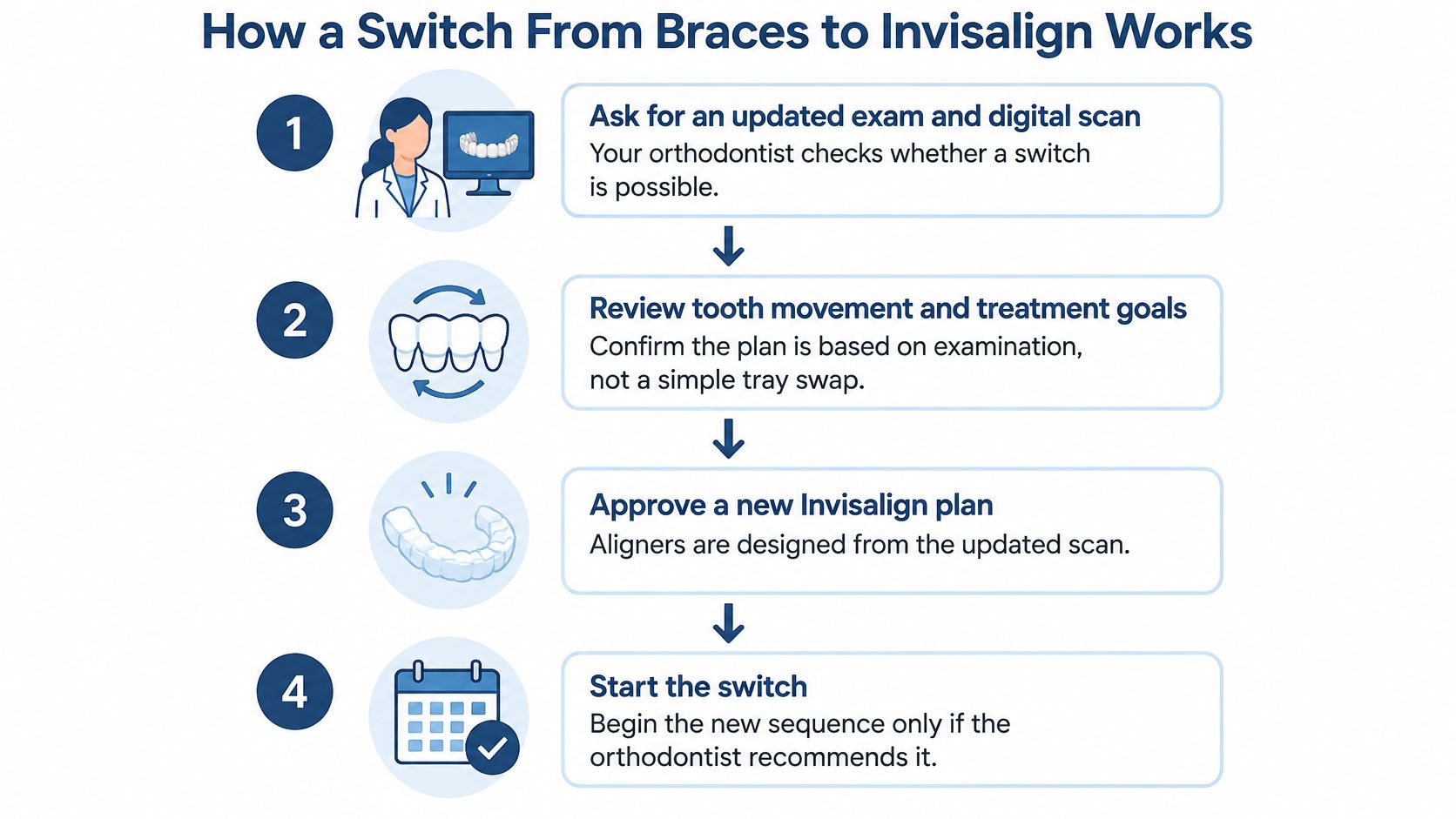
A mid-treatment switch starts with a fresh assessment, not just removing brackets and ordering trays. The orthodontist needs to establish whether an aligner can complete the remaining work without sacrificing the treatment goals.
The overview below shows the main stages of that decision.
The clinical steps before the change
Arrange an updated examination and digital scan. The orthodontist assesses current tooth positions, bite relationships, and oral health. A scan documents the starting point for a possible new sequence.
Compare the original plan with current progress. Teeth may have reached some goals while other goals remain unfinished. This comparison helps separate completed alignment from unresolved bite or root-position work.
Identify the remaining movements. The list should name space closure, rotations, bite correction, and root positioning rather than describe treatment as almost finished. Each task needs an appropriate method of control.
Choose the mechanics needed to finish. Aligners may work alone, or the plan may require attachments, elastics, or continued fixed appliances. Attachments are bonded tooth-colored shapes that help trays grip teeth, while elastics apply forces between selected points.
Discuss the anticipated tray sequence and refinements. Refinements are additional aligners made when the initial sequence doesn't complete the intended movements. The family should understand the expected scope without treating a digital preview as a guarantee.
Coordinate brace removal and cleaning. Braces shouldn't be removed before the transition plan is ready. The orthodontist should explain how appliance removal, cleaning, and the beginning of aligner wear will be coordinated.
Set monitoring appointments. Check-ins allow the orthodontist to compare actual movement with the plan. A tray that doesn't fit properly may require reassessment rather than automatic advancement.
A predicted finish isn't a guaranteed finish
A 2025 systematic review and meta-analysis of 20 studies identified discrepancies between planned and achieved movements in extraction treatment, including weaker root-control and tooth-contact outcomes with aligners than with fixed appliances. The practical concern is whether the trays can finish the difficult movements, not merely whether they can make the smile look neater.
For example, a patient may have straight front teeth but still need roots brought into better alignment beside a closing extraction space. That patient's conversion plan should address the root movement explicitly.
A useful switch plan includes an agreed response if teeth stop following the predicted sequence.
That response might involve revised attachments, elastics, another scan, further trays, or a return to braces. Families should know how those possibilities affect timing and fees before approving the change.
The accompanying video provides another way to approach the treatment discussion.
Stellar Orthodontics offers this review at its North Wilmington, Middletown, Dover/West Dover, and Millsboro offices. The examination provides the basis for recommending a switch or continuing the existing approach.
Treatment Time and Retention After Either Option
A switch doesn't automatically shorten treatment. The remaining schedule depends on the tooth and bite movements still to be completed, not just when braces come off. General treatment ranges describe full courses of care, so they do not tell a patient already wearing braces how much time remains. Adding an aligner range to time already spent in braces can create unrealistic expectations.
The phases families should compare
| Phase | Braces | Invisalign | Planning question |
|---|---|---|---|
| Active movement | Brackets and wires guide teeth through the plan | A prescribed tray sequence guides movement | Which unfinished tasks determine the remaining schedule? |
| Adjustments and monitoring | Wire, bracket, and bite checks | Fit checks, new trays, and assessment of tracking | Are additional finishing adjustments anticipated? |
| Finishing | Removal appointment and final cleaning | Final-tray assessment and removal of attachments when appropriate | What must be achieved before active treatment ends? |
| Retention | Retainer type and handover instructions | Retainer type and handover instructions | Who will explain care, fit, and follow-up? |
During active treatment, braces appointments may involve wire changes or adjustments to other components. With aligners, monitoring checks whether teeth are following the planned sequence and whether further trays are needed. The finish phase should also have clear goals. For example, front teeth can look aligned while the back teeth still meet unevenly, leaving a bite adjustment unfinished.
What can change the schedule
- Missed appointments: Delayed checks can postpone needed adjustments and let a fitting or movement problem go unaddressed.
- Insufficient tray wear: Teeth may not reach the position needed for the next aligner, so the sequence may need to pause or change.
- Poor oral hygiene: Gum or tooth problems may need attention before treatment can proceed appropriately.
- Broken appliances: A loose bracket, damaged wire, or unusable tray can interrupt planned movement.
- Difficult finishing movements: Some corrections require reassessment or additional mechanics.
A useful estimate explains the expected path and what could change it. Families should ask whether a planned refinement is part of the finishing process or whether a new issue could extend treatment.
Finishing active treatment also includes a handover to retention. Before the last appointment, ask which retainer is planned, how to clean it, how replacements are handled, and whom to contact if it feels tight, becomes damaged, or no longer fits. These details help the patient know what to do once active tooth movement ends.
Stellar Orthodontics' guide to how long retainers are worn after braces explains the long-term commitment. The orthodontist should give the patient instructions suited to their treatment, including how to follow the prescribed wear schedule and maintain the retainer.
Daily Wear, Cleaning and Staying on Track
The daily wear requirement is often the biggest practical difference between braces and Invisalign. Aligners can't deliver the planned forces while sitting in a case, so meal breaks, snacks, and forgotten reinsertion all matter.
A review of aligner treatment and periodontal outcomes describes strongly cooperation-dependent treatment and hygiene comparisons that tend to favor aligners, but with low to very low certainty. Removability creates an opportunity for easier cleaning. It doesn't guarantee healthier gums or predictable movement.
Daily routines need to include both tray care and tooth cleaning.

A routine that supports treatment
- Keep a case available: Trays belong in a protective case during meals, not in a napkin or loose pocket. A spare case can help with school, work, or travel.
- Check the fit after insertion: Each tray should seat as instructed. A persistent gap between the tray and a tooth deserves a call to the orthodontic office.
- Record wear consistently: A simple daily log can reveal long breaks that otherwise go unnoticed.
- Agree on a lost-tray response: The patient should contact the office rather than guess whether to skip forward or return to an earlier tray.
- Protect the appliance during meals: Aligners come out for eating, and plain water is the safest drink while they're in place. Braces patients should avoid foods that can break brackets or bend wires.
- Clean teeth and trays separately: Brushing and flossing address the teeth; the trays also need cleaning according to the orthodontist's instructions.
Monitoring matters as much as cleaning
With braces, the patient doesn't need to remember to reinsert the appliance. However, brushing around each bracket and cleaning beneath wires still require care, and prescribed elastics may still require cooperation.
A parent can help a younger patient connect tray wear with regular activities, such as packing lunch or preparing for bed. The aim is a routine the child can sustain, not occasional bursts of perfect behavior.
Patients should bring concerns and relevant trays to monitoring visits. A lost tray, persistent poor fit, or broken appliance shouldn't be left unreported until a distant appointment.
Inconsistent wear puts both the schedule and the intended result at risk. Honest reporting gives the orthodontist a better chance to adjust the plan appropriately.
Choosing for a Child, Teen or Adult
Children and teens may appreciate removable trays, but comfort and enthusiasm don't establish readiness. The daily routine needs to work during school, meals, activities, and weekends.
A 2025 review of interceptive clear-aligner therapy reported 85%–92% satisfaction among patients and parents, with useful results for selected mild-to-moderate problems such as anterior and posterior crossbites. Small samples and inconsistent study methods limited how broadly those findings could be applied.
A school-and-sports example
Consider a hypothetical child with a mild crossbite, a busy school schedule, and regular sports practices. A parent checks tray wear each evening, but the child handles lunch and after-school snacks independently.
The key question is what happens during those unsupervised hours. A child who repeatedly leaves trays in a backpack may struggle even with strong parental support at home.
Sports planning also needs attention. The orthodontist should explain appliance handling and appropriate mouth protection rather than allowing the family to assume aligners serve as a sports mouthguard.
Adult convenience still needs a workable plan
Adults often value discreet treatment and the ability to remove trays for meals. Yet frequent coffee breaks, prolonged business meals, or irregular shifts can make consistent wear harder than expected.
The examination should also account for existing fillings, crowns, implants, and gum health. An adult's preference for removable treatment is important, but it doesn't replace an assessment of the bite and remaining movements.
A practical decision frame includes these questions:
- Self-management: Can the patient reliably store, clean, and reinsert trays without repeated reminders?
- Problem complexity: Is the task mainly alignment, or does it include extraction closure, substantial rotation, deep-bite correction, or root control?
- Daily reliability: Does the patient's actual routine leave room for consistent wear?
- Backup options: What will happen if the chosen appliance doesn't produce the expected progress?
These questions shouldn't become a test a child can pass or fail. They help the family choose an appliance whose demands match the patient's current abilities.
A professional examination remains the deciding step. Age alone can't establish whether aligners are suitable, and a responsible teenager may manage removable treatment more reliably than an adult with an incompatible routine.
What Braces and Invisalign Cost
Cost depends on the tooth movements still needed, the appliance, and how long active treatment is expected to continue. A switch from braces to Invisalign may change the fee because the new plan must address the remaining work, not replace brackets with trays.
How treatment needs affect the price
For Invisalign in Delaware, treatment typically costs $3,500 to $7,500, depending on case complexity. A case closer to the lower end may involve fewer remaining movements. More involved work, such as closing extraction spaces, correcting difficult rotations, or controlling roots, can move the cost toward the higher end. The appliance name alone cannot tell you where a case will fall.
Time and follow-up also matter. A longer treatment plan may require continued supervision, while a mid-treatment switch can involve reassessment, scanning, and planning. Ask whether the quoted fee covers the full planned course, including any refinements if the trays do not produce the intended finish.
Retainers are part of the cost conversation, too. Ask what is included initially and what replacement arrangements apply later. A lower starting quote may not cover the same care as another estimate.
Stellar Orthodontics offers monthly payment plans for braces and Invisalign. Invisalign and ceramic upgrades are private pay, so check which benefits apply to the proposed appliance and treatment stage. Delaware Medicaid generally does not cover Invisalign or clear aligners; monthly financing is available for these private-pay options.
Questions to ask about a switch
- Included care: Does the quote cover conversion, attachments, monitoring, and refinements?
- Replacement costs: What would it cost to replace a lost or broken tray or retainer?
- Plan changes: Would returning to braces change the total fee?
- Coverage: Which benefits apply to this appliance and stage of treatment?
Compare written estimates for the same remaining movements and included services, rather than advertised totals for different cases. The guide to braces costs in Delaware offers more context for comparing treatment costs.
Book a Free Consultation to Choose Your Path
The best next step isn't choosing a tray brand or requesting immediate bracket removal. It's finding out exactly what remains unfinished and whether a removable appliance can complete that work reliably.
A practical starting point is:
- Primarily mild alignment and leveling: Aligners may be an option when daily wear is dependable.
- Demanding space closure or movement control: Fixed braces may offer a more predictable finish.
- A mid-treatment conversion: The recommendation should follow an updated examination and a specific plan for the remaining movements.
A clear discussion before a commitment
Stellar Orthodontics' free consultation includes a full orthodontic examination, a 3D iTero scan, and a printed treatment plan with transparent pricing before the patient leaves. The consultation walks patients through Invisalign, braces, timing, and financing in plain language.
Patients already wearing braces can bring available treatment records and a list of concerns about appearance, cleaning, comfort, or daily routines. Those details help make the conversation specific rather than a general comparison between appliances.
Appointments are available in North Wilmington, Middletown, Dover/West Dover, and Millsboro, giving families across Delaware options close to home. A useful consultation should leave the family understanding not only which path is recommended, but why that path fits the patient's bite and habits.
Stellar Orthodontics offers free consultations to assess whether switching from braces to Invisalign fits the remaining tooth movements and the patient's daily routine. Families can visit Stellar Orthodontics to book an appointment and bring questions about tray wear, finishing mechanics, and the backup plan if treatment needs adjustment.