
Advice to choose brackets instead of braces starts with a misunderstanding: they aren't competing treatments. A parent searching for “braces vs brackets” doesn't need to choose the more advanced-sounding word. The useful decision is which complete appliance suits a child's bite, daily habits, appearance preferences, and budget.
For Delaware families, that means looking beyond photographs of metal or clear attachments. A good comparison considers the movements needed, the likelihood of repairs, the work involved at home, and the total treatment cost.
Table of Contents
- What Each Term Means in Plain Language
- Braces, Brackets and Your Options at a Glance
- How Fixed Braces Work From Start to Finish
- Bracket Reliability, Friction and Daily Performance
- Aligners Versus Fixed Brackets by Case Type
- Costs, Coverage and Payment Options
- Book a Free Consultation to Choose Your Option
What Each Term Means in Plain Language
Braces and brackets aren't interchangeable. Braces describe the assembled appliance; brackets are individual parts attached to teeth.
The American Association of Orthodontists glossary defines braces as a fixed orthodontic appliance that usually includes brackets, bands, and wires. A bracket is a small metal, ceramic, or plastic attachment bonded to an individual tooth with tooth-colored adhesive. Its slot holds the orthodontic wire.
A bracket is a holder, not an independent tooth-moving appliance. Its position and design help the orthodontist guide movement, but a row of brackets alone won't straighten teeth.
The illustration distinguishes the complete appliance from its individual attachments.
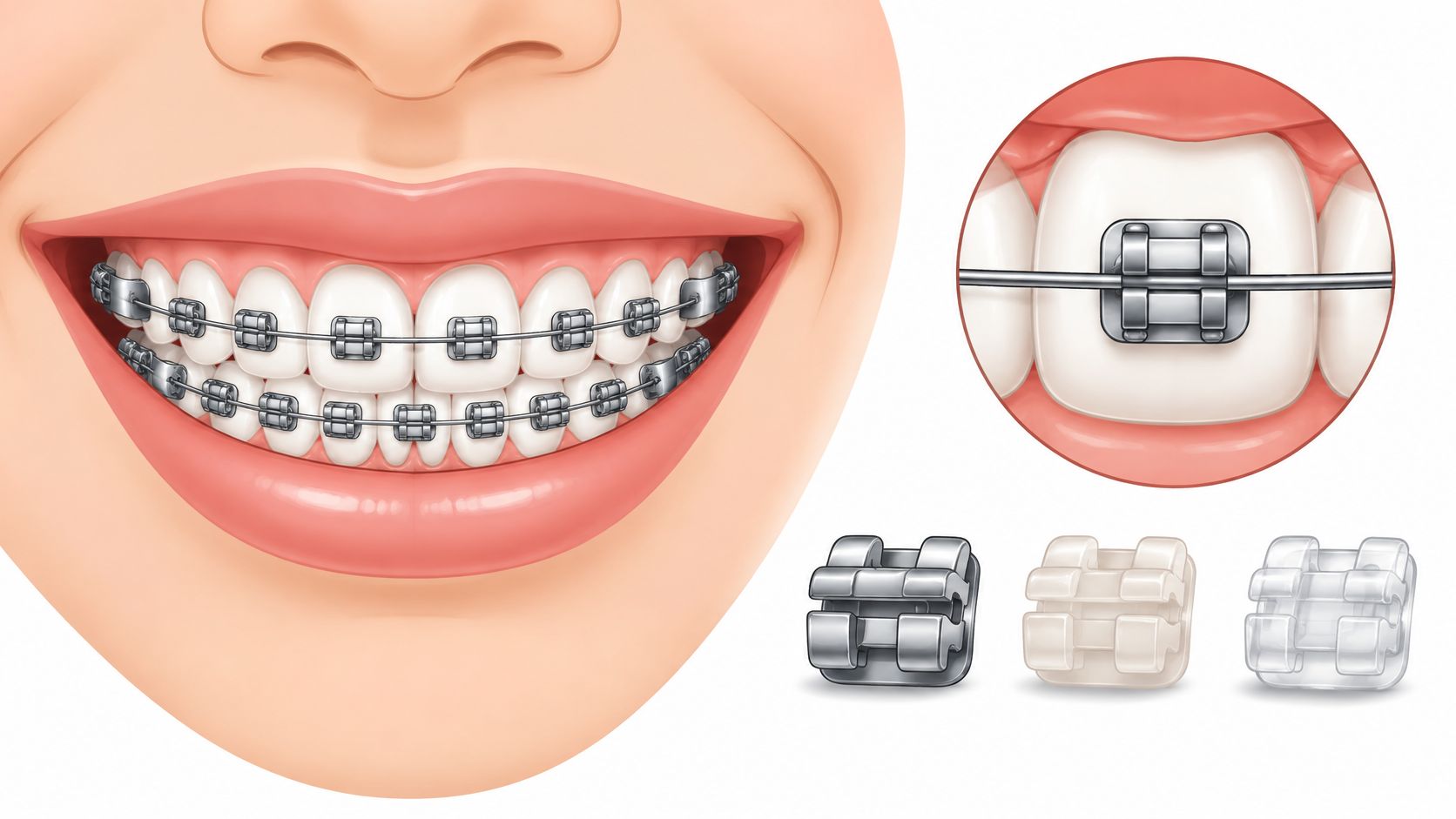
How the parts connect
The archwire fits into the bracket slots and supplies the force that moves teeth, as the American Association of Orthodontists archwire guide explains. Early treatment commonly uses thinner wires; later stages may use rectangular wires for more control over tooth position.
Small elastic O-rings, sometimes called modules, can hold the wire in place. Other systems use stainless-steel ligatures or a door built into a self-ligating bracket. These are different ways of securing the wire, not separate alternatives to braces.
Bands are rings that fit around back teeth and can help anchor the appliance. Not every patient needs precisely the same combination of parts, so a treatment discussion may include attachments that another family member didn't have.
A familiar comparison
A fence offers a useful picture: brackets are like the posts, the archwire is the connecting rail, and ligatures are the ties. The analogy describes how the components connect, although living teeth respond to controlled forces rather than behaving like fence posts.
That distinction helps parents understand an appointment discussion. A loose bracket is a problem with an individual component, while changing a braces system means considering the appliance as a whole.
Brackets are parts, and braces are the assembled system. Asking “brackets or braces?” is like asking whether a fence is its posts or its rails.
Braces, Brackets and Your Options at a Glance
The practical comparison is between appliance systems. Their appearance, how they stay in place, and the kinds of tooth movement they support all matter.
Fixed and removable options side by side
| Option | What it is | Visibility | Removable by patient |
|---|---|---|---|
| Traditional metal braces | Metal brackets bonded to teeth and linked by an archwire | Most visible | No |
| Clear ceramic braces | Tooth-colored brackets bonded to teeth and linked by an archwire | Lower-profile look | No |
| Self-ligating braces | Brackets with a built-in door in place of elastic or steel ties | Metal is more noticeable; ceramic blends with teeth | No |
| Lingual braces | Brackets placed on the tongue side of the teeth | Hidden from front view | No |
| Clear aligners (Invisalign) | Custom plastic trays worn in a planned sequence | Nearly invisible | Yes |
| Removable plates | Plastic plates that move teeth only in very limited ways | Visible | Yes |
What the table can establish
Metal and ceramic braces use a similar overall arrangement, but differ in bracket material and appearance. Stellar Orthodontics offers both classic metal braces and clear ceramic braces, as well as Invisalign for teens and adults. Ceramic brackets have a lower-profile look, while the choice between ceramic and metal can also reflect budget priorities.
Self-ligating describes how a bracket secures the wire, rather than promising a particular appearance. Lingual describes brackets placed on the tongue side of the teeth. The review of orthodontic bracket development describes these design approaches and cautions that design changes do not automatically establish better treatment outcomes.
A removable plate and a clear aligner both come out of the mouth, but they do different jobs. NHS Inform's orthodontic guide explains that removable plates can accomplish only very limited tooth movements. For example, a patient needing detailed root control may need an appliance that can guide that movement, something the visibility and removability columns alone cannot show.
The choice is best considered across case complexity, bracket reliability, daily responsibilities, and total cost. A less noticeable option may suit a family's preferences, while the orthodontist also considers which movements the patient's treatment requires.
How Fixed Braces Work From Start to Finish
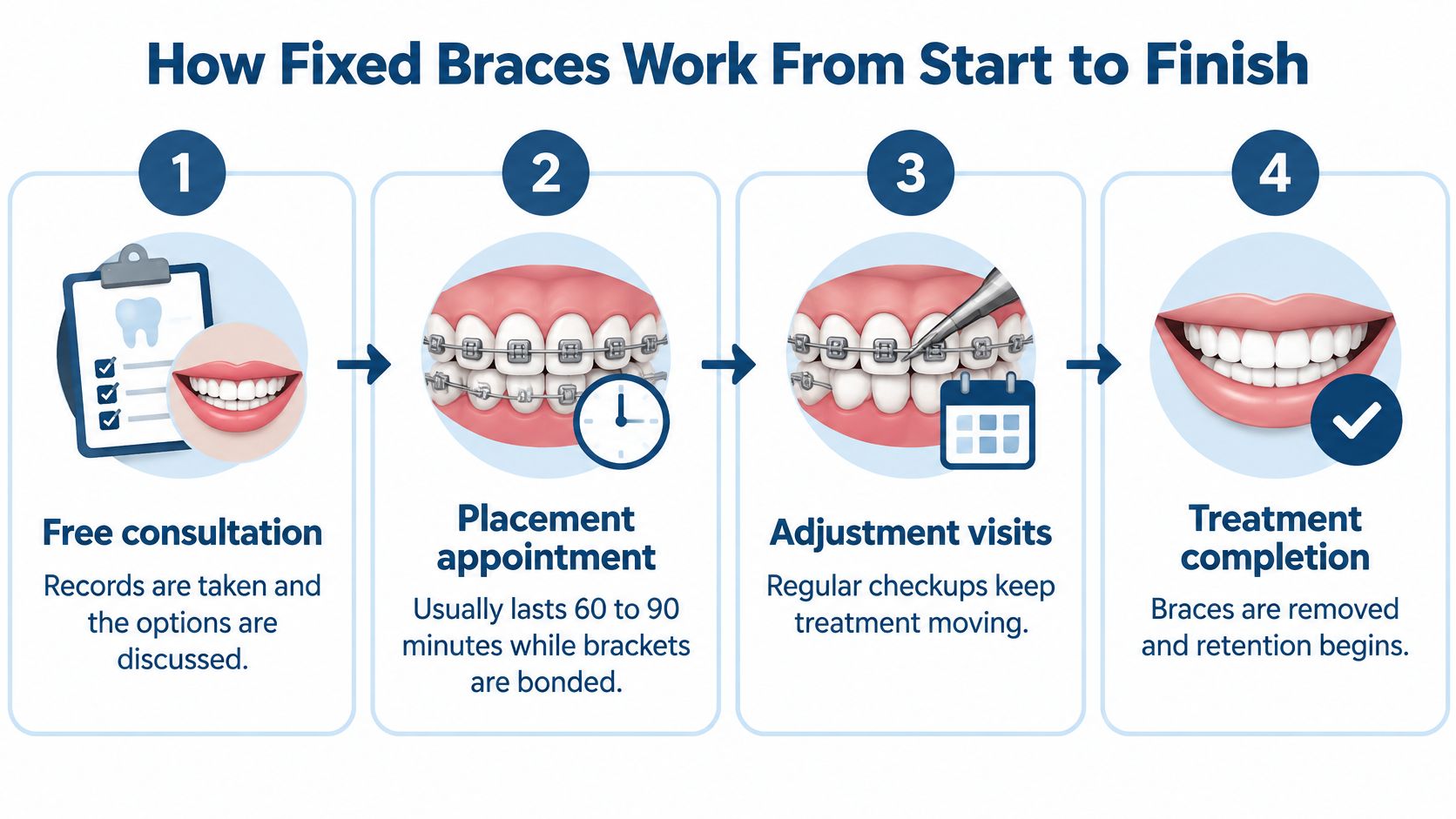
A typical braces journey begins with an examination and records, not a decision about bracket color. At the free consultation, the team discusses the bite, available options, timing, and financing in plain language.
The process overview shows the main milestones, with individual care adjusted to the patient.
Placement and active treatment
Placement takes 60 to 90 minutes. Brackets are bonded to the front of each tooth, and the first archwire is placed. The procedure involves no injections, drilling, or pain, although soreness can develop afterward as teeth begin responding.
At adjustment appointments, the orthodontist checks progress and changes or adjusts the wire as needed. Later wire choices help refine alignment and the bite. The team can explain expected soreness, suitable comfort measures, and which symptoms warrant a call.
Treatment planning also matters before the appliance goes on. A systematic review of 15 trials involving 1,084 patients found no significant treatment-quality or duration difference between aligners and fixed appliances in non-extraction cases, but better treatment quality with fixed appliances in extraction cases.
A hypothetical child with mild crowding and a teen with a deep bite may therefore need different plans, even if their front teeth initially look similarly uneven. Neither appearance nor age alone supplies a dependable completion date.
The video provides another view of fixed-appliance treatment.
Timing, repairs, and completion
Most braces cases at the practice finish in 18 to 30 months. The NHS braces guide describes 1 to 2 years as common within its service, but that service-specific range isn't a prediction for an individual Delaware patient.
A loose bracket or troublesome wire may require a repair visit between scheduled appointments. Families should contact the office rather than waiting for the next routine visit or attempting to reposition parts themselves.
At completion, braces are removed in a single appointment, followed by a final cleaning and retainers. Retention becomes part of the plan rather than an optional extra.
For the first week, practical preparation helps:
- Choose manageable foods. Soft meals reduce the need to bite forcefully while teeth feel tender.
- Practice cleaning. The team can demonstrate brushing around brackets and cleaning between teeth.
- Keep contact instructions handy. Families should know how to report irritation, a loose attachment, or a wire problem.
Consistent hygiene and attendance help the orthodontist carry out the planned treatment without avoidable interruptions.
Bracket Reliability, Friction and Daily Performance
| Factor | What it affects | Useful question |
|---|---|---|
| Bonding method | How the bracket attaches to enamel | What happens if an attachment loosens? |
| Material and tooth location | The conditions each bracket encounters | Are any areas more difficult to maintain? |
| Food and chewing habits | Pressure on brackets and wires | Which foods need cutting or avoiding? |
| Wire-bracket interaction | Resistance during tooth movement | Does the proposed design offer a relevant benefit? |
| Appointment attendance | Monitoring and timely adjustments | What schedule should the family plan around? |
Bracket reliability is measurable, but there isn't one universal failure rate. A systematic review of bracket detachment synthesized 17 studies, with individual studies evaluating 361 to 3,336 brackets, and reported detachment incidence ranging from 0.6% to 28.3%; study populations had mean ages ranging from 10.5 to 38.7 years.
Those figures describe different studies, not a personalized risk estimate. They include younger and adult populations, but don't establish that every age group or appliance has the same likelihood of breakage.
Why brackets can loosen
Bonding methods, bracket materials, tooth location, patient behavior, and study populations all influence the results. A bracket on a heavily loaded back tooth encounters different conditions from one on a front tooth.
Daily habits matter because adhesive and attachments aren't designed to withstand every chewing force. Biting ice, chewing pens, and pulling at sticky foods can put unnecessary stress on the appliance.
The practical distinction is between an appliance needing maintenance and an entire treatment failing. A detached bracket may require rebonding, an extra visit, or a schedule adjustment, but it doesn't automatically mean the treatment has failed.
What friction means in practice
As teeth move along an archwire, contact between the wire and bracket creates resistance. Wire size and material, bracket angulation, surface roughness, the ligation method, and conditions in the mouth all influence that interaction.
A systematic review of intraoral aging and bracket friction found that clinically used brackets generally developed rougher surfaces and greater friction. It also explains why reduced ligation-related friction with self-ligating designs doesn't establish a definitive overall treatment-time advantage.
Practical rule: A low-friction label isn't a promise of faster treatment. The planned movements, appliance management, and follow-through still matter.
Everyday prevention and repair planning
Families benefit from concrete food instructions rather than a vague warning to be careful. Apples can be sliced instead of bitten whole, and corn can be cut from the cob. The foods-to-avoid-with-braces guide helps families plan suitable meals and snacks.
The repair policy deserves attention before treatment starts. Parents can clarify how to report a loose bracket, whether a repair needs a separate visit, and what to do while waiting for instructions.
A useful comparison therefore includes maintenance demands, not just bracket appearance. An appliance that suits the patient's routine is easier for the family to support consistently.
Aligners Versus Fixed Brackets by Case Type
“Braces” and “brackets” are not competing treatment categories: brackets are the small attachments used in fixed braces. The practical choice is between appliance systems, weighed against the movements a case requires, how reliably the appliance works for that patient, daily routines, and total cost.
Which appliance tends to fit each case type
| Case type | Usually better suited | Why |
|---|---|---|
| Mild to moderate crowding with consistent wear | Clear aligners | Suitable non-extraction cases can achieve comparable quality when trays are worn reliably |
| Non-extraction cases where speed matters | Either, after individual assessment | Treatment time depends on the case and plan |
| Extraction cases | Fixed braces | Better control of bodily movement, torque, and space closure |
| Major tooth rotations | Fixed braces | More control of demanding movements |
| Vertical discrepancies and complex root positioning | Fixed braces | More control over bite and root relationships |
| Complex bite issues or severe crowding | Fixed braces | These cases can require detailed tooth rotations and coordinated movements |
| Inconsistent wear expected | Fixed braces | Aligners depend on consistent daily wear |
Why the required movement matters
Straightening a tilted tooth is different from moving its root and crown together through bone. Bodily movement means moving the tooth more as a unit; torque is control of the root's position. Closing extraction spaces can require careful control of both.
For complex bite issues, severe crowding, or detailed tooth rotations, fixed braces are often the better fit. A teen who needs an extraction should expect fixed appliances to be considered because they provide more control over tooth movement and space closure.
Clear aligners suit selected simpler cases when the plan fits the needed movements and the patient wears the trays consistently. Their removability offers flexibility, but it also puts part of the treatment routine in the patient's hands.
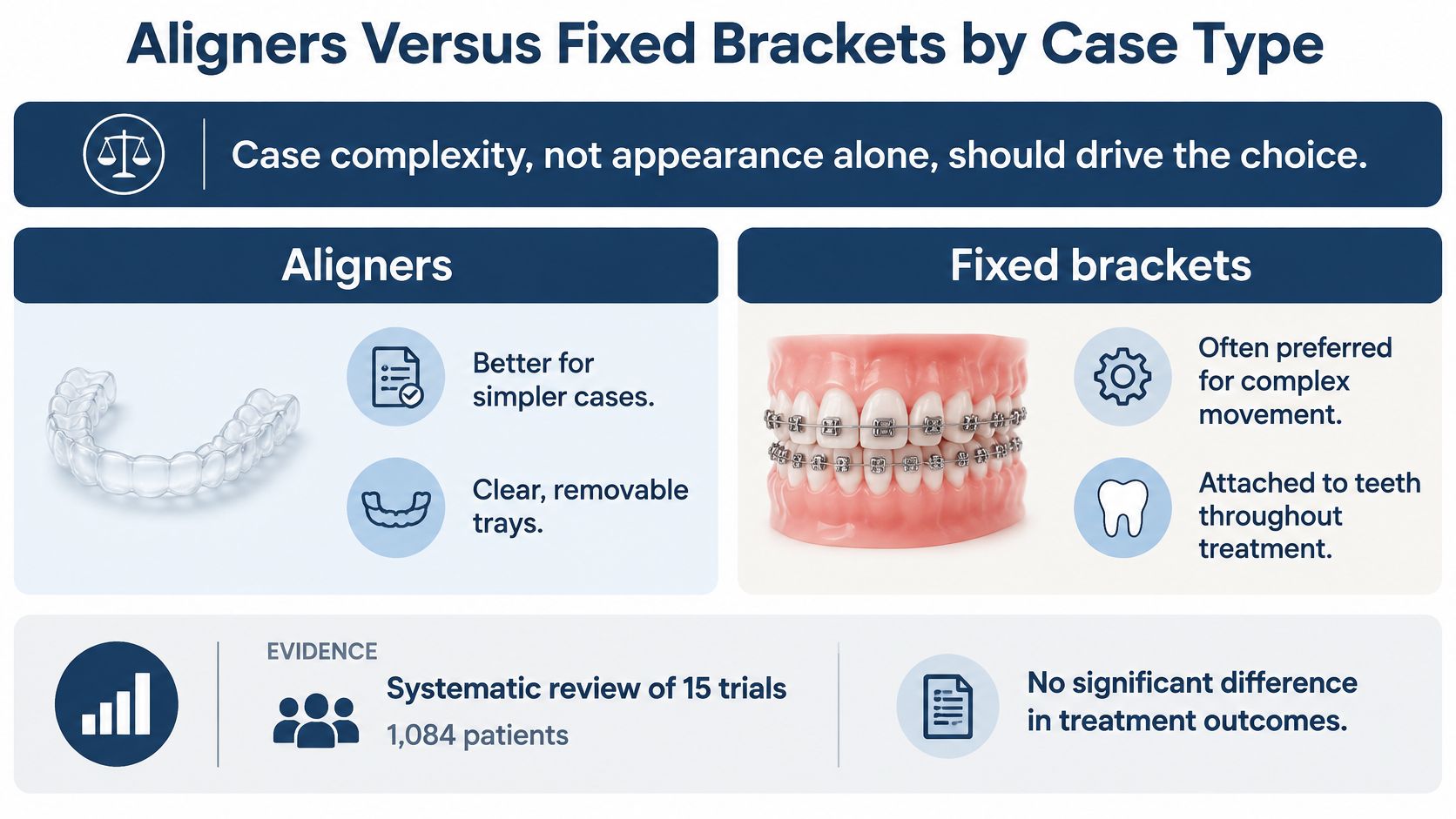
How the choice changes for teens
A teen with mild crowding who reliably wears trays may be a good candidate for aligners. A teen who needs an extraction is more likely to benefit from fixed appliances, even with equally strong motivation.
The orthodontist also considers which permanent teeth have erupted and whether space will be created through extractions or interproximal reduction, a planned reduction of enamel between selected teeth. Those decisions depend on an examination, not just a smile photograph.
The guide to Invisalign for crowded teeth explains how crowding can affect aligner suitability. Ask which specific tooth movements the proposed appliance is expected to achieve.
Convenience isn't the same as simplicity
Removable trays let patients take them out to eat and clean their teeth, but they must also manage storage, cleaning, and reinsertion. Fixed appliances stay attached, while cleaning around the brackets and adjusting eating habits become part of the daily routine.
Neither option guarantees that retainers will be unnecessary. The choice comes down to fit: aligners offer discretion and removability, while fixed braces provide more control for complex movements. A suitable plan must also work with the patient's everyday routine.
Costs, Coverage and Payment Options
The appliance choice affects both coverage and what a family pays privately.
| Option | Delaware Medicaid coverage | Payment route |
|---|---|---|
| Traditional metal braces | Covered for eligible children and teens under 21 with pre-authorization | Approved coverage; monthly plans, HSA, or FSA for private-pay care |
| Clear ceramic braces | Generally not covered; an upgrade | Private payment with monthly plans |
| Invisalign clear aligners | Generally not covered; an upgrade | Private payment with monthly financing |
| Replacement retainers after the first set | Typically a private cost if lost or broken | Private payment |
Stellar Orthodontics accepts all three Delaware Medicaid plans plus CHIP, accepts HSA and FSA payments, and offers monthly payment plans for braces and Invisalign. Medicaid coverage requires pre-authorization; private insurance benefits depend on the patient's plan.
What approved Medicaid treatment includes
For eligible patients with approved pre-authorization, the table's metal-braces coverage includes the treatment package. Families should confirm approval before making financial plans, since acceptance of a Medicaid plan does not guarantee that a proposed case will qualify.
A private-pay example shows why it helps to compare the full cost. Traditional metal braces in Delaware typically run $3,000 to $6,500 when pre-authorization is denied and the family chooses private pay. Spread evenly over 24 months, that range works out to about $125 to $271 per month, before any plan-specific terms or fees. A monthly payment plan can change when the family pays, but the total estimate is still the key figure to compare.
Compare the total, not just the installment
Ask for a written estimate that separates approved coverage, private upgrades, and later costs. Replacement retainers lost or broken after the initial set are typically a private-pay expense.
The guide to dental insurance for braces can help families prepare questions about orthodontic benefits, approval requirements, and charges they may owe. Compare the total commitment and payment timing, not just the advertised monthly amount.
Book a Free Consultation to Choose Your Option
The words “braces” and “brackets” can make the choice sound more technical than it is. Braces are the appliance system; brackets are one part of fixed braces. The practical question is which option suits the bite and the patient's priorities.
For patients choosing between suitable fixed options, clear ceramic braces and traditional metal braces are equally effective. Ceramic brackets are tooth-colored and lower-profile, while metal brackets are more visible. A consultation helps connect those differences to the patient's needs.
A practical consultation checklist
A useful evaluation produces specific answers, not just a list of appliance names. For example, the orthodontist can explain which movements the bite requires and why fixed braces or Invisalign may suit the case.
- Appearance: Which options fit the bite, and how will they look during treatment?
- Complex bite concerns: Do the needed tooth movements point toward fixed braces?
- Daily routine: What should the patient know about cleaning, eating, and wearing aligners?
- Appointments and repairs: How might visits and bracket or wire repairs fit the family's routine?
A teen may also have questions about school lunches, photographs, or sports. Those everyday concerns belong in the discussion alongside the clinical recommendation.
What the free visit provides
Stellar Orthodontics offers free consultations at all four offices, where families can discuss Invisalign, braces, and treatment timing in plain language. A free Medicaid braces evaluation is also available at every office, whether or not the child qualifies for coverage.
For a family considering Medicaid-covered metal braces and a private ceramic upgrade, the visit can produce a written estimate that separates covered services from private costs. The consultation is free whether or not the family proceeds with treatment or insurance covers any of it.
A clear recommendation should explain the proposed appliance and why it fits the bite. The family can then weigh clinical needs, daily responsibilities, appearance, and cost together.
The right choice is one the family understands and can manage.
Families can book a free consultation in North Wilmington, Middletown, West Dover, or Millsboro. There is no pressure to choose an appliance during the visit.
Stellar Orthodontics offers traditional metal braces, clear ceramic braces, and Invisalign across Delaware. Families can book a free consultation at any of its four offices to discuss which appliance may suit the patient's needs.