.png)
A Wilmington parent scrolling through before-and-after photos with a teenager may notice the same pattern: the final smiles look remarkable, but the months between the first bracket placement and the final reveal rarely appear. The practical questions usually come later. Will ceramic brackets stay discreet at school or work? Will coffee, curry, or a prom-day meal change their appearance? Could a broken bracket add appointments or time?
Ceramic braces can be an effective choice for selected children, teens, and adults, but the decision deserves more than a quick look at a polished gallery. Ceramic braces before and after photos show the destination. Families also need to understand the weekly changes, cleaning routine, staining risk, possible repairs, and differences between ceramic braces, metal braces, and clear aligners.
Table of Contents
- What Ceramic Braces Look Like and Why Families Pick Them
- How Teeth Actually Change During Treatment
- Real Patient Stories From Delaware
- Daily Care That Keeps Ceramic Braces Looking Clean
- Ceramic Braces Compared to Metal and Invisalign
- Honest Trade-Offs Behind Those Before and After Photos
- Your Next Step and a Free Consultation in Delaware
What Ceramic Braces Look Like and Why Families Pick Them
A teen in North Wilmington may describe ceramic braces as “braces that blend in.” That's close, but the appliance still has visible parts. Ceramic braces use translucent or tooth-colored brackets bonded to the front of the teeth, usually with a thin metal archwire and clear or white ligatures, the small rings that hold the wire in place.
The mechanics are familiar. Brackets and wires apply steady pressure so teeth can move into planned positions. The ceramic material changes the appearance, not the basic orthodontic purpose. From across a classroom, a school-photo backdrop, or a work meeting, tooth-colored brackets generally draw less attention than stainless-steel brackets, although the wire and ligatures can still be seen up close.
Practical rule: Ceramic braces are a clinical appliance with an aesthetic advantage, not a decorative version of orthodontic care.
The final look depends on more than the bracket alone. A clear bracket, a tooth-colored bracket, a bright metal wire, and a stained elastic tie can create four different appearances. Patients should ask which bracket system, archwire, and ligature options fit the planned treatment and daily habits.
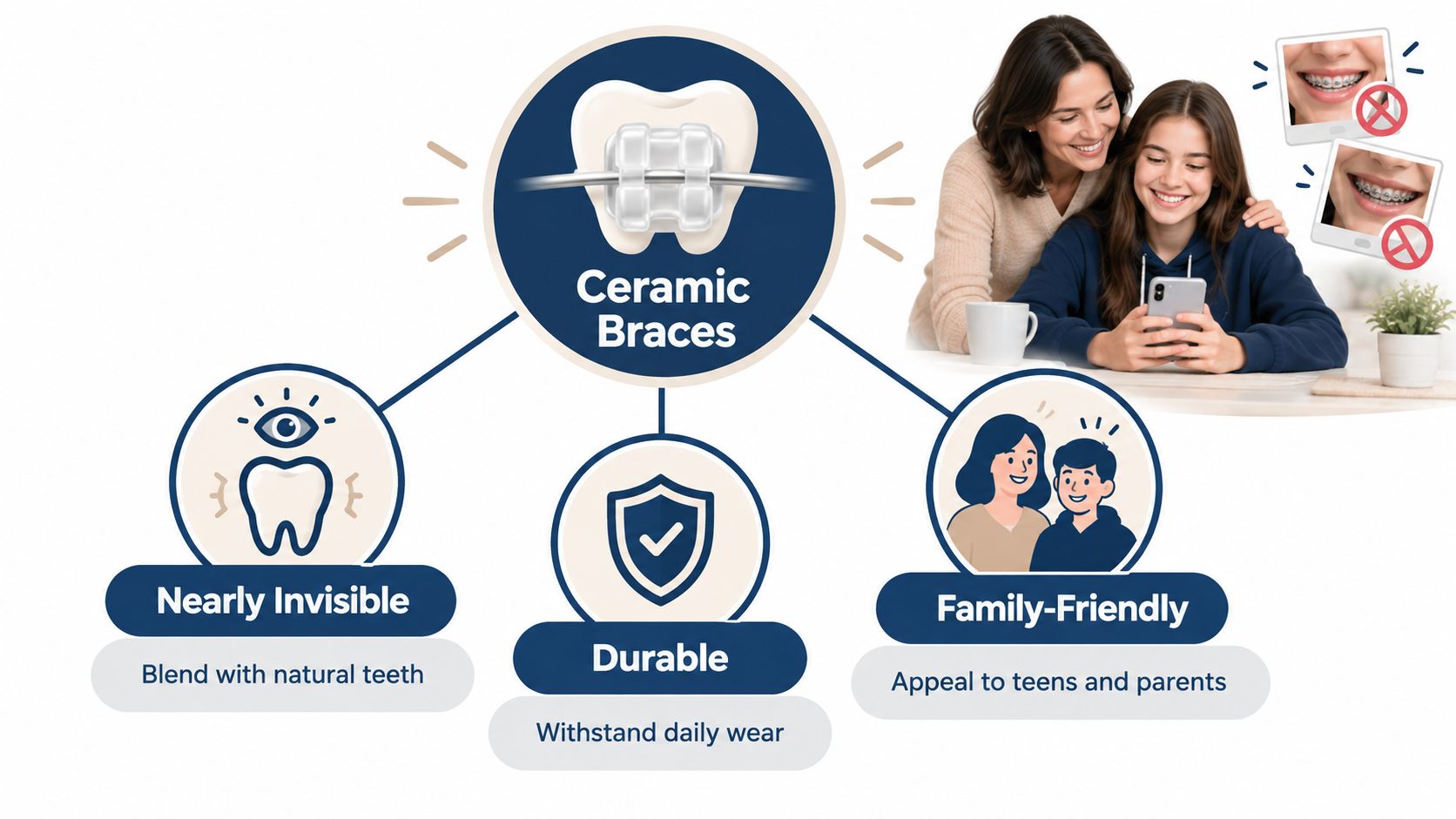
Families often choose ceramic braces because a child or adult feels more comfortable with a discreet appliance. An adult preparing for client meetings may prefer upper ceramic brackets, while a parent may consider a combination of ceramic brackets on visible teeth and metal brackets where additional durability matters. The right arrangement depends on the bite, tooth positions, oral hygiene, and the orthodontist's treatment plan.
Treatment timing also deserves a calm explanation. Ceramic braces are commonly described as taking about 18 to 36 months, with mild cases sometimes finishing in about 12 to 18 months and complex cases extending to 36 months, according to Healthline's overview of ceramic braces. A Delaware family comparing offices in North Wilmington, Middletown, Dover, or Millsboro should look beyond the final photograph and ask how the proposed plan accounts for the patient's specific bite and habits.
How Teeth Actually Change During Treatment
The mirror usually shows small changes before it shows a new smile. Teeth don't move as a single row. One tooth may straighten while another rotates, and the bite can feel unfamiliar before it feels settled.
The first four weeks
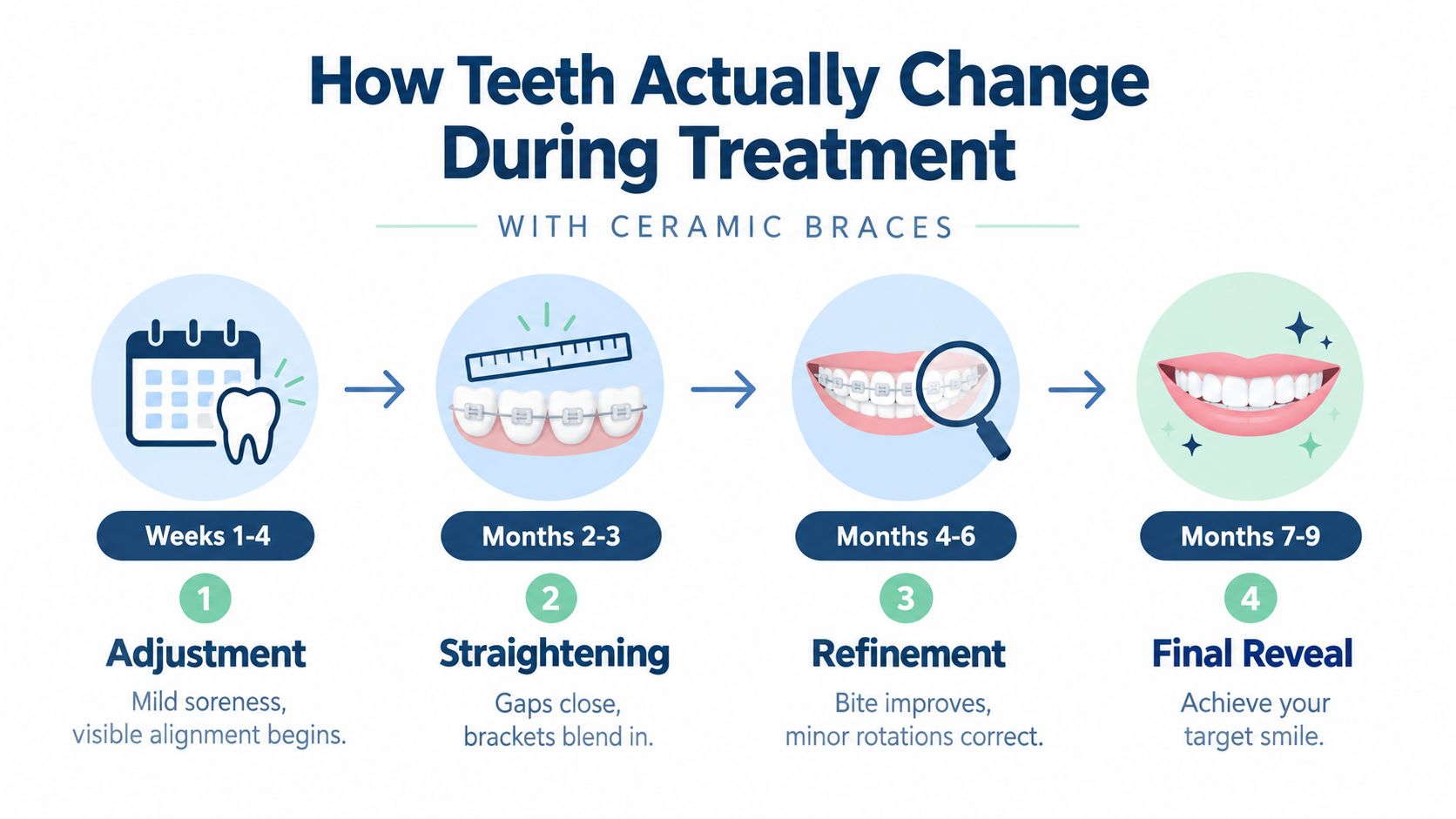
During weeks 1 to 4, many patients are adjusting to pressure, cleaning around brackets, and a different bite sensation. Mild crowding may begin to relax, front teeth can look less overlapped, and the patient may notice that the upper and lower teeth meet differently.
Those early changes shouldn't be judged as a final result. A front tooth that appears slightly more prominent may be moving into the space needed for a better long-term alignment. Photos taken under the same lighting and from the same angle are more useful than daily mirror checks.
Months 2 to 4
Between months 2 and 4, rotations in the canines and incisors may become easier to see. Small gaps may begin closing, and families often notice the change when an older phone photo is compared with a new one. The ligatures, however, may look less tidy before the teeth look fully straight. Dark foods and drinks can discolor clear or white elastic ties, while the ceramic brackets themselves are less noticeable.
A treatment timeline is case-specific. Modern clinical evidence shows comparable treatment timelines in studied adult populations. One retrospective study reported a mean duration of 366.97 days for ceramic brackets versus 425.68 days for metal brackets, while another adult dataset found 363.04 days for ceramic versus 439.20 days for metal, according to the clinical comparison of ceramic and metal bracket treatment. Those findings don't promise that ceramic braces will be faster for every patient. They do challenge the assumption that choosing ceramic automatically creates a major time penalty.
Months 5 to 9
During months 5 to 9, treatment may focus more on arch development and bite correction. The overbite or underbite can begin to improve, and chewing may feel more even. This phase can look uneven in photographs because teeth may be moving at different rates while the archwire guides the broader shape.
Some ceramic systems can move slightly slower in certain situations because the wire may interact differently with the bracket, and orthodontists may use force levels suited to the material and the patient's needs. Research has also identified higher failure risk with round nickel-titanium archwires in one comparative analysis, while rectangular wires were associated with lower failure risk in that dataset, as reported in the clinical study of ceramic bracket failures.
Finishing and retention
From months 10 to 18, many cases enter a finishing stage. The orthodontist may refine rotations, correct the dental midline, coordinate the arches, and make small adjustments that improve how the teeth meet. The final photograph captures those details, but it doesn't show the patience required to reach them.
A related video can help families visualize the appliance and treatment process:
Real Patient Stories From Delaware
A useful before-and-after conversation starts with the patient's concern, not the bracket color. The following representative Delaware vignettes show how treatment choices can vary even when the goal is a straighter, healthier bite.
A Newark teenager with crowding
A 14-year-old from Newark presented with moderate crowding and a deep bite. The planned appliance used Clarity Advanced ceramic brackets on the upper arch and metal brackets on the lower arch, combining a less noticeable appearance where the smile showed most with added durability in the lower arch.
The treatment finished in 18 months with an excellent arch form. The visual change was gradual. Early photographs showed overlapping front teeth beginning to separate, later images showed the canines rotating into place, and the final photos showed a more coordinated arch and improved bite.
The family's small surprise came before prom. One clear ligature picked up color from a meal and looked darker than expected. The bracket hadn't changed color, but the elastic tie had. A replacement at the next adjustment restored the lighter appearance.
A Middletown patient with a stubborn gap
A second representative patient, a teen from Middletown, wanted to close a midline gap and improve the appearance of uneven front teeth. The treatment plan used ceramic brackets in the visible upper arch, with regular follow-up to guide the space closure and check the bite.
The patient experienced a debonded bracket after biting into an apple. Cutting firm foods into smaller pieces would have reduced the force placed on the bracket, but accidents can still happen. The repair required an additional visit and reinforced an important point: ceramic braces need careful eating habits, especially around the back teeth and during early treatment.
A later wire change finally closed the stubborn midline gap. That moment mattered more to the family than a dramatic early photo because it showed how small adjustments accumulate.
A Dover professional seeking discretion
A 34-year-old professional from Dover chose ceramic brackets on the upper teeth with tooth-colored wires. The priority was a presentation-friendly appearance during client meetings, and the patient accepted that the treatment plan might require slightly more time than a more durable bracket choice.
The patient stayed consistent with cleaning and appointments, rinsed after dark drinks, and asked about ligature choices when appearance became a concern. The result was a gradual improvement that fit around work rather than requiring the patient to postpone treatment indefinitely.
Families can view treatment examples in the Stellar Orthodontics smile gallery, while remembering that a gallery can't predict an individual result. Consistent care, faithful elastic use when prescribed, and regular visits to a Delaware orthodontic office influence progress more than the ceramic material by itself.
Daily Care That Keeps Ceramic Braces Looking Clean
Ceramic brackets look discreet only when plaque and discoloration stay under control. The brackets are not the same as the elastic ligatures around them. Neutral clinical literature describes ceramic braces as less noticeable but also notes conflicting evidence about plaque accumulation and possible enamel mineral changes in early testing, as summarized in this review of ceramic orthodontic materials and oral effects.
A practical cleaning routine
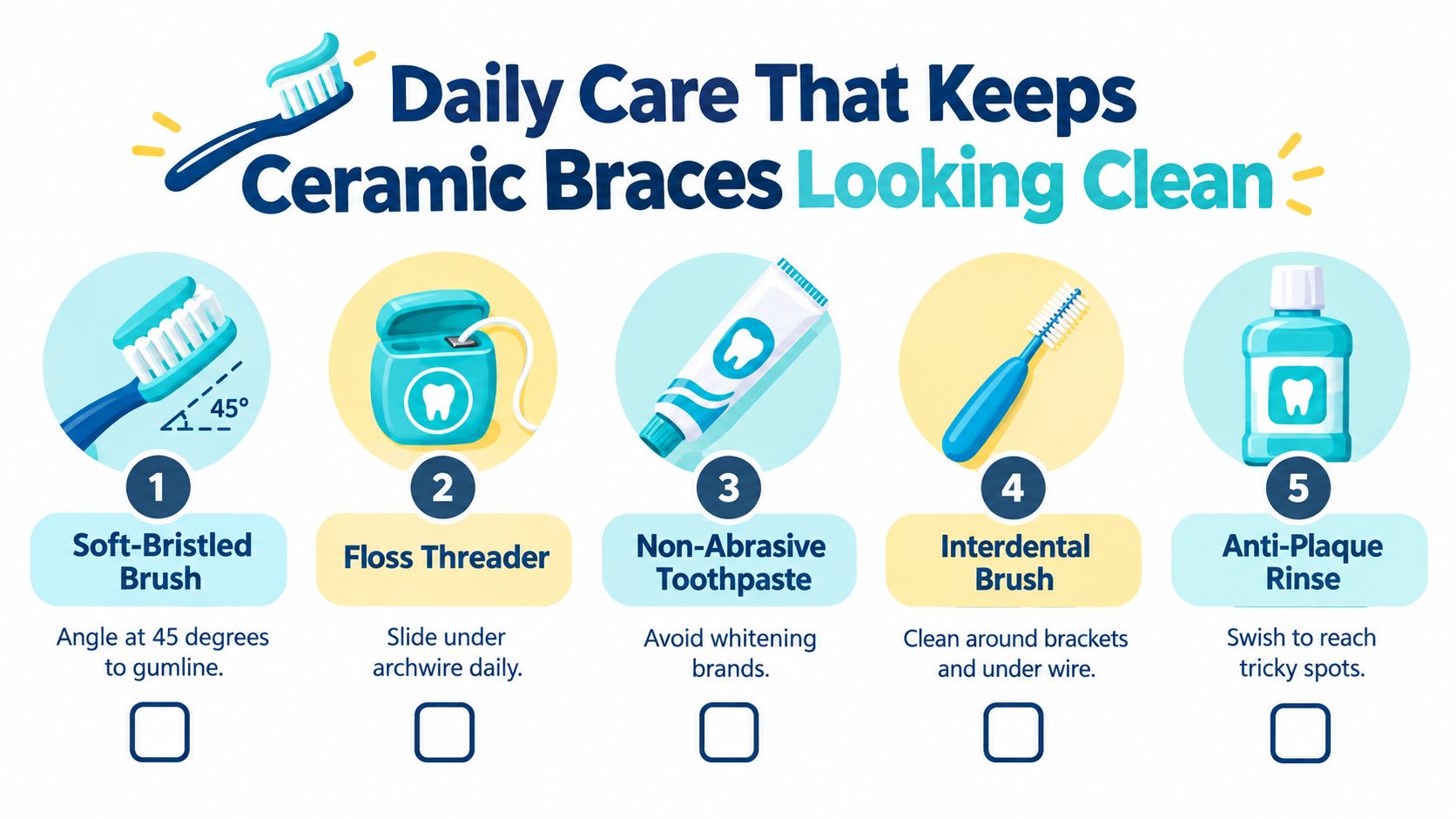
A soft-bristled toothbrush should be angled at 45 degrees along the gumline, then guided around the top and bottom edges of every bracket. A proxabrush or interdental brush reaches under the archwire and into spaces where a standard brush can miss. A water flosser can help flush tight areas, but it doesn't replace careful brushing and daily cleaning between teeth.
The ceramic braces care guide from Stellar Orthodontics can serve as a reference for families building a routine at home. Patients should follow the specific instructions supplied by their orthodontic team, particularly if the treatment plan includes elastics or other appliances.
Managing staining and food choices
The tiny elastic rings can absorb color from coffee, tea, curry, cola, red wine, ketchup, and other dark foods or drinks. Some ceramic brackets resist staining better than the ligatures, so the patient may see yellowing around the brackets even when the bracket itself hasn't changed appearance, as described by WebMD's guidance on ceramic braces.
Helpful habits include:
- Rinse with water: Rinsing after any non-meal drink limits the contact between pigments and the appliance.
- Choose softer preparation: Ice and unpopped popcorn kernels should be avoided. Apples and carrots should be cut into small pieces, and patients shouldn't bite directly into crusty rolls.
- Keep appointments: Wire adjustments commonly occur every six to eight weeks, with quicker visits needed when a bracket breaks.
- Ask about ligatures: Fresh elastic ties can make the appliance look cleaner, especially for patients who drink staining beverages regularly.
Rinsing with water after a non-meal drink is the habit families can use almost anywhere, including school, work, and travel between Delaware communities. It's simple, discreet, and easier to maintain than trying to eliminate every strongly colored food.
Ceramic Braces Compared to Metal and Invisalign
The best choice depends on what the patient values most. Ceramic braces reduce visibility, metal braces offer greater toughness, and removable clear aligners provide a different experience that depends heavily on faithful wear and suitability for the bite.
| Factor | Ceramic Braces | Metal Braces | Invisalign |
|---|---|---|---|
| Appearance | Tooth-colored or translucent brackets blend with the teeth, though the wire and ligatures remain visible up close. | The most visibly noticeable of the three options. | Removable clear trays are generally the least noticeable when worn. |
| Durability | More vulnerable to fracture or debonding, particularly under excessive force. | More tolerant of hard foods and accidental bumps. | Trays can be misplaced, damaged, or removed too often. |
| Staining | Ceramic brackets are less noticeable, but clear or white ligatures can discolor. | Metal components don't discolor in the same way. | The trays don't stain in the same way, but hygiene problems can affect the teeth underneath. |
| Treatment length | Often comparable with metal in studied cases, but repairs or case complexity can change the timeline. | Efficient for a wide range of cases. | May require more time for some complex bite corrections. |
| Cost | Typically positioned between metal braces and clear aligners, depending on the plan. | Often the most affordable bracket option. | Often the highest-cost option among these choices, depending on treatment needs. |
| Speech and comfort | May cause temporary irritation while the mouth adjusts. | May cause temporary irritation while the mouth adjusts. | Can affect speech during the initial adjustment period for some patients. |
The ceramic braces versus metal braces comparison can help families prepare questions for a consultation. A cost comparison should also include repair visits, replacement parts, insurance benefits, and payment arrangements rather than relying on the bracket price alone.
Clinical summaries report that adults may rate aligners higher for aesthetics, comfort, pain, psychological impact, and overall satisfaction, while other retrospective data found minimal differences in treatment duration and satisfaction between ceramic and metal braces, as described in this academic comparison of orthodontic treatment outcomes and satisfaction. The practical rule is straightforward: ceramic braces fit the patient who wants a less noticeable fixed appliance, accepts greater fragility, and can maintain diligent hygiene.
Honest Trade-Offs Behind Those Before and After Photos
A final smile photo can hide the hardest part of treatment. Ceramic brackets have a higher failure burden than stainless-steel brackets in real-world treatment, and one retrospective cohort found a 62% higher hazard of bracket loss, with a hazard ratio of 1.62 and a 95% confidence interval of 1.14 to 2.29. The same cohort found that each additional bracket failure extended treatment by about 0.6 months on average, while earlier reports estimated up to 1.5 months of added treatment after three or more failures, according to the study of bracket-system failure patterns.
That doesn't mean every ceramic patient will lose a bracket. It means families should treat repairs as a known possibility, not an unexpected personal failure.
The messy middle
During the middle months, teeth may shift unevenly. A space can open before it closes, one incisor may look temporarily higher than its neighbor, and the archwire can draw attention before the final alignment settles. These photographs often look less impressive than the starting image, even though the treatment is progressing as planned.
Ceramic brackets also require attention during bonding and removal. Clinical literature has reported concerns involving enamel wear on opposing teeth, increased appliance friction, and debonding complications, which helps explain why ceramic brackets may suit selected teeth or carefully planned cases rather than every patient, according to the clinical report on ceramic bracket complications.
Why early care matters
In one 12-month comparison, the ceramic failure rate reached 25.63% in the study sample, with failures especially common in the mandibular arch and posterior region. Earlier comparative work found that 87.5% of bracket failures occurred during the first six months, making early follow-up and careful force management particularly important, as detailed in the published review of ceramic bracket development and removal.
The trade-off can include extra driving time from Newark, Wilmington, Middletown, Dover, or Millsboro, along with more chair time for repairs and ligature changes. Ceramic braces can still produce excellent results for the right candidate. The decision should reflect the whole treatment experience, not only the discreet appearance in the final image.
Your Next Step and a Free Consultation in Delaware
A consultation turns a general question into a patient-specific decision. The process typically starts with a brief phone intake, followed by a clinical visit that may include photographs and digital scans. At Stellar Orthodontics, free consultations are available with iTero digital 3D scanning, allowing the orthodontic team to discuss the proposed tooth movements and compare ceramic braces, metal braces, and clear aligners.
Families can ask focused questions:
- Appearance: Which bracket, wire, and ligature combination will look most discreet?
- Durability: Are ceramic brackets appropriate for the patient's bite, habits, and sports activities?
- Hygiene: Which foods and drinks create the greatest staining concern?
- Timing: What could extend the estimated treatment period?
- Finances: How might dental insurance, monthly payment options, or public coverage affect the plan?
Stellar Orthodontics has offices in North Wilmington, Middletown, West Dover, and Millsboro, serving families across the Brandywine Valley, the MOT corridor, Kent County, and Sussex County. The office information lists locations at North Wilmington, Middletown, West Dover, and Millsboro, giving households a choice based on the most manageable drive.
The consultation is obligation-free, so families can compare options before deciding. Starting braces is rarely an urgent decision, and the visit gives parents and patients time to ask about staining, bracket durability, repairs, treatment length, insurance benefits, and the difference between a gallery result and the day-to-day experience.
For children and teens, orthodontic treatment becomes more manageable when the plan fits school, meals, activities, and family schedules. Adults can weigh professional appearance against maintenance and appliance durability without feeling rushed. A clear ceramic braces before and after plan should explain not just how the smile may look at the end, but what the patient will need to do along the way.
Stellar Orthodontics offers free consultations, iTero digital 3D scanning, ceramic braces, metal braces, and clear aligners at four Delaware locations. Families comparing ceramic braces before and after results can visit Stellar Orthodontics to request a consultation and discuss appearance, hygiene, durability, timing, and payment options with the orthodontic team.