.png)
Most parents begin with the wrong question: Which option is less visible, ceramic braces or Invisalign? Appearance matters, especially for a teenager or adult, but it shouldn't decide treatment by itself. The more useful question is whether the appliance matches the patient's daily habits and the movements the bite requires.
Clear aligners can be comfortable and discreet, but they only work when they're worn and managed consistently. Ceramic braces are less removable, yet they provide fixed control and keep working throughout the day. For Delaware families, the practical choice often comes down to two things: Can the patient manage a removable appliance reliably, and does the bite need the control of bonded brackets?
| Factor | Clear aligners | Fixed ceramic braces |
|---|---|---|
| Visibility | Very discreet removable trays | Tooth-colored or translucent bonded brackets |
| Daily responsibility | High, because trays must be worn, cleaned, stored, and replaced | Lower for wear time, because the appliance stays attached |
| Eating | Trays come out for meals and drinks other than water | Some foods may need to be avoided to protect brackets |
| Hygiene | Easier access to teeth while trays are removed | Brushing and flossing around brackets requires extra care |
| Complex movement | Strong option for selected non-extraction and mild-to-moderate cases | Often more predictable for complex bite correction and extraction cases |
| Main risk | Lost trays, inconsistent wear, or poor tracking | Bracket breakage, particularly in areas exposed to stronger chewing forces |
Table of Contents
- The Hidden Factor in Choosing Clear Orthodontics
- How Clear Brackets and Digital Aligners Work
- Daily Life and Maintenance Realities for Families
- Matching the Appliance to the Clinical Objective
- The Teen Compliance Challenge and How to Navigate It
- Navigating Costs and Delaware Insurance Coverage
- Your Next Steps at Stellar Orthodontics
The Hidden Factor in Choosing Clear Orthodontics
The least visible appliance isn't automatically the best appliance. A removable tray can look excellent on a school morning, but it won't deliver the planned result if it stays in a lunchbox, sports bag, or bedroom for much of the day.
A 2025 scoping review found that most adolescents don't meet prescribed daily wear times for removable intraoral appliances, while researchers used inconsistent definitions of compliance. The same review found that adolescent adherence to clear aligner treatment specifically hasn't been adequately studied, even as interest in aligners grows. The review of adolescent appliance adherence also identified promising but not yet definitive evidence for digital monitoring and image-based reminders.
That matters because parents often evaluate comfort and appearance while underestimating self-management. A teen who regularly forgets sports equipment, loses water bottles, or needs repeated reminders to follow routines may struggle with trays, even if the trays feel comfortable.
Practical rule: A removable appliance is only convenient when the patient can manage it consistently.
The decision parents should actually make
Parents should assess behavior before choosing the more discreet option. Can the teenager remember to put trays back after eating? Will the family supervise wear without turning every evening into an argument? Can the patient keep the case available at school, during travel, and at sports activities?
Ceramic braces remove much of that daily wear-time burden. They remain bonded to the teeth, so the patient doesn't have to decide whether treatment is active after every meal. That doesn't make them maintenance-free. Patients still need careful cleaning, sensible food choices, and regular appointments.
For adults, the same principle applies in a different way. A busy professional may prefer aligners because they can be removed for meetings, meals, and photography. Another adult may find fixed ceramic braces easier because there are fewer objects to track during a demanding workday.
Appearance is only one part of suitability
Clear aligners may offer a less noticeable appearance, but the U.S. Food and Drug Administration describes them as prescription medical devices, not over-the-counter products. The FDA recommends evaluation by a licensed dentist or orthodontist, preferably through an in-person examination, before treatment begins. Its guidance explains that an evaluation can help identify unsuitable cases and reduce the risk of uneven bites, unintended movement, pain, or tooth loss. The FDA's guidance on clear dental aligners also warns that complex conditions and missed follow-up care can affect whether treatment progresses as intended.
The best choice is therefore the appliance the patient can use correctly for the planned movements. A less visible treatment that repeatedly stalls isn't more successful than a slightly more noticeable treatment that stays on track.
How Clear Brackets and Digital Aligners Work
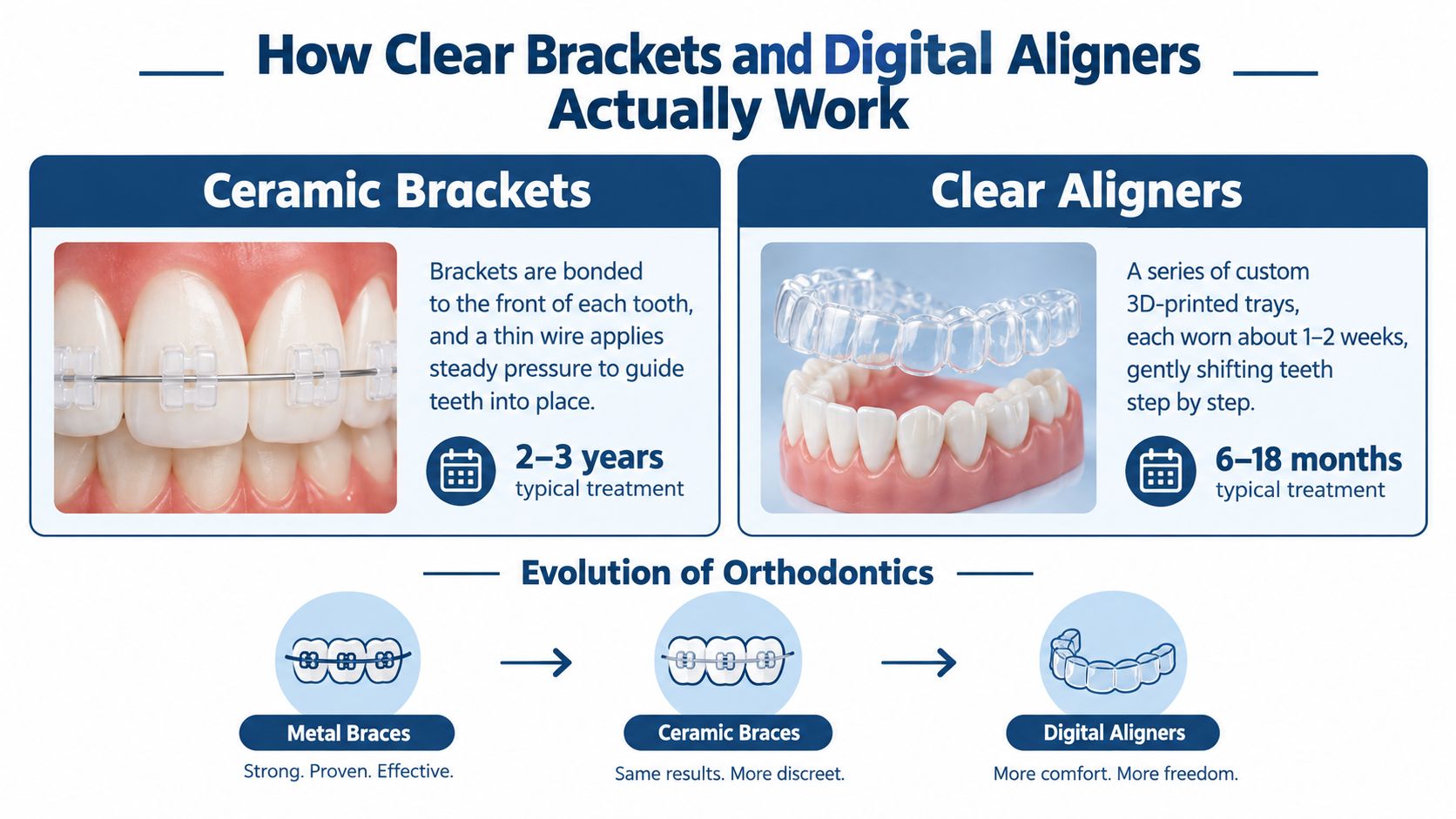
Ceramic braces and clear aligners move teeth through different mechanical systems. Ceramic braces are fixed appliances. Brackets bond to the front of the teeth and connect with an archwire, allowing the orthodontist to control force through the appliance and adjustments while it stays attached between visits.
Modern ceramic brackets can produce tooth movement broadly comparable to conventional metal brackets. A 2025 review synthesizing 59 publications reported similar effectiveness for tooth movement, although mechanical durability can differ. The review of ceramic bracket performance also identifies an important practical distinction. A 2024 clinical study found significantly higher ceramic bracket-failure rates during the first 12 months, particularly in the lower arch and posterior teeth, with an overall comparison of p < 0.0001.
Ceramic braces remain a reasonable option when their placement and maintenance fit the treatment plan. Material choice matters most where chewing forces are higher. Ask whether clear brackets will be placed on lower or back teeth, and how a broken bracket could affect appointments, comfort, and progress.
Aligners use a planned sequence
Clear aligners follow a different treatment model. In 1997, Invisalign launched a digitally planned, removable alternative to fixed braces. The history and technology of Invisalign describes how digital scanning, three-dimensional treatment simulation, and computer-aided appliance fabrication shaped the system.
Instead of one bonded appliance applying force continuously, the patient receives a sequence of custom thermoplastic trays. Each tray targets a planned stage of movement, and the next tray advances the sequence. The patient must wear, clean, store, and change the trays according to the orthodontist's instructions.
That difference explains many of the practical trade-offs families notice at home. Ceramic braces give the orthodontist a fixed platform for controlling teeth. Aligners give the patient more freedom, along with responsibility for wearing them consistently. Attachments and other design features can improve control, but removable trays still depend on the patient's daily routine.
Parents who want a clearer explanation can read this guide to how Invisalign works.
The following video offers another visual introduction to orthodontic treatment:
Daily Life and Maintenance Realities for Families
A treatment plan has to survive ordinary weekdays. The relevant comparison isn't how each appliance looks in a consultation room. It's what happens during breakfast, school, sports, dinner, brushing, and bedtime.
Eating and school routines
Aligners come out for meals, which means patients can generally eat without brackets in the way. That flexibility is useful for school lunches and family dinners, but the trays need a safe place while the patient eats. Wrapping them in a napkin creates an easy path to accidental disposal. Leaving them loose in a backpack exposes them to damage or loss.
Ceramic braces stay attached, so patients don't face that particular risk. They do need to protect the brackets from hard or sticky foods and follow the orthodontist's dietary advice. Ceramic material can be more vulnerable to failure in areas exposed to stronger chewing forces, especially in the lower and posterior teeth, so food choices can affect appointment interruptions.
Hygiene and comfort
Aligners allow teeth to be brushed and flossed without an appliance covering them. The trays themselves also need cleaning, and patients must replace them after eating and cleaning their teeth. A teen who treats the tray case as optional may create avoidable problems.
Braces demand more technique. Food can collect around brackets and wires, so brushing needs to cover the gumline, bracket edges, and spaces under the archwire. Flossing may take longer, but consistent home care remains essential for either treatment.
Families comparing fixed ceramic treatment can use this guide to caring for ceramic braces to understand the daily routine.
Sports, instruments, and travel
Removable trays can be taken out for some activities, but patients must remember to put them back in and protect them during storage. Contact sports also require the patient to follow the orthodontist's guidance about mouth protection and appliance use.
Fixed ceramic braces don't disappear during a game or rehearsal. That can be simpler for a forgetful teenager, but the patient still needs appropriate protection and should report damage promptly. A broken bracket isn't a reason to panic, but it can mean an extra repair visit or a change to the treatment schedule.
The strongest option is the one that fits the family's actual routine:
- For organized, consistent teens: Aligners may fit well if the patient tracks wear, carries a case, and follows cleaning instructions.
- For forgetful or highly active teens: Fixed ceramic braces may be more predictable because they can't be left at school or misplaced after lunch.
- For adults with changing schedules: Either option can work, but the decision should reflect whether removability simplifies life or adds another task.
Matching the Appliance to the Clinical Objective
Orthodontic treatment isn't just about making the front teeth look straight. The orthodontist also has to manage root position, tooth inclination, vertical movement, the relationship between upper and lower arches, and the way the teeth meet at the end.
For mild-to-moderate crowding, clear aligners can be a reasonable choice. A 2024 systematic review that evaluated 10 eligible studies, including six randomized controlled trials, found low-certainty evidence that treatment duration for mild-to-moderate crowding was similar between clear aligners and fixed braces, with no significant difference. The review of aligners and fixed appliances for crowding directly challenges the assumption that aligners are automatically faster.
The evidence becomes more conditional as the movement becomes more demanding. In non-extraction cases, systematic-review evidence indicates that aligners and fixed appliances can produce comparable overall outcomes, with no consistent treatment-duration difference. In extraction cases, fixed appliances tend to produce higher-quality results because they offer more reliable control of bodily movement, buccolingual inclination, and occlusal contacts. The systematic review of aligner treatment outcomes supports evaluating the planned movement rather than selecting an appliance based only on appearance.
Where each option fits
| Orthodontic objective | Clear aligners | Fixed ceramic braces |
|---|---|---|
| Mild-to-moderate crowding | Often a reasonable option when wear is reliable | Effective fixed alternative |
| Selected non-extraction treatment | Can produce comparable overall outcomes | Provides continuous control |
| Transverse arch expansion | Promising and predictable in selected adolescent cases | Strong fixed-appliance platform |
| Anterior crossbite correction | Promising in selected adolescent cases | May be considered when broader control is required |
| Significant rotations | Less predictable when precise control is difficult | Often more reliable |
| Extraction spaces | More limited for bodily movement and final contacts | Generally stronger biomechanical choice |
| Vertical discrepancies | Can be challenging to control | Often provides more consistent control |
| Complex bite correction | Suitability depends heavily on the planned movements | Frequently favored for three-dimensional control |
| Patient with inconsistent wear | Treatment may not track as planned | Appliance remains active without daily tray decisions |
A 2025 systematic review reported promising and predictable aligner results particularly for transverse arch expansion and anterior crossbite correction in adolescents, with patient and parent satisfaction of roughly 85% to 92%. The adolescent clear-aligner review also supports a necessary caution: satisfaction reflects comfort and experience, not automatic clinical suitability.
Another review found that clear aligners performed better for segmented tooth movement, while fixed appliances performed better for adequate occlusal contacts, torque control, and retention. The same review reported a statistically shorter average treatment duration of 6.31 weeks, approximately 1.5 months, for aligners, with a 95% confidence interval of 4.24 to 8.37 weeks. The comparison of clear aligners and fixed appliances still supports a case-based decision because a shorter average duration doesn't mean every patient will finish sooner.
Parents should ask three direct questions:
- Which movements are predictable with aligners in this specific bite?
- Does growth or an erupting tooth change the appliance recommendation?
- What is the backup plan if tracking or compliance becomes a problem?
The Teen Compliance Challenge and How to Navigate It
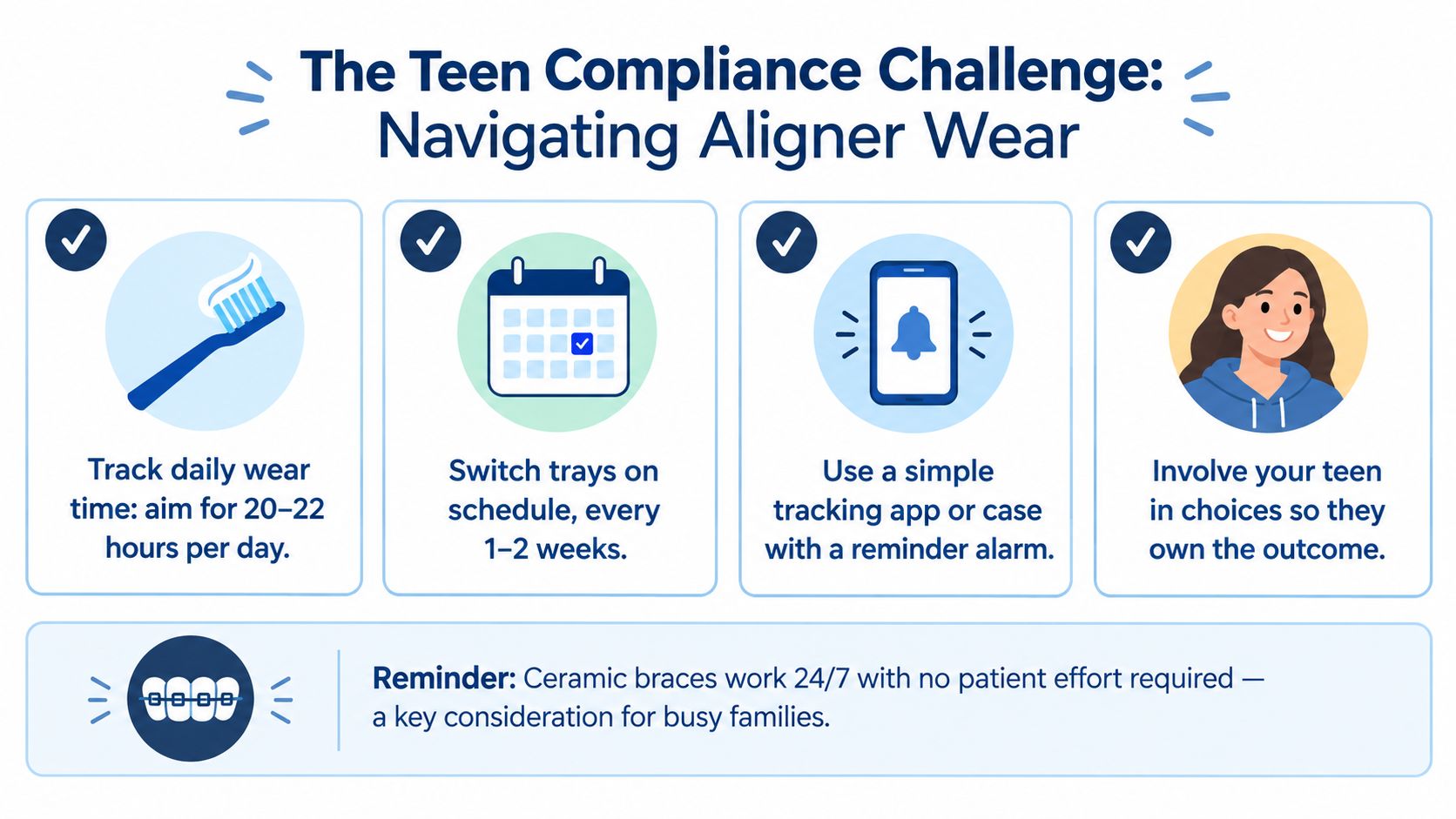
For teenagers, compliance may be the deciding clinical factor. Clear aligners require the patient to keep them in for the schedule prescribed by the orthodontist, return them after meals, protect them during activities, and move through the sequence correctly.
The common failure points are ordinary and predictable. A teen forgets the trays at school, loses them during sports, leaves them in a restaurant, or eats and doesn't put them back. The problem isn't that the teenager lacks motivation. The problem is that every day contains several opportunities to interrupt treatment.
The adolescent adherence review found that most adolescents don't meet prescribed daily wear times for removable intraoral appliances. It also found inconsistent definitions of compliance and insufficient research specifically focused on adolescent clear-aligner adherence. Parents should treat this as a reason for honest planning, not as a judgment about their child.
A realistic readiness check
A teen may be ready for aligners when the following behaviors already exist:
- Belongings stay organized: The patient routinely keeps track of glasses, retainers, sports equipment, and school materials.
- Routines happen without repeated prompts: Brushing, homework, medication, and school preparation don't depend entirely on a parent's reminders.
- Meals have a reset habit: The teen can remove the trays, store them safely, brush or rinse as directed, and put them back.
- Sports and travel have a plan: The patient knows where the case is and what to do if a tray is lost or damaged.
- The family can supervise constructively: Parents can monitor the routine without making appliance wear a daily conflict.
If several of these points don't describe the patient, fixed ceramic braces deserve serious consideration. They still require cooperation with hygiene, food guidance, and appointments, but they don't depend on the patient choosing to wear them every morning after breakfast.
Parenting reality: If a teen can't reliably manage a removable retainer, a removable aligner plan may create more stress than freedom.
Digital monitoring or reminder systems may help some families, but the evidence for adolescent aligner-specific adherence interventions still needs stronger trials. A reminder can support a routine. It can't replace the patient's decision to wear the appliance or solve every lost-tray problem.
The right conversation at consultation should include what happens if wear time falls short. Families should understand whether the current tray can be extended, whether a replacement is needed, and how the orthodontist will identify poor tracking. Clear aligners can be an excellent fit for a mature teen, but ceramic braces may be the safer route when treatment success depends on independence that hasn't developed yet.
Navigating Costs and Delaware Insurance Coverage
Families shouldn't assume that one appliance is universally cheaper. The fee depends on the treatment plan, the clinical complexity, the appliance selected, and the coverage available through the family's dental plan.
Insurance discussions should begin before treatment starts. Families can review how dental insurance for braces works and ask the orthodontic office to explain eligibility, orthodontic benefits, exclusions, waiting periods, and the portion that remains the family's responsibility.
Questions worth asking about the financial plan
A useful consultation should clarify:
- What the quoted fee includes: Ask whether records, active treatment, adjustments, refinements, replacement trays, repairs, and retention are included.
- How insurance is handled: Confirm whether the office verifies benefits and submits claims.
- What happens with a lost tray or broken bracket: Understand whether replacement or repair creates an additional charge.
- What payment schedule is available: Ask for the monthly amount, due dates, and any enrollment requirements.
- Whether the plan changes by appliance: Ceramic braces and aligners may have different fees in a particular office, but no universal price should be assumed.
Stellar Orthodontics accepts most major dental insurance and offers flexible monthly payment plans with $0 down. The practice also accepts all three Delaware Medicaid plans, AmeriHealth Caritas Delaware, Highmark Health Options, and Delaware First Health, plus CHIP. Those programs can make orthodontic care more accessible for eligible children and teens under 21 across Delaware.
Families should still confirm eligibility and benefit details directly, because coverage depends on the patient's plan and clinical requirements. A financial coordinator can explain the available route without forcing the clinical decision to follow the insurance category.
The financial choice should support the clinical choice. Selecting aligners because they appear convenient, then paying for replacement trays after repeated losses, isn't necessarily economical. Selecting ceramic braces because they reduce wear-time responsibility may make practical sense for one teenager, while aligners may suit an organized adult whose plan doesn't require complex movement.
Your Next Steps at Stellar Orthodontics
A consultation should answer more than whether a patient can wear clear trays. It should establish what the bite requires, how the teeth are positioned, whether growth or eruption affects the plan, and which appliance offers the most dependable control.
At Stellar Orthodontics, families can book a free consultation at the North Wilmington, Middletown, Dover/West Dover, or Millsboro location. The practice uses iTero digital 3D scanning, which avoids messy putty impressions and allows the orthodontist to show a digital model and simulate potential outcomes on screen.
What the appointment should clarify
The consultation can help a family work through the decision in a practical order:
- Clinical examination: The orthodontist evaluates alignment, bite relationships, growth considerations, and the movements needed.
- Digital records: The iTero scan creates a three-dimensional view without traditional putty impressions.
- Appliance discussion: The family compares removable aligners with fixed ceramic brackets based on the planned movements and the patient's routine.
- Compliance planning: If aligners are considered, the conversation addresses storage, wear, cleaning, lost trays, and follow-up.
- Financial review: The team explains insurance, payment plans, and the expected treatment structure.
Dr. Robert Park, Dr. Can Nguyen, and Dr. Sonal Dave provide orthodontic care for children, teens, and adults across Delaware. Dr. Can Nguyen is Board Certified by the American Board of Orthodontics. Their evaluation can help parents distinguish between a case that is well suited to aligners and one where fixed ceramic braces offer a more dependable mechanical platform.

The recommendation should fit the patient
A mature teen with mild-to-moderate crowding, a suitable non-extraction plan, and dependable routines may be a strong aligner candidate. A teen who regularly loses belongings or struggles with daily responsibilities may have a better experience with ceramic braces.
An adult with a complex bite may benefit from fixed control even if aligners are appealing aesthetically. Another adult with a simpler plan may value removability enough to choose aligners, provided the person can follow the prescribed routine.
The important decision isn't whether one appliance wins in every category. It's whether the appliance matches the clinical objective and the patient's behavior. Families should leave the consultation knowing why a recommendation was made, what could complicate treatment, and what responsibilities belong to the patient.
Stellar Orthodontics offers free consultations, iTero digital 3D scanning, clear ceramic braces, and Invisalign evaluation at locations in North Wilmington, Middletown, Dover/West Dover, and Millsboro. Families can visit Stellar Orthodontics to book an appointment and compare the option that best fits the patient's daily habits and bite complexity.