.png)
A Delaware parent sits in a consultation room with two questions on the table. Their child wants braces that won't dominate every photo, but the family also wants a treatment plan that fits the bite, the budget, sports schedule, and daily routine. The choice often comes down to conventional clear ceramic braces versus Damon Clear.
The most useful question isn't which name sounds more advanced. It's which system makes sense for the patient's appearance goals, comfort, expected treatment length, hygiene habits, breakage risk, cost, and appointment needs. Clear brackets can look discreet, but “clear” doesn't mean every ceramic system behaves the same way.
Families visiting Stellar Orthodontics in North Wilmington, Middletown, Dover/West Dover, or Millsboro can use the comparison below to prepare for a more productive consultation. The guidance also applies to adults weighing fixed braces against other discreet options, as explained in this guide to clear braces for kids. By the end, parents should have a practical list of questions for an orthodontist instead of a brand-driven guess.
Table of Contents
- A parent's first question when clear braces come up
- What each bracket type actually is
- How they compare on the criteria that matter
- What the research actually says about treatment time
- Which option tends to fit which Delaware family
- Maintenance, daily care, and what to ask at your visit
- How to choose without second-guessing yourself
- Quick answers parents ask at the front desk
A parent's first question when clear braces come up
A parent may begin with a simple question: “Which one is better, ceramic braces or Damon Clear?” In a consultation, that question usually contains several others. Will the brackets show in school photos? Will the child be comfortable? Could the appliance break during sports? Will cleaning be manageable? Is the more expensive option worth paying for?
A useful comparison starts by separating appearance from mechanics. Both options use fixed brackets bonded to the teeth, so neither can be removed for meals or brushing. Both require careful cleaning and food choices. The main design difference is how the archwire is secured, while the final result still depends on the patient's bite and the orthodontist's treatment plan.
The seven decisions behind the brand question
Parents generally need clear answers about:
- Appearance: How discreet will the brackets and ligatures look during treatment?
- Comfort: Could bracket shape, wire changes, or adjustment visits affect daily comfort?
- Treatment length: What timeline fits the patient's actual crowding, spacing, bite, and cooperation?
- Hygiene: Can the patient clean around brackets and wires consistently?
- Breakage: Does the patient's sport, bite, or food routine create added risk for ceramic brackets?
- Cost: What is included in the treatment fee, and what happens if repairs are needed?
- Consultation questions: Which bracket-and-wire combination does the orthodontist recommend, and why?
Practical rule: A bracket should fit the patient's treatment needs first. Appearance and convenience matter, but they shouldn't override mechanics that the bite requires.
A family may reasonably prefer ceramic braces for a child who wants a subtle look. Another patient may value Damon Clear's integrated door and the absence of elastic ligatures. Neither preference proves that one system will finish faster or feel better for every patient.
A free consultation at Stellar Orthodontics can help families compare the options in person across the four Delaware locations. The strongest outcome from that visit isn't a quick brand selection. It's a short list of questions tied to the child's teeth, habits, schedule, and budget.
What each bracket type actually is
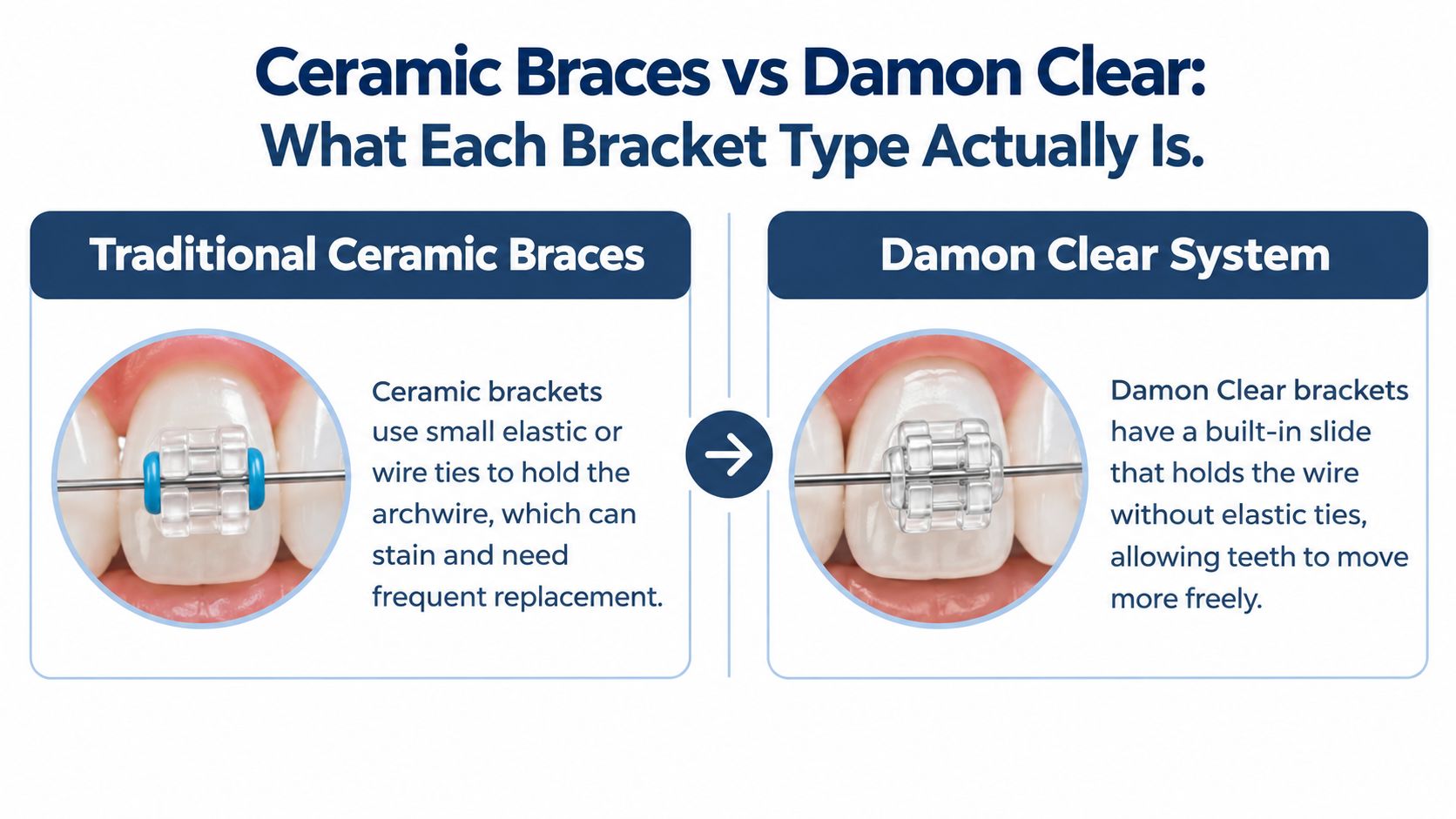
Traditional clear ceramic braces use tooth-colored or translucent ceramic brackets bonded to the teeth. The orthodontist generally secures the archwire with small elastic ties or wire ligatures. Those ties hold the wire in the bracket slot and are changed during appointments.
Damon Clear is a passive self-ligating bracket. Instead of using an elastic tie to hold the archwire, each bracket has an integrated sliding door that secures the wire. That is a mechanical distinction, not a promise of a faster or more comfortable result.
The wire sequence matters
Damon Clear is designed for use with force-calibrated archwires. The manufacturer's protocol specifies that each wire should remain in place long enough to express its programmed shape before the next wire is used. That means the bracket can't be judged separately from the archwire sequence, bracket positioning, wire size, force level, and the movements required.
Conventional ceramic braces also rely on a planned sequence of archwires. The orthodontist chooses wire progression and other mechanics according to the patient's alignment and bite. The presence of elastic ties doesn't make the system unsuitable, just as a sliding door doesn't make Damon Clear automatically superior.
A patient looking for more background on fixed treatment can review types of braces for adults. The important distinction is simple: bracket design affects workflow and wire engagement, while the treatment outcome depends on the complete clinical plan.
Families in North Wilmington, Middletown, Dover/West Dover, and Millsboro can ask to see the bracket options during a free consultation. The orthodontist should be able to explain why a particular combination is appropriate for the patient's movements, not merely repeat that one system is newer or faster.
How they compare on the criteria that matter
The table below gives parents a quick starting point. It isn't a universal ranking because the best choice changes with the patient's bite, habits, and priorities.
Ceramic braces vs Damon Clear at a glance
| Criterion | Conventional clear ceramic braces | Damon Clear |
|---|---|---|
| Appearance | Tooth-colored or clear brackets. Elastic ties may become noticeable or stain between visits. | Clear ceramic brackets with an integrated sliding door and no elastic ligatures. |
| Comfort | Depends on bracket edges, wire changes, tie pressure, and the patient's adjustment response. | Depends on bracket edges, wire changes, door design, and the patient's adjustment response. |
| Treatment time | No reliable universal advantage based on conventional ligation alone. | Self-ligation doesn't reliably shorten total treatment. |
| Hygiene | Fixed brackets and elastic or wire ties require careful brushing and interdental cleaning. | Fixed brackets still require careful cleaning, with no elastic tie around the slot. |
| Breakage and enamel | Ceramic has lower fracture toughness than stainless steel and requires careful removal. | The bracket remains ceramic, so self-ligation doesn't remove ceramic-related fracture or debonding considerations. |
| Cost | Often the more practical ceramic choice when the family wants a discreet fixed appliance. | Typically costs more than conventional ceramic braces because of the bracket system itself. |
Appearance
Both options are less visually prominent than metal braces. Conventional ceramic braces can still show their ligatures, especially when clear ties discolor from foods and drinks. Damon Clear removes one common source of visible staining because the wire is held by the integrated door rather than an elastic tie.
Practical takeaway: If the patient cares most about avoiding colored or stained ligatures, Damon Clear may have an appearance advantage, but the ceramic bracket itself still remains visible at close range.
Comfort
Comfort doesn't come from the brand name alone. Bracket edges, wire ends, the amount of tooth movement, tie pressure, and adjustment visits all influence how treatment feels. A self-ligating door may simplify wire engagement, but clinical evidence doesn't support assuming that it eliminates soreness or guarantees a gentler experience.
Practical takeaway: Ask how the orthodontist expects the specific wire sequence and bite correction to affect comfort, rather than choosing based on “self-ligating” language.
Hygiene
Both appliances are fixed. Patients can't take either one out to brush, floss, or eat, so both require a consistent routine around brackets and wires. Damon Clear avoids elastic ties, but the bracket door, slot, wire, and surrounding tooth surface still need attention.
Practical takeaway: The easier system is the one the patient can clean thoroughly every day, not automatically the one with fewer visible components.
Breakage and enamel
Ceramic brackets can be more brittle than stainless steel brackets. Research also highlights the need for careful ceramic-bracket removal because debonding can affect the enamel surface.
Practical takeaway: A contact-sport athlete or patient with a heavy bite should discuss mouthguards, food restrictions, repair policies, and the practice's removal protocol before selecting a ceramic system.
Cost
Damon Clear typically costs more than conventional ceramic braces because of the bracket system itself. The family should compare the full treatment fee, repair terms, payment options, and insurance contribution rather than focusing only on the initial quoted difference.
Practical takeaway: Ask for the total estimated cost in writing, including what happens if a ceramic bracket comes loose.
What the research actually says about treatment time
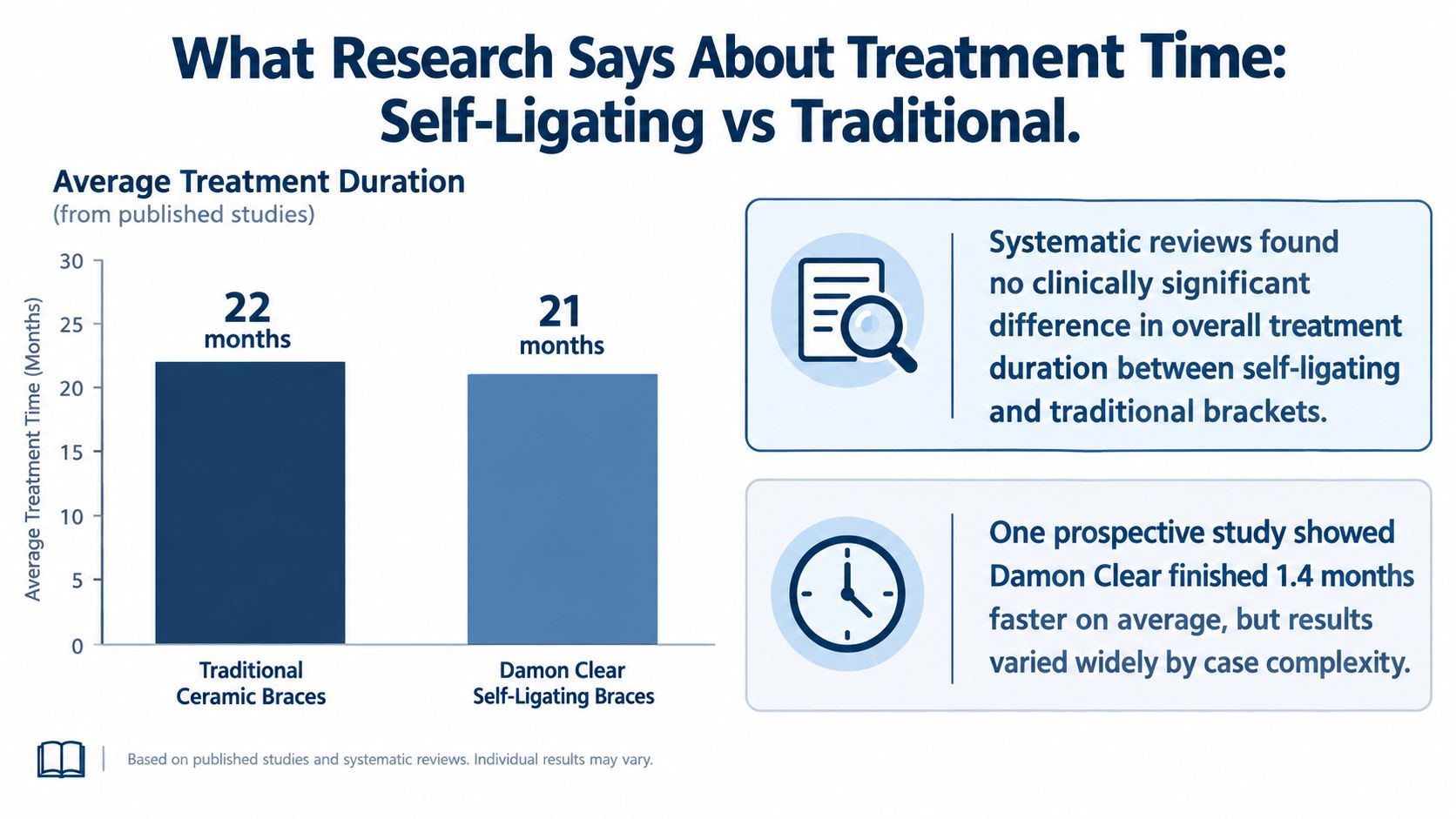
The strongest answer to the “Is Damon Clear faster?” question is not reliably. A systematic review found no significant differences between self-ligating and conventional brackets in pain at 4 hours, 24 hours, 3 days, or 7 days, and it found no significant differences in appointment number or total treatment duration. Another review identified shorter chair time as the clearest supported advantage, while treatment-time and final-occlusion benefits weren't established. That review reported approximately 1.5 degrees less mandibular-incisor proclination with self-ligating systems in pooled analyses, a finding that doesn't translate into a universal finish-date promise. Read the systematic review summary
A prospective comparison reported average treatment times of 20.4 months for self-ligating brackets and 18.2 months for conventional brackets, with no statistically significant difference. The same study reported average visit counts of 15.5 for self-ligating brackets and 14.1 for conventional brackets, again without a statistically significant difference. A separate review and meta-analysis covering 25 trials and 1,321 patients found that self-ligating treatment averaged 2.01 months longer, with a 95% confidence interval of 0.45 to 3.57 months. Review the clinical comparison and meta-analysis
Why friction doesn't settle the question
Laboratory friction measurements can be useful, but they don't directly predict total treatment time or clinical outcomes. In an in-vitro comparison of esthetic self-ligating brackets, Damon Clear generated the highest kinetic friction among the tested systems across multiple archwire dimensions and material types. Ceramic brackets also tend to create more friction than metal brackets because their rougher surfaces can bind orthodontic wires more readily. Review the in-vitro friction comparison
Another ceramic-bracket comparison found substantial mechanical variation among designs. Monocrystalline ceramic brackets generated the highest resistance to sliding, and adding a metal slot to polycrystalline brackets didn't significantly reduce friction in that testing. The authors noted that ceramic resistance could theoretically absorb up to 60% of applied movement force, but laboratory friction still doesn't establish a patient's actual treatment duration. Review the ceramic bracket friction research
The practical conclusion is direct. Treatment time comes from the bite and the plan, including malocclusion severity, extractions, growth, cooperation, appointment attendance, wire progression, and finishing needs. A consultation should produce an estimate based on those factors, not a promise based on the word “self-ligating.”
Which option tends to fit which Delaware family
The right choice becomes easier when the family describes daily life instead of asking which bracket wins in general.
The Brandywine Valley teen athlete
A teenager who plays contact sports may want clear brackets, but the more important question is impact management. Ceramic brackets have lower fracture toughness than stainless steel designs, so the family should discuss a properly fitted mouthguard, practice rules for contact, food restrictions, and what happens if a bracket fractures.
That teen may still be a candidate for ceramic braces or Damon Clear. The decision should depend on the bite, sports schedule, cleaning habits, and the orthodontist's approach to repairs and eventual debonding. A clear bracket that matches the appearance goal isn't automatically the safest choice if the patient won't use the mouthguard or protect the appliance.

The Dover-area adult professional
An adult who meets clients or appears on video calls may prefer a discreet fixed appliance. Damon Clear's lack of elastic ligatures can appeal to someone who wants fewer visible tie changes, particularly if appearance is a daily concern.
That preference doesn't make Damon Clear the automatic recommendation. The orthodontist still needs to assess the bite, required movements, hygiene routine, and budget. A conventional ceramic system may provide the needed mechanics while meeting the patient's appearance goals, especially if the adult accepts the need to manage ligature staining.
The Sussex County Medicaid family
For a family seeking affordable care for a child under 21, the first priority may be access and coverage rather than a premium bracket system. Conventional clear ceramic braces may be the more practical fit if the family wants a discreet fixed appliance and the treatment plan supports it.
Stellar Orthodontics accepts all three Delaware Medicaid plans, AmeriHealth Caritas Delaware, Highmark Health Options, and Delaware First Health, along with CHIP. The family should confirm eligibility, covered treatment, any patient responsibility, and whether the selected bracket system changes the out-of-pocket cost.
The rule of thumb is straightforward: match the bracket to the bite, the lifestyle, and the budget. The orthodontist should recommend the mechanics after evaluating the patient, not after hearing only which bracket looks more appealing.
Maintenance, daily care, and what to ask at your visit
Fixed ceramic braces and Damon Clear both require discipline. Neither option offers the removability of an aligner, so food and plaque can collect around the brackets, archwire, gumline, and contact points if the patient rushes through brushing.
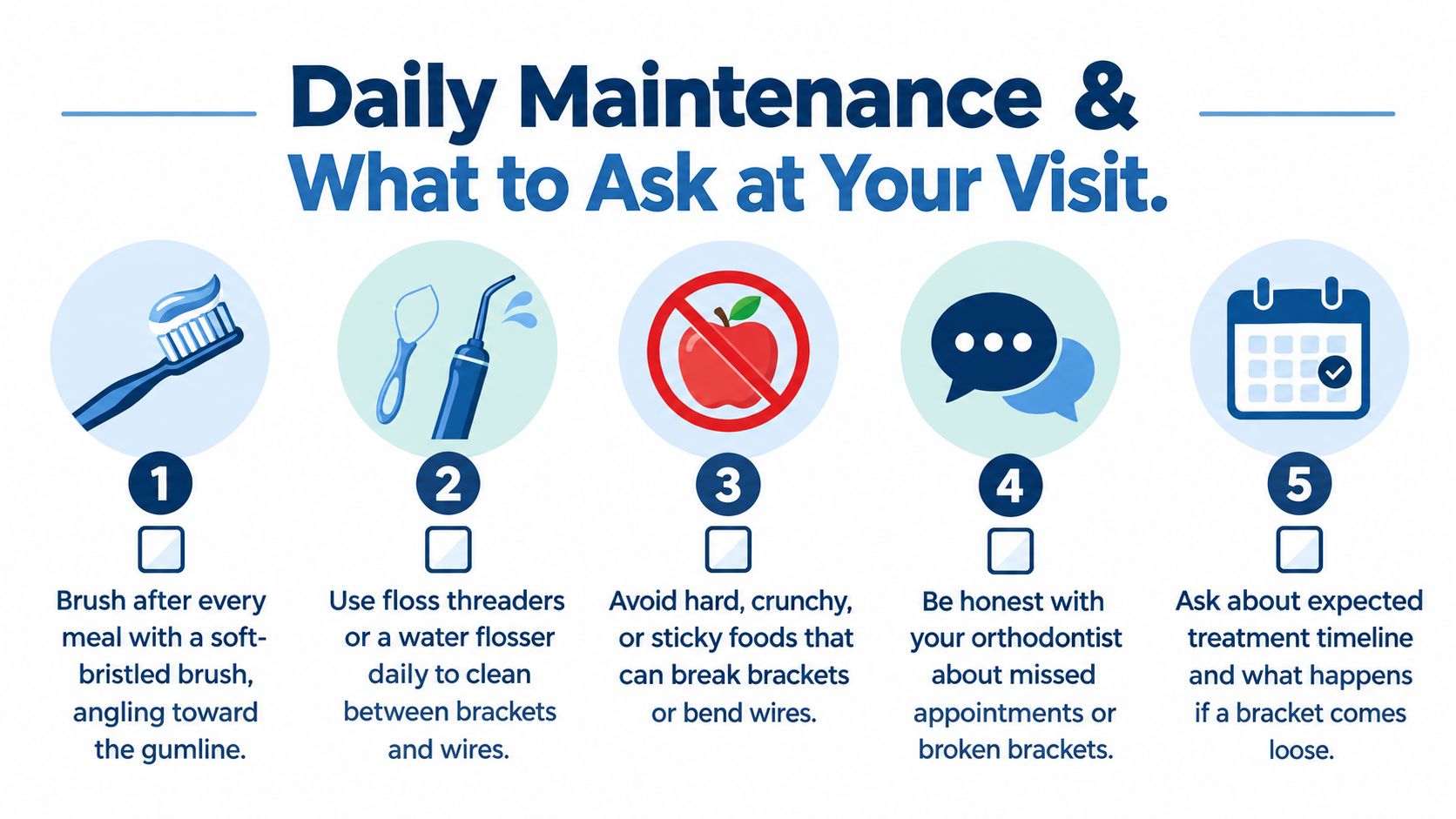
A workable routine includes brushing after meals with a soft-bristled brush, angling the bristles toward the gumline and around each bracket. A floss threader or water flosser can help clean below the wire and between teeth. Hard, crunchy, and sticky foods can break brackets or bend wires, so patients should follow the orthodontist's specific food instructions.
Details that differ by system
Conventional ceramic braces require a conversation about ligature staining. Coffee, tea, curry, and strongly colored foods can affect the appearance of clear or light-colored ties. The ceramic bracket itself isn't the only visual factor, and the orthodontist may discuss tie color and replacement during appointments.
Damon Clear has no elastic ligature around the slot, but the sliding door and wire still need careful cleaning. The wire sequence also matters because the system is designed around force-calibrated archwires used in a planned progression. Ceramic brackets in either system require careful attention to breakage and enamel-safe debonding.
Families can bring this checklist to a consultation at North Wilmington, Middletown, Dover/West Dover, or Millsboro:
- Bracket and wire combination: Which system and archwire sequence fit the patient's bite?
- Appointment cadence: How often should visits occur, and what happens after a missed visit?
- Breakage policy: What fee or repair process applies if a ceramic bracket comes loose?
- Total estimated cost: Does the estimate include repairs, retainers, and finishing?
- Payment options: Are flexible monthly plans available, including $0 down?
- Coverage: Which dental insurance and Medicaid plans are accepted?
More home-care guidance is available in this practical guide to taking care of ceramic braces. The central habit remains the same: clean thoroughly, protect the brackets, and tell the orthodontist promptly about damage or persistent irritation.
How to choose without second-guessing yourself
A parent can make the decision in three filters.
First, start with the bite. The movements required, the complexity of the malocclusion, and the finishing details matter more than the bracket label. Damon Clear's mechanism may suit one plan, while conventional ceramic braces may suit another.
Second, assess daily life. A careful teen who wants fewer visible ligatures may lean toward Damon Clear. A contact-sport athlete or patient at higher risk of ceramic breakage may need a more detailed discussion about protection and durability. Neither system works well if the patient won't clean around fixed brackets.
Third, confirm the budget and coverage. Families should compare total costs, repair terms, insurance benefits, Medicaid eligibility, and monthly payment options. The same family could reasonably choose conventional ceramic braces for one child and Damon Clear for another because the treatment needs and priorities differ.
Stellar Orthodontics offers free consultations at North Wilmington, Middletown, Dover/West Dover, and Millsboro, with iTero digital 3D scanning for treatment planning. The practice accepts most major dental insurance and offers flexible monthly payment plans. A consultation lets families see the bracket options, ask about the wire system, and receive an estimate tied to the actual bite.
Quick answers parents ask at the front desk
Will Damon Clear stain like other clear braces? The ceramic bracket doesn't behave like an elastic ligature. Conventional clear ties can discolor, while Damon Clear's integrated door removes that usual tie-related concern.
Is Damon Clear faster than regular ceramic braces? Not reliably. Clinical reviews and comparisons don't support a universal reduction in total treatment time based only on self-ligation.
Which option is easier to keep clean? Neither is removable. Damon Clear avoids an elastic tie around the slot, but both systems still require careful brushing and interdental cleaning.
Does insurance or Medicaid cover Damon Clear the same as ceramic braces? Coverage is typically based on medical necessity and treatment coding, not the brand alone. Stellar Orthodontics accepts most major dental insurance, all three Delaware Medicaid plans, and CHIP. A free consultation can clarify the individual answer.
Families comparing ceramic braces vs Damon Clear don't need a louder marketing claim. They need a bracket recommendation tied to the patient's bite, habits, appearance goals, and budget. Visit Stellar Orthodontics to book a free consultation at North Wilmington, Middletown, Dover/West Dover, or Millsboro and discuss clear ceramic braces, Damon Clear, iTero scanning, insurance, and payment options.