.png)
An adult in Delaware may spend weeks comparing braces online, only to stop at the same question: how can treatment fit the budget without insurance? The concern is understandable. Orthodontic care is a significant purchase, and the advertised monthly payment rarely tells the full story.
The practical answer isn't to chase the smallest number on an advertisement. Affordable braces for adults without insurance usually come from matching the appliance to the clinical need, comparing the complete treatment fee, and choosing a payment plan that doesn't create surprises. Metal braces may offer the strongest value for many cases, while ceramic braces or clear aligners can make sense when appearance matters more.
Published U.S. fee data places complete adult treatment roughly between $3,000 and $10,000, depending on complexity and appliance type, with many uninsured adults planning around the middle of that range. The absence of insurance generally means the patient pays the full orthodontic fee instead of receiving an insurer-negotiated discount, so the listed treatment price becomes the out-of-pocket starting point. CareCredit's braces cost guide explains the national averages and the factors behind them.
A sensible plan starts with a consultation, not a coupon. The orthodontic team needs to determine whether the concern involves straightforward crowding, spacing, or a more involved bite correction. From there, the patient can compare metal braces, ceramic braces, and clear aligners, then ask how retainers, adjustments, diagnostics, refinements, and extended treatment are handled.
Stellar Orthodontics offers free consultations at locations serving North Wilmington, Middletown, Dover and West Dover, and Millsboro. A consultation can give an adult a clearer price, treatment recommendation, and payment discussion before any decision is made.
Table of Contents
- Introduction to affordable braces for adults without insurance
- How much braces cost for adults without insurance
- How to compare quotes and payment plans wisely
- Practical ways to lower your out-of-pocket cost safely
- What Delaware adults should know about Medicaid and eligibility
- Your next steps to affordable treatment in Delaware
Introduction to affordable braces for adults without insurance
An adult may want straighter front teeth before a professional change, feel more confident, or address a bite that has bothered them for years. Seeing the possible fee can make treatment seem out of reach, especially without orthodontic insurance. The practical answer is to choose the right appliance and build a payment plan around the complete treatment cost, not chase the lowest monthly figure.
“Cheap” should mean smart value. A responsible plan includes an appropriate diagnosis, professional supervision, a realistic treatment goal, and a clearly stated total fee. A very low advertised price may exclude imaging, retainers, refinements, or care for problems caused by unsupervised tooth movement.
What uninsured adults are actually paying for
Orthodontic treatment is a course of care, not a single product. The fee may cover the examination, treatment planning, appliance placement, scheduled adjustments or checks, and retention planning. In Delaware, ask the office to list every inclusion and possible extra before you agree to treatment.
Adults may pay a similar base fee to younger patients when the appliance and treatment goal are comparable. Age alone usually isn't the main price driver. Case complexity, appliance type, and the supervision required have more influence on the final fee.
Published national averages show why appliance choice matters. Metal braces average about $6,343, ceramic braces about $5,834, clear aligners about $5,108, and lingual braces about $9,221, according to national adult braces pricing data. These figures are budgeting guidelines, not a Delaware treatment quote.
A safer way to think about affordability
Start with three questions:
- What result does the case require? Mild crowding may need a different plan from bite correction.
- Which appliance can achieve that result efficiently? Traditional metal braces are often the value-focused choice, while lingual treatment carries a much higher average fee.
- What will the patient pay in total? A small monthly payment may come with a larger down payment, interest, or additional charges.
Ask whether retainers, adjustments, diagnostics, refinements, and extended treatment are included. Then compare the total fee, financing terms, and appliance recommendation together. That approach helps Delaware adults avoid a cheap-looking plan that costs more later and choose supervised care that fits the household budget.
How much braces cost for adults without insurance
An adult in Delaware comparing quotes may see a metal-braces plan near the lower end of the market and a hidden appliance priced much higher. That gap reflects appliance choice, case complexity, and the financing plan, not age alone. National figures help with budgeting, but they are not a guaranteed Delaware fee.
Lingual braces, placed behind the teeth, average about $9,221, while metal braces average about $6,343, according to this adult braces price comparison. The difference can affect whether treatment fits comfortably into a household budget or requires a longer payment schedule.
Average adult braces cost by appliance type
| Appliance type | National average fee | Best for |
|---|---|---|
| Metal braces | About $6,343 | Adults prioritizing value and broad treatment capability |
| Ceramic braces | About $5,834 | Adults seeking a less noticeable fixed appliance |
| Clear aligners | About $5,108 | Adults whose case is suitable for removable trays and who can follow the wear plan |
| Lingual braces | About $9,221 | Adults who place a high priority on appliances hidden behind the teeth |
These figures come from published U.S. orthodontic fee data. Use them to compare appliance categories, not to predict a specific office's quote. A clear-aligner plan may cost more or less than braces after an orthodontist reviews the bite, tooth movement, and treatment goals.
Complexity matters more than age
Mild alignment concerns usually require a different plan from bite correction. More involved movement can require closer monitoring, additional planning, or refinements. The quote should state how those possibilities affect the total fee.
For a full adult course without insurance, a practical planning band is about $3,000 to $8,000, with complex or specialized treatment reaching higher, as explained in a 2026 cost guide for treatment without insurance. Treat that range as a starting point for questions, not a promise of treatment cost.
Practical rule: Choose the least expensive appliance that can safely meet the treatment goal, then build a financing plan around the total fee. The lowest monthly payment is not automatically the cheapest option.
Before accepting a quote, confirm whether it includes records, routine visits, retainers, emergency repairs, and refinements. Ask for the amount due before treatment, the remaining payment schedule, and any interest or added charges. A Delaware consultation can then connect the appliance recommendation with a realistic budget, instead of forcing you to choose based on one monthly figure.
How to compare quotes and payment plans wisely
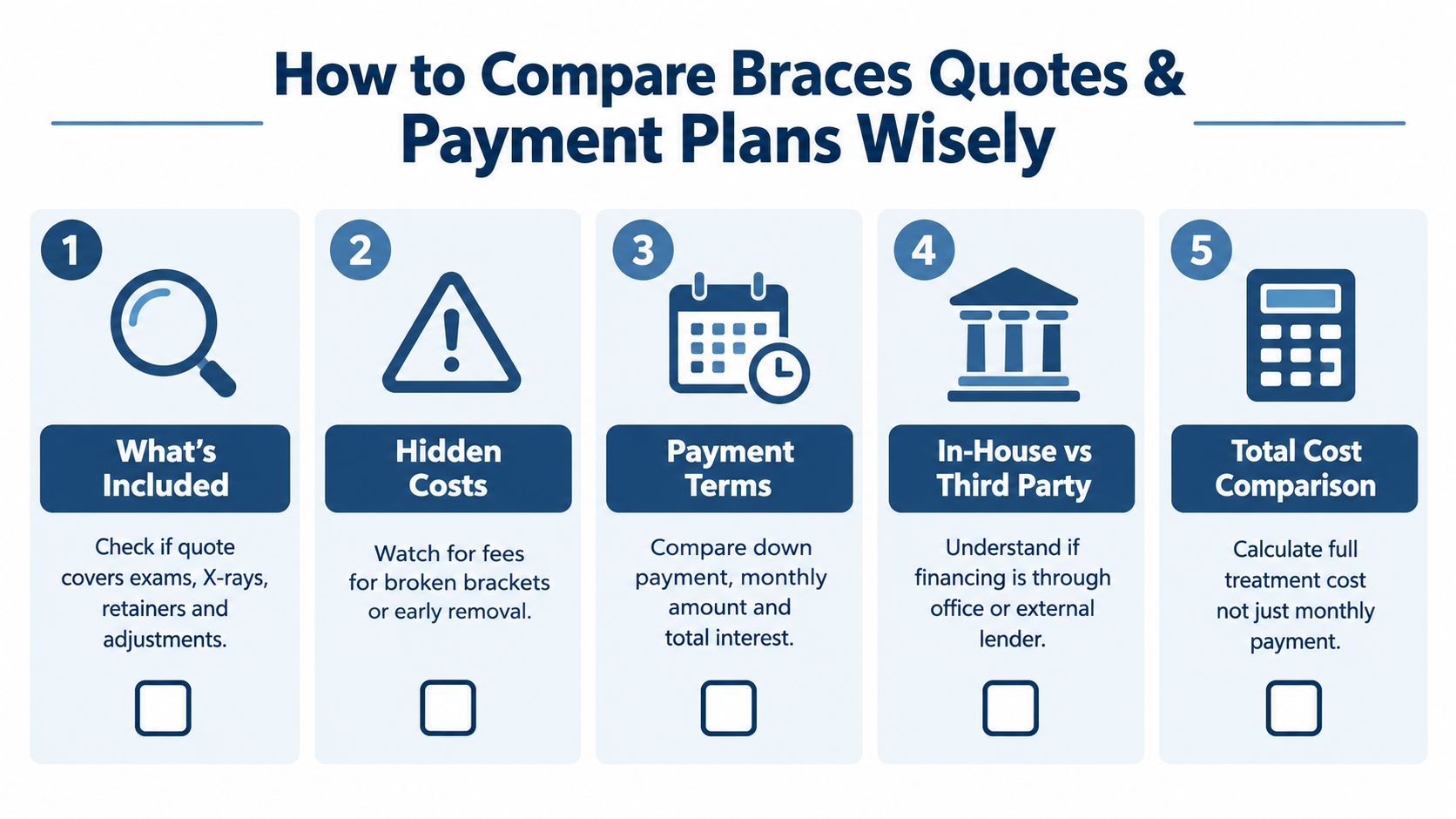
A quote helps only when it shows the full financial commitment. Do not compare one office's monthly payment with another office's total fee. A smaller monthly figure may require a larger initial payment, include interest, or leave out retainers and other services.
Request an itemized treatment estimate in writing. It should name the recommended appliance, expected treatment scope, total fee, amount due before treatment, and schedule for remaining payments. It should also state how additional visits, refinements, or treatment delays affect the balance.
Questions that belong at the consultation
A productive consultation should answer practical cost questions, not just present a projected monthly amount.
- What's included? Ask whether the fee covers the examination, diagnostic records, imaging, appliance, adjustments, retainers, and refinements.
- What could cost extra? Confirm charges for broken brackets, lost aligners, replacement retainers, missed visits, and early removal.
- What happens if treatment takes longer? Ask whether an extension changes the fee and which circumstances trigger an additional charge.
- Are payments interest-free? A low monthly amount can still produce a higher final balance when interest applies.
- Who provides the financing? In-office plans and outside financing may have different approval rules, terms, and consequences.
Ask whether payments continue throughout treatment or follow a separate fixed schedule. That detail affects your budget if treatment finishes early, takes longer, or requires refinements. Appliance choice and financing belong in the same conversation. Selecting metal braces, ceramic braces, or aligners based only on the monthly payment can leave you with the wrong total cost.
Compare the total, then compare the terms
Use a worksheet with four lines for every consultation:
- Total treatment fee.
- Initial payment.
- Monthly payment and number of payments.
- Items excluded from the fee.
This format exposes the actual obligation before you commit. Review any available orthodontic benefit, even when coverage appears limited. Adult coverage rules vary, and a benefit may reduce the balance without paying for the entire course of treatment. Delaware adults should ask the office to verify benefits and explain exactly how the allowance applies to the recommended appliance.
Payment arrangements are a normal part of orthodontic consultations. Compare the appliance recommendation, total fee, down payment, installment schedule, interest, and included care together. Review the Stellar Orthodontics payment plan information, then bring specific questions to a Delaware orthodontic consultation. The right plan makes the treatment affordable without choosing an appliance solely because its advertised monthly payment looks lowest.
Practical ways to lower your out-of-pocket cost safely
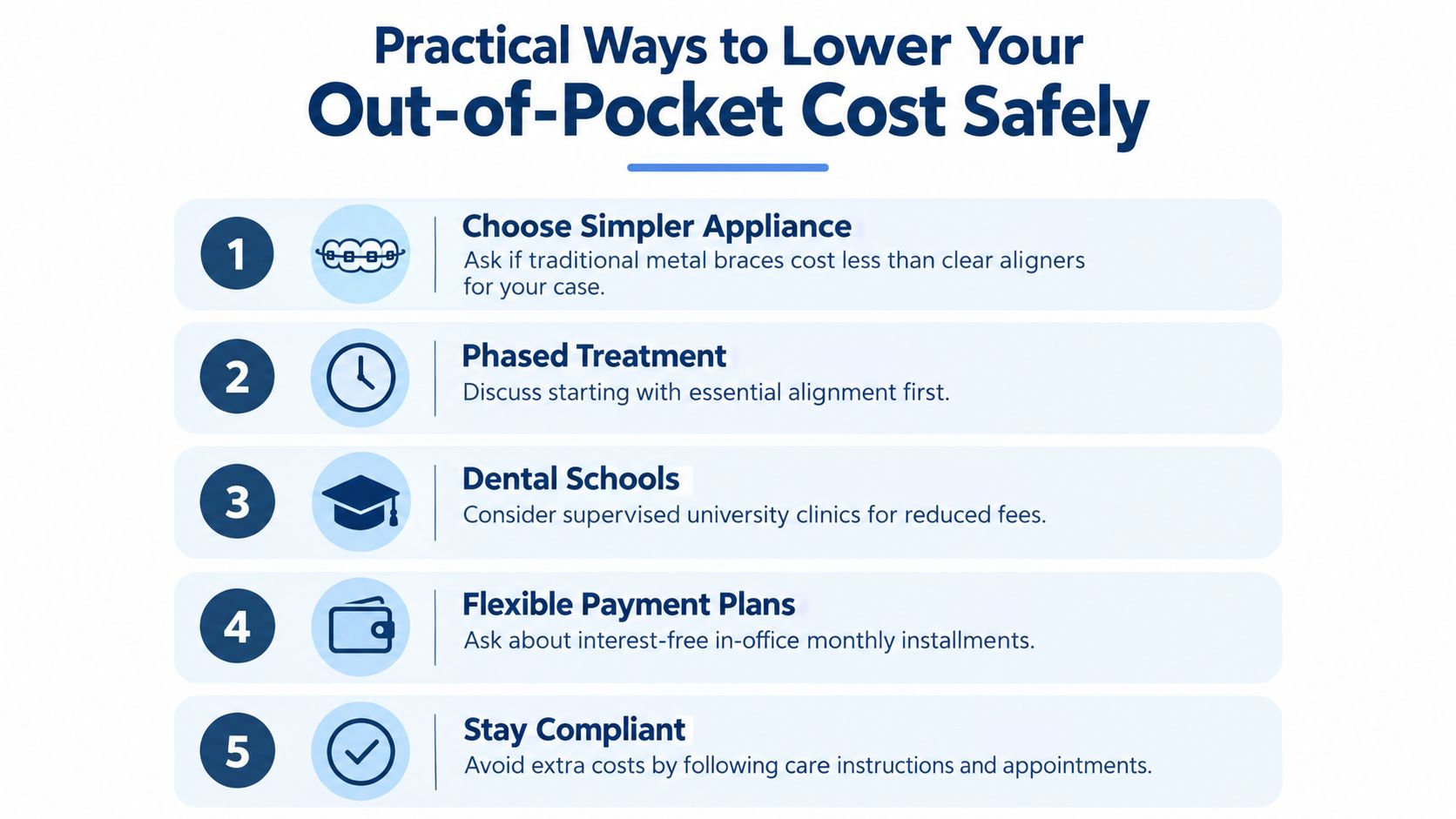
A Delaware adult comparing braces should choose the appliance and payment strategy together. The lowest monthly payment can hide a longer schedule, added refinements, or fees for care outside the basic plan. Savings should come from a suitable treatment design and clear supervision, not from cutting out needed orthodontic checks.
Choose the simplest suitable appliance
Traditional metal braces are usually the first option to discuss when controlling cost matters. Ceramic braces can provide a less noticeable appearance, while clear aligners may offer convenience and easier removal. Each option can change the total fee, and aligners fit only cases that can be planned and monitored safely.
Ask whether a mixed appliance plan could meet your goals. Ceramic brackets on the upper teeth with metal brackets on the lower teeth may balance appearance and price. The right choice depends on the movements required, the expected treatment course, and what the quoted fee includes. Do not select an appliance only because its advertised monthly payment is lower.
Use phased care and tax-advantaged funds carefully
Some adults can discuss a phased plan when the immediate goal is limited and the orthodontist confirms that delaying other corrections will not create a clinical problem. Phasing does not automatically reduce the total cost. Before starting, ask for the projected cost of the full plan, not just the first stage, and confirm what could change later.
Tax-advantaged accounts may let working adults use pre-tax funds for eligible medical expenses. Account rules and personal circumstances determine the actual benefit. Confirm eligibility with the account administrator or a tax professional before including those funds in your budget.
Avoid unsupervised aligner shortcuts
Mail-order or at-home aligners may appear less expensive at the start, but they provide less direct clinical supervision. Problems can include gum recession, loose teeth, open bite, and root resorption. This clinical risk overview of mail-order aligners explains why correcting a poorly controlled result can cost more than supervised care from the beginning.
Safety comes before the discount: A lower price is not a bargain if you later need corrective orthodontic treatment.
A supervised plan should include appropriate diagnostic imaging, staged tooth movement, and periodic assessment. The affordable choice is a simpler safe plan that fits the diagnosis, not a plan that removes clinical checks.
Dental-school clinics can offer a lower-cost route for adults with flexible schedules who accept a teaching environment. Care remains supervised, but appointments may take longer to arrange, and the clinic may not provide every appliance or treatment pathway. Compare the complete fee, expected wait, travel needs, and scope of care before choosing this option.
The guide to affordable adult braces pathways also discusses appliance choices, phased options, and dental-school care. Use those points to prepare questions, then confirm the recommendation and full cost with a licensed orthodontic team.
What Delaware adults should know about Medicaid and eligibility
Delaware adults often assume Medicaid will cover braces because children and teens may qualify under different rules. That assumption can create a frustrating delay. Adult orthodontic coverage in Delaware is very limited and generally exception-based, so an adult without private orthodontic insurance should prepare to discuss private-pay pricing and payment options.
Delaware Medicaid orthodontic coverage is generally limited to patients under 21 enrolled in DSHP or CHIP who meet medical-necessity requirements. Eligibility may involve a qualifying HLD Index score or an auto-qualifying condition, rather than a preference for straighter teeth alone. The Delaware Medicaid orthodontic eligibility guidance outlines the distinction between coverage for younger patients and the limited pathway for adults.

Why age changes the conversation
A child or teen who meets the program's requirements may have a coverage route that isn't available to an adult with the same cosmetic concern. For an adult, Medicaid approval generally requires an exception tied to medical necessity. The patient shouldn't assume that enrollment alone guarantees orthodontic benefits.
Families should ask the orthodontic office to verify the patient's eligibility and benefit details before making financial plans. Coverage can depend on age, enrollment, documentation, and the clinical condition being treated. A consultation can clarify whether the case appears to fall within a covered pathway or whether private-pay planning makes more sense.
Planning for private-pay care
Adults who aren't covered should request a complete quote and ask about monthly payment options. The most useful discussion compares the recommended appliance with a lower-cost appliance that can still meet the treatment goal. That approach gives the patient a real choice instead of forcing a decision between unaffordable treatment and an unsupervised shortcut.
Stellar Orthodontics serves patients in North Wilmington, Middletown, West Dover, and Millsboro. Those locations give adults across the Brandywine Valley, MOT corridor, Kent County, and Sussex County a practical place to ask about diagnosis, appliance selection, and payment terms.
Your next steps to affordable treatment in Delaware
Affordable orthodontic treatment starts with a decision sequence. First, establish a realistic price band for the type of care being considered. Then determine whether the case is straightforward alignment, bite correction, or something more involved. The diagnosis should guide the appliance choice, not the other way around.
Next, compare complete treatment fees. The quote should identify what's included, how retainers are handled, whether refinements carry a charge, and what happens if the planned course takes longer. The payment plan should be judged by its total obligation, down payment, interest, and timing, not by the monthly figure alone.
A patient who prioritizes value will usually ask about traditional metal braces first, then compare ceramic braces or clear aligners if appearance or daily convenience is important. Supervised care remains essential, especially when aligners are being considered. A lower entry price doesn't justify giving up diagnostic imaging or professional monitoring.
A free consultation can make the next decision much easier. Stellar Orthodontics offers free consultations with iTero digital scanning, flexible monthly payment plans with $0 down, and four Delaware locations in North Wilmington, Middletown, West Dover, and Millsboro. Adults can use the visit to receive a personalized treatment recommendation, review the complete fee, and ask which appliance offers the best balance between cost and appearance.
Adults looking for affordable braces without insurance can visit Stellar Orthodontics to schedule a free consultation, review iTero digital scanning, and discuss metal braces, ceramic braces, or clear aligners. The team can also explain the full treatment fee and flexible monthly payment options with $0 down at locations in North Wilmington, Middletown, West Dover, and Millsboro.