
If clear braces and ceramic braces often mean the same thing, what should a family compare? The useful distinction is not just how an appliance looks. It's whether treatment uses fixed brackets or removable trays, which tooth movements are needed, and how comfortably the patient can manage daily care.
For Delaware parents and adults searching for clear braces vs ceramic braces, understanding the names first can prevent a confusing comparison. A less noticeable appliance may be appealing, but appearance alone doesn't explain treatment control, repair needs, or the responsibilities that come with it.
Table of Contents
- Clear Braces, Ceramic Braces and Clear Aligners Compared
- How Bracket Materials Shape Looks and Durability
- Keeping Teeth Clean During Treatment
- Which Treatment Situations Fit Each Option
- Comfort, Repairs and Daily Life With Each Option
- Costs, Coverage and Your Next Step
Clear Braces, Ceramic Braces and Clear Aligners Compared
Walk into a consultation asking for "clear braces" and you could mean either of two quite different appliances. Clear braces usually refers to ceramic braces, a fixed appliance in the same family as metal braces, while clear aligners are removable plastic trays worn on a schedule. The goal is the same; the mechanics and the daily responsibilities are not.
The three options at a glance
| Option | What it is | Removable? | Typical treatment time |
|---|---|---|---|
| Clear ceramic braces | Fixed braces with tooth-colored ceramic brackets | No, bonded until treatment ends | Most braces cases finish in 18 to 30 months |
| Classic metal braces | Fixed braces with metal brackets | No, bonded until treatment ends | Most braces cases finish in 18 to 30 months |
| Clear aligners (Invisalign) | Series of removable clear plastic trays | Yes, on a prescribed daily wear schedule | Planned after the exam and digital scan |
The ceramic row describes the bracket material. Tooth-colored or translucent brackets blend with the teeth, but they stay bonded in place and a wire still connects them to guide movement. The metal row describes the same fixed approach with a different bracket material. Both need professional adjustments and careful cleaning around the attached components. Clear ceramic braces and traditional metal braces are equally effective for appropriately selected treatment plans, so aesthetics and budget help guide the choice.
The key distinction: Bracket material is mainly an appearance and materials decision. Fixed braces versus removable aligners changes how treatment works and how much it relies on daily wear habits.
Where the names blur
"Clear" gets used loosely. Families apply it to tooth-colored brackets, transparent trays, and plastic brackets, which are three separate products with different care instructions. Invisalign is an aligner system, and the explanation of what Invisalign is and how it works helps families match a name to the product they have in mind. Asking for "the clear option" is a reasonable way to start a conversation. The consultation is where the term gets pinned down to one appliance.
Why appearance doesn't predict timing
Removability reshapes the everyday routine: meals, cleaning, storage, and who is responsible for wear time. Treatment length follows the tooth movements required, so a discreet-looking appliance can still run a year and a half.
A systematic review of complicated orthodontic cases included six clinical studies and 283 patients and found that both aligners and fixed appliances could effectively treat premolar-extraction cases, though fixed appliances produced shorter treatment durations in those cases. That compares treatment systems, not ceramic brackets against metal brackets.
Crowding, bite severity, extraction needs, growth, and cooperation all feed into the plan. Digital records show how teeth and roots need to move, including problems that never show up in a smile photo.
An adult may notice one crooked front tooth while the orthodontist also finds a bite problem farther back. The appliance has to solve the whole problem, which is why case fit is settled before appearance. Stellar Orthodontics offers clear ceramic braces, classic metal braces, and Invisalign for teens and adults, so that comparison can happen in a single visit.
How Bracket Materials Shape Looks and Durability
Bracket color decides what a parent notices in a school photo. Bracket material decides how the appliance handles staining, breakage, and sliding along the wire. Treat those as two separate questions, because the option that wins on the first may not win on the second.
Bracket materials compared
| Bracket type | Visibility | Staining | Fracture resistance | Friction with metal wire |
|---|---|---|---|---|
| Classic metal | Most visible | Metal brackets don't stain | High | Lower |
| Tooth-colored ceramic | Lower-profile appearance | Resists staining better than plastic | More brittle than metal | Higher than metal |
| Plastic or composite clear | Low to moderate | Stains more readily | Depends on the specific bracket design | Depends on the specific material and wire combination |
A review of orthodontic bracket materials describes ceramic brackets as less visible and more stain-resistant than plastic brackets, but also more brittle and associated with greater friction against metal archwires. Those differences shape both the bracket the orthodontist orders and the mechanics used to move teeth.
What the material changes
Ceramic refers to the tooth-colored bracket itself. The archwire, the ligatures that tie it in, and any elastics stay visible, so a patient gets a reduced profile rather than an invisible appliance. The color match is what does the work: each bracket blends toward enamel instead of reflecting light like polished metal.
Plastic or composite clear brackets can look nearly identical to ceramic in a photograph while behaving differently in the mouth. A family comparing two estimates should ask which material each quote includes, since the word “clear” covers more than one product.
Friction causes a lot of confusion in consultations. The archwire works like a track, and each bracket rides along it like a small carriage. Some tooth movements require that carriage to slide a measurable distance. A rougher interface between bracket and wire makes the slide harder to control, so the orthodontist adjusts force levels or selects a different bracket for that part of the plan.
None of this makes every ceramic case slower. It means the appliance and the mechanics get matched to the planned movement instead of assuming all fixed brackets behave alike.
Why repair habits belong in the decision
A fractured bracket costs more than the part. It costs an extra visit, a replacement, and a rearranged school or work day. Even when two treatment fees land close together, the practical burden of fitting in a repair still counts.
For a teenager with significant crowding, extraction needs, or a season of contact sports, durability deserves its own conversation. Ceramic brackets are built to handle ordinary orthodontic forces; their brittleness becomes relevant when a bracket takes a direct hit. A mouthguard and a quick call after any impact keep small damage from turning into a lost month.
Three questions worth asking at the consultation:
- Material: Which bracket material is recommended here, and what makes it the better fit?
- Mechanics: Will the planned tooth movements make ceramic brackets a poorer match?
- Repairs: How are fractured brackets handled, and what should the family do between noticing damage and being seen?
Discreet treatment is a reasonable priority. Pairing it with a clear picture of maintenance is what keeps the result on schedule.
Keeping Teeth Clean During Treatment
Cleaning access differs more than bracket color. Ceramic brackets, wires, and ligatures create spaces where plaque can collect, so brushing needs to reach above, below, and beside each attachment.
The illustration highlights how fixed appliances and removable trays change the cleaning routine.
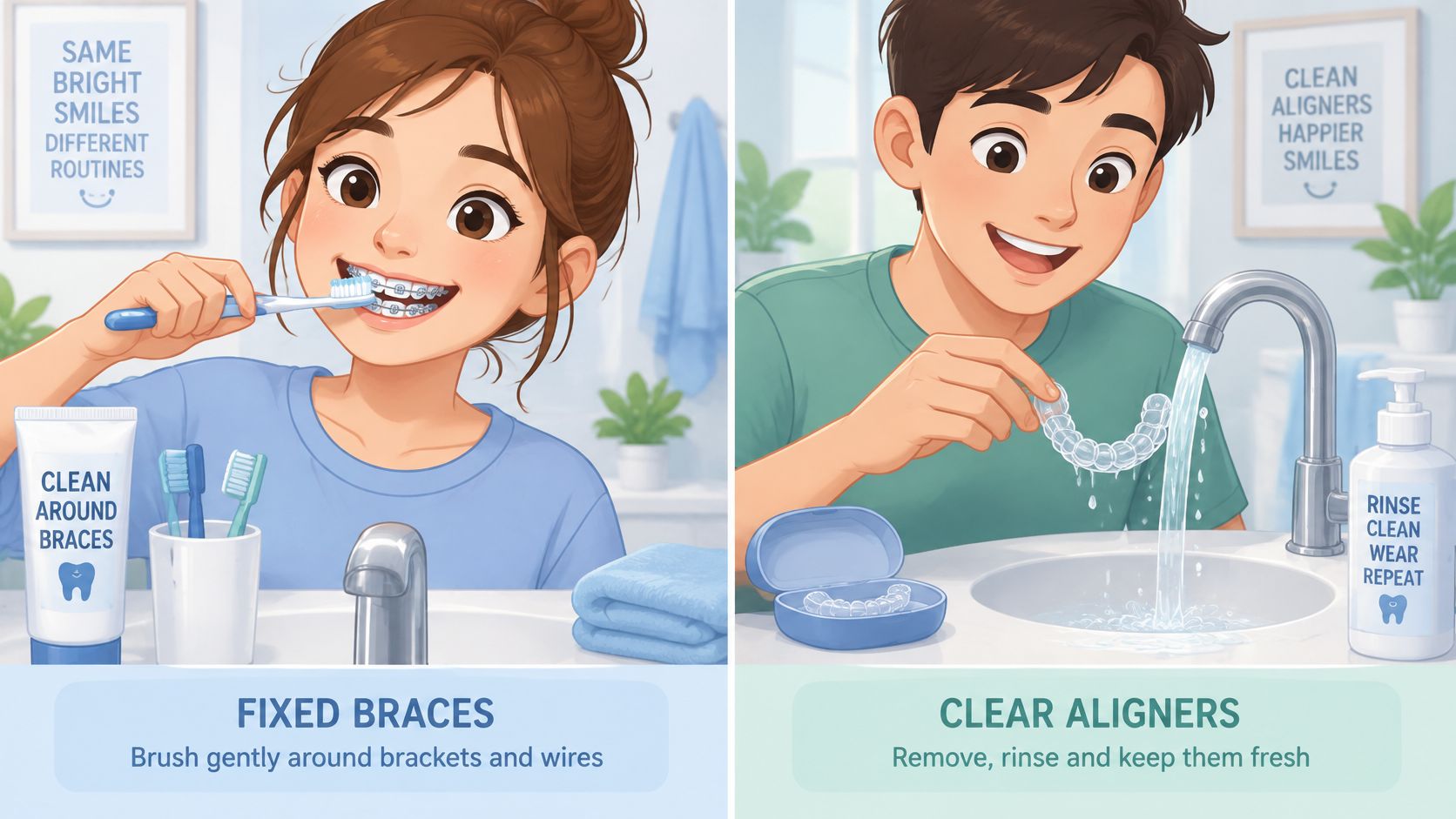
A meta-analysis of eight studies on oral hygiene during orthodontic treatment found lower plaque accumulation with clear aligners at three, six, and twelve months. Removable trays allow direct access for brushing and flossing, but that advantage still requires consistent cleaning.
A practical routine for ceramic braces
A soft toothbrush and an appropriately sized interdental brush help reach areas that a quick pass over the teeth misses. The care team can demonstrate positioning so the bristles clean the tooth surfaces rather than merely touching the brackets.
- Brush after every meal or snack. Remove food around attachments and along the gumline instead of leaving it there until bedtime.
- Clean around each bracket and under the wire. An interdental brush can reach narrow spaces without forcing or bending the wire.
- Floss daily with a threader. Guide the floss under the archwire, then clean gently against the sides of adjacent teeth.
- Use fluoride toothpaste as directed. Fluoride supports enamel protection, but it doesn't replace thorough plaque removal.
- Keep dental checkups and orthodontic visits. Routine dental care and appliance monitoring serve different purposes, and both remain important.
The guide to taking care of ceramic braces provides additional help with everyday maintenance. Parents can support younger patients by checking technique rather than assuming that time spent holding a toothbrush equals effective cleaning.
The following video offers another way to review orthodontic care.
What white spots mean
White-spot lesions are early enamel-demineralization marks associated with plaque and acid exposure. They're a prevention issue to discuss, not a reason to assume orthodontic treatment should be avoided.
Neither appliance eliminates this risk. With aligners, teeth need cleaning before trays return to the mouth; with braces, plaque must be removed around fixed components. Diet, fluoride exposure, brushing technique, and attendance at preventive visits all help determine the outcome.
Which Treatment Situations Fit Each Option
Which option often fits each situation
| Situation | Often a better fit | Why it matters |
|---|---|---|
| Mild to moderate alignment, patient can wear trays reliably | Clear aligners or ceramic braces | Aligners work for most mild to moderate cases |
| Severe crowding or complex bite | Fixed braces, ceramic or metal | Fixed brackets give the orthodontist control over detailed movement |
| Spaces from extracted teeth and detailed root control | Fixed braces | Closing a space moves the whole tooth, root included |
| Teen unlikely to follow the prescribed aligner wear schedule | Fixed braces | Brackets stay on without daily reinsertion |
| Active teen in sports with impact risk | Metal braces, or ceramic after discussing impact risk | Ceramic brackets are more brittle than metal |
The table is a starting point for discussion. An orthodontist has to look at the bite, tooth positions, roots, oral health, and treatment goals before confirming which row describes a particular patient.
A systematic review of 15 trials involving 1,084 patients compared aligners with fixed appliances. In non-extraction cases, the two approaches produced broadly similar treatment quality and duration. In extraction cases, fixed appliances came out ahead on quality. Closing an extraction space asks for precise root control and movement of the entire tooth, root as well as crown, and that is where a wire-and-bracket system does its best work.
Matching mechanics to the problem
A fixed appliance maintains a continuous, three-dimensional force system. The wire keeps pushing between visits, and the orthodontist adjusts it at each appointment. An aligner works in stages instead, holding one shape for a couple of weeks before handing off to the next tray in the sequence. Both deliver orthodontic force. They differ in who does the adjusting and how often.
Take an adult with mild front-tooth crowding and a routine that supports reliable tray wear. Clear aligners may be reasonable here. Ceramic braces may suit just as well if the adult would rather not manage removable trays at meals and bedtime.
A teen with a complex bite, severe crowding, or significant rotations needs a different conversation. Fixed braces may give more predictable control, and the orthodontist then decides whether ceramic or metal brackets best suit the mechanics of that particular case.
A treatment plan should fit the movements required and the daily routine the patient actually has.
Timing and keeping the result
Most braces cases finish in 18 to 30 months. Aligner treatment gets its own estimate after an examination, because the number of trays depends on the movements planned.
The consultation also needs to cover what happens once active treatment ends. Evidence on long-term stability across these appliances remains limited, so plan on retention whichever option you choose.
The team can review records, explain whether fixed treatment or aligners suit the case, and discuss the likely timeline during a free consultation. The most useful recommendation explains both why an option fits and what the patient must do to keep treatment on track.
Comfort, Repairs and Daily Life With Each Option
A typical week with braces begins with attachments that stay in place through school, work, meals, and sleep. During placement, brackets are bonded to the front of the teeth and the first archwire is fitted. Placement involves no injections, no drilling, and no pain, although later soreness or irritation can differ between patients.
With aligners, the patient manages a different rhythm: removing trays, storing them safely, and returning them to the mouth. The American Association of Orthodontists' braces and aligners comparison advises braces patients to avoid hard, sticky, and chewy foods, while aligner patients remove trays for meals.
Removal deserves a conversation too
Ceramic braces don't harm enamel in every case. A study of ceramic-bracket removal techniques illustrates that bracket design and removal technique can affect enamel outcomes, with conflicting findings across methods.
Braces are removed in a single appointment, and covered services include the removal visit and a final cleaning. A patient with hypomineralized, restored, cracked, or previously traumatized teeth should mention that history before treatment planning, because the enamel may need particular consideration.
Practical habits and questions include:
- Tray storage: Keep a labeled case available rather than wrapping aligners in a napkin.
- Clean reinsertion: Clean teeth before replacing trays.
- Sports protection: Arrange appropriate protection with the orthodontic team rather than assuming an ordinary mouthguard will fit.
- Prompt repair contact: Call the office about a broken bracket or wire and follow its instructions.
- Removal safeguards: Ask which ceramic material is used, how brackets are removed, whether unnecessary ultrasonic debonding is avoided, and how enamel is inspected and polished afterward.
Comfort can't be guaranteed from an appliance photograph. A useful discussion covers what the patient may feel, which problems need a call, and how the office manages repairs.
Costs, Coverage and Your Next Step
Cost and coverage by option
| Option | Typical cost route | Medicaid coverage | Payment options |
|---|---|---|---|
| Traditional metal braces | Private pay $3,000 to $6,500 if pre-authorization is denied | Covered when pre-authorization is approved | Monthly plans, HSA and FSA |
| Clear ceramic braces | Private-pay upgrade, individualized price quoted after evaluation | Generally not covered | Monthly plans, HSA and FSA |
| Clear aligners (Invisalign) | Private pay, individualized price quoted after evaluation | Generally not covered | Monthly financing, HSA and FSA |
Coverage approval and appliance preference are separate decisions. Delaware Medicaid generally doesn't cover ceramic braces or Invisalign upgrades, so a family should understand the private-pay responsibility before choosing either.
When pre-authorization is approved, Medicaid covers complete diagnostic records, traditional fixed metal braces, scheduled adjustments, repairs to broken brackets or wires during treatment, appliance removal, and the initial retainers. Replacement retainers lost or broken after the initial set are typically private pay.
A practical Delaware decision plan
A Medicaid-eligible child under 21 usually starts with a review of the covered metal-braces option and authorization requirements. Eligibility alone doesn't guarantee approval. Stellar Orthodontics accepts all three Delaware Medicaid plans plus CHIP and offers free Medicaid braces evaluations.
A family with budget limits and a straightforward case can compare metal and ceramic braces after confirming clinical suitability. The guide to braces costs in Delaware can help prepare for a discussion of the total fee rather than only the monthly payment.
For an adult with mild to moderate alignment needs, reliable tray wear may make aligners worth considering. The American Association of Orthodontists' aligner guidance states that patients typically wear each aligner for about one week, keeping it in place for at least 22 hours per day, with removal for meals, drinks other than tap water, brushing, and flossing.
A useful budget comparison: Include the appliance, expected visits, repair arrangements, and retention costs, not just the amount due each month.
Questions worth bringing
- Bracket material: Which material best suits the planned movements?
- Treatment choice: Why are braces or aligners recommended for this patient?
- Repairs: What repair visits might be needed, and what charges are included?
- Timeline: What is the expected treatment length, and what could change it?
- Total cost: What does the written estimate include, and how do monthly payments, HSA funds, or FSA funds apply?
Current prices, Medicaid coverage rules, and age limits should be confirmed with the office before a family relies on them. Coverage depends on pre-authorization and plan details, while a private-pay quote needs to reflect the individual treatment plan.
Stellar Orthodontics offers clear ceramic braces, classic metal braces, and Invisalign, with free consultations that include iTero digital 3D scanning whether or not treatment goes ahead. Families and adults can visit Stellar Orthodontics to book a free consultation in North Wilmington, Middletown, Dover/West Dover, or Millsboro and compare the options against their bite needs, daily routine, and budget.