.png)
A parent may notice a child's lower jaw shifting while chewing, a front tooth that seems unusually prominent, or a wide gap that appeared after the adult teeth came in. The natural question is simple: Should treatment start now, or is waiting safer?
The answer depends less on age than on the specific bite and growth pattern. Early orthodontic treatment can protect teeth, guide development, or correct a problem that may become harder to manage later. It can also add appointments, appliance time, expense, and treatment fatigue without producing a clearly better final result.
For Delaware families, the most useful way to understand the pros and cons of early orthodontic treatment is to view Phase I as a targeted decision, not a universal upgrade.
Table of Contents
- What Early Orthodontic Treatment Really Means
- How Phase I Orthodontics Works in Practice
- Key Benefits Parents Should Weigh
- The Honest Drawbacks and Tradeoffs
- Which Problems Actually Need Early Treatment
- Costs, Insurance, and Delaware Medicaid Coverage
- When to Book a Free Orthodontic Consultation
What Early Orthodontic Treatment Really Means
A child may still have baby teeth while the developing adult teeth and jaws reveal important clues. A lower jaw that shifts during biting, an upper jaw that is too narrow, or front teeth meeting in the wrong direction can point to a bite problem that deserves assessment. A gap between the front teeth or visible crowding may look alarming, yet some of these changes settle as more teeth erupt.
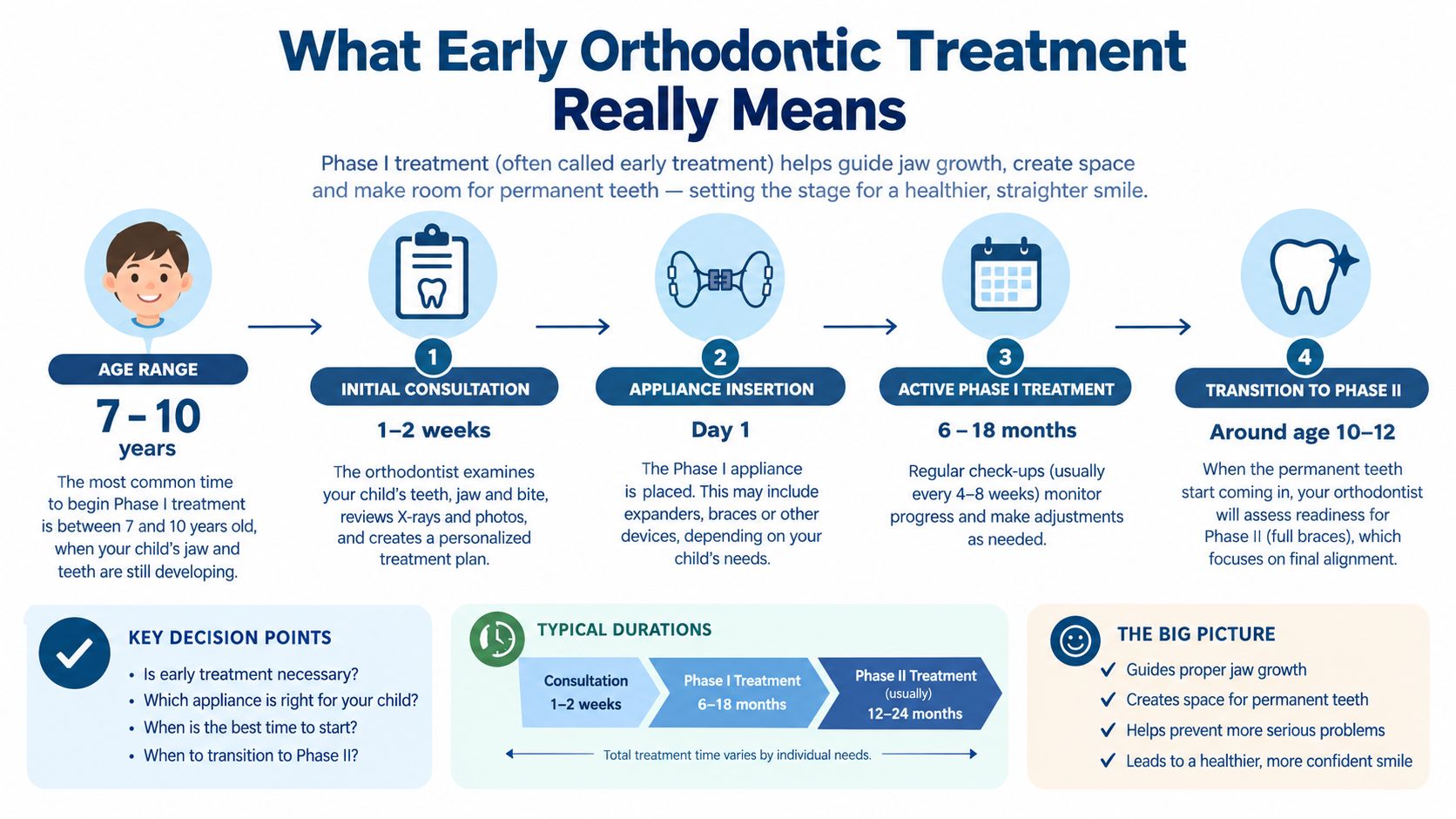
Early orthodontic treatment, also called interceptive orthodontics or Phase I treatment, begins during the mixed dentition period, when baby and permanent teeth are present together. This stage commonly occurs around ages 7 to 11, according to a review of early intervention research published in the medical literature. The goal is selective, not automatic. An orthodontist addresses a defined problem while growth and tooth eruption are still underway, rather than placing every child in full braces.
Screening isn't the same as starting treatment
The American Association of Orthodontists guidance on orthodontic screening for children recommends an initial orthodontic check by age 7, or earlier if a parent notices a concern. Screening is an information-gathering visit. It does not commit a child to treatment.
The orthodontist may recommend:
- Treat now, if a bite or growth issue could cause harm or become harder to manage.
- Monitor, with periodic checks as permanent teeth erupt.
- Wait for full treatment, if one later phase is likely to be more efficient.
This three-way decision is why an early visit can be useful even when no appliance is needed. It separates problems that benefit from timely guidance from changes that can safely be watched.
When Phase I is recommended, active treatment often lasts for a limited period. The child then enters a resting and observation phase while additional permanent teeth emerge. A second phase, often using braces or aligners during the teen years, may still be needed. Children continue growing, and early treatment does not bring every permanent tooth into place, as explained in this overview of early-phase orthodontic care.
Practical rule: A screening identifies timing. It doesn't create an obligation to begin treatment.
How Phase I Orthodontics Works in Practice
Phase I treatment is similar to strengthening a house's foundation before adding a second story. The orthodontist isn't trying to finish every detail at once. The aim is to improve a specific structural or eruption problem so later development has a better starting point.
The first visits build the diagnosis
The initial consultation begins with a clinical examination and a discussion of the child's dental history, habits, growth, and any symptoms the family has noticed. If more information is needed, a diagnostic records appointment may include photographs, a panoramic X-ray, cephalometric imaging, and impressions or a digital scan.
These records help the orthodontist assess the relationship between the jaws, the position of unerupted permanent teeth, available space, and the direction of growth. A scan can show the shape of the dental arches, but the records matter because treatment decisions should be based on the whole developing bite rather than on one crooked tooth.
Appliances address different problems
The appliance depends on the diagnosis:
- A palatal expander can widen a narrow upper jaw or help correct certain crossbites.
- Headgear may be considered for selected severe upper-jaw growth patterns.
- Partial braces can move a limited group of front teeth rather than all teeth.
- A habit appliance may help when thumb sucking or tongue thrust affects the bite.
- A space maintainer can preserve room after the early loss of a baby tooth.
Active wear may last qualitatively less than the entire orthodontic journey, and some treatment plans use an active period of roughly nine to twelve months. That range must be confirmed for the individual child rather than treated as a promise. During active treatment, visits commonly occur every six to eight weeks, followed by retention and observation that may continue for one to three years, depending on growth and eruption.
Families should also ask what happens after the appliance comes out. Phase I isn't complete just because the first appliance has been removed. The orthodontist must continue watching the bite, incoming teeth, and jaw relationship before deciding whether Phase II is needed.
Key Benefits Parents Should Weigh
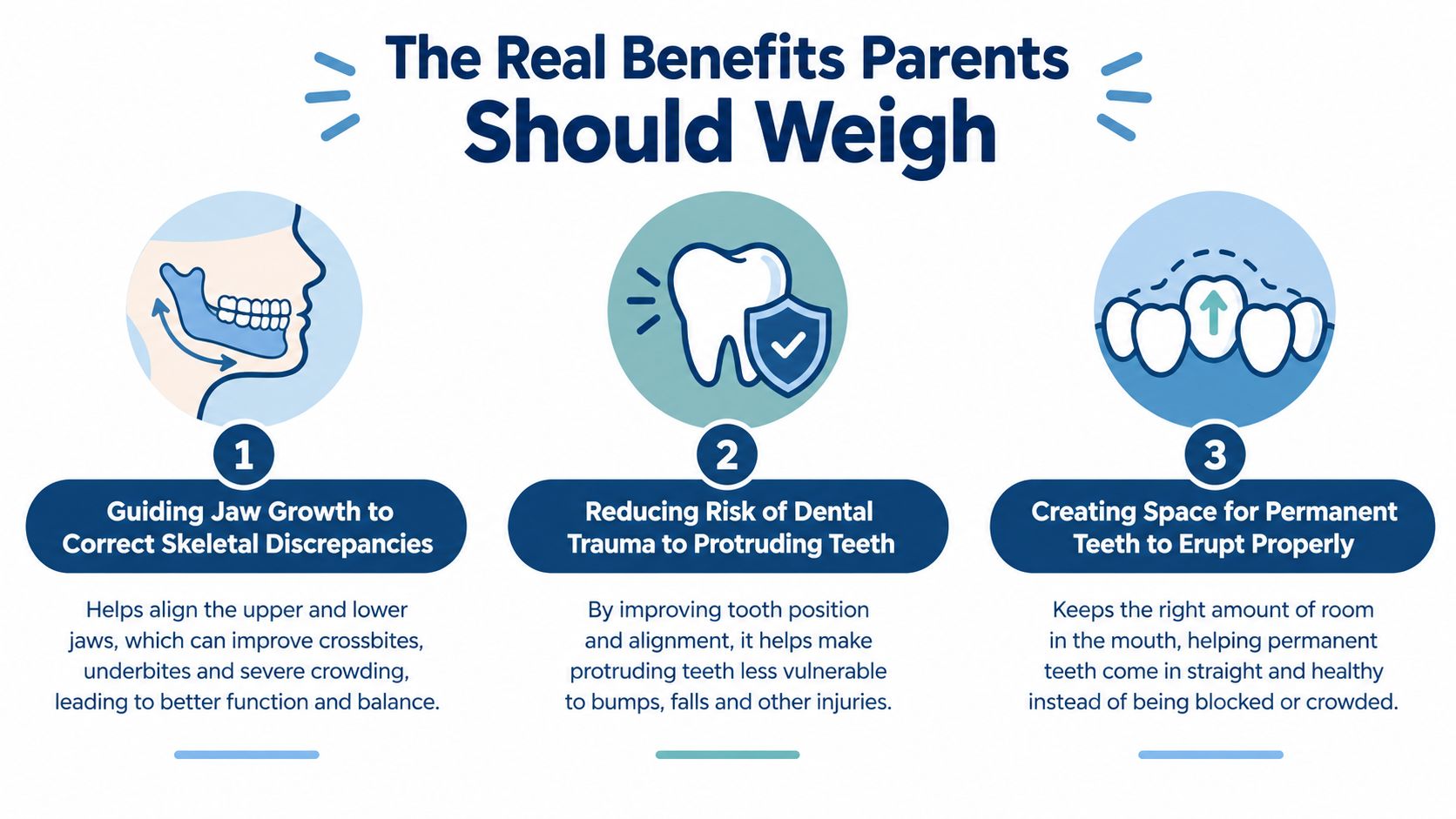
A parent may hear that early orthodontic treatment will create a better smile sooner. The more useful question is narrower: What risk or functional problem changes if treatment begins now? Early care is a targeted decision, not a universal upgrade. Its strongest purpose is to prevent harm, improve function, or guide the conditions in which the jaws and permanent teeth develop.
Structural and functional gains
During growth, treatment may help a narrow upper jaw, crossbite, developing underbite, or severe overbite. Correcting the bite early can improve how the upper and lower teeth meet and may reduce the severity of a developing jaw discrepancy. Research supports short-term changes in measures such as overjet, ANB angle, and PAR scores. However, a 2025 systematic review and meta-analysis found no statistically significant long-term advantage over delayed treatment in those key measures.
Space management is another possible benefit. Expansion, a space maintainer, or limited tooth movement may give a blocked-out permanent tooth a better path to eruption. That can sometimes reduce the need for more invasive treatment later. No appliance guarantees that extractions will be avoided.
Airway claims need care. Widening a narrow palate may support nasal breathing for some children, but orthodontic treatment is not a universal answer for mouth breathing or sleep-disordered breathing. Persistent breathing symptoms call for medical evaluation as well as orthodontic assessment.
Protection and confidence
Prominent upper front teeth can be more exposed to injury. In children with a Class II problem, an evidence review found that early treatment reduced incisal trauma, with an odds ratio of 0.45 and a 95% confidence interval of 0.25 to 0.80 among 237 participants in the review of early treatment for prominent upper front teeth. The same review found no other clear advantages over later one-phase treatment.
A child may feel more comfortable smiling after a visible dental problem improves. That emotional benefit matters, although confidence and self-esteem are measured less consistently than bite changes. The clearest conclusion is that early treatment can provide clear functional or protective benefits for selected problems. Social benefits are possible, but they should not be promised.
If the clinical reason for starting now is unclear, observation may be the more responsible choice.
The Honest Drawbacks and Tradeoffs
Two-phase treatment asks a young child and family to stay engaged over a long span of development. Even when the active Phase I period is limited, the overall pathway can include an appliance, a break, ongoing monitoring, and a later full phase.
Treatment fatigue is real
Children must remember appliance instructions, keep devices clean, attend follow-up visits, and cooperate with adjustments. Some appliances affect speech or eating temporarily, and removable appliances only work when children wear them as directed. A young patient who starts orthodontics early may later feel tired of treatment before the full phase begins.
A 2005 study of 512 orthodontic cases reported disadvantages associated with early treatment, including longer treatment time, worse final treatment scores, and more premature treatment termination, which the authors connected with patient and parent burnout in their assessment of early treatment outcomes. That finding doesn't mean early treatment is inappropriate. It does mean cooperation and family capacity belong in the decision.
More time doesn't guarantee a better finish
Early correction may improve a bite for a period, but growth can continue to influence the final relationship between the jaws. A facemask for selected Class III cases can produce short-term skeletal and dental improvements, yet long-term benefit remains unproven and the evidence includes important bias concerns in the systematic review of early facemask therapy.
The financial burden can also rise because two phases may involve separate active periods, retainers, visits, and appliance management. A 2025 review concluded that two-phase care did not outperform one-phase care for Class II skeletal correction, stability, or treatment complexity, while early intervention could increase duration and cost and reduce compliance in its review of two-phase treatment.
A useful question for any recommendation: What specifically becomes harder, riskier, or less predictable if treatment waits?
That question separates a necessary early intervention from treatment that merely starts sooner. Mild crowding, ordinary spacing, and cosmetic concerns often don't justify years of added management when a later single phase can address the same issue.
Which Problems Actually Need Early Treatment
Early treatment makes the most sense when the orthodontist can identify a time-sensitive problem. The concern may involve tooth injury, a jaw shift, a blocked permanent tooth, or a growth pattern that responds better while the child is still developing.
The comparison below isn't a diagnosis. It gives parents a practical way to understand why one child may need Phase I while another child can be safely observed.
| Issue | Treat Early (Phase I) | Can Usually Wait |
|---|---|---|
| Crossbite | A posterior or anterior crossbite with a skeletal component, especially when the jaw shifts during closure, may justify early correction. | A minor tooth-position issue without a functional shift may be monitored. |
| Severe crowding | Treatment may be considered when a permanent tooth is blocked, displaced, or at risk of erupting improperly. | Mild or moderate crowding may be observed while more teeth erupt. |
| Functional mandibular shift | Early assessment is important when the lower jaw moves to find a comfortable bite. | A stable bite with no shift can often be reviewed over time. |
| Harmful oral habits | Persistent thumb sucking or tongue thrust can warrant evaluation when it changes the bite. | A habit that has stopped and hasn't created a meaningful bite problem may need observation rather than an appliance. |
| Developing Class III pattern | Early evaluation may be appropriate for an emerging underbite or growth discrepancy, with expectations discussed carefully. | A mild appearance concern without a developing skeletal pattern may not require Phase I. |
| Protruding upper front teeth | Treatment may reduce the risk of incisal trauma in selected children. | Without a meaningful injury risk, later treatment may provide comparable final results. |
| Cosmetic spacing | Early care is less often necessary when spacing doesn't affect function or eruption. | Many spacing concerns can wait for adolescent comprehensive treatment. |
The evidence supports selective care rather than routine intervention for every bite issue. The 2023 scoping review found that early treatment wasn't consistently superior in effectiveness, total appliance duration, or cost-benefit ratio, and the later evidence review reached a similar conclusion about long-term outcomes in its analysis of early versus delayed treatment.
Parents can use the guide to when children should get braces as a starting point, then ask an orthodontist to connect the general guidance to the child's actual bite. The key distinction is whether Phase I changes the child's risk or development, not whether treatment can move a few teeth sooner.
Costs, Insurance, and Delaware Medicaid Coverage
Families should request a written estimate before agreeing to Phase I. The cost depends on the appliance, diagnostic records, length of active care, retention, and whether a second phase will follow. Exact ranges vary by office and case, so a responsible consultation should explain the expected total pathway rather than quote an attractive first-phase figure alone.
Questions about insurance
Dental insurance with orthodontic benefits often limits coverage to one course of orthodontic treatment per lifetime. A two-phase plan may therefore use some or all of the available benefit during Phase I, leaving less assistance for later extensive care. The policy may also distinguish between dependent coverage, age limits, waiting periods, deductibles, and medical necessity.
Before signing, parents should ask:
- Lifetime benefit: Is the orthodontic benefit shared across both phases?
- Timing rules: Does the plan require treatment to begin before a certain age?
- Coverage definition: Does the policy cover the recommended appliance or only full-course treatment?
- Second phase: What happens financially if Phase II is needed?
- Refund policy: How are payments handled if treatment stops early?
Delaware public coverage
Delaware Medicaid coverage for children is based on medical necessity, not just a desire for straighter teeth. Orthodontic eligibility commonly involves the Handicapping Labio-Lingual Deviation, or HLD, index, with documentation showing that the bite meets the program's requirements. The Delaware Healthy Children Program, or CHIP, follows similar medical-necessity principles.
Families should confirm current eligibility, covered providers, prior authorization requirements, and plan-specific rules because public benefits can change. The Delaware orthodontic Medicaid coverage information can help families prepare questions before an appointment, but the child's plan should provide the final coverage determination.
Payment options may include monthly plans, health savings account funds, or flexible spending account funds when eligible. A consultation should clearly separate the initial phase, retainers, observation, possible Phase II, insurance estimates, and the family's expected balance.
When to Book a Free Orthodontic Consultation
A parent may notice a front tooth coming in behind another, a child shifting the jaw to bite, or a smile that looks crowded. Those signs do not automatically mean treatment should start. They do suggest that an orthodontic evaluation could clarify whether the child needs early care, monitoring, or later full treatment.
The American Association of Orthodontists recommends an initial screening by age 7, when enough permanent teeth have often erupted for an orthodontist to assess developing jaw and tooth relationships in the association's child orthodontics guidance. The appointment is a baseline, not a treatment contract.
An assessment may be useful after early or late loss of baby teeth, persistent thumb or pacifier habits after age five, regular mouth breathing, speech changes, jaw shifting, visible crowding, a crossbite, or protruding front teeth.
Signs that deserve attention
Parents can schedule an assessment when a child:
- Loses baby teeth unusually early or late, especially when eruption looks uneven.
- Keeps a thumb, finger, or pacifier habit, and the habit appears to affect the bite.
- Breathes through the mouth regularly, snores, or has breathing concerns that need appropriate evaluation.
- Shifts the jaw while biting, or cannot bring the teeth together comfortably.
- Has a visible crossbite, underbite, severe overbite, or blocked tooth.
- Has upper front teeth that project forward, particularly when an injury risk is present.
At the first visit, the orthodontist may complete a clinical examination, take photographs, and recommend a panoramic image or an iTero digital scan if those records are needed. The conversation should explain whether the child needs treatment now, observation, or a later Phase II plan. A scan or image supports the decision, but it does not determine the plan by itself.
Questions that improve the conversation
Ask what problem treatment is meant to solve, what may happen if care is delayed, how long active treatment could last, and whether later full treatment is likely. Parents can also ask about Phase I experience, appliance care, possible extractions, total cost ranges, insurance handling, and the plan if cooperation becomes difficult.
Delaware families can seek a complimentary evaluation near North Wilmington, Middletown, Dover or West Dover, and Millsboro. Some practices offer virtual evaluations as an initial discussion, though an in-person examination and diagnostic records may still be needed before treatment is recommended.
The best plan may be careful monitoring with clear return milestones. Timing should match the child's needs, not pressure to begin early.
Stellar Orthodontics offers free consultations with clinical examinations and iTero digital 3D scanning to help Delaware families choose between monitoring, Phase I care, or later full treatment. Parents can visit Stellar Orthodontics to book a consultation in North Wilmington, Middletown, Dover/West Dover, or Millsboro.