.png)
A lot of parents notice the same thing at the same moment. Their child smiles, the top front teeth seem to cover almost all of the bottom front teeth, and a simple question pops up fast: can braces fix that bite, or do they only straighten crooked teeth?
They can often do both, but an overbite isn't corrected by lining teeth up in a row and hoping for the best. A deep bite needs a plan for how the upper and lower teeth should meet, how the front teeth should overlap, and how the back teeth should support the bite once treatment is finished.
Table of Contents
- Understanding the Overbite Correction Process
- The Biology of Moving Teeth Safely
- Specific Mechanics for Deep Bite Reduction
- The Role of Elastics and Specialized Hardware
- Dental Versus Skeletal Overbite Considerations
- Treatment Timelines and Next Steps for Families
Understanding the Overbite Correction Process
An overbite is about vertical overlap. In plain language, it describes how much the upper front teeth cover the lower front teeth when someone bites together. A small, healthy overbite may not need treatment at all. Independent guidance notes that treatment is usually recommended when the bite is causing tooth wear, gum trauma, chewing difficulty, or jaw discomfort, not because any overlap exists (guidance on when overbite treatment is necessary).
That distinction helps families avoid a common misunderstanding. Not every child with a visible overbite needs braces right away, but a child with a deep overbite often benefits from an orthodontic evaluation so the team can tell whether the issue is mild, dental, or tied to jaw growth.
What parents usually notice first
A parent may notice that a child's lower front teeth seem hidden behind the upper teeth. Another child may complain that the front teeth “hit funny” when chewing. Sometimes the lower teeth contact the gum tissue behind the upper teeth. Sometimes nothing hurts, but the bite still looks unusually closed.
Practical rule: Straight teeth and a healthy bite aren't always the same thing.
Braces fix an overbite by using controlled, sustained force to move teeth into better positions over time. That force isn't random. Orthodontists choose where to open the bite, where to level the arches, and which teeth need the most vertical control.
Why treatment happens in phases
Bite correction follows a sequence. Orthodontic guidance says the overbite should be reduced before overjet reduction is attempted, which shows that treatment doesn't move everything at once (orthodontic guidance on treatment sequence).
That's why appointments can seem very deliberate. A family may expect immediate visible changes in the front teeth, while the orthodontist may spend early visits building the foundation for bite correction first. In Delaware, families visiting offices in North Wilmington, Middletown, Dover/West Dover, or Millsboro often find that this part of the conversation is the most helpful, because once the mechanics are explained, the treatment plan makes much more sense.
The Biology of Moving Teeth Safely
One of the biggest worries parents have is simple and reasonable. If teeth are anchored in bone, how can braces move them safely?
The short answer is bone remodeling. Teeth don't get yanked through solid bone like fence posts being pulled from concrete. Braces apply light, steady pressure. The body responds by reshaping the bone around the tooth so the tooth can gradually settle into a new position.
What's happening under the surface
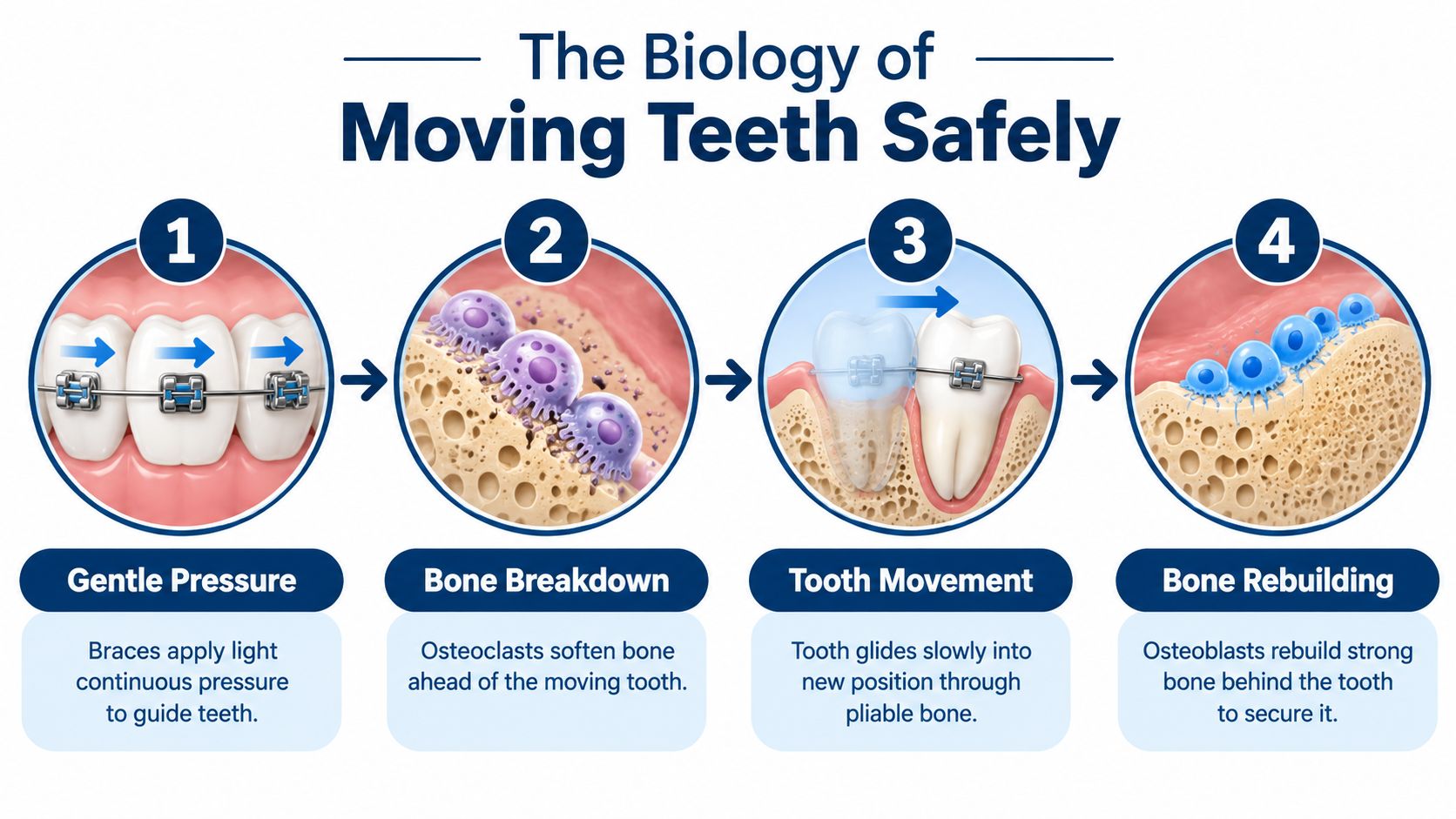
The biology works in a step-by-step pattern:
- Gentle pressure starts the process. Brackets and wires apply low, continuous force.
- Bone is removed where the tooth needs to go. Cells called osteoclasts break down bone on the pressure side.
- The tooth shifts gradually. It moves through a biologically active support system, not through untouched solid bone.
- Bone is rebuilt behind it. Cells called osteoblasts build new bone on the tension side.
That basic mechanism is described in orthodontic biomechanics research. Sustained, low-magnitude forces create compression and tension zones in the periodontal ligament, which triggers bone resorption on one side and bone apposition on the other. That remodeling is what allows movement over months rather than days (biomechanics of tooth movement and target overbite range).
Why slow movement is safer movement
Parents sometimes assume faster is always better. In orthodontics, the body sets the pace. Bone has to break down and rebuild in an organized way. If too much force is used, movement becomes less controlled. If light force is used consistently, the teeth can travel more predictably.
The braces are only the delivery system. The body does the actual moving.
That's also why patience matters so much in deep bite treatment. The bite may look tight at the start, but the orthodontist isn't just pushing visible teeth around. The goal is to guide the supporting bone and tooth positions together.
Families comparing braces and aligners often ask how this differs with removable treatment. A helpful overview of how Invisalign works can make that comparison easier, especially when the main concern is bite correction rather than crowding alone.
A short visual explanation can also help make the biology less abstract:
Specific Mechanics for Deep Bite Reduction
Straightening teeth is only part of the job. A deep overbite usually needs vertical control, which means changing how high or low certain teeth sit, not just how straight they look from the front.
Research on deep-bite correction describes three main mechanics: intrusion of the front teeth, extrusion of the back teeth, and flattening the curve of Spee (deep bite mechanics overview). Those words sound technical, but each one has a simple purpose.
The three main movements
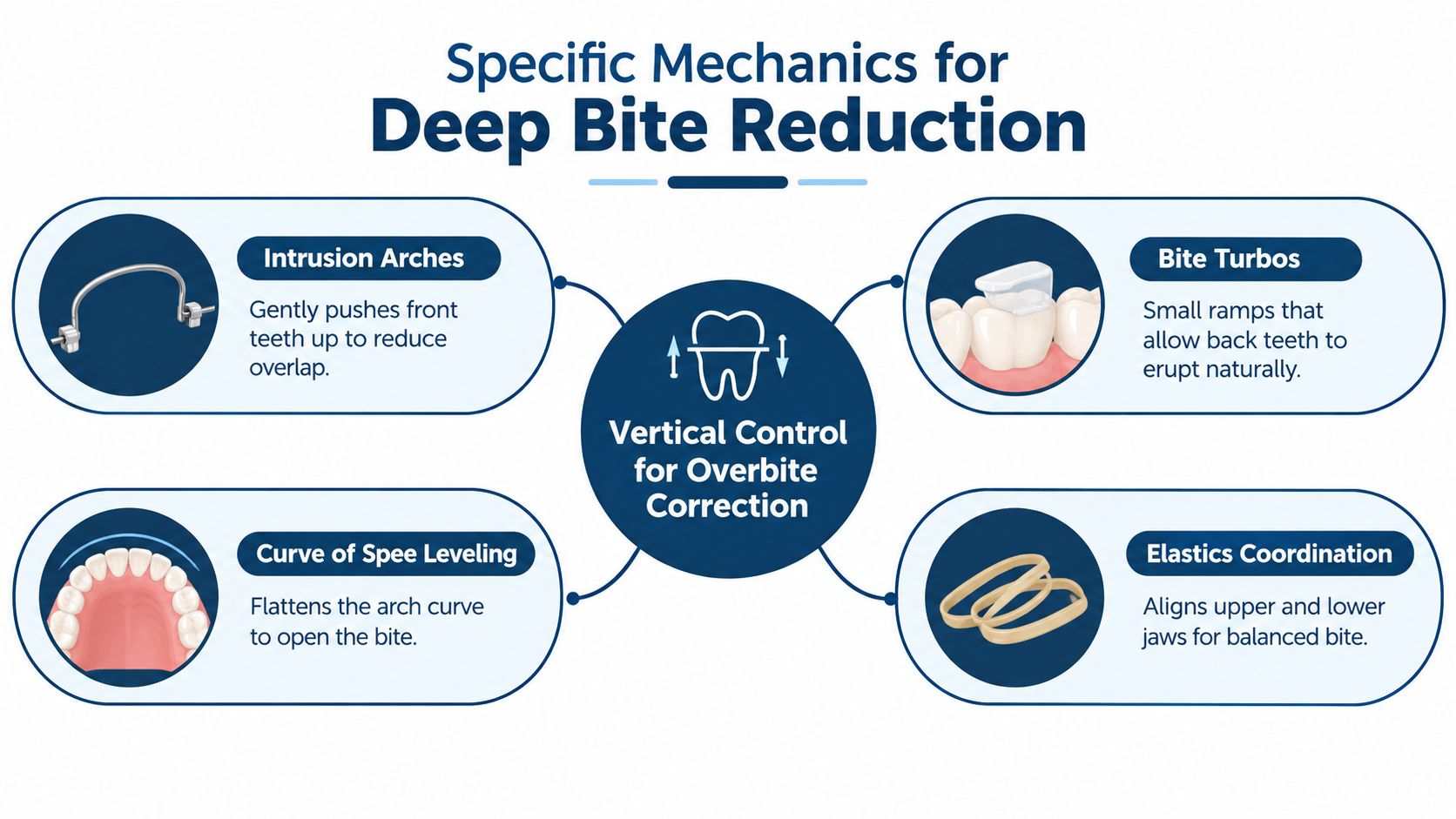
Intrusion means moving the front teeth slightly upward into the bone so they don't cover the lower teeth as much.
Extrusion means allowing or encouraging the back teeth to come down a bit more, which helps open the bite from behind.
Flattening the curve of Spee means reducing the natural deep curve in the lower arch so the lower front teeth and back teeth work together more evenly.
A fixed-appliance review found that traditional braces achieve a mean overbite reduction of about 3 mm, while clear aligner therapy showed a pooled mean reduction of 1.79 mm and only 28% to 55% clinical accuracy for overbite reduction in deep-bite cases.
Why one movement usually isn't enough
Many parents imagine that the orthodontist “pushes the top teeth back.” That may be part of some treatment plans, but a deep overbite is usually more vertical than horizontal. The bite often improves because several changes happen together.
A useful way to picture it is a lid closing too tightly on a container. The solution may involve lifting the front edge a little, supporting the back edge better, and reshaping the path so the lid closes properly instead of jamming shut.
| Bite problem | What the orthodontist may change | Why it helps |
|---|---|---|
| Too much front overlap | Front tooth intrusion | Reduces excessive vertical coverage |
| Bite feels overly closed | Posterior extrusion | Opens the bite from the back |
| Lower arch looks deep or scooped | Curve of Spee leveling | Creates a more balanced bite path |
What results typically look like
A systematic review reported that fixed appliances changed overbite by roughly 0.9 to 4.4 mm during treatment. It also found average initial overbite dropping from 5.3 mm to 2.6 mm after treatment, with long-term follow-up averaging 3.4 mm. Relapse ranged from 0 to 2.1 mm over follow-up periods from 1.2 to 14.7 years (systematic review of overbite correction and relapse).
That matters because it sets realistic expectations. Braces can make a substantial correction, but long-term stability depends on diagnosis, finishing details, and retention.
Deep bite correction isn't one tooth moving in one direction. It's a coordinated set of vertical changes.
The Role of Elastics and Specialized Hardware
Brackets and wires do a lot of the work, but overbite correction often depends on smaller tools that families don't expect at the first visit.
The most familiar are elastics, also called rubber bands. Braces apply steady force through brackets and archwires, and elastics or springs can add directional pull so upper teeth can be moved back, lower teeth can be guided forward, and the bite can be aligned more precisely (how braces use elastics and springs for bite correction).
What elastics actually do
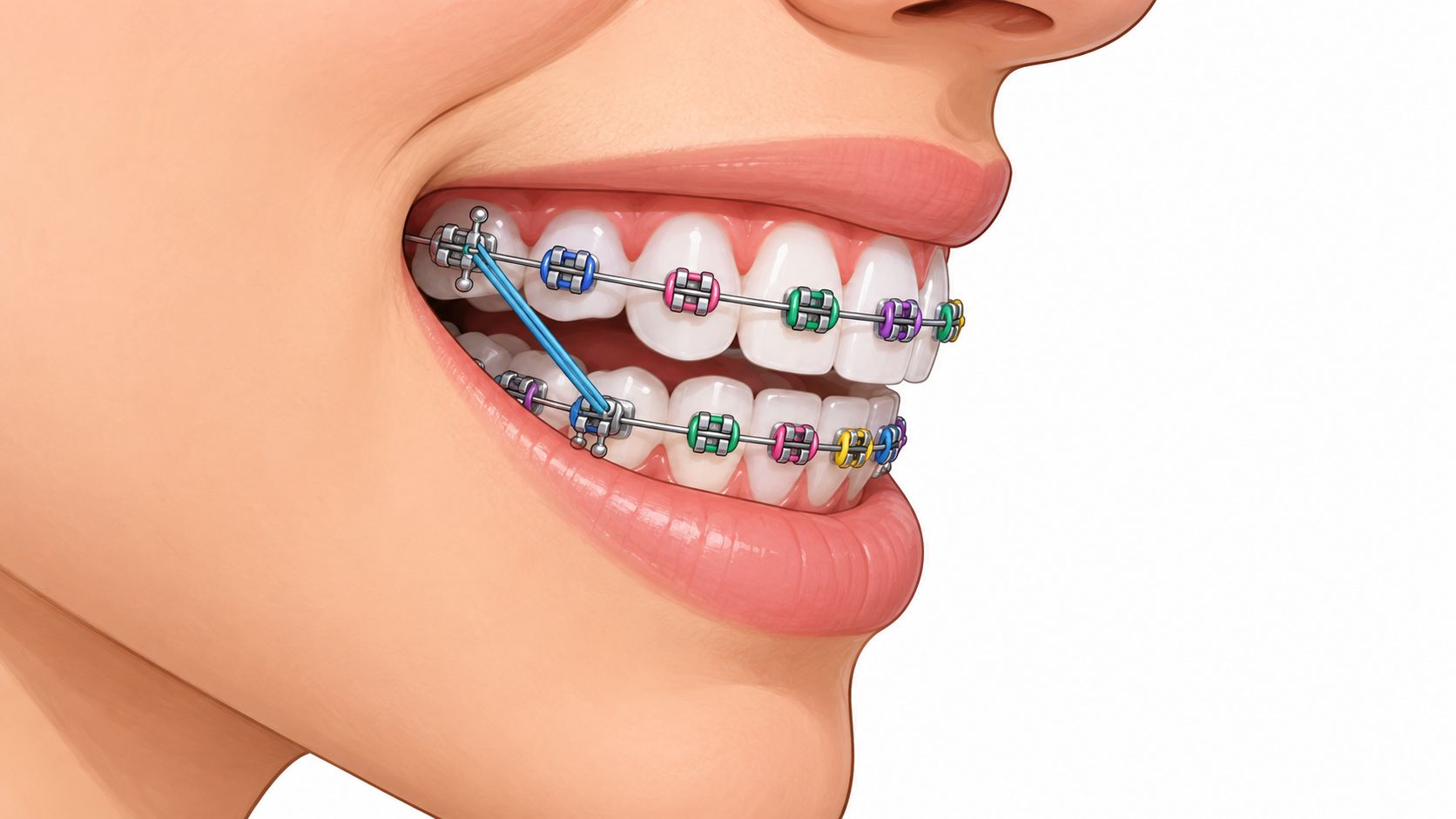
Elastics connect the upper and lower arches. That connection helps coordinate how the two arches fit together, which is critical when the bite needs more than simple alignment.
Parents often notice this phase because it asks more from the patient. Teeth don't care whether a rubber band was worn only at school or only at night. The bite responds to consistency.
A few accessories show up often in deep bite treatment:
- Elastics for coordination: These help the top and bottom teeth meet in a more balanced way.
- Bite turbos or bite blocks: These small buildups keep the teeth from fully closing, which can protect brackets and create room for correction.
- Special archwires or intrusion mechanics: These focus more force where vertical control is needed.
Why the hardware can look small but matter a lot
A child may think a bite turbo is “just a bump on a tooth,” but it changes how the whole bite closes. A parent may think elastics are optional because they're removable, but they often supply the missing direction that braces alone can't provide.
Some adults and teens also ask whether different appliance styles change how this feels day to day. A practical comparison of types of braces for adults can help families understand appearance, control, and maintenance without losing sight of the bigger issue, which is the bite itself.
At Stellar Orthodontics, treatment options include traditional metal braces, clear ceramic braces, and Invisalign clear aligners, so the appliance choice can be matched to the bite problem rather than appearance alone.
Dental Versus Skeletal Overbite Considerations
Many online explanations fall short. Not every overbite comes from the same place.
A dental overbite is mostly about tooth position. A skeletal overbite involves the relationship of the jaws and facial growth pattern. Braces are excellent at moving teeth, but they don't erase every jaw discrepancy in the same way.
Why that difference matters
If a child has a dental deep bite, treatment may focus on tooth intrusion, arch leveling, and bite coordination. If the child has a skeletal pattern contributing to the bite, growth timing becomes more important because the orthodontist may be planning around how the jaws are developing, not just where the teeth sit today.
A comparative study published for 2026 found no significant difference overall between braces and clear aligners in overbite improvement, but braces had a greater impact on vertical facial dimensions while aligners were associated with more upper incisor proclination. That doesn't mean one option is always better. It means diagnosis matters more than assumptions.
Children and adults need different conversations
For growing children and teens, the question may be whether treatment should guide eruption and growth at the right time. For adults, the question is often how much correction can come from tooth movement alone and whether the bite problem is mainly dental or more structural.
A practical way to consider it:
- Dental overbite: Teeth are the main issue. Braces often handle this well.
- Growth-related overbite: Timing matters because growth can help or limit the plan.
- More severe skeletal discrepancy: Tooth movement may improve the bite, but it may not fully change the underlying jaw relationship.
For severe deep bites, orthodontic literature emphasizes true anterior intrusion as a high-control strategy. A miniscrew-assisted lever arm clinical report showed that upper incisor intrusion reduced anterior overbite to the normal range in 3 to 4 months, illustrating how anchorage control can improve efficiency and reduce unwanted side effects (clinical report on controlled incisor intrusion).
A parent doesn't need to memorize the mechanics. The useful question is whether the problem is mostly in the teeth, the jaws, or both.
That's one reason early evaluation can be helpful. It gives families time to understand the kind of overbite they're dealing with before deciding when and how to treat it.
Treatment Timelines and Next Steps for Families
Families usually want one practical answer after all of the science. How long will this take, and what will daily life look like?
The honest answer is that the timeline depends on the type of overbite, the severity, the child's growth stage, and how consistently the instructions are followed. Deep bite correction often takes time because the orthodontist is changing vertical relationships carefully, not just straightening visible teeth. Compliance matters most when elastics or bite-opening mechanics are part of the plan.
What families can expect day to day
Most children and teens adapt quickly to braces, but overbite treatment may bring a few phases that feel different from simple alignment.
- Early adjustment: The bite may feel strange as the teeth begin to separate or coordinate differently.
- Elastic wear: Success depends on wearing them as directed.
- Retention after braces: This helps protect the correction once treatment ends.
Families who want a broader overview of timing can read more about how long braces take to work. The key point is that the teeth may start looking straighter before the bite is fully corrected, and that's normal.
For Delaware families, convenience matters too. Free consultations with iTero digital 3D scanning are available in North Wilmington, Middletown, West Dover, and Millsboro, which makes it easier to see exactly how a child's bite fits together and what kind of correction may be needed. Stellar Orthodontics also accepts most major dental insurance, offers flexible monthly payment plans with $0 down, and is one of the few Delaware orthodontic practices that accepts all three state Medicaid plans plus CHIP for children and teens under 21.
Families who are wondering how braces fix an overbite can get a clear, case-specific answer during a free consultation at Stellar Orthodontics. The team uses digital 3D scanning to show how the bite fits together and whether the issue is mainly dental, growth-related, or a mix of both. With locations in North Wilmington, Middletown, West Dover, and Millsboro, it's easy for Delaware families to take the next step.