.png)
A lot of Delaware parents hear the word “attachments” for the first time while sitting beside a child in an Invisalign consultation, looking at a 3D smile simulation on a screen and trying to keep up. The trays make sense right away. The tiny bumps on certain teeth usually don't.
That's the moment many families start wondering whether attachments are just cosmetic add-ons, whether they'll be noticeable, and whether they really matter. They do matter, but not in the way many first assume. They aren't random bumps. They're small planned features that help an aligner hold, direct, and maintain force on a tooth that wouldn't move as predictably with smooth plastic alone.
For parents trying to understand how do Invisalign attachments work, the clearest answer is this: attachments give the aligner something solid to push against, but they only do their job when the aligner is worn consistently. Shape matters. Placement matters. Daily habits matter just as much.
Table of Contents
- The Moment Attachments Come Up at Your Consultation
- What Invisalign Attachments Actually Are
- How Attachments Change the Force Your Aligner Can Deliver
- How Attachments Are Placed and Removed
- Why Wear Habits May Matter More Than the Attachment Itself
- Caring for Attachments Day to Day
- Key Takeaways and Booking Your Free Visit
The Moment Attachments Come Up at Your Consultation
A parent is watching the smile simulation, following the trays on the screen, and then a few small shapes appear on certain teeth. That is usually the first pause in the visit. The question comes quickly: “What are those, and do we really need them?”

That moment matters because attachments are often the first sign that aligner treatment is not only about having trays made to fit the teeth. It is also about giving those trays enough grip and direction to move specific teeth in a controlled way. A smooth tray can guide simple movement. Some teeth need a little more control than smooth plastic can provide on its own.
Parents often hear the word “attachment” and assume it refers to a minor add-on. In many cases, it is part of the original design of treatment. If the plan calls for a tooth to turn, lift, tip, or hold a certain position while nearby teeth move, the doctor may build that control into the plan from the start. The attachment is one piece of that design. The other piece is wear behavior. If trays are left out too long, removed often, or not fully seated after meals, even a well-shaped attachment cannot help the aligner deliver force the way it was intended.
A simple way to picture it is a door handle and a hand. The handle helps you apply force in the right direction, but the door still does not move unless you keep your hand on it long enough. Attachments work in a similar way. Their shape matters, but daily wear time and consistent reseating matter too.
That is why this part of the consultation often shifts from “What is that bump?” to “How often will the trays really be in?” Families are not only reviewing where attachments may go. They are also learning how treatment success depends on a pattern of wear that gives the aligners enough uninterrupted time to work.
Once attachments come up, the next questions are usually practical:
- How many might be needed: The number depends on which teeth need extra control.
- Which teeth get them: They are placed where the plan needs more grip or more precise force.
- Whether daily habits affect them: Yes. Consistent wear and careful tray removal can matter as much as attachment shape.
Families who want to know what that first conversation is usually like can review what happens at a first orthodontic visit in Delaware. Knowing that attachments are part of a wear-sensitive treatment design often makes the whole consultation feel clearer and less intimidating.
What Invisalign Attachments Actually Are
At the most basic level, Invisalign attachments are tiny pieces of tooth-colored composite resin bonded to certain teeth. They're made from the same general kind of material many patients recognize from white fillings. Once attached, they create a small mechanical interface between the tooth and the aligner.
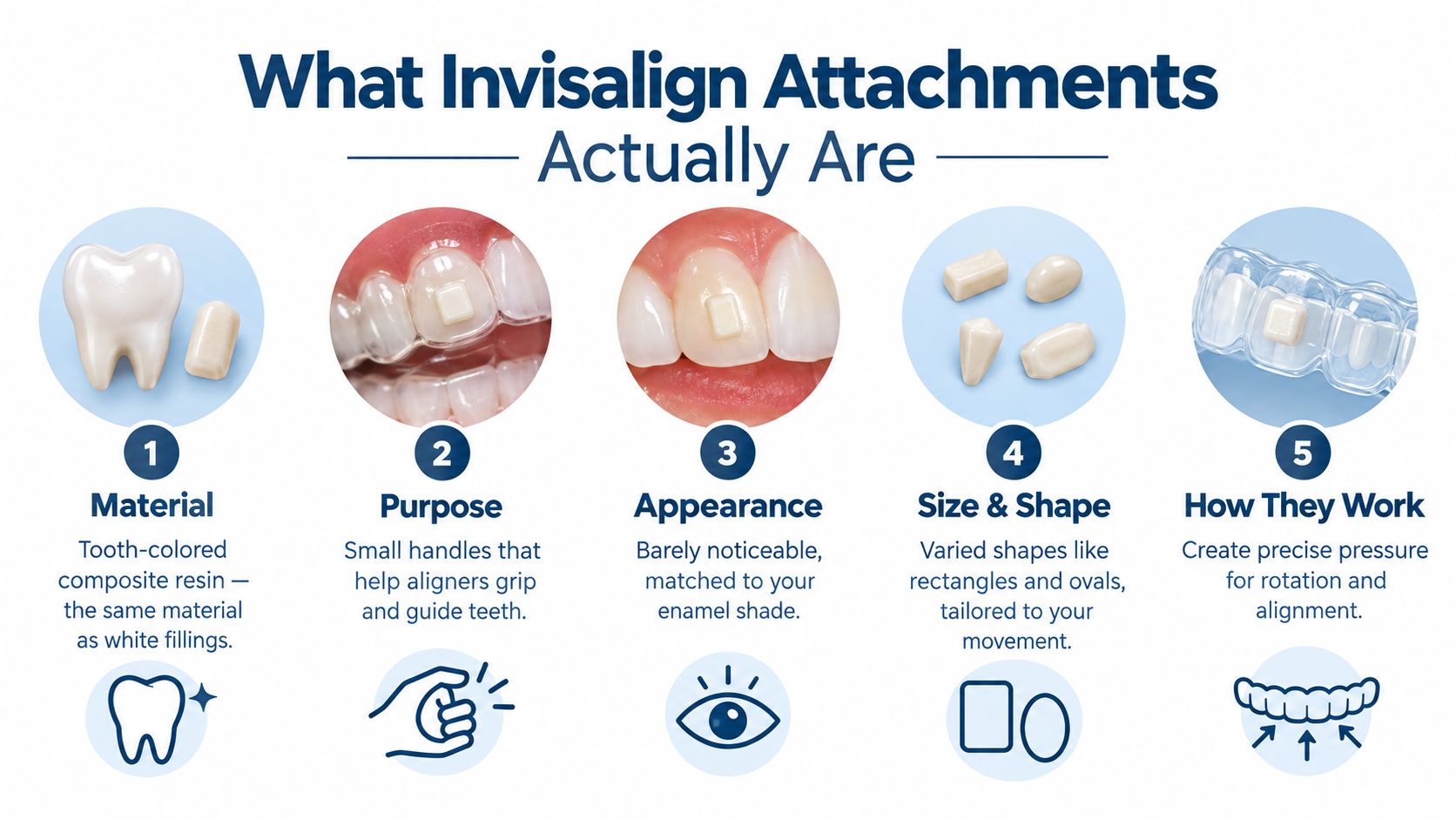
Think of them as tiny handles
A smooth plastic tray can only hold onto a smooth tooth so well. If a tooth needs a simple nudge, that may be enough. If a tooth needs to rotate, lift, or tip in a controlled direction, the tray often needs a handle.
That's the easiest analogy for families. The attachment acts like a tiny handle or anchor. Reviews describe attachments as bonded composite “engagers” that increase retention and convert the aligner's elastic deformation into more directed force vectors for movements such as rotation, extrusion, and controlled tipping, as explained in this biomechanics review.
Why different shapes exist
Attachments aren't all identical because different jobs require different surfaces. Some are more rectangular. Some are more rounded. Some are designed to help with rotation. Others help with vertical movement like pulling a tooth into place.
A parent doesn't need the full engineering language to understand the point. The shape changes how the aligner contacts the bump, and that changes where the push goes.
- Rectangular shapes tend to give the aligner a flatter, more stable surface to push against.
- Rounded or ellipsoid shapes may be chosen when a softer or differently directed grip is needed.
- Movement-specific designs are selected when a tooth needs help with a particular action, such as rotating or erupting into position.
Here's a simple visual explanation that can make the idea easier to picture:
How the tray fits over them
The aligner isn't flat over an attachment. It has a matching pocket or molded recess so the plastic seats over that bump in a specific way. When the tray snaps into place, the aligner and attachment work together. That fit is what helps direct pressure instead of letting the tray slip.
Practical rule: If a family thinks of the tray as the engine, the attachment is one of the steering points.
These attachments are also temporary. They stay on during the phase of treatment when they're needed, then the orthodontic team removes them and polishes the surface smooth at the end. Families who are still learning the basics of clear aligner treatment often find it helpful to start with a broader overview of what Invisalign is and how it works.
How Attachments Change the Force Your Aligner Can Deliver
A clear tray by itself can only do so much on a smooth tooth. Once attachments are added, the tray has small grip points it can catch and press against. That changes the kind of force the aligner can deliver, and it changes how closely the tooth can follow the plan.
A simple way to picture it is a hand trying to turn a round doorknob while wearing slick gloves. You can still push on it, but fine control is harder. Add a better grip surface, and the same hand can guide the motion more precisely. Attachments give the aligner that better grip surface.
Holding a tooth is not the same as guiding it
Families often hear that aligners "move teeth" and assume the job is mostly about pressure. Pressure matters, but direction matters just as much. A tray can squeeze a tooth and still struggle to rotate it, tip it, or pull it slightly up or down if the plastic has nothing solid to catch.
Attachments help the aligner do more than hang on. They give the tray edges and flat planes to press against, so the force can be aimed with more control. That is especially helpful for movements that are easier to lose during real life wear, such as small rotations, vertical changes, or detailed root control.
Research has also shown better movement accuracy for certain attachment-assisted aligner movements than aligners without those added grip features, as noted earlier in the article. The practical takeaway for parents is simple. Attachments can improve the aligner's ability to express the prescription your orthodontist planned.
Shape affects where the push goes
Small changes in shape can create very different effects. One attachment may help the tray pull more vertically. Another may give the plastic a broader surface for stronger directional control. A third may reduce slipping during a rotation.
| Attachment Shape | Common Use | How It Changes Force |
|---|---|---|
| Ellipsoid or cylindrical | Often used for vertical changes or retraction | Gives the tray a rounded grip point that can guide controlled pull-like force |
| Rectangular | Often used for torque or angulation | Creates a flatter contact surface for more defined directional push |
| Flatter designs | Sometimes used when more crown movement is needed | Can increase how efficiently force reaches the visible part of the tooth |
| Lingually placed designs | Selected in some cases for torque control or to limit unwanted rotation | Redirects force from a different side of the tooth |
A systematic review reported that attachment shape and placement both influence which movements are easier to control, and a finite-element study summarized in this review article described the tradeoff clearly. Flatter designs may create more crown displacement, but they can also concentrate stress more intensely in the supporting structures.
That tradeoff matters for treatment planning. The "strongest" attachment is not automatically the right one. The goal is not maximum force. The goal is useful force, in the right direction, on the right tooth.
Better mechanics still depend on wear habits
This point often surprises parents. An attachment can only help when the tray is fully seated over it and worn as directed. If the aligner is out for long stretches, or if it is popped in and out repeatedly during the day, the best attachment design in the world cannot deliver steady pressure.
That is why attachments are a compliance-sensitive design feature, not just tiny bumps bonded to teeth. Their shape matters, but daily wear patterns matter just as much. A well-designed steering wheel does not help if the car keeps leaving the road.
Parents usually notice three practical effects first:
- More precise control: The tray can handle harder movements with better direction.
- A slight visibility tradeoff: More attachments may make aligners a bit easier to notice up close.
- A short adjustment period: Teeth and lips may need a few days to get used to the texture.
Each attachment should have a job. And each hour the aligner is worn helps that job get done.
How Attachments Are Placed and Removed
A lot of parents hear the word "attachments" and picture something invasive. The actual appointment is much simpler than that. In most cases, it feels closer to placing a small bonded marker on the tooth than doing a major procedure.
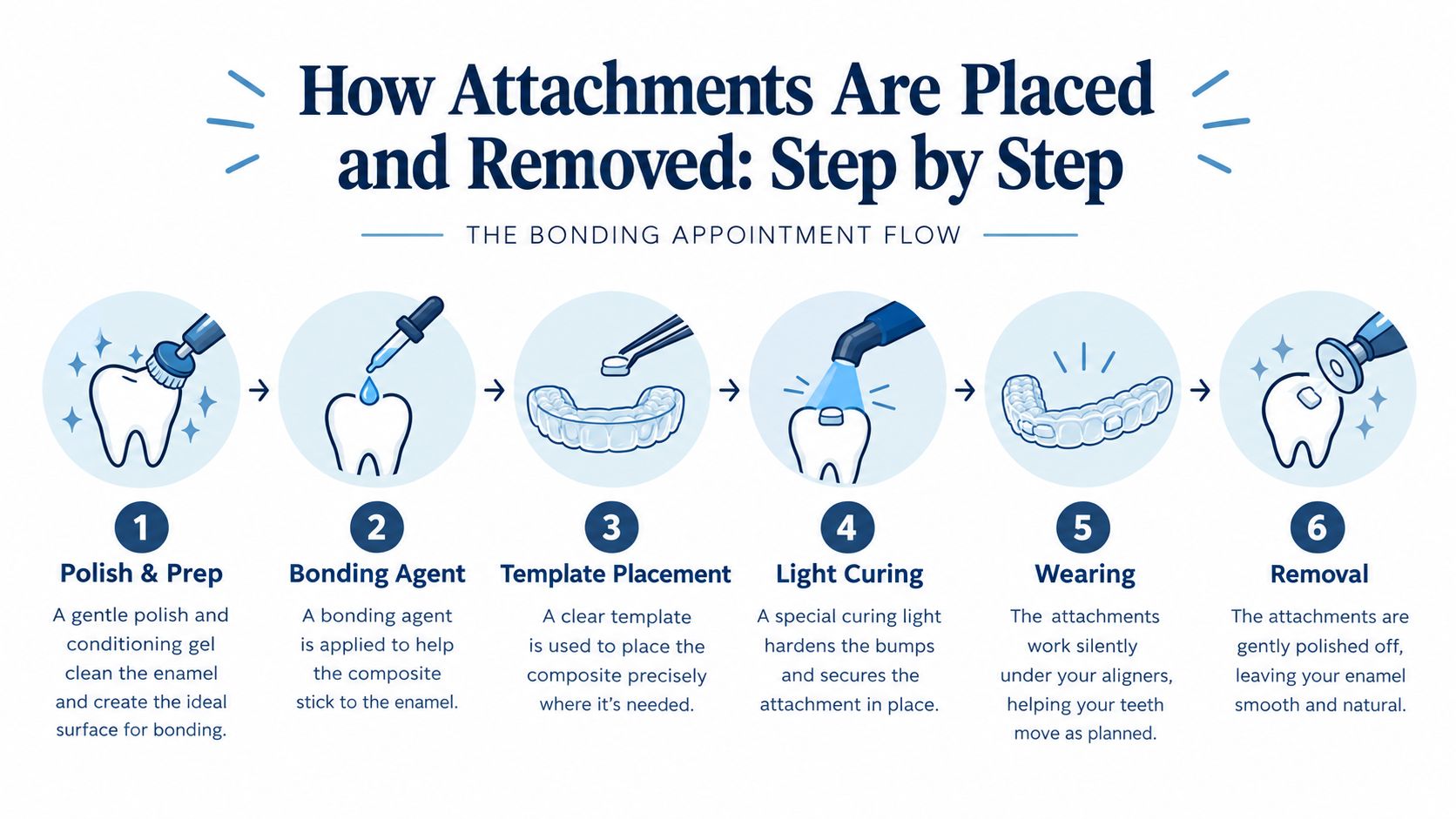
What happens at the placement visit
The process starts with clean, dry teeth. That matters because the attachment has to bond securely enough to do its job every time the aligner goes in and out. Since attachments are a compliance-sensitive part of treatment, good placement is not only about shape. It is also about helping them stay bonded through real daily use.
A gentle conditioning material is placed on the enamel, followed by a bonding agent. Then the attachment material, which is a tooth-colored composite, goes into a custom template that fits over the teeth like a guide. That template places each attachment in the planned spot, almost like using a stencil so every small handle ends up exactly where the aligner expects it to be.
Once the material is in position, a curing light hardens it. The template is removed, and the team checks whether the aligner seats fully over the new attachments.
Most placement visits follow this sequence:
- Clean and dry the teeth so the bonding surface is ready.
- Condition the enamel to help the attachment hold.
- Use a custom template to place each attachment accurately.
- Harden the composite with a curing light so it sets in place.
- Test the aligner fit so the tray grips and seats the way it should.
What it feels like
Children and teens usually describe this visit as strange for a few minutes, not painful. There is no drilling to create the attachment, and there is no healing period afterward.
The bigger adjustment is often the first day or two with the aligners back on. Lips and cheeks may notice the new texture before they get used to it.
Most patients go right back to school, sports, or normal afternoon routines after attachment placement.
How removal works at the end
Removal is also straightforward. When an attachment is no longer needed, the orthodontic team carefully takes off the composite and polishes the tooth so the surface feels smooth again.
That last polish matters. The goal is not just to get the bump off. The goal is to leave the enamel clean and comfortable without scratching or roughening the tooth.
Parents are often relieved to hear that attachments are temporary and professionally removed. They should not be picked at or clipped off at home, even if one looks small or partly worn down.
A few details usually help families feel more comfortable:
- Attachments are temporary: They come off when that stage of tooth movement is finished.
- Removal is controlled and gentle: The team uses instruments designed to lift off the composite and smooth the surface.
- There is no downtime: Kids usually return to normal activities right away.
Why Wear Habits May Matter More Than the Attachment Itself
This is the part many families don't hear clearly enough at the start. Attachments can be designed beautifully, placed precisely, and still underperform if the aligners aren't worn consistently.
An attachment is a handle. It is not a motor. The aligner still has to stay on the teeth long enough to deliver force.
The steering wheel still needs a driver
Parents sometimes focus on whether a child will need attachments, how many there will be, or whether they'll show in photos. Those are fair questions. But the bigger issue is usually daily wear.
When the aligner is seated over an attachment, the plastic stores elastic energy and pushes in a planned direction. Every long break interrupts that process. Every extra removal for snacking, casual sipping, or forgetting to reinsert trays slows it down.
That's why attachments are best understood as a compliance-sensitive design feature. They depend on behavior.
Frequent removal can create real problems
Evidence shows attachments significantly improve retention, but day-to-day habits still affect whether they stay bonded and keep working. A 2025 study reported attachment loss rising over time, with 17% loss in one group versus 8% in another, and a 2.3-times higher risk of loss with frequent aligner removal, according to this published review and summary of attachment loss findings.
That matters for families with busy schedules. A teen who removes aligners often for snacks, sports, band practice, or public speaking may be putting more stress on those bonded bumps than a teen who removes them only when needed.
Why consistency often matters more than design details
There's another useful reality check here. A 2025 systematic review found no significant differences in accuracy for canine derotation, anterior extrusion, or root angulation in most comparisons between optimized and conventional attachments. A broader 2025 review reported the strongest rotation success with weekly-changed optimized attachments at 81.5%, then 76.5% with 14-day changes, and 63.1% for conventional attachments in a more difficult rotation scenario, as outlined in this review article on attachment effectiveness.
For parents, the takeaway is simple. The key question usually isn't “Are attachments good?” It's “Will this child wear the aligners consistently enough for the attachments to do their job?”
A perfectly designed attachment can't help much if the tray spends too much time in a case instead of on the teeth.
Caring for Attachments Day to Day
Daily care gets easier once a patient stops thinking of attachments as fragile little bumps and starts treating them as part of the normal tooth surface. They do need attention, though, because plaque can collect around raised edges more easily than on a completely smooth tooth.
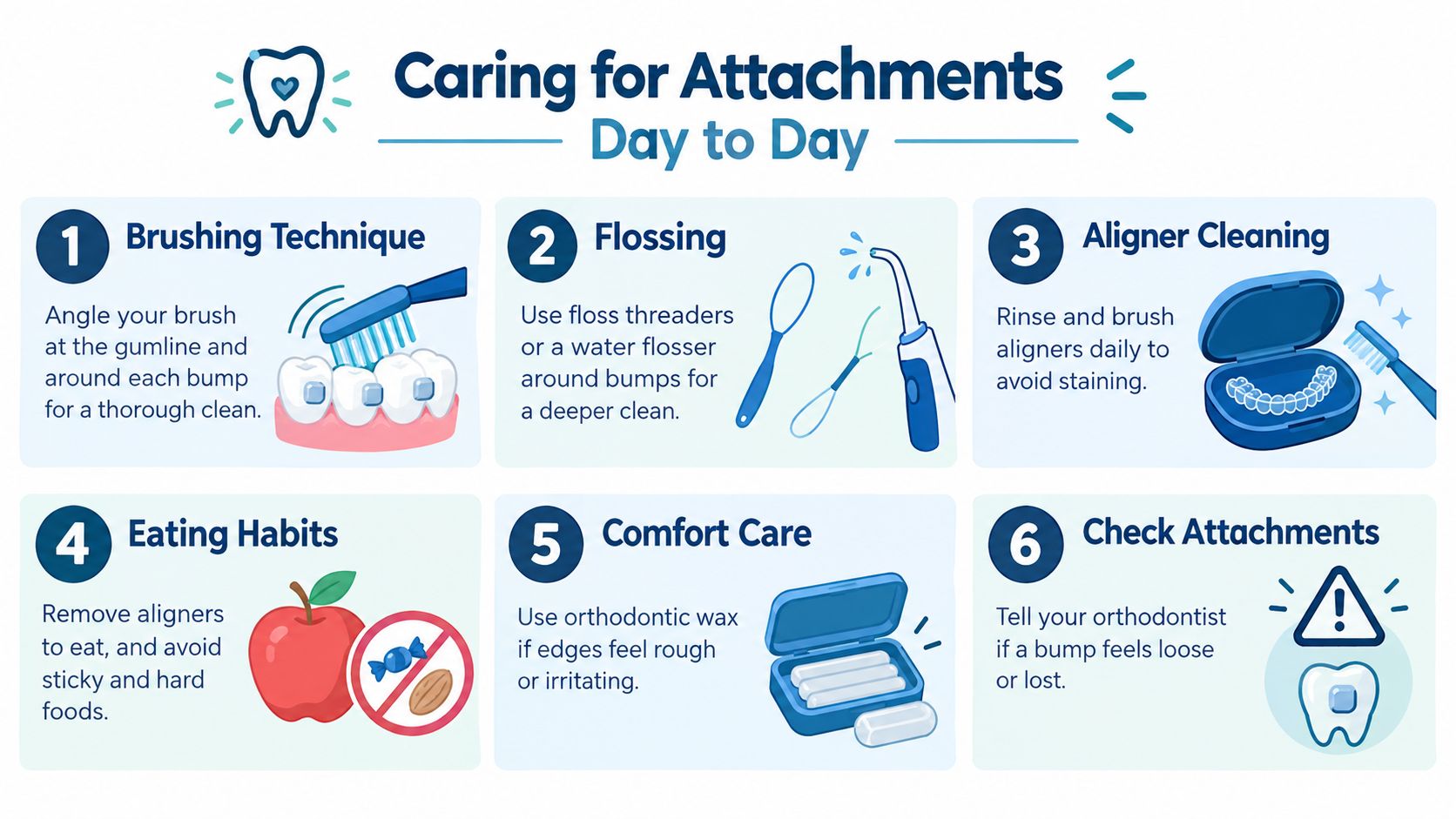
Brushing and flossing around the bumps
The best brushing approach is usually simple and gentle. Angle a soft-bristled brush at the gumline, then sweep around each attachment instead of scrubbing straight across it. That helps clean the ledges where food and plaque can linger.
Some families also find that small interdental brushes or a water flosser make it easier to clean around attachments, especially for teens who rush through brushing. For patients comparing cleaning tools, a general guide to using a water flosser with orthodontic appliances can help explain where those tools fit into a routine.
Food and stain habits
Aligners should come out for meals and for anything other than water. That part is familiar to most Invisalign families. What's less obvious is that attachments can pick up stain over time if a patient repeatedly exposes the mouth to strong pigments and doesn't rinse soon after.
Common stain culprits include:
- Coffee and tea: Dark liquids can dull the look of attachments over time.
- Curry and turmeric: Strong yellow pigments tend to cling.
- Red wine and smoking: Both can discolor teeth and bonded composite.
If brushing isn't possible right away, a good water rinse is still helpful. It doesn't replace brushing, but it's better than letting pigments sit.
If one pops off
A loose or missing attachment isn't a reason to panic, but it is a reason to call the office. In many cases, patients should continue wearing aligners if the tray still fits, then have the orthodontic team decide whether the attachment needs rebonding.
A few practical habits help protect them:
- Remove trays carefully: Don't yank from one side with a twisting motion.
- Avoid biting directly into very hard foods with front teeth: That can stress bonded areas.
- Tell the office if the aligner suddenly feels different: That can be a clue that an attachment is missing.
One Delaware option for families using Invisalign is Stellar Orthodontics, which offers free consultations with digital 3D scanning at its four locations. The useful point for this topic is that attachment checks and aligner fit checks are part of routine orthodontic follow-up, not a separate mystery issue families are expected to manage alone.
Key Takeaways and Booking Your Free Visit
By the time most parents finish learning about attachments, the bumps themselves feel less confusing and the treatment habits feel more important. That's the shift that matters.
Five points families should remember
- Attachments are bonded composite shapes. They're small, tooth-colored features placed on selected teeth.
- They give the aligner something to push against. That extra contact helps with movements a smooth tray may not control as well.
- Shape and placement aren't random. The design matches the movement needed, whether that means rotation, tipping, vertical change, or torque.
- Wear habits strongly affect results. Attachments work best when aligners stay in place consistently and aren't removed more than necessary.
- Good daily care helps them stay discreet and effective. Careful brushing, smart food habits, and prompt follow-up for a loose attachment all matter.
What this means for Delaware families
For families in North Wilmington, Middletown, Dover/West Dover, and Millsboro, the most helpful next step is usually a consultation where the orthodontist can show exactly which teeth may need attachments and why. That conversation often answers more than an online article can, because the pattern depends on the smile, the bite, and the type of movement being planned.
Parents can make that visit easier by bringing recent dental records if they have them, along with insurance information and a list of any questions about school routines, sports, speech, or wear habits. Those practical details often matter just as much as the scan on the screen.
Attachments are worth understanding, but they aren't something families need to fear. They're part of how clear aligners become more precise. Once a parent sees them as planned tools rather than random bumps, the treatment process tends to feel much more manageable.
Families across Delaware can schedule a free consultation to learn whether Invisalign attachments would be part of a child's or adult's treatment plan, what those attachments would do, and how daily wear habits could affect success. To explore care at North Wilmington, Middletown, West Dover, or Millsboro, visit Stellar Orthodontics.