.png)
$9,221 is the cited average for lingual braces versus $6,343 for traditional metal braces, making lingual treatment about $2,878 more expensive on average. The actual gap varies by case, the arches treated, treatment complexity, and the orthodontic provider.
For Delaware families, that difference can change the entire treatment decision. A hidden appliance may be valuable for a client-facing adult, but it can be a poor use of money for a teenager who plays contact sports or a family working within a strict orthodontic budget. The right question isn't only how much lingual braces cost. It's what the extra money buys, and whether that benefit matters in daily life.
Table of Contents
- The Quick Answer on Lingual Braces Cost
- What Lingual Braces Are and Why They Cost More
- Lingual Braces vs Metal, Ceramic, and Invisalign
- What Actually Drives the Lingual Braces Premium
- Who Should and Should Not Pay the Lingual Premium
- Insurance, Medicaid, and Payment Plans in Delaware
- Is the Lingual Premium Worth It for Delaware Families
The Quick Answer on Lingual Braces Cost
The national comparison is clear. Traditional metal braces average about $6,343, while lingual braces average about $9,221, a difference of $2,878, or roughly 45% more using those averages.
The broader headline range is also useful. Lingual braces are commonly listed around $8,000 to $13,000, while conventional metal braces are often around $3,000 to $7,000 in consumer pricing summaries (braces cost ranges). That puts the practical premium somewhere around $3,000 to $6,000 in many comparisons, although the final quote depends on whether treatment covers one arch or both, how complicated the tooth movement is, and how much technical time the case requires.
What Delaware parents should ask
A family comparing quotes should ask four direct questions:
- Which arches are included? Upper-only lingual treatment won't carry the same price as lingual appliances on both arches.
- What does the fee cover? The written estimate should identify scans, appliance fabrication, adjustments, retainers, and follow-up care.
- Is the treatment plan fixed or adjustable? Some practices quote one all-inclusive fee, while others separate major components.
- What happens if the plan changes? A complex bite correction or bracket replacement may affect the final cost.
Lingual braces sit at the premium end because the brackets and wires are made for the tongue side of the teeth, where access is limited and placement is more demanding. The lingual braces pricing overview places lingual treatment around $5,000 to $13,000, compared with roughly $3,000 to $7,500 for conventional metal braces.
Practical rule: A Delaware family should compare the complete treatment fee, not just the starting price. A cheaper quote can become less attractive if important services are excluded.
The rest of the decision comes down to value. If invisibility is a genuine professional requirement, the premium may be defensible. If the goal is a less noticeable smile during treatment, ceramic braces or clear aligners may provide enough cosmetic benefit without the full lingual price.
What Lingual Braces Are and Why They Cost More
Lingual braces use brackets bonded to the back, or tongue side, of the teeth. That placement makes them far less visible than standard braces, whose brackets and wires sit on the front surfaces (how lingual braces work).
The hidden position creates the appeal, but it also creates the cost. The orthodontist has less room to see, reach, and manipulate the brackets. The appliance must fit the individual contours of the inner tooth surfaces rather than relying on a standard front-facing bracket position.

Custom work raises the appliance cost
Lingual brackets and archwires are custom-made for the patient's teeth. Digital scans or impressions help the laboratory design an appliance that follows the anatomy behind the teeth. Each bracket must then be positioned carefully so the planned tooth movement can occur.
That differs from the more standardized components used in conventional metal and ceramic treatment. Standardized appliances still require skill, but the laboratory and placement process is generally less specialized. A guide to adult brace types can help families understand how visibility, removability, and customization differ across treatment options.
Placement requires specialized technique
The orthodontist must work around the tongue and the limited space behind the teeth. Adjustments can also take more care because the brackets are harder to access. Those technical demands help explain why lingual braces are consistently placed at the top of consumer pricing comparisons.
Not every orthodontic office provides lingual treatment. Families should ask how often the provider places and adjusts these appliances, what training supports that service, and whether the consultation includes a clear explanation of the limitations as well as the cosmetic advantage.
Lingual Braces vs Metal, Ceramic, and Invisalign
The clearest comparison places lingual braces beside the main alternatives. National consumer pricing summaries commonly list metal braces around $3,000 to $7,000, ceramic braces around $4,000 to $8,500, clear aligner treatment around $3,500 to $8,000, and lingual braces around $8,000 to $13,000. The lingual range comes from current pricing summaries, while the other ranges are the comparison figures used for this decision framework.
| Treatment Type | Average Cost Range | Monthly at 24 Months | Visibility During Wear |
|---|---|---|---|
| Traditional metal braces | $3,000 to $7,000 | Total divided across the payment term | Clearly visible |
| Ceramic braces | $4,000 to $8,500 | Total divided across the payment term | Less noticeable on the front teeth |
| Invisalign and clear aligners | $3,500 to $8,000 | Total divided across the payment term | Usually discreet, removable |
| Lingual braces | $8,000 to $13,000 | Total divided across the payment term | Hidden behind the teeth |
The monthly column should be treated as a budgeting method rather than a quoted financing offer. A family can divide the complete treatment fee by the number of planned payments, then ask the office whether the schedule includes interest, a down payment, retainers, and replacement appliances. A treatment fee isn't the same thing as a financing agreement.
Metal braces remain the value benchmark
Metal braces are the straightforward financial baseline. They work across a broad range of alignment and bite concerns, remain visible during treatment, and usually carry the lowest starting cost among fixed options. For many Delaware children and teens, that practicality matters more than concealment.
Ceramic braces offer a middle path
Ceramic braces use tooth-colored or less noticeable brackets on the front of the teeth. They can appeal to adults and teenagers who want a lower-profile appearance without moving the appliance behind the teeth. The trade-off is a higher price than metal braces, with visibility that is reduced but not eliminated.
Clear aligners trade hardware for compliance
Clear aligners are removable and discreet, which can make them attractive for patients whose treatment plan suits that approach. They require consistent patient participation, and the total price depends on the treatment plan and number of aligners. Families comparing this option can review clear aligners versus braces for adults before deciding.
Lingual braces are the only option in this comparison that is completely hidden during normal conversation. That distinction matters for some adults, but it doesn't automatically make lingual treatment the best value.
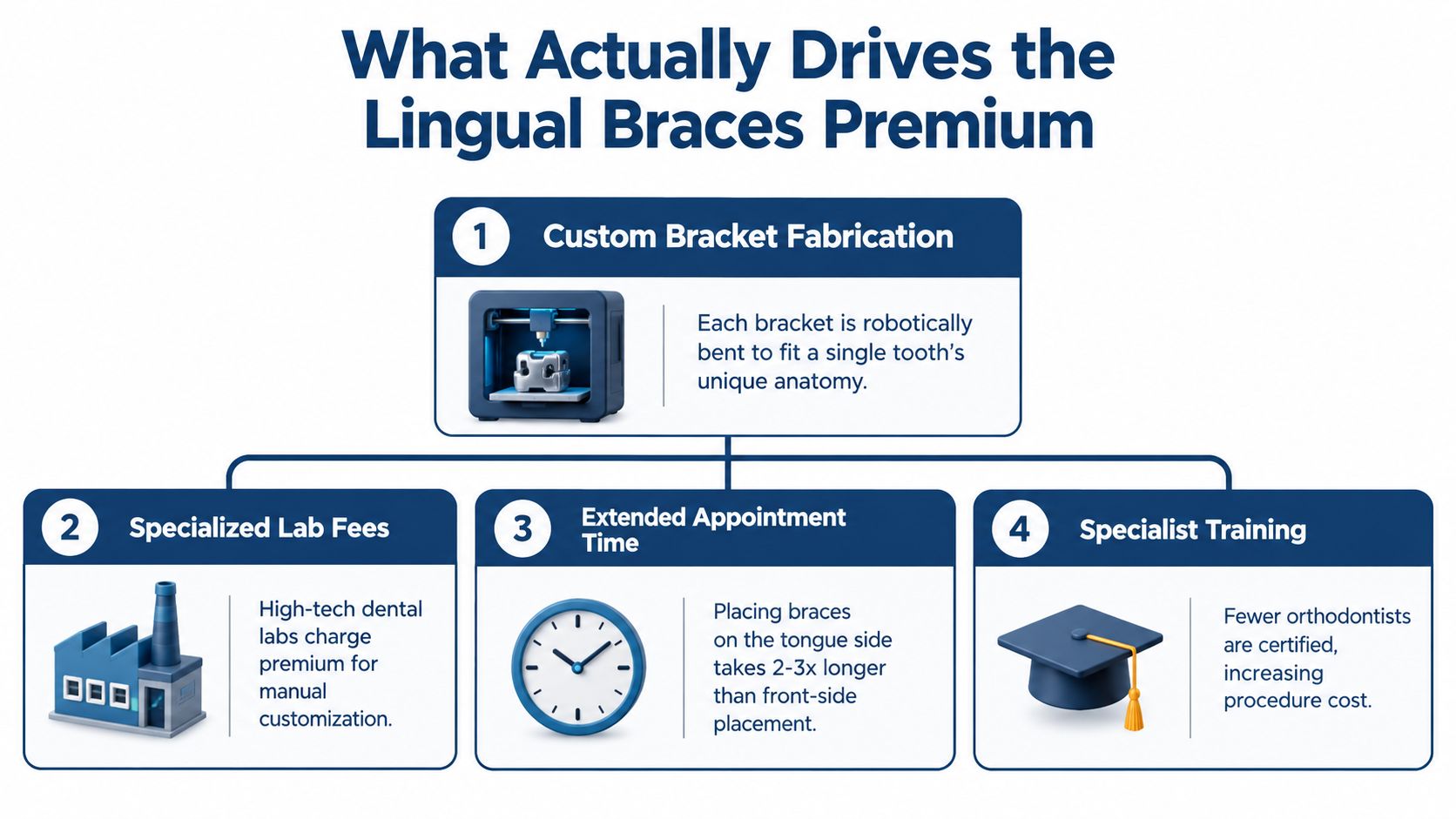
What Actually Drives the Lingual Braces Premium
The premium comes from several connected demands, not from appearance alone. Lingual appliances require more individualized planning, more specialized components, and more difficult access during treatment.
Custom bracket fabrication
A lingual bracket must fit the back of a particular tooth. The inner surface varies from tooth to tooth, so the appliance can't rely on the same straightforward positioning used for many front-facing brackets. Custom fabrication adds laboratory work before the brackets reach the practice.
Specialized scanning and laboratory work
The treatment team may use digital scanning or impressions to create the appliance. The laboratory then fabricates brackets and wires around the patient's anatomy. Those steps add work that isn't required to the same degree for more standardized appliances.
More demanding appointments
The orthodontist works behind the teeth, near the tongue, with less direct visibility. Placement and adjustment therefore require careful handling and specialized experience. The explanation of lingual brace costs identifies custom fabrication and more technical chair time as central reasons lingual treatment can cost more than labial braces.
Case complexity magnifies the difference
Crowding, rotations, and bite corrections can increase the demands of any orthodontic plan. With lingual treatment, repositioning or repairing a hidden bracket can be more technically involved because access is limited. A consultation should therefore explain whether the quoted premium reflects the appliance itself, the treatment difficulty, or both.
Cost question to ask: “Which part of this quote is for the lingual appliance, and which part reflects the complexity of the correction?”
A single-arch plan can sometimes reduce the total cost because it doesn't require the same appliance work on both arches. That option only makes sense when the orthodontist can achieve a balanced result with the selected combination of appliances.
Who Should and Should Not Pay the Lingual Premium
A Wilmington teenager who plays soccer or lacrosse may not be an ideal lingual candidate because the braces are hidden. Contact and impact can make any fixed appliance uncomfortable, and the tongue-side position can create its own irritation during the adjustment period. A removable aligner plan, when clinically appropriate, or a smoother front-facing ceramic option may offer a more practical fit.
An adult in Dover or Newark who works in sales, real estate, law, or another client-facing role faces a different calculation. If visible brackets would affect confidence during daily meetings and presentations, the hidden appearance may have meaningful value. That patient isn't paying only for hardware. The patient is paying for a treatment experience that remains discreet while the teeth are moving.
Budget can settle the question quickly
For a Sussex County family relying on Delaware Medicaid, lingual treatment may be functionally out of reach if the program doesn't pay the additional custom laboratory and premium appliance costs. In that situation, the practical conversation should focus on covered orthodontic care and clinically appropriate options, not on stretching the household budget for a cosmetic upgrade.
The same principle applies to families paying privately. Lingual braces can consume money that might otherwise cover retainers, transportation, missed-work costs, or other household needs. A premium option isn't a good option if the payment creates ongoing financial stress.
Mixed-arch treatment may fit some adults
Some image-conscious adults may ask about lingual braces on the upper teeth with ceramic or metal braces on the lower teeth. That arrangement can reduce the amount of lingual hardware while keeping the most visible part of the smile discreet. Whether it works depends on the bite, tooth movement, and the orthodontist's treatment plan.
The decision should be based on the patient's priorities:
- Choose lingual selectively: The patient places a high value on hidden treatment and accepts the added cost and adjustment demands.
- Choose a middle option: The patient wants a less noticeable smile but can accept brackets or aligners that remain somewhat visible.
- Choose conventional treatment: The family prioritizes predictable budgeting and broad practicality over concealment.
Insurance, Medicaid, and Payment Plans in Delaware
The first step is to request a written benefits check before choosing an appliance. Orthodontic coverage often has a lifetime maximum, and a premium appliance can use that benefit without covering the entire treatment fee. The policy may also classify lingual treatment as a cosmetic upgrade, so the family should ask specifically whether the plan excludes or limits it.
Dental insurance
A benefits coordinator can confirm the orthodontic lifetime maximum, age restrictions, waiting rules, in-network requirements, and exclusions. Families shouldn't assume that coverage for metal braces automatically means equal coverage for lingual braces. The plan's language controls the reimbursement.
HSA and FSA funds
Health savings and flexible spending accounts may help eligible families pay orthodontic expenses with pre-tax funds. The account holder should confirm eligibility and documentation rules with the plan administrator before committing the money to a treatment schedule.
Monthly financing
In-office payment plans can spread the balance across the treatment period. The important questions are whether the plan carries interest, requires a deposit, includes all adjustments, and explains what happens if treatment changes. A monthly figure without those details isn't enough for a fair comparison.
| Payment Source | Typical Coverage | Key Limitation |
|---|---|---|
| Dental insurance | May contribute toward eligible orthodontic care | Lifetime maximums and appliance exclusions can limit help |
| HSA or FSA | May be used for eligible orthodontic expenses | Account rules and available balance apply |
| In-office financing | Spreads the patient balance over scheduled payments | Terms, deposits, and included services vary |
| Delaware Medicaid | Eligibility and covered care depend on program rules and medical necessity | Premium hidden appliances may not be covered |
Families can review Medicaid orthodontic coverage information and then confirm the current benefit directly with the plan. Coverage rules can change, and a pre-treatment estimate is more reliable than a general assumption.
Is the Lingual Premium Worth It for Delaware Families
For most Delaware families, the lingual premium isn't worth paying unless invisibility is a genuine personal or professional requirement.
The financial gap is substantial. Consumer comparisons place lingual braces around $8,000 to $13,000, while traditional braces commonly fall around $3,000 to $7,000. Another comparison places conventional metal braces around $3,000 to $7,500 and lingual braces around $5,000 to $13,000, showing how the premium changes with the starting point and the complexity of the case (orthodontic cost comparison).
That money buys a hidden appliance, not a guarantee of a better final alignment. The orthodontist still has to select the right mechanics, the patient still has to attend appointments and maintain hygiene, and the treatment plan still has to match the teeth and bite.
When lingual treatment earns consideration
Lingual braces can be defensible for an adult who regularly presents to clients, appears on camera, or feels unable to accept visible hardware. The cosmetic benefit lasts throughout treatment, which may justify the expense when appearance has a direct effect on professional comfort.
The option can also deserve consideration when a patient needs fixed orthodontic mechanics but doesn't want brackets on the front teeth. That decision requires an orthodontic assessment, particularly when the bite or tooth position makes the inner surfaces difficult to use.
When the premium is wasted
The premium is harder to justify for a teenager who is likely to focus more on comfort, sports, cleaning, and day-to-day convenience. It is also a weak fit for a family whose insurance or Medicaid plan won't contribute to the additional appliance cost.
Ceramic braces or clear aligners may provide enough cosmetic improvement for patients who want treatment to be less noticeable. If those options can meet the clinical and lifestyle needs, paying substantially more for hidden brackets may not improve the overall experience.
| Delaware Patient Scenario | Recommended Option | Is the Lingual Premium Worth It? |
|---|---|---|
| Teenager involved in contact or field sports | Consider removable aligners when suitable, or a front-facing option | Usually not |
| Adult in frequent client-facing work | Lingual may be appropriate after a full assessment | Sometimes, if invisibility is essential |
| Medicaid family or household with a tight budget | Start with covered and financially sustainable options | Usually not |
| Adult seeking a discreet but lower-cost alternative | Consider ceramic braces or clear aligners when suitable | Usually not |
| Patient needing fixed treatment and strongly rejecting visible brackets | Discuss lingual candidacy and total cost | Potentially |
The simplest decision rule is direct. If hidden treatment is a true professional requirement and the budget can absorb the premium, lingual braces are defensible. Otherwise, Delaware families will often make a smarter financial decision with metal braces, ceramic braces, or clear aligners.
Stellar Orthodontics offers free consultations, digital 3D scanning, braces, and clear aligner treatment at locations in North Wilmington, Middletown, West Dover, and Millsboro. Families can visit Stellar Orthodontics to compare lingual treatment with more budget-conscious options and request a clear consultation-based estimate.