.png)
Braces adjustments are typically scheduled every 4 to 12 weeks, and most patients come in every 4 to 8 weeks during active treatment. That means the answer to how often do braces need to be tightened is usually “not every day, and not on a fixed weekly rhythm,” which can be a relief when a child is settling into treatment.
A lot of parents in Delaware sit in the waiting room with the same quiet question. They're looking at the calendar, juggling school pickups, and trying to figure out whether the next visit will be a big appointment or just another quick check-in.
Table of Contents
- Understanding Braces Adjustment Schedules
- Why Appointment Timing Varies Between Patients
- What Happens During a Braces Adjustment Visit
- How Appliance Type and Age Affect Scheduling
- Signs Your Child May Need an Earlier Visit
- Challenging the More Frequent Is Better Assumption
Understanding Braces Adjustment Schedules
A parent in North Wilmington may hear “come back in a month,” while another family in Middletown is told to wait closer to two months. That difference doesn't mean someone's care is better or worse. It usually means the orthodontist is matching the schedule to the child's teeth, the stage of treatment, and the appliance being used.
The basic pattern is simple. Braces adjustment visits are usually scheduled every 4 to 12 weeks, with many active-treatment patients seen every 4 to 8 weeks (Oral-B on follow-up visits). In everyday terms, that means the plan is flexible, not rigid. Some families will feel like they're back often, while others will notice longer gaps between visits.
The schedule is a roadmap, not a stopwatch
That flexibility is intentional. The American Association of Orthodontists describes braces visits as typically repeating every 4 to 12 weeks, and also notes that follow-up timing varies by treatment stage and the appliance used (AAO braces overview). The practical point is that teeth don't move on a fixed calendar.
Practical rule: a longer gap between visits doesn't automatically mean anything is wrong, and a monthly visit doesn't automatically mean something is difficult.
For parents, the question is usually simpler than the search phrase suggests. It's not only “how often do braces need to be tightened,” it's “how often will my child need to come in, and what happens if that timing changes?” That's the part most first-time families want explained in plain language.
In Delaware, that expectation-setting matters because schedules can feel different from office to office. A child may be seen more often early in treatment, then less often later, or the reverse if the orthodontist is watching a specific movement closely. The important thing is that the rhythm is planned, not random.
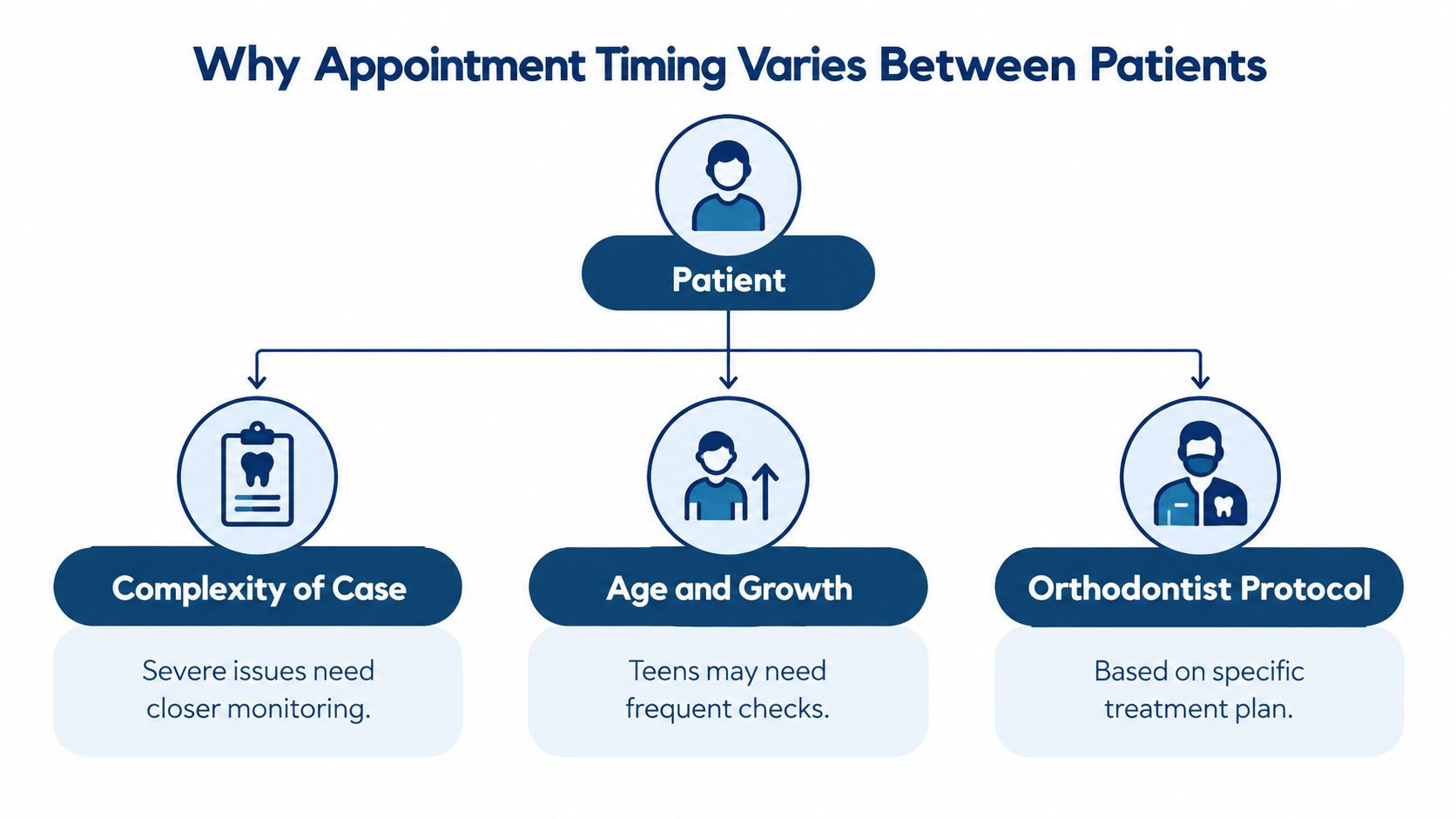
Why Appointment Timing Varies Between Patients
A child can leave one braces visit with a new wire, then return to an appointment that feels much lighter. That difference is normal. Braces care is paced around biology, risk, and progress, so the calendar matters, but it does not tell the whole story (evidence-based considerations).
Why the wire isn't left alone forever
Braces work through gentle force, and that force changes over time. As teeth move, the archwire relaxes and its effect shifts, so the orthodontist schedules the next visit to refresh the mechanics before movement slows too much. These appointments also let the doctor replace elastics, change wires, and check that everything is still moving in a safe direction.
The pace is not the same for every patient. Evidence-based orthodontic guidance describes shorter intervals for adults, often 4 to 6 weeks, because slower cellular response and higher periodontal risk can call for closer monitoring. Children and lower-risk cases may be seen at 6 to 8 weeks or 8 to 10 weeks when the mechanics allow it (AAO clinical guidance).
Simple translation: the schedule fits the patient, then the orthodontist adjusts it as treatment changes.
Some findings need closer follow-up as well. When a concern like clinically relevant root resorption appears, shorter checks, including 4-week visits or a temporary rest period, may be used so tooth movement stays balanced with tissue safety and radiographic monitoring (evidence-based considerations). That is one reason the same child may move from one interval to another during treatment.
Families usually find the variation reassuring once it is explained. A flexible schedule usually means the orthodontist is tracking how the teeth respond to each force change. That is a sign of careful care, especially when treatment is still changing from visit to visit.
What Happens During a Braces Adjustment Visit
The phrase “tightening appointment” makes it sound like someone is cranking down on metal. That's not really what happens. At these visits, the orthodontist may change or replace the archwire, and the archwire is the metal wire that connects the brackets and helps move teeth gradually into position (archwire explanation).
A typical visit, step by step
The visit usually starts with a look at how the teeth have responded since the last appointment. The orthodontist checks whether the brackets are secure, whether the bite is changing the right way, and whether the wire still matches the stage of treatment. If needed, elastics may be replaced and the wire may be adjusted so the next phase of movement can continue.
Think of the archwire like a gentle guiding hand. It keeps working for a while, then needs a refresh so it can keep nudging the teeth in the right direction. That's why some visits feel more noticeable than others.
A simple way to understand this:
- First, the orthodontist looks at progress. The teeth are compared with the expected movement.
- Then, hardware is refreshed if needed. That can include wire changes or new elastics.
- Finally, the plan is checked again. The goal is safe, steady progress, not forcing movement.
Some families ask whether every visit hurts the same way. Not usually. A wire change can create some pressure afterward, but that feeling varies from patient to patient and from visit to visit. The important point is that discomfort, when it appears, is usually tied to the teeth being asked to adapt to a new force pattern.
For parents who want a better sense of appointment length and flow, this overview of how long braces appointments take helps put the visit in context without the mystery.
Why not every visit looks dramatic
Some appointments are mostly checks. Others involve active changes. That's why a family can come in every six weeks without seeing a major wire change every single time. The cadence of visits and the amount of work done at each visit aren't always the same thing.
The calmest way to read the schedule is this, the appointment is the checkpoint, not always the main event. Sometimes the orthodontist is just confirming that the plan is still on track.
How Appliance Type and Age Affect Scheduling
A child with traditional braces and elastic ligatures may not follow the same rhythm as a teen wearing another bracket system. That difference is normal. Some appliances need closer follow-up because they rely on regular wire changes, while others can stretch the time between visits a little farther. For a plain-language comparison of those treatment styles, see clear aligners vs traditional braces.
The appliance matters
Some guidance from Orthodontics Australia on tightening frequency describes orthodontic visits as commonly spaced within a range that can include 6 to 10 weeks, while earlier convention often placed adjustments around 6 to 8 weeks. That is a schedule, not a fixed rule. The actual interval depends on how the appliance is built and how the teeth are responding.
A self-ligating system may allow longer gaps between visits than traditional braces, because the visit is often more about checking progress than replacing ties. Traditional braces, by contrast, may need more hands-on changes when the wires and elastics are doing the main work. The appointment can feel like a tightening visit in one chair and a quiet checkup in another.
Age also matters. Teens and adults do not always move on the same timetable, because growth, bite complexity, and gum health can change how often the orthodontist wants to see them. Children and teens may stay on a standard rhythm at first, then shift if their teeth move faster or slower than expected. Some patients need a shorter interval because the next step is ready sooner. Others are better served by waiting until the scheduled visit, so the teeth are not pushed before they are ready.
Good scheduling follows the tooth movement, not the other way around.
For families comparing treatment options, age and appliance type affect more than the calendar. Aligners usually involve periodic check-ins rather than wire adjustments, while bracket-based systems rely more directly on appointment-based changes. Parents who want a side-by-side overview can use this guide to clear aligners vs traditional braces as a starting point.
A Delaware-specific reality
Stellar Orthodontics sees families across North Wilmington, Middletown, Dover/West Dover, and Millsboro, so scheduling often needs to work around school, sports, work, and driving time. That makes personalized planning more than a convenience. It is part of keeping treatment realistic for families.
The simplest takeaway is this. There is no single schedule that fits every child or every appliance. The right rhythm is the one that matches the mechanics being used and the way the teeth are responding.
Signs Your Child May Need an Earlier Visit
Most braces schedules assume everything is moving along normally. When something changes between visits, that schedule can shift. A broken bracket, a detached band, or a wire that starts poking can all mean the orthodontist should take a look sooner rather than later.
The signs that deserve a call
Some problems are obvious. Others are subtle enough that a parent only notices because the appliance looks or feels different from last week.
- Broken or loose hardware: A bracket that has come off or a band that no longer feels secure should be reported.
- A poking wire: Sharp irritation from the wire can usually be handled sooner, before it turns into a constant sore spot.
- Elastics that aren't staying in place: Missing or loose elastics can change how treatment is progressing.
- Pain that doesn't match normal soreness: A little tenderness after an adjustment is expected, but lingering or sharp discomfort deserves attention.
- Movement that looks off: If teeth seem to be shifting in an unexpected way, the schedule may need to change.
That last point is the one families often miss. Many guides don't explain why visit timing varies so much, even though treatment is increasingly individualized. Parents usually don't need to diagnose the issue, they just need a reason to call.
A simple rule helps: if something looks broken, feels different, or seems to be tracking poorly, don't wait for the next routine visit. Early attention is usually a normal part of orthodontic care, not a sign that something has gone badly wrong.
Families who notice new spacing concerns can also look at this article on why teeth may separate with braces to understand why changes sometimes happen during active treatment.
When in doubt, a call is better than a guess. That's especially true for parents in North Wilmington, Middletown, Dover/West Dover, or Millsboro who want to avoid unnecessary stress and keep treatment on track.
Challenging the More Frequent Is Better Assumption
A family can sit down expecting another wire change and leave with a quieter visit. That can feel surprising, but it often means the plan is working as intended. In orthodontics, more appointments do not always mean better progress. Some schedules leave more time between visits because the teeth, the appliance, or the treatment stage calls for a slower rhythm, as noted in appointment-interval guidance.
Why a busier schedule isn't always a better one
Some visits are more like a checkpoint than a reset. The orthodontist may look at alignment, confirm the mechanics are still doing their job, or make a small change that keeps everything on course. A visit can still matter even when it does not feel dramatic.
The hidden FAQ is not the calendar number. It is the judgment call, whether the next appointment should wait or happen sooner because the plan needs attention. That distinction is what parents usually want most, because it turns uncertainty into a clear next step.
A faster pace can also work against the goal if it pushes treatment before the mouth is ready. Orthodontic care depends on steady, safe movement, not on filling the calendar. Like watering a plant, the right rhythm supports growth better than too much, too soon.
For Delaware families, that usually means a plan that fits the child instead of forcing the child into a fixed schedule. Stellar Orthodontics offers personalized scheduling across North Wilmington, Middletown, Dover, and Millsboro, so visits can match real treatment needs rather than a one-size-fits-all routine.