
A parent has a dentist's recommendation, a school calendar full of activities, and an insurance card that doesn't explain much about braces. North Wilmington, Middletown, Dover/West Dover, and Millsboro may all be reachable, but it's still hard to tell which orthodontic office deserves the family's trust.
Learning how to choose an orthodontist starts with questions that go beyond appliance brands. Can the office book a new patient under the child's coverage? Who will make treatment decisions, and will that orthodontist remain involved through follow-up and retention? Clear answers matter more than a polished lobby or an appealing monthly payment.
Table of Contents
- A Parent Checklist Before You Book
- Check Specialty Training and Board Status
- What the First Visit Should Decide
- Make Sure Coverage Means a Real Appointment
- Judge Follow-Up Before You Compare Quotes
- Book the Delaware Office You Will Keep
A Parent Checklist Before You Book
Orthodontist scorecard for Delaware parents
Use a separate copy for each office. Mark each answer while it is fresh, then compare the completed scorecards. The goal is to see who will guide the case, what the plan includes, and whether the family can keep up with visits.
| Check | A useful answer | Ask this | Walk away if |
|---|---|---|---|
| Credentials | The doctor's specialty training and board status are clear | Is the doctor an orthodontic specialist, and is the doctor board certified? | The office gives only a general dental title |
| Who treats the case | The orthodontist responsible for the case runs the consultation and sees the patient at each visit | Who handles the consultation and adjustments? | The office cannot name the orthodontist who will follow the case |
| Timing | The recommendation is now, later, or no treatment, with a reason | Does this child need treatment at this age? | The family is pressured to start braces that day |
| Written plan | The plan explains treatment options, timing, monitoring, and retainers | Can we take home a written plan? | The office gives only a verbal finish-date estimate |
| Coverage access | The specific plan can be used for a new orthodontic patient | Is this Medicaid, CHIP, or dental plan accepted for a new patient? | Staff say coverage is accepted but cannot identify the plan |
| After active care | The office explains follow-up, urgent help, and retainer arrangements | Who handles a broken wire or a retainer problem? | The quote says nothing about retainers or urgent visits |
| Location | The office is practical for recurring appointments every 6 to 8 weeks | Which Delaware office fits school and work schedules? | The family doubts it can keep attending visits there |
Use the scorecard during the consultation
Start by identifying the orthodontist who will make clinical decisions. A coordinator can help with scheduling and paperwork, but the family should know which orthodontist is responsible for the diagnosis, treatment plan, and adjustments.
Then ask why treatment is recommended now, later, or not at all. A clear answer ties the recommendation to the child's needs. Request the written plan so the family can review the options, expected timing, monitoring, and retainers rather than relying on a quick verbal summary.
Coverage and follow-up need separate questions. An office may accept a plan in general but not be able to book a new patient under it. Ask about the exact plan, urgent concerns, and what happens after active treatment ends.
Stellar Orthodontics has four Delaware offices: North Wilmington, Middletown, West Dover, and Millsboro. The scorecard can help families compare whether an office fits their schedules and the visits their child's care will require.
A welcoming lobby and an appealing payment arrangement cannot replace a named orthodontist and a written plan.
Record what the office still needs to answer
Write down the child's main concern, such as difficulty biting, crowded teeth, or discomfort about appearance. Use those details to check whether the orthodontist's explanation addresses the family's actual questions.
Before leaving, mark any unanswered scorecard items. A “fail” means pause before committing and ask the office to resolve the gap. Treat a finish-date estimate as a guide, not a guarantee: growth, oral hygiene, and missed visits can affect timing.
Check Specialty Training and Board Status
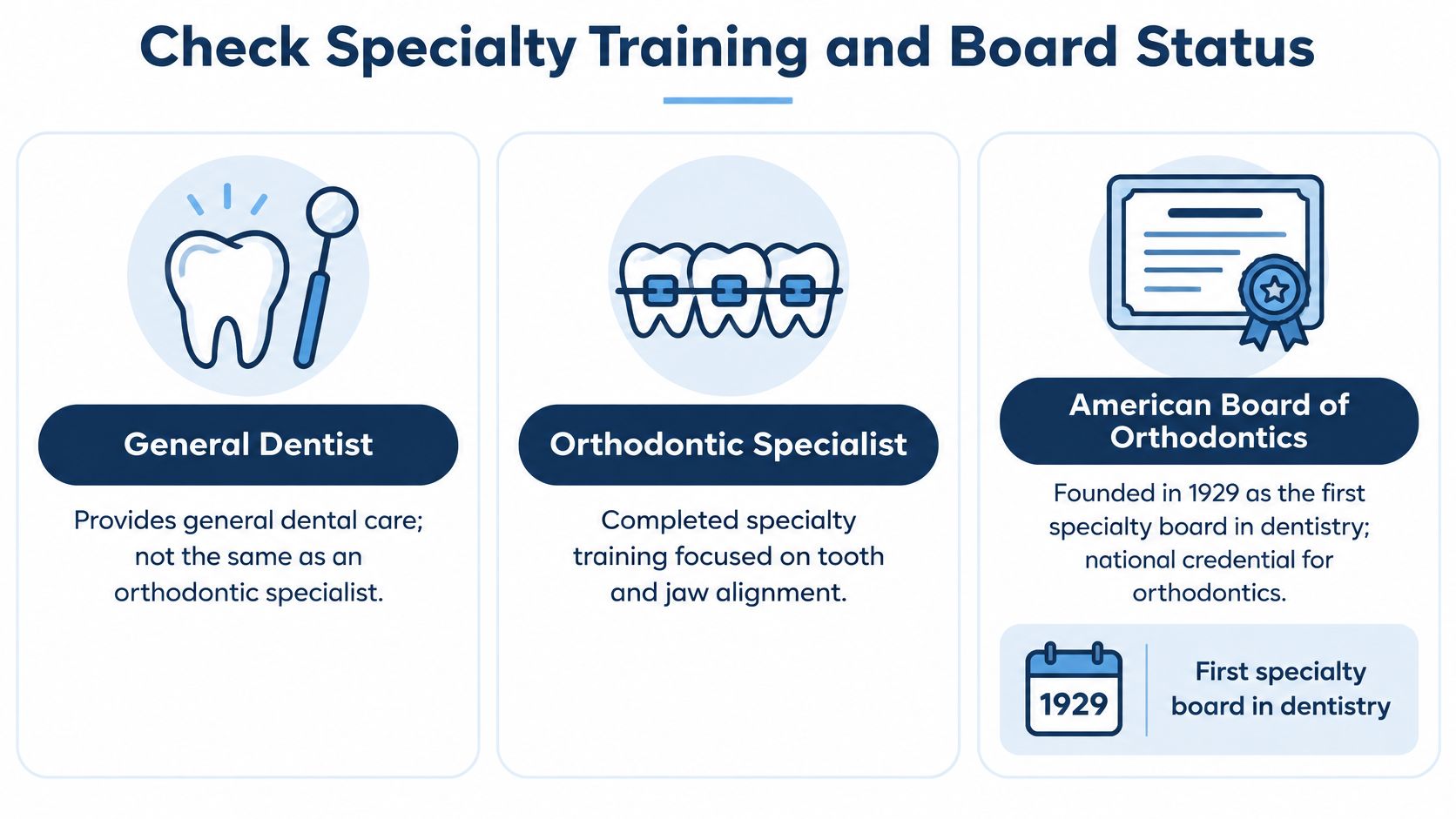
A dentist may have additional training focused on tooth and jaw alignment. Before comparing appliances, ask whether the doctor treating the case completed an accredited orthodontic program. Board certification is another credential to check, alongside the doctor's license and the explanation of the proposed care.
The difference is easier to compare visually.
What board certification establishes
The American Board of Orthodontics, founded in 1929 as the first specialty board in dentistry, certifies orthodontists and dentofacial orthopedists. It reported that 58% of AAO members were board certified in 2022, compared with approximately 46% of practicing AAO orthodontists in 2020. These figures show why families should check the individual doctor's status rather than assume the credential is held by every orthodontist.
Certification is voluntary and provides an additional professional assessment. It can help families understand a doctor's qualifications, while the consultation explains the treatment being considered for the patient.
According to the ABO's credential-verification information, candidates complete an accredited orthodontic program, pass a written examination, then qualify for and pass a scenario-based clinical examination. Certified orthodontists must meet renewal requirements every 10 years.
Verify the individual doctor
The credential belongs to a specific doctor, not to a practice logo. Record the treating orthodontist's full name and confirm whether the advertised certification is active.
- License: Ask for the doctor's Delaware license number and check its current status through the state's professional licensing records.
- Specialty training: Ask where the doctor completed an accredited orthodontic program.
- Certification: Check the named doctor's ABO status instead of relying only on a website badge.
- Responsibility: Clarify which doctor will approve the diagnosis and treatment plan.
Stellar Orthodontics has three orthodontists, including board-certified specialist Dr. Can Nguyen. Dr. Nguyen belongs to the American Association of Orthodontists, the Middle Atlantic Society of Orthodontists, and the American Dental Association.
Dr. Robert Park's research on dental education and orthodontic materials has been published in dental journals, and he lectures to local dentists on orthodontics. Publications, professional memberships, specialty training, and board certification describe different parts of a doctor's background.
If the ABO's records do not confirm a doctor's status, ask the office to clarify the credential before relying on it. Then consider the doctor's training and the treatment explanation together when deciding whether to proceed.
What the First Visit Should Decide
The first visit should establish whether treatment is appropriate and, if so, when it should begin. It shouldn't require a parent to arrive already knowing which appliance to choose.
The American Association of Orthodontists' family guidance recommends a first orthodontic checkup no later than age 7, when many children have both primary and permanent teeth; children with noticeable concerns can be evaluated earlier, and older children haven't missed their opportunity for an initial assessment.
The consultation should turn those general recommendations into an explanation specific to the child.
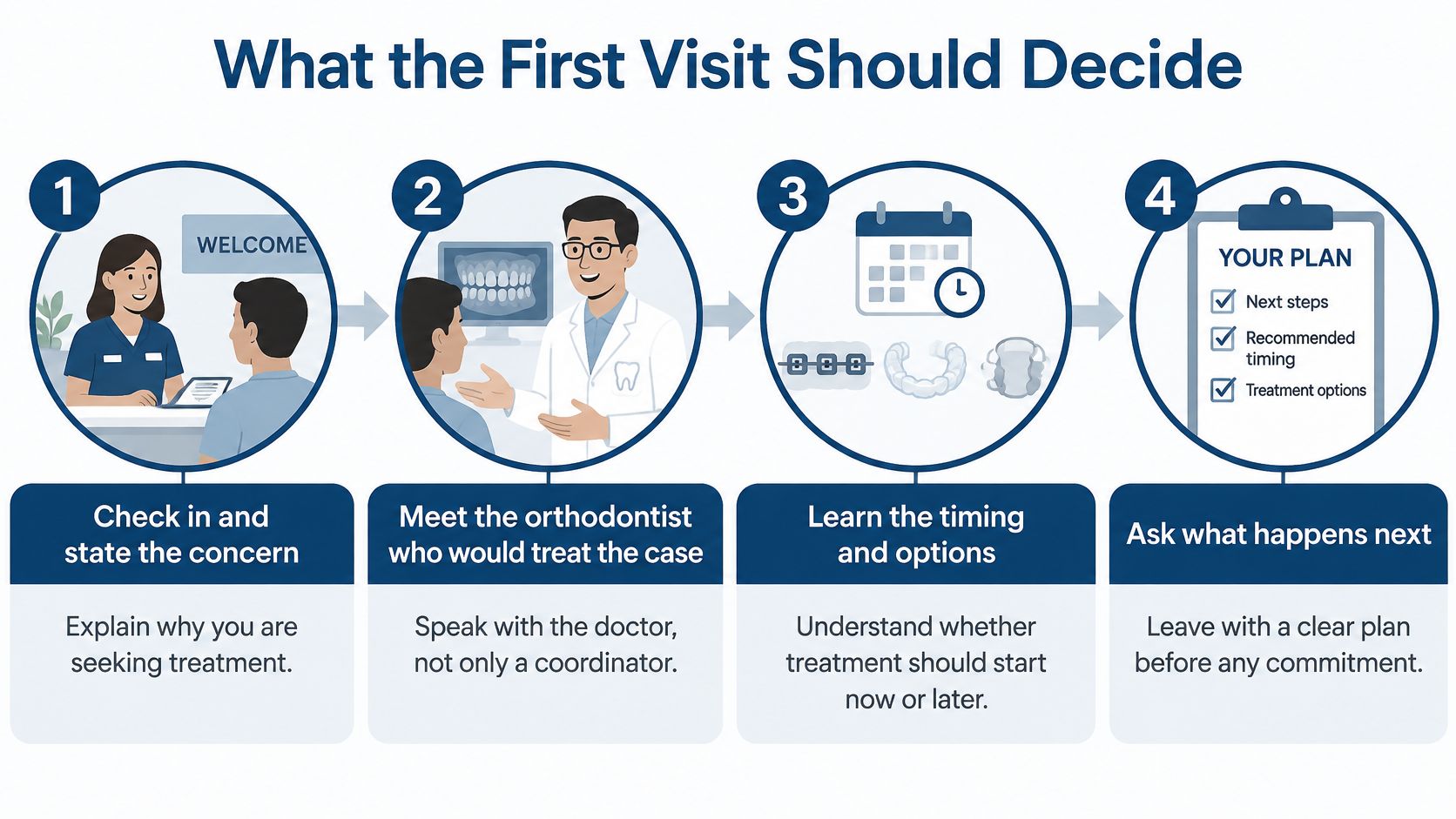
Follow the visit from concern to decision
Stellar Orthodontics follows this consultation sequence, and the orthodontist who would treat the case runs the consultation:
- Check-in, about 5 minutes. The family explains the concern and supplies relevant history. The decision to establish is what the appointment needs to investigate.
- Meeting the orthodontist, about 5 minutes. Parents and patients meet the doctor responsible for the proposed care. The family should leave this step knowing who owns the clinical decisions.
- Clinical examination, about 10 minutes. The orthodontist examines the teeth, bite, eruption, and jaw relationships. The explanation should identify the concern, not merely label the smile as crowded.
- Records, about 15 minutes. This stage includes a 3D iTero scan and x-rays as clinically justified. The doctor should explain what the records help assess.
- Treatment plan, about 15 minutes. The orthodontist explains timing, goals, options, and estimated duration. The decision is whether to start, monitor development, or recommend no treatment.
- Financial walkthrough, about 10 minutes. The family reviews the proposed costs and coverage. The decision is whether the financial arrangement is understood before any commitment.
Families can review the first-visit overview before attending, then bring questions that match their child's concerns.
Translate clinical language into a usable plan
A diagnosis should explain how tooth position, jaw relationships, growth, and eruption affect the recommendation. If extraction is proposed, the orthodontist should explain why and discuss the alternatives. Gum health and oral hygiene also belong in that conversation.
A clinical review of orthodontic treatment planning emphasizes documented assessment, clear objectives, appliance alternatives, adherence, and retention rather than selection based only on an appliance brand.
A consultation can end with monitoring or no treatment. That's a clinical decision, not an unsuccessful appointment.
Some Stellar Orthodontics consultations find that the patient doesn't need orthodontic treatment, and the team tells the patient so. When monitoring is recommended, the written next step should explain what change would prompt reassessment.
Parents should also understand what happens if hygiene deteriorates, appointments are missed, or growth changes the original assumptions. A useful plan makes room for clinical judgment rather than treating the estimated completion date as a fixed deadline.
Make Sure Coverage Means a Real Appointment
Coverage on paper doesn't necessarily produce an available appointment. National access research and a 2025 database review described limited or no access to orthodontic or other dental specialists for Medicaid-enrolled children in about half of U.S. states, with 17 states having no orthodontic or dentofacial-orthopedic provider accepting new patients, as summarized in this Medicaid specialist-access analysis.
For a Delaware family, the useful response is verification, not an assumption that local care is unavailable. Staff need to confirm the exact plan, patient eligibility, and an actual booking opportunity.
The access checks below help separate a general insurance statement from an appointment the family can use.
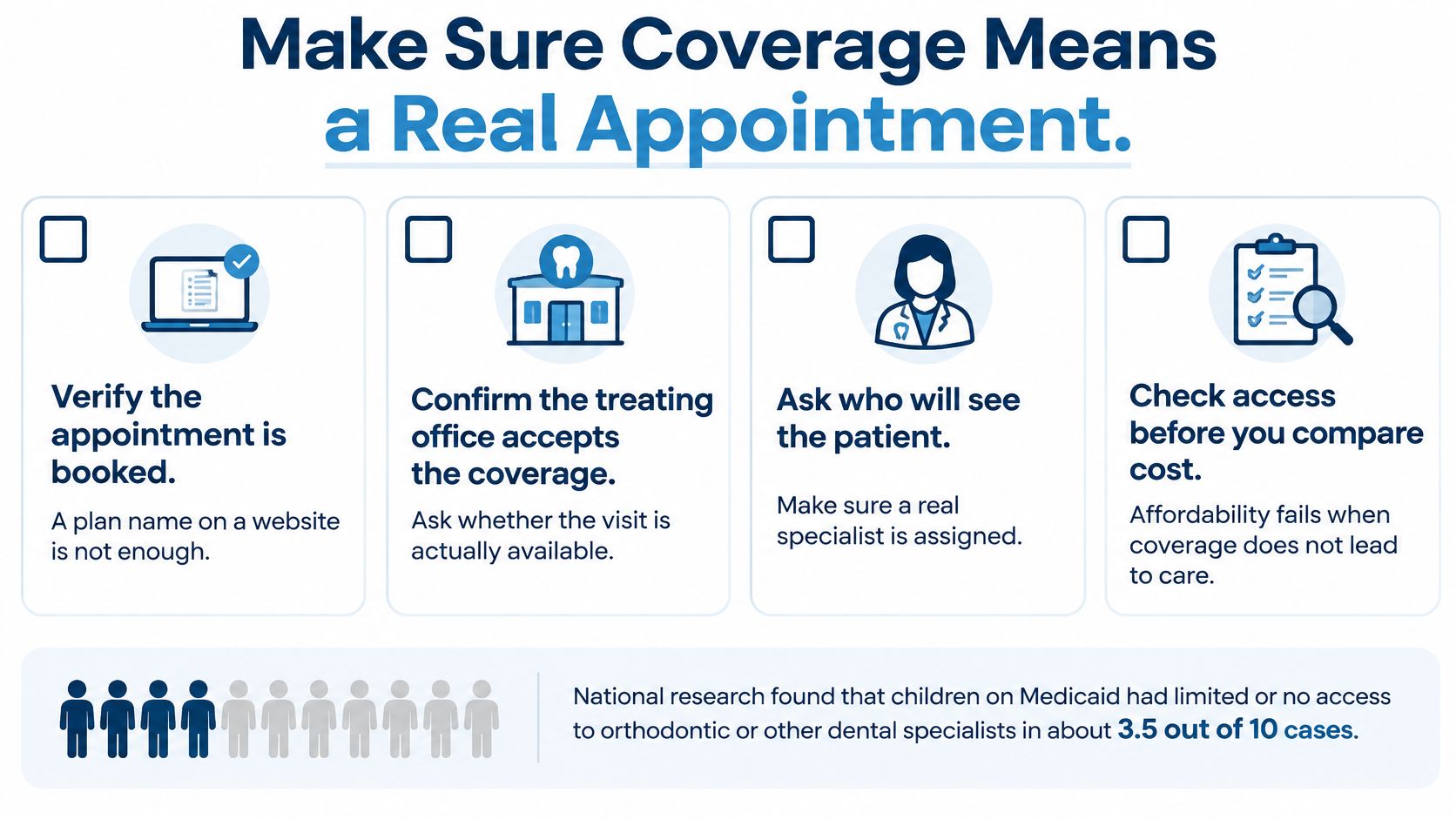
Questions that turn coverage into a next step
- Which exact plan is on the card? Staff should verify the full Medicaid, CHIP, or commercial dental plan name, rather than treating all coverage as interchangeable.
- Are new orthodontic patients being booked under that plan? A useful answer includes an available consultation time at the intended office, not just confirmation that the practice participates.
- Does the child meet the plan's medical-necessity criteria? The family needs to know who evaluates the bite and documents eligibility. At Stellar Orthodontics' free evaluation, the orthodontist determines whether the child meets Delaware Medicaid's medical-necessity criteria, and the family learns the result before leaving.
- Who handles prior authorization and a denial? Establish who submits records, how the family receives updates, and what review or appeal options the plan permits.
- Is a dentist's referral required? Most Delaware Medicaid plans allow self-referral for orthodontic evaluation, so a dentist's referral is often unnecessary. The office should still confirm the requirement for the specific card.
The insurance information page can help families prepare for that conversation. An eligibility assessment and an insurer's authorization are different steps, so parents should understand which has been completed before scheduling treatment.
Compare the financial responsibility, not just the payment
Medicaid, CHIP, and commercial dental coverage shouldn't be compared as though they follow identical rules. Public coverage can depend on qualifying clinical criteria and authorization, while commercial benefits may leave a different balance for the family.
| Coverage situation | Written answer the family needs |
|---|---|
| Medicaid or CHIP | Eligibility findings, authorization steps, and any permitted patient responsibility |
| Commercial dental insurance | Estimated plan contribution and the remaining family balance |
| Coverage denied or unavailable | Full self-pay amount and available payment arrangements |
For a commercial estimate, separate the orthodontic fee, imaging, retainers, replacement appliances, missed-appointment charges, and urgent visits. Identify whether refinements or extended treatment could change the total.
Cost check: A low monthly payment isn't the total price. The family needs the full amount, payment schedule, and exclusions.
A family facing uncertain coverage should also request a written explanation of what happens if the insurer pays less than estimated. That answer makes comparison possible without assuming approval or committing under pressure.
Judge Follow-Up Before You Compare Quotes
A lower starting quote may be less useful than a clear answer about who will guide the case from adjustment visits through retention. Ask whether one orthodontist will follow progress, explain treatment changes, and remain responsible as active treatment ends. That continuity matters more than the appliance brand.
At Stellar Orthodontics, patients see the same orthodontist at every visit. If that orthodontist is out, another can provide continuity of care. Adjustment appointments happen every 6 to 8 weeks, last about 30 minutes, and allow the orthodontist to adjust treatment as the patient's smile changes.
Use a calendar to check how recurring appointments fit school, work, and family schedules.

Establish responsibility between appointments
Ask who treats the case, who covers when that orthodontist is unavailable, and how the team tracks progress through examinations, photographs, or scans. If treatment changes, the orthodontist should explain what is changing and why, so the family understands more than a new wire or instruction sheet.
Clarify how to get help with an urgent problem, such as a poking wire. Ask whom to contact outside office hours, how staff decide whether the patient needs an appointment, and whether an urgent visit has an additional charge.
A family might manage routine visits but find it difficult to return during the school day for a repair. Knowing the contact process ahead of time makes it easier to plan what to do if an appliance breaks.
Evaluate retention before active treatment ends
A retainer plan should identify the appliance for the upper and lower teeth, how often to wear it, when it will be reviewed, and what repairs or replacements cost. Ask what to do if a bonded wire comes loose or a removable retainer stops fitting. Who replaces a failed bonded retainer, and what does that service cost?
The review of orthodontic retention evidence found limited evidence that fixed retainers are generally more effective than removable retainers over the long term. It reports that fixed retainers may maintain lower front-tooth alignment more reliably during the first six months. The review also summarizes published failure estimates:
Published retainer failure ranges
Source: review of orthodontic retention evidence
| Measure | Reported figure |
|---|---|
| Bonded fixed retainers, overall failure | About 28.17% |
| Bonded fixed retainers, first year | About 25% |
| Bonded fixed retainers, 5 to 6 years | About 41.78% |
| Mandibular fixed retainers, average | About 29%, with wide variation across studies |
These figures describe study findings, not what will happen to an individual patient. Retainers need cleaning, appropriate wear, maintenance, and periodic review. Ask how the office handles follow-up if a retainer needs attention.
The embedded video below discusses orthodontic retention and can help families prepare questions about keeping teeth in position after active treatment.
Before comparing final quotes, establish whether the treating orthodontist supervises retention or formally transfers responsibility. Ask who handles a failed retainer and what the service costs.
Clear aligners still call for a discussion about attachments, refinements, and retention. The complete care pathway matters more than the appliance label.
Book the Delaware Office You Will Keep
A clinic can be close to home and still be hard to reach between school, work, and other family commitments. Before choosing an office, trace the trip you would make on a weekday, then consider whether that route will still work for regular appointments.
Stellar Orthodontics has four Delaware offices: North Wilmington at 2304 Concord Pike, Middletown at 818 Kohl Avenue, West Dover at 125-2 Greentree Drive, and Millsboro at 26670 Centerview Drive. The locations serve families across Brandywine Valley, the MOT corridor, Kent County, and Sussex County. Use the Delaware office locations to compare routes with your usual schedule.
Test the journey against a normal weekday
For example, a parent choosing between North Wilmington and Middletown can estimate the trip from school or work, rather than only from home. Include the time needed to collect the child and get back to the rest of the day. A Kent County family considering West Dover can also plan who will take the child if the usual caregiver is unavailable.
The same test applies in Sussex County. An office that suits an occasional weekend trip may be less practical than Millsboro if weekday transportation there is more reliable. Adults can make a similar comparison by considering time away from work and how easily follow-up visits fit their routine.
The office matters, but so does the clinician who follows the case. Stellar has three orthodontists, Dr. Robert Park, Dr. Can Nguyen, and Dr. Sonal Dave. Patients see the same orthodontist at every visit, and another orthodontist can provide continuity of care if theirs is out. Ask how that arrangement would work at the office you choose, including through retention.
Arrive prepared, without an obligation to start
Stellar Orthodontics offers a free consultation, whether or not the patient proceeds with treatment, insurance covers any of it, or a child qualifies for Medicaid braces. The family can use the visit to discuss the child's school schedule, travel arrangements, and any practical questions about returning for care. There is no need to decide on treatment because an evaluation took place.
Some patients do not need orthodontic treatment. If that is the orthodontist's assessment, the family is told. That answer can help clarify whether to wait and what would make another evaluation appropriate.
When you are ready, choose the Delaware office that fits your ordinary travel routine and ask about the appointment process. That practical fit, together with continuity with the treating orthodontist, matters more over time than choosing an appliance by name.