.png)
For straightforward crowding or spacing, Invisalign is often a strong choice for Delaware adults, especially when comfort and flexibility matter. For complex bite corrections or patients who struggle to wear removable appliances consistently, traditional braces can remain the more predictable value.
An adult in North Wilmington may want a straighter smile before an important presentation, while a parent in Middletown may be thinking about treatment before a family event. Someone in Dover or Millsboro might like the idea of orthodontics but worry that visible braces won't fit comfortably into work, travel, school, or social plans. The question isn't only whether clear aligners can move teeth. It's whether the benefits justify the cost, daily responsibility, and possible limitations for that particular adult.
Table of Contents
- Introduction - The Delaware Adult's Dilemma
- The Clinical Reality of Adult Invisalign
- The Compliance Factor - Wear Time and Discipline
- Comparing the True Cost - Invisalign vs Traditional Braces
- Comfort, Aesthetics, and the Adult Lifestyle
- Treatment Timelines and Local Candidacy
Introduction - The Delaware Adult's Dilemma
An adult who has postponed orthodontic treatment often has practical reasons. Work meetings, family photographs, public speaking, travel, sports, and busy evenings can make traditional braces feel difficult to picture. Clear aligners appear to solve that problem because they're less noticeable and can be removed, but convenience only creates value when the treatment works with the patient's habits and clinical needs.
The better question is not, “Are aligners better than braces?” It's, “Which option gives this adult a predictable result without creating a burden that becomes difficult to manage?” That answer depends on the type of tooth movement needed, the patient's willingness to wear aligners consistently, and the insurance-adjusted price rather than the advertised starting figure.

A realistic adult decision
Consider a professional who removes an aligner during lunch, forgets to put it back before a meeting, and then gets home to manage dinner and children. That routine may be manageable if the aligner is returned promptly, but repeated delays can change the treatment experience. A fixed appliance doesn't depend on remembering to put it back after every meal.
Another adult may have mild crowding, care a great deal about appearance, and keep a reliable daily routine. For that person, the ability to remove aligners for meals and maintain familiar brushing and flossing habits may justify choosing Invisalign even when braces are also clinically possible.
The decision becomes clearer when the evaluation includes four questions:
- Clinical fit: Is the case mild to moderate, or does it require difficult bite and root movements?
- Daily behavior: Can the patient wear aligners for most of the day and remember to replace them?
- Financial value: What will insurance, financing, and available HSA or FSA funds do to the actual out-of-pocket amount?
- Lifestyle priority: Does discreet treatment matter enough to justify the discipline of a removable appliance?
Practical rule: Invisalign is valuable when its visibility and flexibility solve a real adult problem, not simply because the aligners look modern.
The following factors help adults in North Wilmington, Middletown, Dover/West Dover, and Millsboro judge that trade-off fairly.
The Clinical Reality of Adult Invisalign
Clear aligners aren't limited to tiny cosmetic adjustments, but they also aren't a universal substitute for fixed appliances. In adult cases involving mild-to-moderate, non-extraction malocclusions, a recent systematic review found that clear aligners can be clinically comparable to fixed appliances for overall correction and showed similar overall efficacy in tooth movement. The same review concluded that Invisalign treatment tended to require less time than fixed appliances in the pooled studies. Read the systematic review on adult clear aligner efficacy
That finding supports Invisalign for adults with relatively straightforward crowding, spacing, or alignment concerns. It doesn't mean that every patient will receive the same result from either appliance, and it doesn't remove the need for a careful examination of the bite.
Where predictability becomes more important
The evidence is consistently weaker for complex movements such as vertical control, torque, and extraction cases. In plain language, some treatment plans require an orthodontist to control not just where a tooth moves, but how its root, height, angle, and relationship with neighboring teeth change. Those demands can make a removable aligner plan less predictable.
An adult with modest front-tooth crowding may therefore be a strong aligner candidate. An adult who needs substantial bite correction, precise root positioning, large rotations, or movements associated with extractions may need a more cautious comparison with fixed braces. Refinements can become part of that decision because additional aligners may be needed when the teeth don't follow the original plan closely enough.
A clinical consultation matters
A digital simulation can help patients understand the intended direction of treatment, but the treatment choice still depends on the actual bite and movement requirements. The most attractive option on a screen isn't automatically the most reliable option in the mouth.
A useful consultation should address:
- The main movement: Which teeth need to move, and in what direction?
- The bite relationship: Is the concern limited to alignment, or does the bite require broader correction?
- Predictability: Which parts of the plan are well suited to aligners, and which may be more difficult?
- Refinement expectations: What happens if teeth don't track exactly as planned?
For adults, the clinical reality is encouraging but specific. Invisalign can offer strong value when the case fits the evidence and the patient accepts the daily responsibility. Traditional braces may offer better value when clinical complexity makes predictability more important than discreet appearance.
The Compliance Factor - Wear Time and Discipline
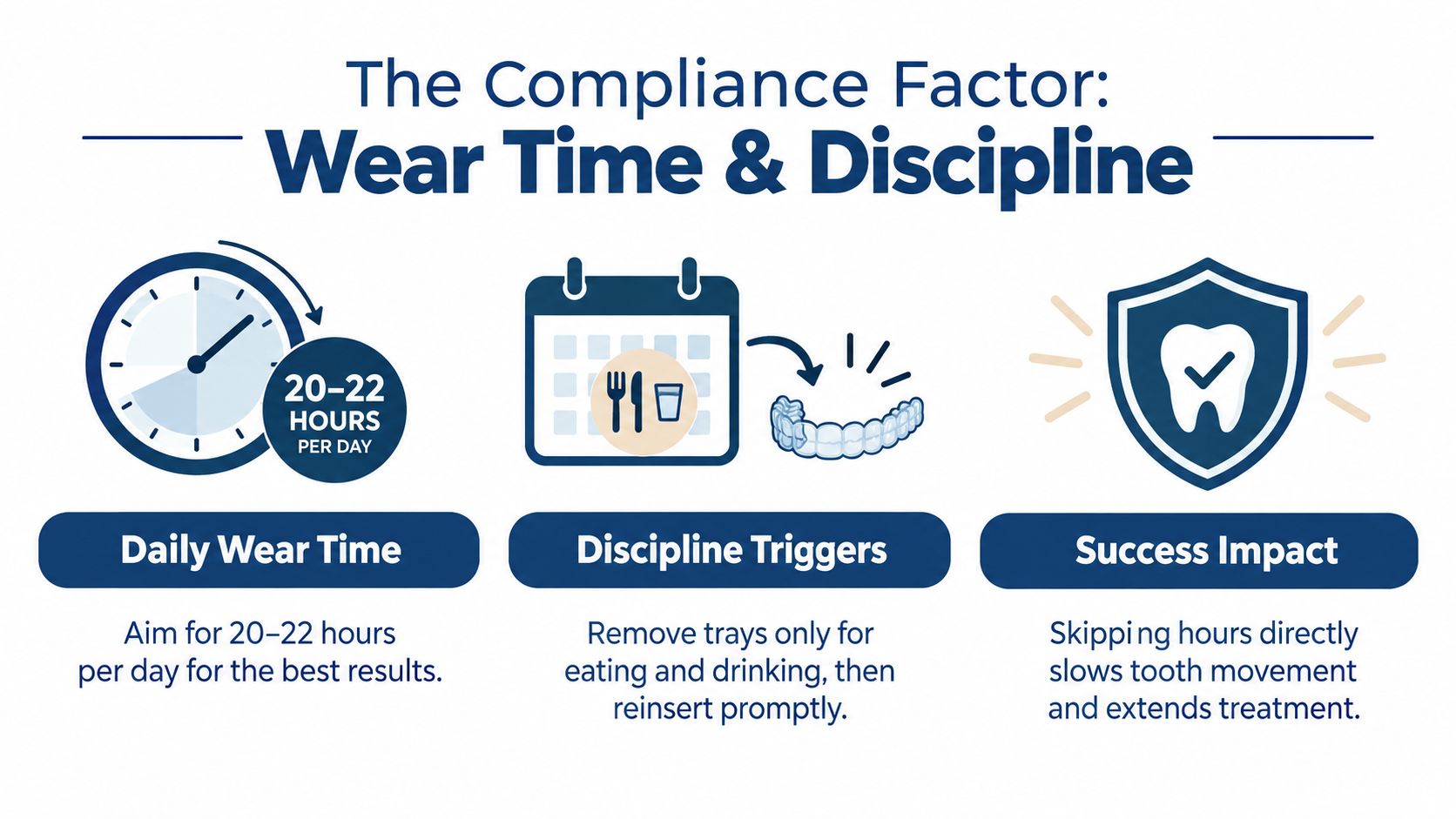
The biggest technical determinant of adult Invisalign success is often behavior rather than appliance design. Invisalign treatment is commonly prescribed for 20 to 22 hours per day, with aligners removed for meals, drinks other than water, and oral hygiene. A clinical review of clear aligner treatment mechanics and wear expectations explains why the appliance has to remain in place for most of the day to follow the planned sequence.
Adults can learn more about the appliance itself through this guide to what Invisalign is and how it works, but the practical question is simpler: can the aligner return to the teeth quickly after each interruption?
The daily routine
A working parent might remove the aligners for breakfast, coffee, lunch, and dinner. That pattern can still work if the aligners are cleaned as directed and reinserted promptly. The difficulty comes when a short break becomes an afternoon, an aligner is left in a restaurant, or a busy schedule makes wear time unpredictable.
A randomized clinical trial in adults with Class I relationships and very mild crowding found that a 12-hour daily wear protocol still produced clinically adequate maxillary alignment over the first 10 aligners, but the study covered only early-phase alignment and mild cases. Review the randomized clinical trial and its limitations That result shouldn't be treated as permission to ignore the prescribed schedule. Broader reviews repeatedly identify patient compliance as a key outcome modifier.
Daily reality: A removable appliance gives the patient control, and that control becomes a treatment risk when the patient can't use it consistently.
Aligners compared with fixed braces
Fixed braces remain attached to the teeth, so the patient doesn't need to remember to reinsert them after eating. They still require careful cleaning and dietary guidance, but they remove the central wear-time decision from the daily routine.
Clear aligners may be a sensible choice for an adult who already follows structured habits. A calendar reminder, a dedicated case for meals, and a routine of replacing the aligner immediately after brushing can reduce avoidable interruptions. An adult who knows that workdays, travel, or frequent snacking will make that routine unreliable may find fixed braces more predictable and more cost-effective.
The question isn't whether an adult is disciplined in every part of life. It's whether the proposed schedule fits ordinary days in Wilmington, Middletown, Dover/West Dover, or Millsboro. If not, the apparent flexibility of Invisalign may become its main drawback.
Comparing the True Cost - Invisalign vs Traditional Braces
A Wilmington professional may receive an aligner quote that looks manageable until insurance, refinements, retainers, and missed-work time enter the calculation. The same questions apply to a braces quote. Adults should compare the insurance-adjusted cost of both options and confirm exactly what each fee includes.
One current cost guide places common adult Invisalign treatment between $3,500 and $9,500, with an average near $5,700. Many plans cap orthodontic benefits around $1,500 to $3,000, while some exclude aligners or process them differently from other orthodontic treatment. Review the adult Invisalign affordability and insurance guide Adults can review the range in more detail in this breakdown of the average cost of Invisalign for adults.
For example, an adult quoted $5,700 with a $1,500 benefit and refinements included would have a $4,200 net cost. That figure can then be compared directly with a braces quote using the same benefit. A patient in Middletown or Dover may therefore find that the apparent price difference is smaller than the advertised totals suggest.
Put the comparison on paper
Ask the practice for a written estimate that separates the total treatment fee, expected insurance contribution, and remaining balance. Payment plans, HSA funds, and FSA funds may also affect affordability, subject to the plan and account rules.
| Cost question | Why it matters |
|---|---|
| Total treatment fee | Shows the starting commitment before benefits. |
| Orthodontic benefit maximum | Identifies how much the plan may contribute overall. |
| Aligner eligibility | Confirms whether the plan covers aligners or processes them differently. |
| Refinement coverage | Shows whether additional aligners are included. |
| Retainers and follow-up | Helps prevent later charges from changing the expected total. |
| Payment options | Shows whether the remaining balance fits the household budget. |
The most useful comparison is the final balance for each treatment, not the headline fee. If the same benefit applies to aligners and braces, the net difference may be modest. If the plan treats aligners differently, the patient may face a much larger gap.
Account for treatment risk
Poor wear-time consistency can slow progress and lead to refinements. Extra visits, longer treatment, and replacement appliances can reduce the value of an initially attractive quote. The financial decision therefore includes time and reliability, not only the appliance itself.
Adults should ask:
- Are refinements included? This can change the practical value of the fee.
- What does insurance cover? The orthodontic maximum may not apply equally to every appliance.
- Can HSA or FSA funds be used? Confirm eligibility under the applicable rules.
- What happens if treatment takes longer? Clarify whether the fee changes.
The same worksheet works at practices near North Wilmington, Middletown, Dover/West Dover, and Millsboro. Invisalign is worth the added cost when its benefits fit the adult's priorities and the treatment routine is realistic. Braces may offer better value when the net cost is lower or fixed treatment provides a more predictable path.
Comfort, Aesthetics, and the Adult Lifestyle
An adult in North Wilmington may feel confident leading a meeting but hesitate to wear a visible appliance in photographs. A parent in Middletown may care more about eating comfortably after work. For adults in Dover/West Dover or Millsboro, the practical question is whether treatment fits professional routines, family plans, and daily habits.
Clear aligners can address appearance concerns because they are less noticeable than fixed brackets and wires. Their removable design also lets patients eat without an appliance in place and follow familiar brushing and flossing routines. Recent comparative research reports higher scores for clear aligners in aesthetics, comfort, and eating satisfaction, while overall effectiveness can be similar to braces in many cases. One 2025 study reported higher satisfaction with clear aligners but found no significant difference in overall effectiveness. Read the comparative findings on patient satisfaction and treatment experience
The benefit adults actually feel
The value depends on the situation. Someone who presents to clients may place a high value on a less visible appliance. A parent sharing dinner with children may appreciate removing aligners during the meal. An adult who plays sports may prefer removing the appliance when appropriate, following professional guidance.
These advantages still require work. Aligners must be removed and reinserted repeatedly, and patients need to keep them clean and wear them as directed. The convenience is more like carrying a removable daily routine than putting treatment out of mind.
The adjustment period is part of the calculation
Treatment can feel different at the beginning. A 2025 scoping review found that patients can experience temporary negative effects on oral-health-related quality of life, pain, anxiety, and speech. A patient may notice pressure after changing aligners or a temporary speech change while the tongue adjusts. Those effects may matter before a presentation, wedding, or family event, even if they improve during treatment.
Traditional braces bring different trade-offs, including visible brackets, wires, and possible irritation. The useful comparison is not “easy” versus “difficult.” It is one group of manageable inconveniences compared with another.
A balanced expectation: Invisalign can be discreet and comfortable, but it is not a painless, low-maintenance experience from the first day.
Adults should weigh the priorities that affect their own routine:
- Visibility: Clear aligners may feel more suitable for professional or social settings.
- Eating: Removal provides meal flexibility, followed by prompt reinsertion.
- Hygiene: Taking aligners out can make brushing and flossing feel familiar.
- Adaptation: Temporary speech changes, pressure, or anxiety may occur at the start.
- Predictability: Complex cases may make fixed braces the more suitable choice.
Invisalign may fit an adult whose appearance, comfort, and hygiene priorities justify the daily responsibility. It may fit less well for someone who dislikes removable appliances or wants treatment that demands little attention between visits. The right choice is the one whose benefits remain useful after the novelty wears off.
Treatment Timelines and Local Candidacy
Many adults can expect an Invisalign timeline of about 12 to 18 months, although shorter or longer treatment is possible depending on the amount of tooth movement required. Mild spacing or crowding may finish faster, while more complex bite problems can take 18 to 24 months or longer. Read more about realistic Invisalign treatment timelines
That estimate matters in Delaware. Someone in North Wilmington may be planning around work travel, while a parent in Middletown may be coordinating school events and family appointments. Adults in Dover/West Dover or Millsboro may also need to consider drive time, work schedules, and how consistently follow-up visits fit into everyday life.
A timeline is an estimate, not a promise
Treatment length depends on the diagnosis, the complexity of movement, the patient's wear habits, and how closely the teeth follow the planned sequence. An adult with mild crowding may have a different experience from someone whose bite needs broader correction. Refinements can also affect the final timeline when additional adjustment is needed.
A consultation should provide more than a generalized range. Patients should ask:
- What problem is the treatment solving?
- Which movements may take the longest?
- How does the estimate change if refinements are needed?
- How often will progress be checked?
- What retainer plan follows active treatment?
A separate guide to how long Invisalign treatment takes can help adults understand the planning questions before a consultation.
Adult aligner care is mainstream
Clear aligners aren't used only for teenagers or very small cosmetic changes. In one review of orthodontist preferences, 97.5% of orthodontists reported using clear aligner therapy primarily for adult patients. Read the review of orthodontist preferences for clear aligner therapy That finding supports the view that aligners are an established adult treatment option, while candidacy still depends on the individual bite.
Stellar Orthodontics offers adult consultations with iTero digital 3D scanning, along with braces and Invisalign evaluation at locations serving North Wilmington, Middletown, West Dover, and Millsboro. A scan and clinical examination can help determine whether the patient's alignment problem, lifestyle, and budget make Invisalign a sensible choice.
The most honest answer to “is Invisalign worth it for adults” is conditional. It often is for adults with suitable mild-to-moderate alignment concerns, reliable wear habits, and a strong preference for discreet treatment. Traditional braces may provide better value when the case is complex, daily compliance is unlikely, or predictability matters more than removability.
Adults can book a free consultation at Stellar Orthodontics to compare Invisalign and braces using an examination, iTero digital 3D scanning, and an insurance-adjusted treatment discussion. The team can review the bite, explain the likely timeline, and help patients in North Wilmington, Middletown, Dover/West Dover, or Millsboro choose the option that fits their clinical needs and daily life.