
Adults can have very different out-of-pocket totals for the same type of braces. The key is to separate the treatment fee from the portion an insurance plan will pay. Adult orthodontic benefits vary, and even a plan that covers treatment may leave part of the fee to the patient.
Use a simple calculation: begin with the written fee for your case, subtract the benefit your insurer confirms is available, then account for any payment plan. Ask the office to put each figure in writing, including any amount still unknown. That turns a broad estimate into a personal budget without assuming insurance will cover the full cost.
Table of Contents
- Metal Braces Cost for Adults at a Glance
- What Drives the Price of Adult Braces
- Metal, Ceramic and Invisalign Costs Compared
- How Insurance Changes Your Out-of-Pocket Cost
- Payment Plans, Savings Accounts and Tax Options
- How to Estimate Your Delaware Out-of-Pocket Cost
- Book a Free Consultation to Get Your Number
Metal Braces Cost for Adults at a Glance
A national estimate helps set expectations, but it is only the first number in an adult's budget. Traditional metal braces in the United States commonly cost $3,000 to $7,500 before insurance. The American Dental Association's 2018 survey put average orthodontic treatment across appliance types at approximately $5,000 to $6,000, as summarized in this Healthline overview of average braces costs. Healthline also gives an estimated post-insurance range of $1,500 to $3,750 for metal braces. Those estimates are benchmarks, not a Delaware adult's final balance.
What a quoted total may include
A braces quote is like a package with several parts: offices may bundle records, placement, adjustment visits, emergency repairs, removal, and initial retainers differently. Replacement retainers, extractions, or care from another dental provider may be billed separately. Ask the office to list what is included and what could cost extra.
Practical rule: Compare the total fee after insurance, not just the monthly payment. A monthly figure can hide differences in the payment term, down payment, and included services.
Metal braces cost for adults by scenario
| Scenario | Typical cost | What it covers |
|---|---|---|
| National private-pay range | $3,000 to $7,500 | Full treatment episode before insurance |
| Delaware private-pay range, traditional metal | $3,000 to $6,500 | Quoted total for full treatment |
| ADA 2018 survey average, orthodontic treatment across appliance types | Approximately $5,000 to $6,000 | National benchmark, not a local quote |
| Consumer estimate after insurance, metal braces | $1,500 to $3,750 | Estimated patient share, depending on plan terms |
The figures answer different questions. The national range gives a broad starting point, while the Delaware range reflects private-pay traditional metal braces when pre-authorization is denied and the patient chooses to pay privately. The insurance estimate is a possible patient share, not a guaranteed discount. Your own figure depends on the plan's deductible, coinsurance, annual or lifetime limits, and adult orthodontic eligibility.
To turn a benchmark into a personal estimate, ask for the full treatment fee and the amount insurance is expected to pay, each in writing. Confirm which services are included, then check whether the plan's benefit applies to adult treatment. Stellar Orthodontics offers monthly payment plans for braces, but the written quote and plan details are what determine the amount to budget.
What Drives the Price of Adult Braces
Two adults in North Wilmington with similar-looking crooked teeth could receive different quotes if one estimate includes routine repairs and retainers while the other lists them separately. The visible brackets are only part of the calculation. Bite needs, dental history, treatment length, and what the fee includes all affect the total.
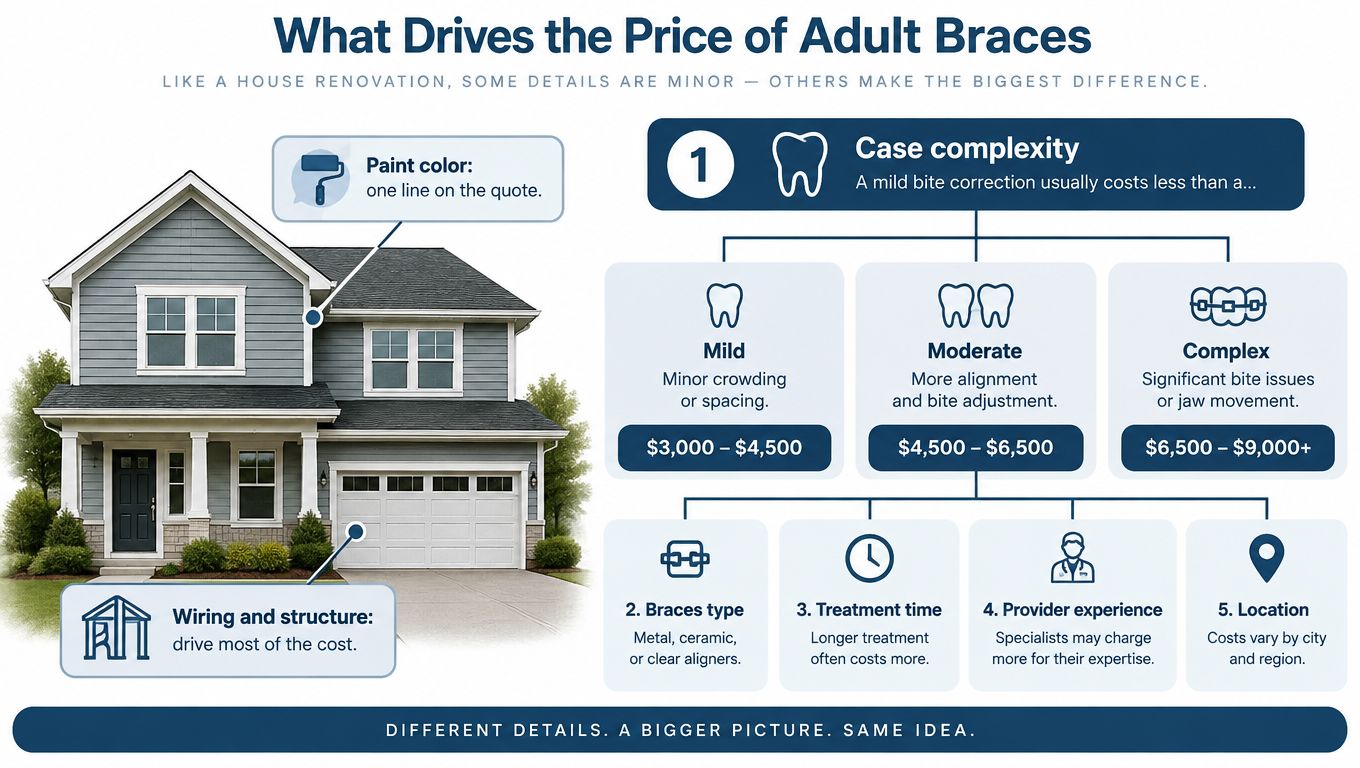
The infographic groups the main cost drivers. Use it as a guide when asking an office to explain a written estimate line by line.
Five factors that move a quote
1. Case complexity. Mild alignment correction may cost less than treatment involving both arches or more involved bite work. Crowding, spacing, overbite, underbite, and crossbite can each change the mechanics needed. At the exam, ask the orthodontist to explain what makes the case simpler or more complex, and how that affects the proposed plan.
2. Treatment length. A published review summarized in NewMouth's orthodontic statistics summary found a mean fixed-appliance treatment duration of 19.9 months across 22 studies involving 1,089 participants. This is a research average, not a promised timeline or a direct price formula. At Stellar Orthodontics, most braces cases finish in 18 to 30 months. Ask how the expected timeline for your case relates to the quoted fee.
3. Location and provider fees. Overhead, staffing, and provider fees can vary by market and office. A case in North Wilmington may receive a different quote from a similar case in Millsboro or West Dover. Two offices can quote differently for the same case, so the written estimate is what counts. Check that you are comparing the same services.
4. Add-ons and related care. Extractions, missing teeth, existing restorations, gum-related limits, or skeletal discrepancies may call for other care or procedures. Replacement retainers can also add cost later. Ask the office to list these items separately, so you can distinguish the braces fee from charges for other care.
5. Appliance choice. The selected appliance affects materials, lab work, and visit patterns, which can change the quote. Compare the total fee for the same case across options, rather than comparing monthly payments that may cover different treatment periods.
A quoted fee applies to a defined course of care. Missed appointments, broken brackets, and lost retainers may lead to extra charges, depending on office policy. Before starting, ask what is included for routine repairs, what circumstances add fees, and whether the quote has a time limit or adjustment cap. Getting those details in writing makes it easier to understand what your estimate covers.
Metal, Ceramic and Invisalign Costs Compared
For a visible front-tooth bite issue, brackets stay attached to the teeth throughout treatment, while clear aligners can be removed. That difference affects how each option fits a patient's priorities, but it does not by itself determine which appliance can treat a particular bite or what the fee will be. Compare options for the same case, not just by how they look or by their monthly payment.
Start with three questions: What is the total fee? How long is treatment expected to take? What does the fee include? This guide to types of braces for adults explains the main appliance categories.
The three options side by side
Traditional metal braces use metal brackets bonded to the front of the teeth and can treat simple and complex bite issues. Clear ceramic braces use tooth-colored brackets for a lower-profile look. Both types of braces are equally effective, so the choice depends on priorities for aesthetics and budget. Invisalign clear aligners use removable trays and are an option for many adults with mild to moderate cases.
Adult braces options compared on cost and time
| Option | Delaware private-pay range | Typical treatment time |
|---|---|---|
| Traditional metal braces | $3,000 to $6,500 | 18 to 30 months for most cases |
| Clear ceramic braces | Get the total fee in writing from the office | 18 to 30 months for most braces cases |
| Invisalign clear aligners | $3,500 to $7,500 | 6 to 18 months for adults |
Traditional metal braces in Delaware typically cost $3,000 to $6,500 for private pay when pre-authorization is denied and the patient chooses to pay privately. Invisalign in Delaware typically costs $3,500 to $7,500, depending on case complexity, with monthly financing available. For ceramic braces, ask the office for a written quote for the same case. These ranges are starting points, not an individual treatment estimate.
Invisalign for adults often finishes in 6 to 18 months, while most braces cases take 18 to 30 months. A shorter expected timeline does not automatically mean a lower total fee. Aligners also depend on consistent wear, so ask whether the quote includes any additional trays that may be needed.
The final comparison should be based on clinical suitability and the full written fee, not a monthly figure alone. Ask the office to list treatment time, what is included, and the total cost for each suitable option. That makes the trade-offs easier to see before choosing an appliance.
How Insurance Changes Your Out-of-Pocket Cost
Dental insurance often covers less of braces than adults expect. Many policies exclude orthodontics or limit eligibility to patients under 18. Plans that cover adult treatment may also have waiting periods of six months to one year, according to this AARP guide to adult braces. A lifetime orthodontic maximum can put a ceiling on the benefit, so the amount an insurer pays may be much smaller than the total treatment fee.
That ceiling is one part of the calculation. Some plans also treat ceramic braces or clear aligners differently from traditional metal braces, which can affect eligibility. To estimate your own balance, first confirm which appliance your plan covers, then check the benefit amount and any deductible or coinsurance.
Worked examples with real subtraction
Start with a straightforward calculation: if the total fee is $6,000 and the plan pays a $1,500 benefit, subtract the benefit from the fee. The remaining balance is $4,500. If it were spread over 24 months with no interest assumed, that would be $187.50 per month, before any deductible or coinsurance changes the math.
Out-of-pocket examples for adult metal braces
| Total fee | Insurance benefit | Your share before payment plan |
|---|---|---|
| $4,000 | $1,000 | $3,000 |
| $5,000 | $0, no adult orthodontic benefit | $5,000 |
| $6,000 | $1,500 | $4,500 |
| $7,500 | $2,000 | $5,500 |
The $5,000 example shows why it is important to ask specifically about adult orthodontics. A plan may cover routine dental care but provide $0 toward braces. In the $7,500 example, even a $2,000 benefit leaves $5,500 for the patient because the benefit does not increase with the treatment fee.
Deductibles and coinsurance can raise the amount you owe beyond these examples. If you must meet a deductible first, or the plan pays only part of its allowed amount, subtracting the stated benefit alone will not give the full balance. For a closer look at the calculation, read this explanation of braces cost with insurance.
Payment timing can also affect your budget. Orthodontic benefits may be paid in installments during treatment rather than all at once. A job change or plan switch could interrupt those payments, so ask how the insurer will apply the benefit to your case. An annual maximum may reset, while a lifetime orthodontic maximum does not.
Before relying on an estimate, ask the office to verify your adult eligibility, benefit limit, waiting period, and payment schedule with your plan. Request the confirmed insurance amount and treatment fee in writing. Then subtract the benefit from the fee, and account for any deductible or coinsurance. That gives you a more useful personal estimate than the insurance card alone.
Payment Plans, Savings Accounts and Tax Options
Once the personal balance is known, the question shifts from how much to how it's paid. Most adults don't pay several thousand dollars in one transaction, and payment structure is where treatment becomes manageable or expensive. Stellar Orthodontics offers monthly payment plans for braces and Invisalign, including plans with $0 down, and accepts HSA and FSA payments.
Ways to pay for adult metal braces
| Option | Upfront cost | How it works | Good to know |
|---|---|---|---|
| Monthly payment plan | $0 down | Balance split over the treatment period | Ask about interest, term length and missed-payment rules |
| Dental insurance benefit | Your deductible and coinsurance | Benefit applied toward the fee | Adult benefits are often capped and may have waiting periods |
| HSA or FSA | Paid from pre-tax funds | Covers eligible orthodontic costs | Check your account rules before booking |
| Itemized medical deduction | Not applicable at payment | Only unreimbursed costs above 7.5% of adjusted gross income | Requires itemizing; talk to a tax professional |
| Pay in full | Full balance | One payment for the treatment | Ask for the total in writing before paying |
Questions that protect a budget
A monthly plan should be judged on four numbers, the monthly amount, the number of months, any interest or fees, and the rules for a missed payment. Multiplying the monthly amount by the term reveals the true total. A guide to finding an orthodontist near me with payment plans can help frame those questions before signing anything.
HSA and FSA funds may cover eligible orthodontic costs from pre-tax dollars. The catch is administrative, not medical. Account rules, documentation requirements, and FSA deadlines differ, so the plan administrator and the office should both confirm that the expense qualifies and how payments should be timed.
Tax treatment is narrower than many people expect. Guidance in the IRS instructions for Schedule A states that braces can qualify as medical and dental expenses, yet an itemizing taxpayer may deduct only unreimbursed eligible expenses exceeding 7.5% of adjusted gross income. A household with adjusted gross income of $80,000 would generally need more than $6,000 in qualifying unreimbursed medical and dental expenses before the excess could potentially be deductible.
Insurance reimbursements can't also be deducted, and eligibility depends on the taxpayer's complete situation. Invoices, payment records, and insurance statements should be kept, and a qualified tax professional should review the details.
A sensible order keeps things clean. Confirm insurance first, apply HSA or FSA funds to eligible amounts, then place the remaining balance on a monthly plan with terms stated in writing.
How to Estimate Your Delaware Out-of-Pocket Cost
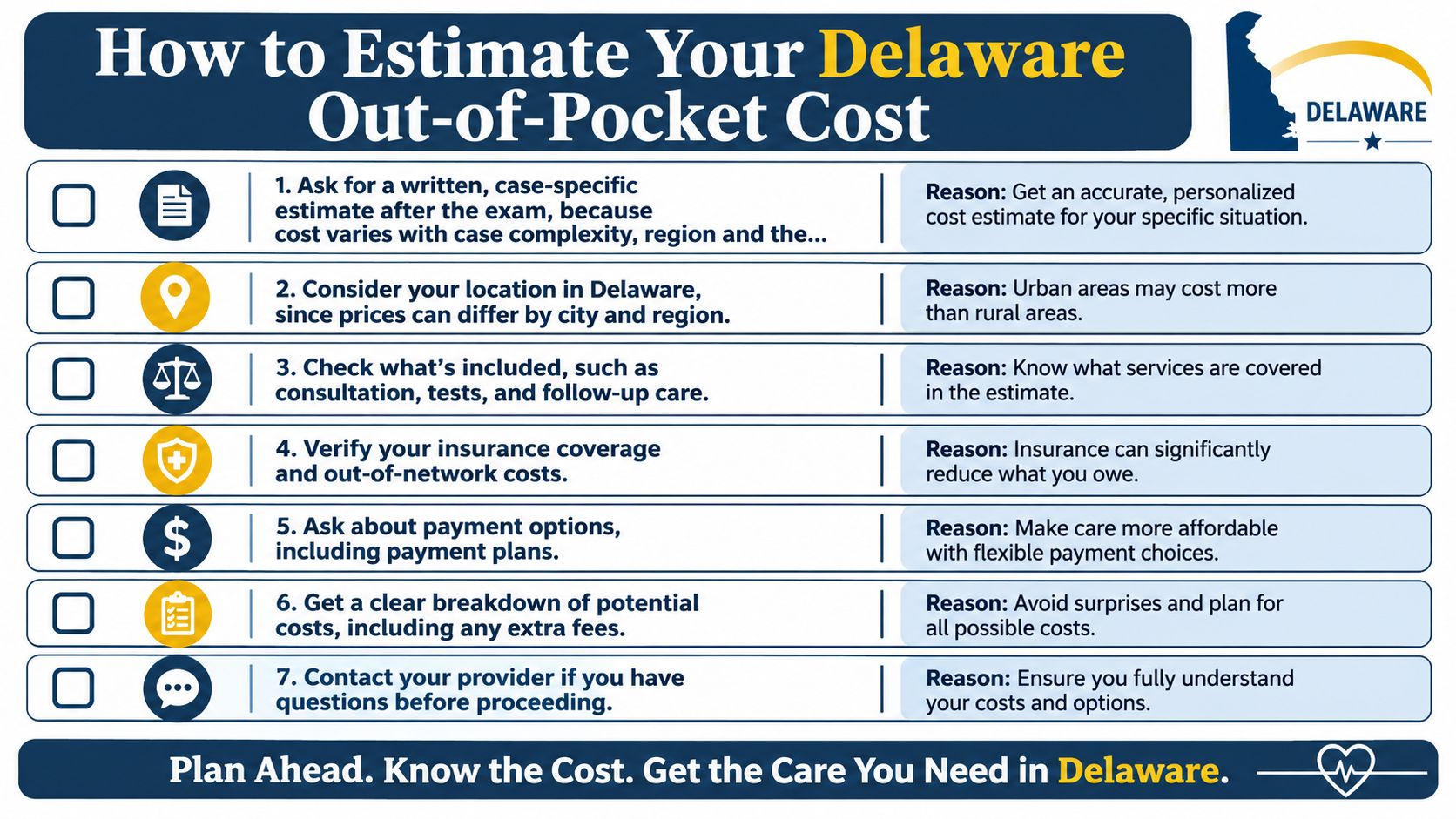
A national benchmark is a starting point, not a personal quote. To estimate what you may pay in Delaware, gather your plan details and a written estimate for your specific case, then subtract only benefits you can use.
Seven steps to a personal number
- Get a written, case-specific estimate after the exam. Case complexity, location, and the orthodontist's fees affect the total, so a national average cannot price your specific bite.
- Confirm what the total includes. Ask whether records, adjustment visits, emergency repairs, removal, and initial retainers are part of the quoted fee.
- Read your dental plan's benefit summary. Check adult eligibility, annual limits, the lifetime orthodontic maximum, waiting periods, and age rules.
- Subtract only benefits you can use. If a maximum applies only to children or a waiting period blocks coverage, leave that benefit out of your calculation.
- Divide the remaining balance by the payment-plan months. Before relying on that monthly amount, ask about interest, fees, and missed-payment rules.
- Ask for the replacement-retainer rate in writing. Use the details discussed earlier in this article to account for any cost that may arise after treatment.
- Ask about limits and extra charges. Confirm how long adjustments are included and what broken brackets or missed appointments could cost.
The video below shows the treatment process, helping connect the line items in a quote to the visits they cover.
Estimate worksheet for an adult braces quote
| Line item | What to ask | Typical amount |
|---|---|---|
| Diagnostic records | Are imaging and models included in the fee? | Included or listed separately on the quote |
| Braces fee | Is the total a single fixed quote? | $3,000 to $6,500 in Delaware for private pay |
| Adjustment visits | Are they bundled into the total? | Usually included in the quote |
| Emergency repairs | Are broken brackets or wires covered? | Ask the office to confirm any per-visit fee in writing |
| Initial retainers | Are they included at the end of treatment? | Ask the office to confirm in the written quote |
| Replacement retainers | What is the private-pay rate? | Ask the office to confirm the rate in writing |
| Insurance maximum | Is there a lifetime orthodontic limit, and how much can you use? | Use the plan's stated maximum, as explained in the insurance section |
| Deductible and waiting period | Do they apply to adult orthodontics? | Check the amount and waiting period in the plan benefit summary |
Write each answer beside its matching line item. A quote becomes easier to compare when the fee, usable insurance benefit, and any uncertain charges are recorded separately. Ask the office to put local amounts and terms in writing, so your estimate reflects the coverage and payment details that apply to you.
Book a Free Consultation to Get Your Number
The number to plan around is the written estimate for one specific case. An exam helps the orthodontist identify which appliances may suit your teeth, while an insurance review clarifies what your plan may contribute. Ask for the total fee and what it includes in writing.
Stellar Orthodontics offers free consultations regardless of whether you proceed with treatment or insurance covers any of the cost. Use the appointment to ask how the recommended treatment fits your priorities, what services are included in the quote, and which costs could arise later.
Bring your dental insurance benefit summary so the office can check adult eligibility, lifetime maximums, and waiting periods. Previous dental or orthodontic records can help the orthodontist account for earlier treatment, missing teeth, or other prior work. Keep your worksheet questions handy, too, so you remember to ask about retainers, repairs, caps, and payment terms.
Stellar has offices in North Wilmington, Middletown, West Dover, and Millsboro. At the visit, ask which monthly payment options are available and whether you can use HSA or FSA funds. The office can confirm the amounts and terms for your case, including what you would owe after any insurance contribution. That written breakdown is the practical next step from a general range to a personal budget.
Use the estimate to compare the treatment fee, expected insurance contribution, and any remaining costs. If a line is unclear, ask the office to explain it before deciding. Book a free consultation with Stellar Orthodontics to get your case-specific estimate in writing.