
Which number tells you what braces will really cost: the monthly payment printed on the quote, or the total you'll have handed over by the final payment date?
Most parents ask the first question, and offices answer it, because a monthly figure is the easiest number to fit into a household budget. It's also the number that hides everything else. A monthly payment dental plan is neither a price nor an insurance benefit. It's an installment arrangement layered on top of both, so the monthly amount only means something after two other questions have answers: what will insurance or Delaware Medicaid pay in practice, and what do the financing terms add back in?
Get those in the wrong order and a comfortable $150 a month can cost far more than the treatment was quoted at. This guide walks Delaware families through the decisions in the order that protects the budget: coverage first, contract second, monthly amount last.
Table of Contents
- How Monthly Dental Payment Plans Work
- Check Coverage Before You Finance Treatment
- What Braces and Invisalign Cost in Delaware
- Reading a Written Quote and the Questions to Ask
- Turning a Treatment Fee Into a Monthly Budget
- Book a Free Consultation to Compare Your Options
How Monthly Dental Payment Plans Work
A monthly payment dental plan takes a defined treatment balance and splits it into scheduled installments over an agreed period. That balance is what remains after insurance or a public program has paid its share, which is why the plan sits alongside coverage instead of replacing it. Coverage lowers the principal. The plan spreads whatever is left.
The American Dental Association guidance on dental financing sorts the common structures into two main families, with deferred-interest credit sitting alongside them as a third. They differ most in what happens to interest when a deadline slips.
| Plan type | Interest | Repayment window | What to check |
|---|---|---|---|
| Low-interest fixed plan | Yes, counted from the original purchase date | Up to 5 years | Whether the quoted payment fully repays the balance |
| No-interest promotional plan | None if the balance is repaid by the deadline | 6 to 18 months | Minimum monthly payment required and the balance due on the promotion end date |
| Deferred-interest credit | Charged back to the purchase date if the promotional balance is not cleared | 6 to 18 months, matching the promotion | Promotion deadline and the full amount due before it ends |
From most predictable to riskiest
A low-interest fixed plan divides a set credit amount into equal payments over a repayment period that can stretch to five years, and interest begins accruing from the original purchase date. Predictable payment, higher total than the quoted fee.
A no-interest promotional plan usually gives six to eighteen months to clear the balance, as long as at least the minimum monthly payment arrives every month. The deadline is where the risk sits: a balance still standing when the promotion ends can change the cost of the whole arrangement.
Deferred-interest credit is the one to handle carefully. Nothing is charged if the balance clears before the promotion ends, but a remaining balance can pull interest back to the purchase date rather than from the deadline forward.
The question that matters most: when does the promotional window close, and what balance will still be outstanding on that date?
A monthly plan works like paying a moving company in weekly installments instead of one lump sum on delivery day. The weekly arrangement feels easier on the household account, but the van still costs what it costs, and a late fee on the final installment means the friendly schedule cost more than the original bill. A monthly amount answers a cash-flow question. The price question still needs its own answer.
Before comparing any two monthly figures, a parent should be able to name which mechanic the quote uses. At Stellar Orthodontics, families leave the planning step with a printed treatment plan and a price that already includes financing options, before they commit to anything. Cherry payment plans there can run 3, 6, 12, 18, or 24 months depending on the plan, with $0 down options available.
Check Coverage Before You Finance Treatment
Delaware parents often assume braces are covered because a child plainly needs them. State dental guidance says otherwise: orthodontic treatment for children is not automatically covered just because a child needs braces, and coverage turns on whether the case meets medical necessity criteria. The Delaware Medicaid and Healthy Children Program dental guidance names handicapping malocclusion as the standard that decides it.
That single fact reorders the whole conversation. Financing is what a family reaches for after coverage has been ruled in or out, not before.
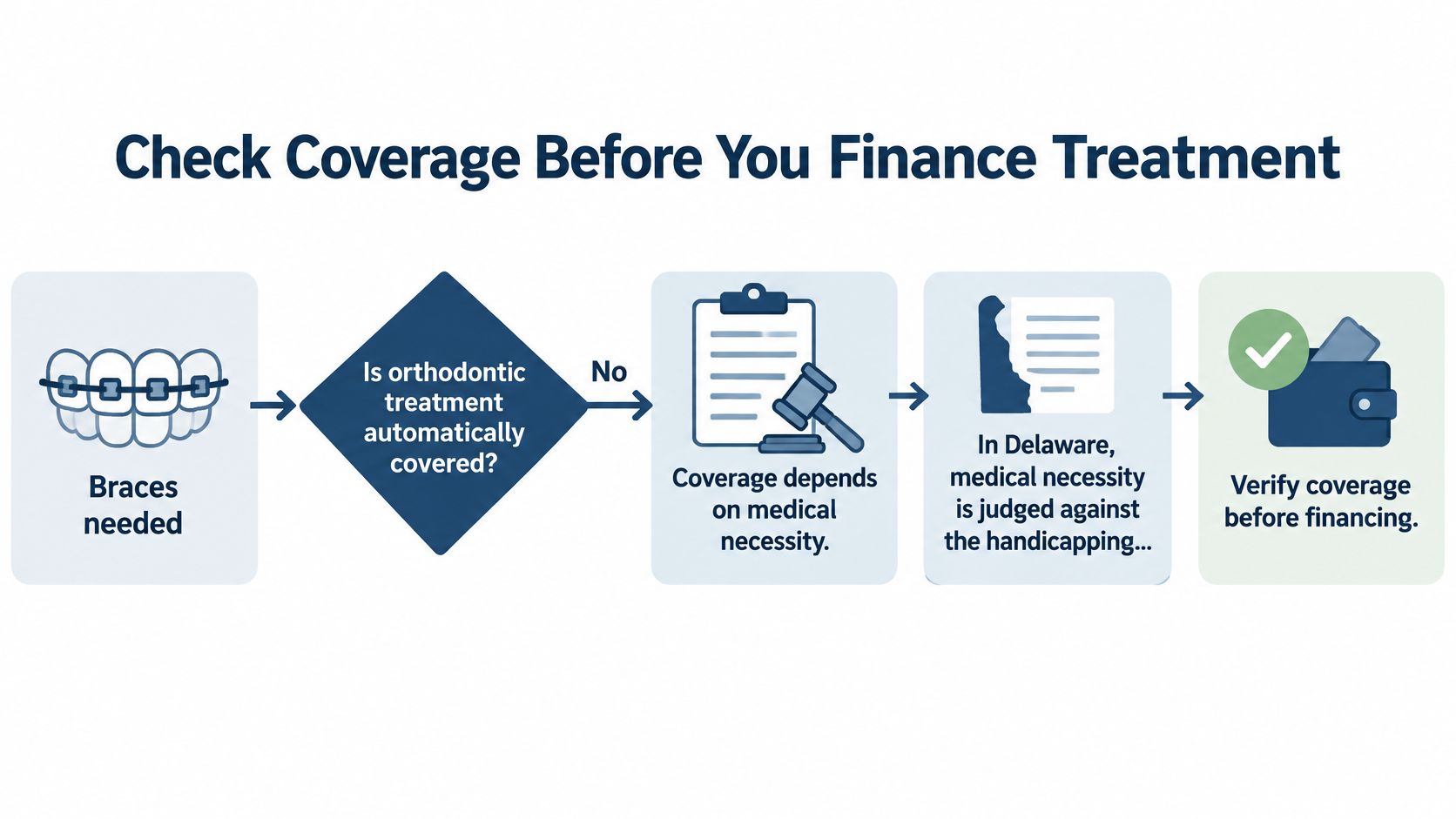
The order that protects your budget
- Confirm age and program enrollment. Children eligible for Medicaid can receive covered dental services through age 20, and children enrolled in the Delaware Healthy Children Program can receive dental coverage through age 18.
- Book the free evaluation. No referral is needed for a first braces evaluation, and most Delaware Medicaid plans allow self-referral, so a dentist's referral is often unnecessary.
- Get the medical-necessity result. At the free evaluation, the orthodontist determines whether the child meets Delaware Medicaid's medical-necessity criteria, and the family learns the result before leaving the office.
- Calculate the covered and uncovered portions. A written pre-authorization or denial makes this concrete instead of guessed.
- Only then compare monthly options for the portion that remains.
| Coverage route | Who it fits | Age limit | Referral needed |
|---|---|---|---|
| Delaware Medicaid | Children and teens with medically necessary orthodontic needs | Through age 20 | No referral for a first braces evaluation |
| Delaware Healthy Children Program | Enrolled children who meet program guidelines | Through age 18 | No referral for a first braces evaluation |
| Private dental insurance | Families with a dental plan that accepts orthodontic care | Set by the plan's own rules | Benefits should be verified before treatment |
| Adult coverage | Adults over 21 seeking orthodontic care | Over 21 | Confirm with the office |
A denial is not a dead end and an approval is not the end of the conversation. Both tell you the size of the balance that financing would cover.
Adults face a different reality. Most adults over 21 aren't eligible for Delaware Medicaid's routine orthodontic benefit, and adult coverage is limited and exception-based, so it's worth confirming any option directly rather than assuming. An office must also tell families what isn't covered and what they're expected to pay before treatment is completed, which means the numbers should be on paper before the first bracket goes on. For a closer look at how benefits get verified, see insurance and coverage at Stellar Orthodontics.
What Braces and Invisalign Cost in Delaware
Two children can wear the same braces and their families can owe different balances, because the treatment price and the covered amount are decided separately. The ranges below are typical private-pay estimates for Delaware, and they anchor every later conversation about monthly payments: a monthly figure only means something once the total behind it is confirmed.
| Treatment | Private-pay range in Delaware | Medicaid coverage | What it means for your balance |
|---|---|---|---|
| Traditional metal braces | $3,000 to $6,500 | Covered for qualifying children when medically necessary | Insurance or Medicaid contribution lowers the balance |
| Invisalign clear aligners | $3,500 to $7,500, depending on case complexity | Generally not covered | Paid privately, with monthly financing available |
| Clear ceramic braces | Written quote from the office, priced above metal braces | Generally not covered | Upgrade paid privately, so request a written price |
Why some options sit outside coverage
Delaware Medicaid generally does not cover Invisalign or clear aligners, and it generally does not cover clear ceramic braces. The benefit is written to fund medically necessary correction, so both esthetic options fall under private pay, with monthly financing available for the difference. A family that wants an upgrade should plan on carrying that cost while any contribution toward the underlying treatment is counted separately.
The annual maximum is why a balance survives
Even a plan that covers orthodontics has a yearly ceiling, and orthodontic billing stretches across many months, so a single benefit year can absorb most or all of a plan's cap. A 2024 analysis cited by the American Dental Association found that 3.4% of dental patients reached their typical annual maximum, another 3.3% came within $100 of common limits such as $1,000 or $1,500, and survey data from CareQuest Institute in the same analysis showed 12% of insured adults reached or exceeded their annual dental maximum in 2024, with 39% of those who hit the limit delaying or discontinuing care until benefits renewed.
Insurance reduces the price of care, and whatever remains after the cap is the patient's share. That remainder is the balance a monthly plan would stretch across 3, 6, 12, 18, or 24 months, so a smaller payment spread over a longer schedule still covers the same total.
Read any orthodontic quote in three steps. The treatment type, then the insurance contribution, then the balance that survives.
Every range above is an estimate, and the written quote from the office sets the true price for one child's case. That written figure is the one worth dividing into monthly payments. More detail on what braces cost in Delaware sits alongside these ranges.
Reading a Written Quote and the Questions to Ask
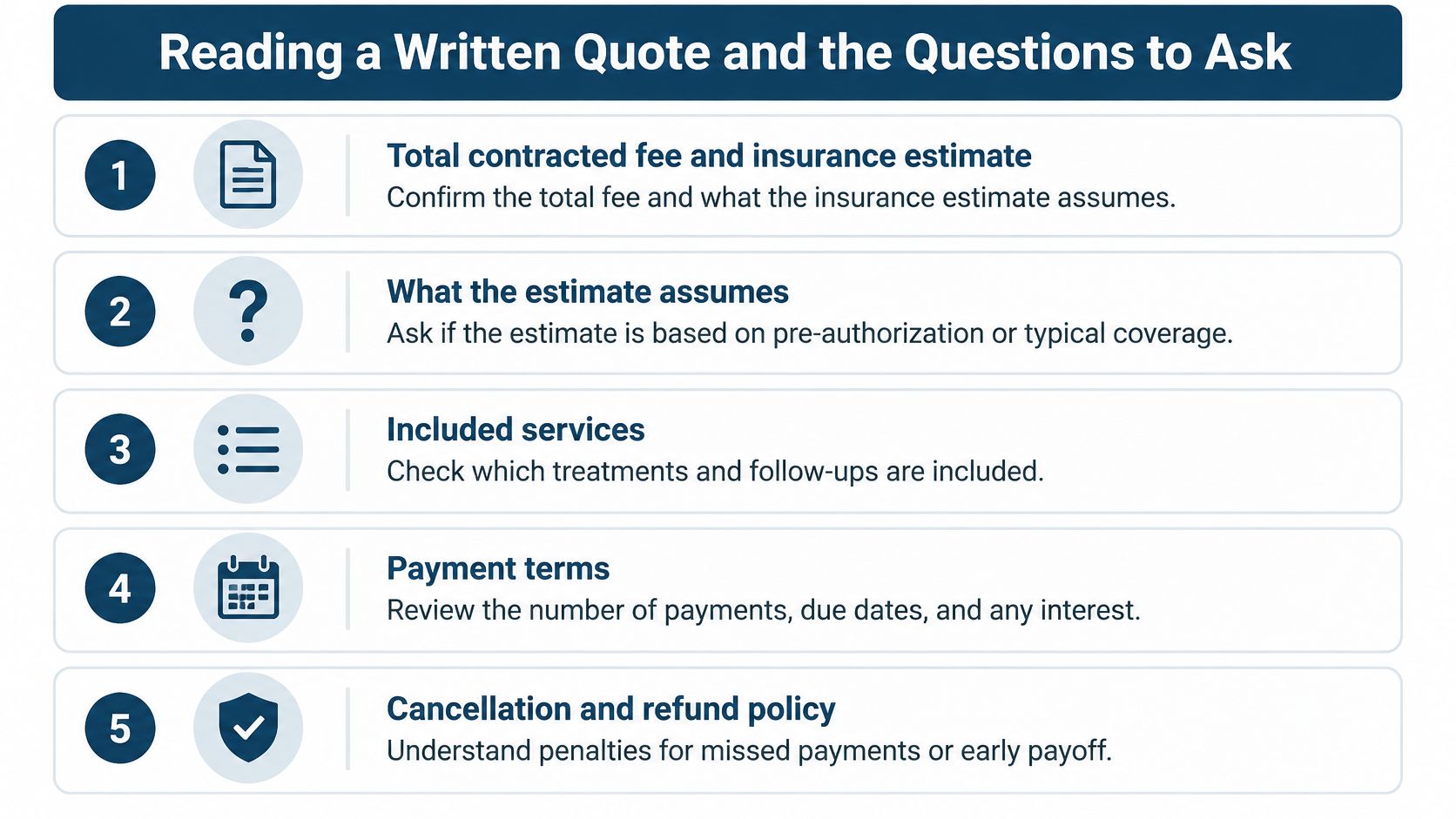
A written quote is a contract summary, not a brochure. Run this checklist against it line by line before signing, and ask why each item reads the way it does.
- Total contracted fee and the insurance estimate. Confirm both numbers, and confirm what the estimate assumes. An estimate built on typical coverage behaves differently from one built on an actual pre-authorization.
- Down payment. Ask whether a $0 down option applies, and what the first payment date would be.
- Installment count, frequency, and the final payment date. Twelve payments and twenty four payments can advertise the same opening month and end a year apart.
- Interest, when it starts, and whether it's deferred. Deferred interest is where a promotional plan turns expensive.
- Total amount repaid. A longer schedule lowers the monthly figure and can raise the total through interest or fees, so compare totals across two quotes.
- Late and missed payment consequences. Ask directly whether an unpaid balance can be sent to external collections.
- Refund policy if treatment ends early. A family that relocates mid-treatment needs to know what comes back.
What the law already requires on paper
The U.S. Consumer Financial Protection Bureau's report on medical credit cards and financing plans separates medical credit cards from installment loans as the two common products, including those marketed for uncovered dental services. In the United States, products with more than four payments or any interest charges generally fall under the Truth in Lending Act and Regulation Z, which require written disclosure of finance charges and annual percentage rate information. If those disclosures aren't in front of you, the terms aren't final.
Questions worth reading aloud in the office
- Which parts of treatment aren't covered, including Invisalign or clear ceramic upgrades, and what each costs in writing?
- How replacement appliances, lost retainers, and treatment beyond a benefit limit get billed?
- Whether the monthly total includes adjustment visits and the final retainers, or whether those arrive as separate charges?
- Whether the printed treatment plan lists the price, the financing option, and the covered portion side by side?
Stellar Orthodontics accepts most major dental insurance and verifies benefits, and patients leave the planning step with a printed treatment plan showing a price that includes financing options before committing to anything. Comparing two quotes on total repayment rather than the monthly figure is the habit that keeps a family out of expensive revolving credit.
Turning a Treatment Fee Into a Monthly Budget
Say a Dover family receives a $4,500 quote for traditional braces, and their insurance estimate comes back at $1,500. The balance to finance is $3,000, not $4,500, and that difference is the entire reason coverage gets checked before a payment plan is chosen. Spread over a year, the balance runs about $250 a month. Spread over two years, roughly $125.
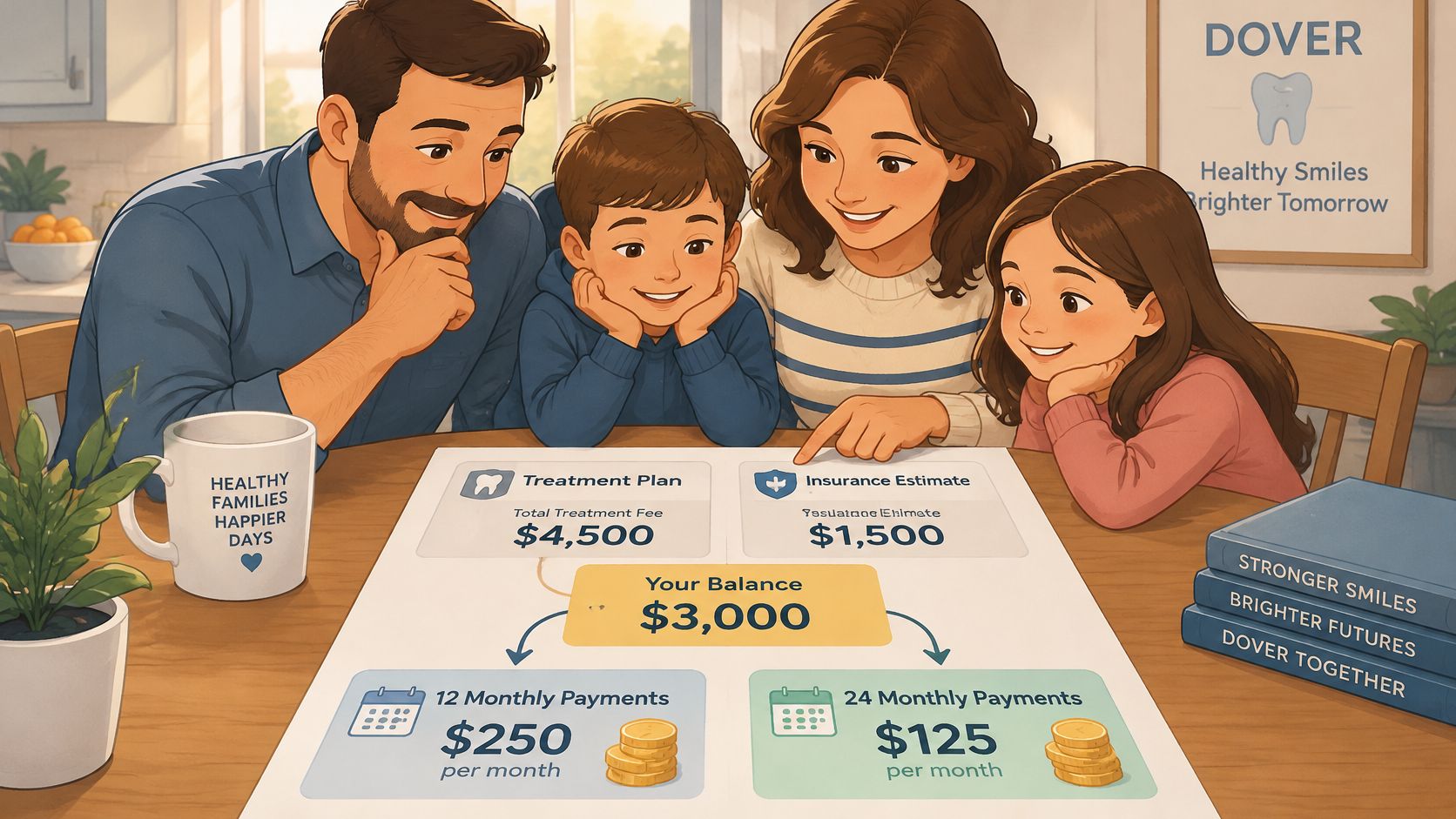
| Treatment fee | Insurance contribution | Balance financed | 12-month payment | 24-month payment |
|---|---|---|---|---|
| $3,000 | $1,000 | $2,000 | $167 | $83 |
| $4,500 | $1,500 | $3,000 | $250 | $125 |
| $6,500 | $2,000 | $4,500 | $375 | $188 |
What the table leaves out
Those figures exclude interest, fees, and any deposit, so a plan that carries interest costs more than the number shown, and a promotional plan that misses its deadline costs more still. The arithmetic is the easy part. The judgment call is which row a household can manage.
A multinational analysis of household dental spending in BMC Public Health found that families paying out of pocket for dental care had 1.88 times the adjusted odds of catastrophic health expenditure and 1.65 times the adjusted odds of impoverishment compared with households not making those payments. That's the case for spreading a large expense, and the warning against spreading it too thin.
Test resilience, not just the payment size
Ask a harder question than "can we afford $250 a month?" Ask whether the payment still works after a missed paycheck or an unplanned car repair. A plan that eats a large share of disposable income stays fragile even when the installment looks modest, and a tight month is what turns a manageable schedule into a late fee.
If financing is declined, ask whether the office offers another installment arrangement, and settle the remaining balance plan before treatment begins. A family should never discover a balance mid-treatment that it can't finance. Treatment usually runs for many months, which is exactly why a fixed schedule, checked against a tight month rather than a good one, makes the cost easier to live with.
Book a Free Consultation to Compare Your Options
The consultation is free whether or not a family moves forward with treatment, whether or not insurance covers any part of it, and whether or not a child qualifies for Medicaid braces. That last point matters most, because the coverage question gets answered before any money is discussed.
Stellar Orthodontics sees families at four Delaware locations: North Wilmington at 2304 Concord Pike, Middletown at 818 Kohl Avenue, West Dover at 125-2 Greentree Drive, and Millsboro at 26670 Centerview Drive. A visit walks through Invisalign, braces, treatment timing, and financing in plain language, and the office verifies benefits before treatment starts. For children enrolled in Medicaid, the orthodontist checks whether the case meets the state's medical-necessity criteria, and the family learns the result before leaving the office.
What to bring
- The insurance card, plus any Medicaid or Healthy Children Program information if the child is enrolled.
- The child's age, since Medicaid orthodontic coverage applies to children and teens under 21.
- A rough monthly budget, including the number that would still feel workable in a tight month.
- The checklist questions from this guide, written down so nothing gets forgotten in the room.
The practice partners with Cherry for monthly payment plans, with terms of 3, 6, 12, 18, or 24 months depending on the plan, plus $0 down options, HSA/FSA payments, and sibling discounts. Asking which term fits the budget, and what the total repayment looks like at each one, is a fair question at the front desk.
Booking the free orthodontic consultation costs nothing and produces the one document that ends the guessing: a written price with the covered portion and the financing term on the same page. Families who arrive knowing their coverage status and their budget number leave with a clear next step.