
Adults accounted for 28.31% of orthodontic patients in 2016, compared with 4.37% in 1960, according to a published analysis of American Association of Orthodontists surveys. Adult treatment isn't unusual anymore. Insurance coverage, however, still requires a closer look than the dental insurance card alone can provide.
For Delaware adults considering treatment, the important question isn't whether braces are covered. It's how much the policy will pay, when payments begin, and which costs remain the patient's responsibility. Understanding those contract details before committing can make the financial side much more predictable.
Table of Contents
- Where Adult Orthodontic Coverage Actually Comes From
- How to Check Your Adult Orthodontic Benefits
- Exclusions and Limits That Catch Adults Off Guard
- What Delaware Medicaid Covers for Adults Age 21 and Older
- How Clear Aligners and Ceramic Braces Change Your Costs
- Paying for Treatment When Insurance Falls Short
- Confirm Your Coverage Before You Commit
Where Adult Orthodontic Coverage Actually Comes From
Among U.S. adults ages 19–64, 64% had private dental benefits, 15% had public dental benefits, and 21% had no dental benefits, according to the American Dental Association's coverage and access data updated in 2026. Having dental coverage is therefore common, but having adult orthodontic coverage is a separate question.
A standard dental benefit may help with examinations and fillings without contributing toward braces. An orthodontic rider is an added part of a policy that establishes orthodontic benefits, much like separate flood coverage on a home policy. The National Association of Dental Plans explains that orthodontic coverage is usually an optional rider and that separate individual policies generally don't cover orthodontia.
Adult orthodontic coverage by source
| Coverage source | Typical adult orthodontic coverage | Main limitation | First thing to check |
|---|---|---|---|
| Dental plan with orthodontic rider | Often pays a percentage of the fee up to a lifetime maximum | Waiting periods, adult-age exclusions, lifetime caps | Whether the rider includes adults |
| Dental plan without orthodontic rider | Usually no orthodontic benefit | Orthodontia is generally an optional rider | Whether any orthodontic benefit exists |
| Individually purchased dental policy | Generally does not cover orthodontia | Separate individual policies rarely include it | Orthodontic section of the policy summary |
| Delaware Medicaid, age 21 and older | Routine adult orthodontics not covered; exceptions only | Medical-necessity or surgical criteria must be met | Whether the case meets an exception |
| Medicare | Generally no coverage for routine orthodontics | Limited to medically necessary cases involving disease or injury | Whether treatment is medically necessary |
The policy matters more than the carrier
An employer-sponsored policy and an individually purchased policy can have different benefits even when the same insurance company administers both. A familiar carrier name doesn't establish adult eligibility, and a parent's benefit may differ from a child's benefit under the same family plan.
The summary of benefits is the best starting document. If its orthodontic description is incomplete, the full policy and any rider should provide the eligibility rules and exclusions.
Practical rule: A dental insurance card identifies the plan. It doesn't establish that adult braces or clear aligners qualify for payment.
Public programs need a different review. Adult Medicaid orthodontic coverage is exception-based, while Medicare generally excludes routine orthodontics and allows only limited medically necessary circumstances involving disease or injury.
Identifying the applicable row helps narrow the next conversation. Someone with an employer plan needs the orthodontic rider; someone relying on Medicaid needs the adult eligibility and medical-necessity policy.
How to Check Your Adult Orthodontic Benefits
A plan can list orthodontics as a benefit and still leave much of the treatment cost to you. Ask the insurer to explain the terms in writing, then compare its answer with the proposed treatment fee.
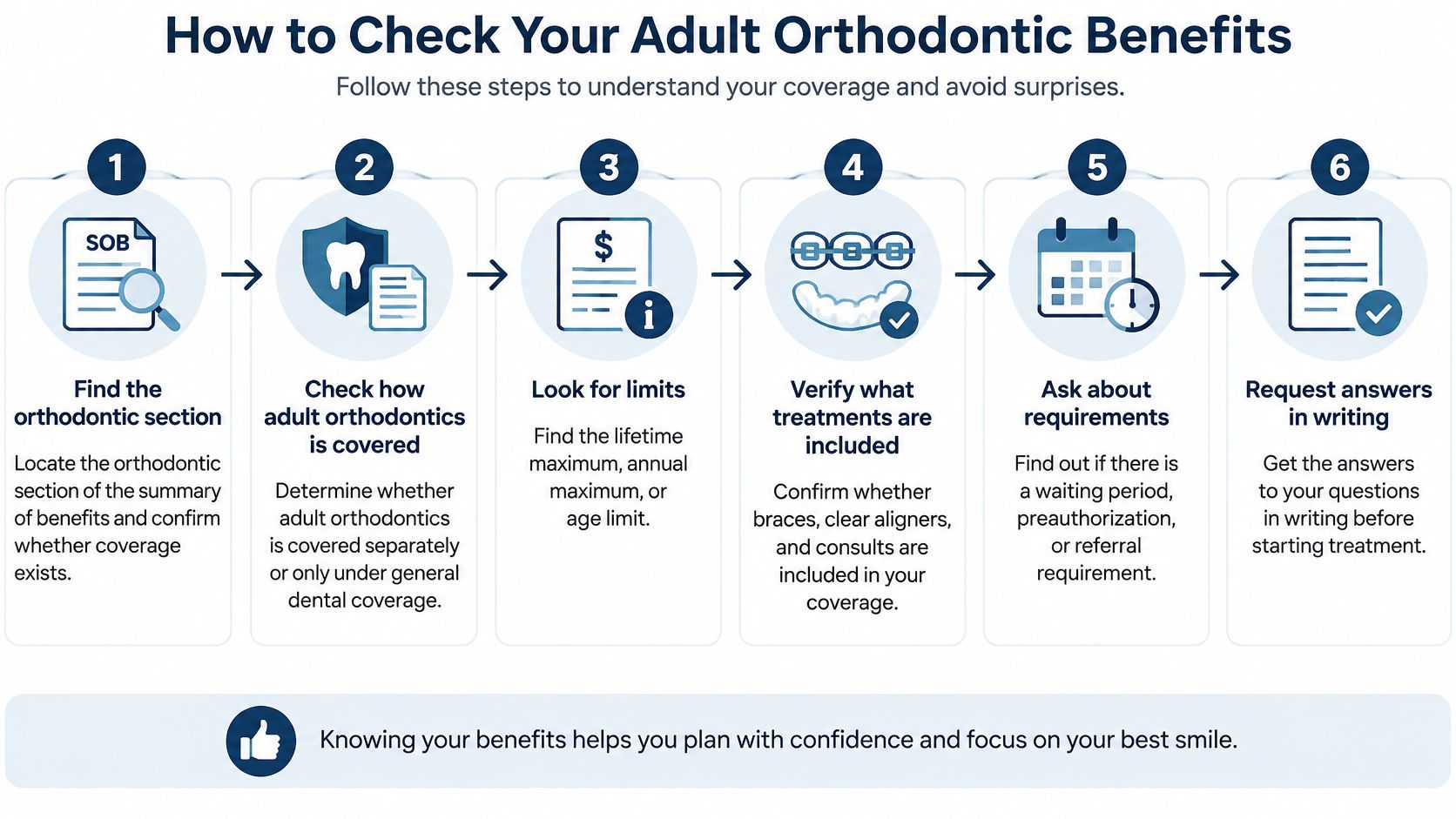
A written benefit check
Confirm adult eligibility. Check whether the orthodontic benefit applies to the adult patient or only to dependent children. The summary of benefits may identify the rule; ask the insurer to confirm it.
Record the lifetime orthodontic maximum. This is the total amount available under the policy's orthodontic rules. Identify it separately from the ordinary yearly dental maximum, and ask how much of the orthodontic benefit has already been used.
Ask how the patient share is calculated. A deductible is an amount you pay before the applicable benefit contributes. Coinsurance is the share of an eligible charge assigned to you and the insurer. Ask how both apply to orthodontic treatment.
Check the waiting period and eligibility date. A waiting period is the time that must pass before a benefit becomes available. Ask when coverage takes effect and whether starting treatment before that date could affect payment for the full course.
Confirm which appliances and services qualify. Ask whether clear aligners, ceramic braces, and metal braces follow the same rules. Check separately how the policy treats consultations, records, and retainers.
Request a written predetermination and check network status. A predetermination is the insurer's estimate based on the proposed treatment plan. Ask which allowed amount, or insurer-recognized fee, applies and whether the treating orthodontist is in network.
Why the maximum isn't the estimate
An analysis of 112,243 U.S. insured patients found that 92% of plans provided eligibility for benefits up to $3,000, while the average orthodontic benefit value was $1,772, according to the insurance analysis cited in Invisalign's affordability guide. These figures describe plan benefits, not a guaranteed payment to every eligible adult.
Compare the proposed treatment fee with the insurer's written estimate. A predetermination is not an unconditional payment guarantee: eligibility and policy conditions still apply.
Checking benefits works best as a written process rather than a verbal assurance. Keep the insurer's response with the treatment plan, and ask about any unexplained adjustment, excluded charge, or uncertain payment before signing a financial agreement. The orthodontic insurance information page can help you prepare questions about coverage.
Exclusions and Limits That Catch Adults Off Guard
A waiting period can delay payment even when a policy lists orthodontic coverage. If treatment starts before the policy's eligibility date, the insurer may exclude the claim. The lifetime maximum does not fix that problem: it limits how much the plan can pay once a claim qualifies.
A lifetime maximum is a cap on the insurer's total orthodontic contribution, often separate from the annual dental maximum. It is not a promised payment. For example, if a plan lists a lifetime maximum but excludes treatment during a waiting period, the patient may receive no orthodontic benefit for that treatment, despite the stated cap.
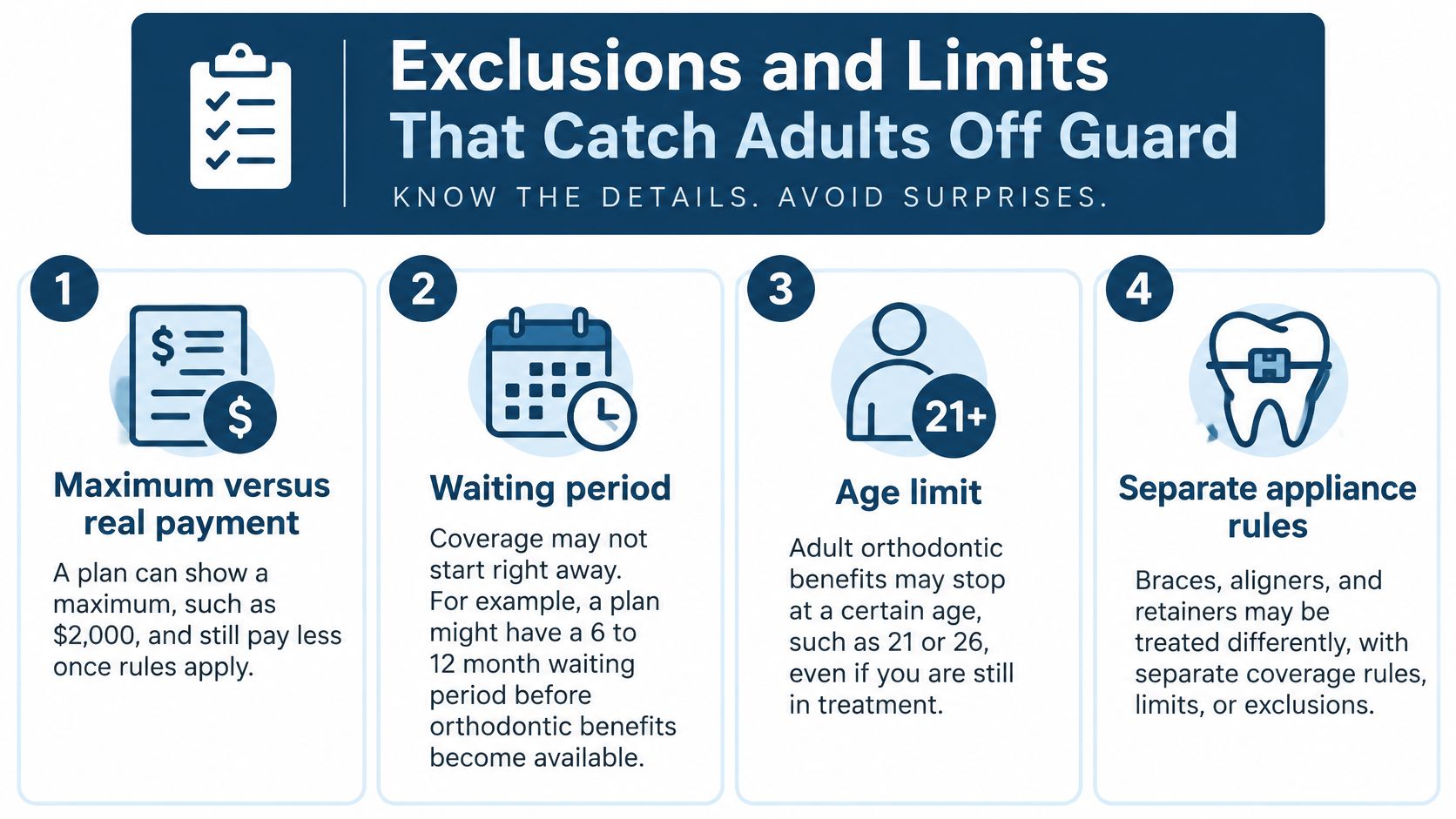
How exclusions affect the amount paid
Some plans pay orthodontic benefits in portions over the course of treatment rather than as one payment at the start. A prorated benefit may depend on ongoing eligibility and scheduled claims. If coverage ends before all portions are paid, the total received may be lower than the listed lifetime maximum.
Other contract terms can shrink the payment too. A plan may limit coverage by age, exclude treatment already in progress, or apply a separate fee schedule. That recognized fee can be lower than the orthodontist's charge, leaving the patient responsible for the difference.
Compare the total premiums with the estimated insurance contribution and remaining treatment balance. If considering an additional policy, check whether its waiting period or exclusions apply to treatment already underway. A policy can include orthodontics on paper and still leave most of the fee with the patient.
Ask the insurer to explain, in writing, when benefits begin, how payments are released, and which charges are excluded. Match those answers to the proposed treatment plan before signing a financial agreement.
What Delaware Medicaid Covers for Adults Age 21 and Older
Delaware's adult dental allowance isn't the same as an adult braces benefit. The Delaware Department of Health and Social Services states that Medicaid-enrolled adults age 21 and older may receive up to $1,000 in dental care each year, with an additional $1,500 potentially available for qualifying emergency or supplemental care when medically necessary.
That allowance shouldn't be budgeted toward routine adult orthodontics without specific confirmation. Most adults over the pediatric eligibility boundary aren't eligible for Delaware Medicaid's routine orthodontic benefit, and adult coverage is very limited and exception-based.
Dental benefits and orthodontic exceptions
Federal law doesn't establish a minimum adult dental benefit, so states determine which adult services to offer, as explained by Medicaid's dental care guidance. Covering dental examinations or restorative care doesn't automatically establish orthodontic eligibility.
An adult exception may involve orthodontics that is necessary for covered jaw surgery or reconstruction, or certain documented craniofacial conditions. These are conditions affecting the development or structure of the face and jaws, not a general pathway for routine alignment.
Medicare is a separate program and generally doesn't cover routine orthodontics either. Eligibility for a public program alone shouldn't be treated as approval for braces.
The transition from pediatric coverage
Delaware Medicaid covers medically necessary braces for children and teens, with Delaware First Health's dental program guidance identifying medical necessity and the associated Delaware coverage guidance specifying prior authorization and a one-time-per-lifetime limit. Pediatric orthodontic eligibility applies to patients under 21, and continued coverage shouldn't be assumed when a teen reaches that boundary.
For treatment near the cutoff, the family should confirm whether care has already started, what was authorized, and whether coverage can continue under the member's circumstances. Approval before the birthday shouldn't be treated as automatic approval afterward.
Families in North Wilmington, Middletown, Dover/West Dover, and Millsboro can review the same questions with their Medicaid plan and Stellar Orthodontics:
- Medical necessity: Does the proposed adult treatment meet a covered exception?
- Prior authorization: Is approval required before treatment begins or continues?
- Supporting records: Which clinical notes, images, diagnosis, or surgical documentation must accompany the request?
How Clear Aligners and Ceramic Braces Change Your Costs
The appliance label doesn't determine the insurance payment by itself. The important issue is whether the policy places clear aligners and braces under the same eligible orthodontic benefit.
Appliance choices should be compared alongside their written insurance estimates.
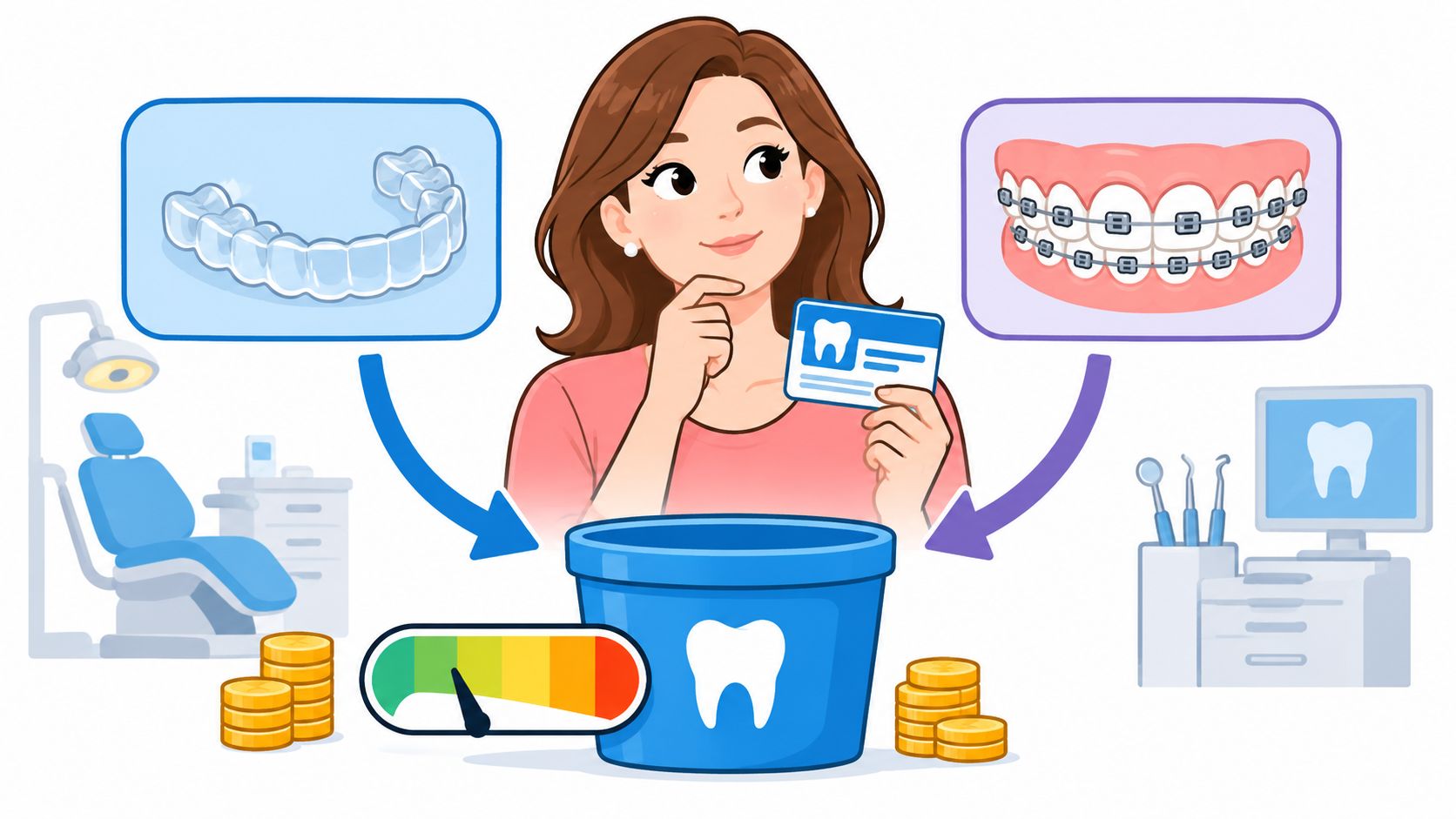
A hypothetical capped-benefit example
Consider an illustrative case, not a Stellar Orthodontics quote: an adult has a covered clear aligner fee of $5,500, a policy paying 50%, and an unused $2,000 lifetime orthodontic maximum.
| Calculation | Hypothetical amount |
|---|---|
| Eligible treatment fee | $5,500 |
| Half of the eligible fee | $2,750 |
| Payment after the lifetime cap | $2,000 |
| Patient balance before any deductible | At least $3,500 |
The insurer's percentage would produce a larger contribution, but the lifetime cap limits payment. A deductible, excluded service, or different allowed amount could increase the patient's share.
This is a relatively favorable hypothetical benefit. Aflac's consumer guidance on braces coverage notes that available adult benefits may cover 25%–50% of treatment, include waiting periods, and cap benefits around $1,500.
Comparing appliances fairly
If ceramic braces carry the same hypothetical fee and qualify under identical policy terms, the calculation stays the same. If the policy excludes an appliance, recognizes a different fee, or treats an upgrade separately, the balance changes.
A useful comparison therefore includes the full treatment fee, expected insurance contribution, included services, and patient balance for each appropriate option. Stellar Orthodontics's ceramic braces and Invisalign cost comparison offers additional context for evaluating those choices.
The accompanying video provides another format for considering treatment options.
Monthly installments can make a remaining balance easier to manage, but they don't change the insurer's lifetime cap. The financial agreement should show the complete payment schedule and total amount owed, not just an appealing monthly figure.
Paying for Treatment When Insurance Falls Short
Approximately 72 million U.S. adults, or 27%, lacked dental insurance in the 2024 State of Oral Health Equity in America survey, published by CareQuest Institute for Oral Health in 2025. Planning without an orthodontic benefit isn't unusual, and partial coverage still requires a plan for the balance.
Payment tools serve different purposes. Installments change when money is paid, while eligible tax-advantaged accounts change how expenses are funded.
Payment tools that cover the gap
| Payment option | How it works | Who it suits | Watch for |
|---|---|---|---|
| Monthly payment plan | Spreads the remaining balance across months | Patients with a balance left after insurance | Total cost over the plan length |
| Flexible spending account | Pre-tax dollars for eligible medical and dental expenses | People whose employer offers an FSA | Annual election amounts and use-it-or-lose-it deadlines |
| Health savings account | Pre-tax savings for qualified expenses | People enrolled in a qualifying high-deductible health plan | Only qualified expenses count |
| Upfront or in-full payment discount | Reduced fee when the balance is paid in full, if offered | Patients who can pay the balance at the start | Whether the discount applies alongside insurance |
Compare the total before choosing the monthly amount
A monthly payment plan should fit the household budget without hiding the full obligation. Stellar Orthodontics offers flexible monthly payment plans; its payment-plan information can help patients prepare financial questions before committing.
Flexible spending accounts, or FSAs, and health savings accounts, or HSAs, can fund eligible expenses with pre-tax dollars. Eligibility, annual limits, documentation requirements, and deadlines follow IRS and account rules, so the plan administrator or a tax professional should confirm how orthodontic payments qualify.
Some practices reduce the fee for payment in full. A written quote should clarify whether such a reduction is available and whether it can be combined with insurance; a discount shouldn't be assumed.
- Total price: Is the installment total higher than the upfront price?
- First claim: Does insurance pay the initial claim, and does the patient schedule change if reimbursement arrives later?
- Late payments: Are there late fees or other charges?
- Reconciliation: How will the balance change if the insurer pays less than estimated?
Budgeting safeguard: The payment schedule should account for both the expected insurance contribution and the possibility of a smaller payment.
Out-of-pocket spending remained the largest payment source throughout the national orthodontic expenditure analysis covering 1996–2016, according to the published U.S. expenditure study. Planning the patient balance early is part of treatment preparation, not an afterthought.
Confirm Your Coverage Before You Commit
Adult orthodontic coverage depends on the written policy terms. A plan may list an orthodontic benefit while leaving much of the treatment cost to the patient. Before deciding, get a written estimate for your case and compare it with the insurer's written response.
A practical decision sequence
- Clarify the coverage route. Confirm which policy or payment arrangement applies to the proposed treatment.
- Compare the documents. Check that the insurer's response and the treatment estimate describe the same care.
- Decide whether the balance fits. Consider the full expected patient cost and the terms of any payment arrangement.
A consultation can connect the treatment findings with the estimate. The orthodontist who would treat the case runs the visit, which includes a full orthodontic exam, a 3D iTero scan, and a printed treatment plan with transparent pricing before the patient leaves.
The consultation is free whether or not the patient proceeds, insurance covers any treatment, or a child qualifies for Medicaid braces. Bring insurance information, a summary of benefits, and the orthodontic policy section so coverage questions can be discussed alongside the exam findings.
Delaware consultation locations
- North Wilmington: 2304 Concord Pike.
- Middletown: 818 Kohl Avenue.
- West Dover: 125-2 Greentree Drive.
- Millsboro: 26670 Centerview Drive.
A written treatment plan gives you a case-specific amount to compare with the insurer's response. Review both before deciding whether to proceed.
Stellar Orthodontics offers a free consultation with an orthodontic exam, digital scan, and printed treatment plan to help patients understand their options and expected costs. Adults and families can bring their benefit documents and visit Stellar Orthodontics to book a free consultation at the Delaware location that suits them.