.png)
Clear Essix retainers commonly cost about $100–$250 per arch, Hawley retainers about $150–$300 per arch, and bonded or permanent retainers about $250–$500 per arch. The first set is often included in the braces package, while replacement retainers commonly range from roughly $100–$500 per arch, depending on the type.
A Delaware parent may hear, “The braces are coming off,” and expect the orthodontic bill to be finished. Then the conversation turns to retention, and a new question appears: What is the retainer after braces price, and will the family pay it now or later? The answer depends on the retainer design, whether one arch or both arches need coverage, and whether the initial appliance was included in the treatment agreement.
The table below provides a practical starting point for families. Full upper-and-lower sets often cost more because they cover both arches, and replacement pricing may differ from the first retainer included with treatment.
| Retainer type | Typical cost per arch | Common pricing consideration |
|---|---|---|
| Clear Essix | About $100–$250 | Discreet removable design |
| Hawley | About $150–$300 | Wire-and-acrylic removable design |
| Bonded or permanent | About $250–$500 | Fixed appliance attached behind the teeth |
| Full upper-and-lower set | Often about double the single-arch amount | Depends on the appliance type and treatment package |
For Delaware families in North Wilmington, Middletown, Dover, West Dover, or Millsboro, a written estimate can make the difference between a confusing line item and a manageable long-term plan.
Table of Contents
- Why Retainers Cost What They Do After Braces
- The Three Main Types of Orthodontic Retainers
- Comparing Retainer Costs Across Delaware Options
- Understanding the Hidden Costs of Retention
- Insurance Medicaid and CHIP Coverage in Delaware
- Next Steps for Your Family in Wilmington or Sussex County
Why Retainers Cost What They Do After Braces
A child finishes braces, the brackets come off, and a parent asks whether the final payment includes everything. Sometimes the initial retainer is included in the completed braces package. Sometimes the office lists the appliance separately. Either way, the family needs to know whether the quoted amount covers one arch, both arches, the fitting appointment, and future replacements.
The retainer isn't just a piece of plastic or wire pulled from a shelf. Each appliance is selected and prepared for a particular mouth. The process can involve a digital scan or impression, design work, laboratory fabrication, delivery, and fitting. Those steps help explain why a replacement retainer often carries a separate charge after orthodontic treatment ends.
The first retainer and the replacement retainer
One widely cited U.S. consumer cost reference explains that an initial retainer is often included in the overall orthodontic treatment package, while replacement retainers may cost about $70–$250 for one retainer or $140–$500 for a set. The same reference lists broad single-arch ranges of about $150–$300 for a Hawley, $100–$250 for a clear Essix, and $250–$500 for a bonded retainer. Families can review those ranges in this consumer retainer cost guide.
That difference creates a common pattern. The first appliance may be bundled into the braces fee, but a later appliance can become an out-of-pocket purchase if the original is lost, damaged, worn, or no longer fits.
What the fee supports
A parent paying for a retainer is generally paying for more than the material. The charge may reflect:
- Digital records: A scan or other record captures the tooth positions used to make the appliance.
- Custom fabrication: A laboratory creates the retainer to match the prescribed design.
- Clinical fitting: The orthodontic team checks comfort, seating, and the intended fit.
- Professional follow-up: The office can determine whether the appliance remains appropriate during retention.
Practical rule: A family should ask whether the quoted retainer fee includes the scan, fabrication, fitting, and any early adjustment.
The retainer protects the alignment achieved through braces, but it also requires an ongoing commitment from the patient. A clear explanation of the original fee and replacement policy helps parents plan for that responsibility without treating the appliance as an unexpected add-on.
The Three Main Types of Orthodontic Retainers
The retainer type affects both the initial price and the way a child will use the appliance. A removable design gives the patient responsibility for storage and wear. A fixed design stays attached and requires a different cleaning routine. The orthodontist will choose based on the treatment result, the child's needs, and the family's ability to manage the appliance.
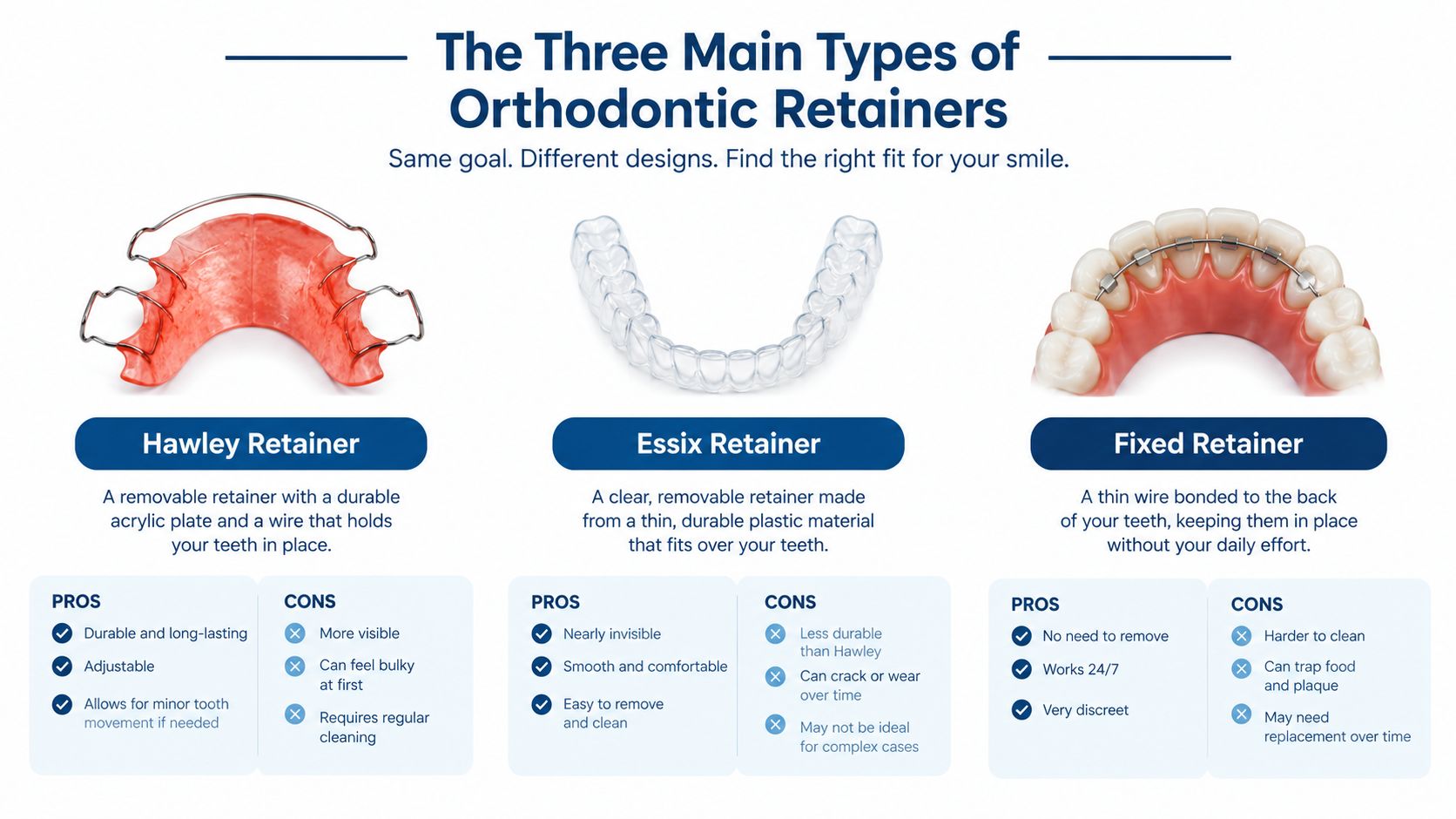
Hawley retainers
A Hawley retainer combines an acrylic portion with a visible wire. It can be sturdy and may allow an orthodontist to make certain adjustments. A U.S. retainer pricing reference commonly lists replacement Hawley retainers at about $150–$350 per arch, with full-set pricing potentially included in a broader range of roughly $300–$1,000 when both arches or premium multi-set packages are involved. The detailed ranges appear in this retainer pricing comparison.
Some children like the opportunity to choose an acrylic color, while others prefer an appliance that draws less attention. The wire is visible, so appearance can influence a patient's preference. The family also needs to remember that a removable Hawley must be taken out for certain activities, stored safely, and cleaned as directed.
Clear Essix retainers
A clear Essix retainer is made from transparent material and fits over the teeth. It usually attracts less attention than a wire-based appliance, which can matter to teens and adults who want a discreet option.
The listed replacement range is commonly about $100–$300 per arch. Its lower single-arch starting range can make it appealing for a family comparing immediate costs, but the long-term budget also depends on how carefully the patient handles and stores it. Heat, chewing, accidental damage, and loss can all create a need for a new appliance, although the timing varies by patient and retainer condition.
Bonded or fixed retainers
A bonded, permanent, or fixed retainer is attached behind the teeth, often along the front teeth. Because it remains in place, the patient doesn't need to remember to insert it each evening. That convenience comes with a need for careful cleaning around the wire and regular attention to its condition.
Replacement pricing is commonly listed at about $250–$500 per arch. The appliance may be considered when continuous support is important for a particular treatment result, but the orthodontic team must decide whether it fits the patient's needs. A fixed retainer isn't automatically the right choice for every child or adult.
Families should compare more than the number on the estimate. Visibility, daily habits, cleaning, storage, and replacement risk all affect the practical value of a retainer.
Comparing Retainer Costs Across Delaware Options
A family leaving braces may receive two estimates that look similar at first glance, yet cover different services. One quote may include the first retainer and fitting appointment. Another may list the appliance separately or charge for each arch. Like comparing a car payment without checking taxes and maintenance, comparing the headline price alone can give an incomplete picture.
For Delaware families, a useful comparison should show how each office handles the treatment agreement, follow-up visits, and future replacements. The retainer type still matters, but the surrounding terms often determine what the family pays later.
| Delaware comparison point | What parents should check | Why it affects the budget |
|---|---|---|
| First retainer | Whether the treatment agreement includes the appliance, scanning, fabrication, and fitting | A bundled retainer can reduce the amount due when braces come off, while an unbundled fee may appear separately |
| Arch coverage | Whether the quoted amount covers the upper arch, lower arch, or both | A single-arch quote does not describe the full cost of retainers for both arches |
| Replacement handling | Whether lost, cracked, or poorly fitting appliances have a stated replacement charge | The office policy can matter as much as the original appliance price |
| Follow-up care | Whether retention checks or adjustments are included in scheduled appointments | A lower appliance fee may not include later visits or repairs |
| Location and scheduling | How the agreement works at North Wilmington, Middletown, Dover, or Millsboro | Travel time and appointment availability can affect the practical cost for a family |
Stellar Orthodontics has four Delaware locations, so families can request the same written cost breakdown from the office that fits their schedule. Comparing the cost of braces in Delaware with retention terms can show whether the quoted braces fee already accounts for the first appliance.
Immediate price versus long-term value
A removable retainer may fit a patient who can follow a storage and wear routine. A fixed retainer may suit a different situation, but it remains attached behind the teeth and requires careful cleaning. The lower initial estimate is not automatically the lower household cost. Consistent use, safe storage, and prompt attention to fit can reduce avoidable replacement problems.
A teen in North Wilmington may value a discreet option. Parents in Middletown may give greater weight to a child's ability to remember and protect a removable appliance. Families near Dover or Millsboro may also consider travel for adjustments. The right comparison asks which design the patient can use and care for reliably.
Questions that clarify a Delaware estimate
Before signing, parents can ask:
- Arch coverage: Is the fee for one arch or both?
- Included services: Are scanning, fabrication, fitting, and adjustments included?
- Replacement policy: What happens if the retainer is lost, damaged, or no longer fits?
- Insurance billing: Will the office submit claims, and could Medicaid or CHIP eligibility affect the family's responsibility?
- Treatment agreement: Was the first retainer included in the braces fee?
These answers turn a general price discussion into a comparison based on the family's actual agreement and location.
Understanding the Hidden Costs of Retention
The price on a retainer estimate usually reflects a chain of services. A family can understand the bill more easily by separating the process into the initial appliance, routine retention care, and future replacement.
First, the orthodontic team records the teeth and selects the appliance design. A digital scan may support the laboratory process, and the lab fabricates the retainer. The office then checks the fit and explains use, cleaning, and storage. If the braces treatment agreement includes the first retainer, those services may be bundled into the overall fee.
What can be included
Bundling varies by office and treatment agreement. Parents should look for clear wording about:
- The initial appliance, including whether it covers one arch or both.
- The fitting appointment, including whether an adjustment is part of the fee.
- Retention checks, which may be handled within scheduled follow-up care.
- Replacement limits, including whether lost or damaged retainers are excluded.
A bundled first retainer doesn't mean every future appliance is included. Replacement fabrication uses a new workflow, and the office may need a new scan, laboratory order, and fitting.
Why replacements recur
Retainers aren't a one-time purchase in practice. A replacement cost reference lists broad costs between $50 and $800, depending on the type, with clear Essix retainers often around $50–$200 per set, Hawley retainers around $150–$300, and bonded permanent retainers around $250–$500. Families can review those categories in this retainer replacement cost guide.
Those ranges cover different appliances and pricing situations, so they shouldn't be treated as a guaranteed Delaware fee. The practical lesson is more useful than a single number: a lost removable retainer, a damaged appliance, or a problem with a fixed wire can create a separate expense after the braces bill has ended.
A retention budget should include the possibility of future replacement, even when the first appliance is included.
A parent can reduce surprises by asking for the office's written replacement policy before braces come off. That conversation gives the family time to understand what insurance may cover, how claims work, and which costs would remain out of pocket.
Insurance Medicaid and CHIP Coverage in Delaware
Insurance coverage for retainers depends on the plan, the patient's eligibility, the treatment agreement, and whether the appliance is part of the original orthodontic service or a later replacement. A family shouldn't assume that a braces benefit automatically pays for every retainer in the years that follow.
Delaware families can ask their dental plan specific questions before treatment ends. This is especially important for parents in Kent County, Sussex County, and communities throughout the state who need to plan for ongoing retention.
Questions for a dental plan
A phone call can be more productive when the parent has the exact details available. Useful questions include:
- Initial coverage: Is the first retainer included in the orthodontic benefit or treatment agreement?
- Replacement coverage: Does the plan cover a lost, damaged, or worn retainer?
- Patient responsibility: Is coverage calculated by arch, by appliance, or by treatment episode?
- Age rules: Does the plan apply different rules to children, teens, and adults?
- Authorization: Does the plan require prior authorization or documentation?
- Claim support: Will the orthodontic office submit the claim, or must the family file it?
Some U.S. market references report that insurance may cover around 50% of replacement costs in certain situations, reducing out-of-pocket expense to roughly $50–$150 per arch. That isn't universal coverage, so families should verify the actual benefit with the insurer and the orthodontic office. The budgeting ranges and insurance example are discussed in this guide to retainer costs and insurance.
Medicaid and CHIP questions for Delaware families
For eligible children and teens under 21, Delaware Medicaid and CHIP may be relevant to orthodontic coverage, but plan rules and approval requirements still need confirmation. The three state Medicaid plans are AmeriHealth Caritas Delaware, Highmark Health Options, and Delaware First Health. Families should ask whether the child's specific plan covers the retainer associated with approved orthodontic care and whether replacement appliances receive different treatment.

Long-term retention also matters because the appliance may be needed well after braces are removed. Cleveland Clinic states that patients typically wear retainers full-time for at least four to six months after treatment, then at night for the rest of their life, as described in its retainer care guidance. Coverage questions therefore deserve attention before the final braces appointment, not after a retainer is lost.
Delaware families can find more context about eligibility and orthodontic benefits through this Medicaid orthodontic coverage resource.
Next Steps for Your Family in Wilmington or Sussex County
A sensible retainer decision starts with a written plan, not a rushed choice at the final braces appointment. Parents can ask the orthodontic team to show the recommended appliance, explain whether one or both arches need retention, and identify which costs are included in the treatment agreement.
The family should also bring insurance information to the discussion. A benefits coordinator can help clarify whether the plan treats the first retainer differently from a replacement. For Medicaid and CHIP families, the office can verify the child's plan and explain what documentation or approval may be needed.
A simple preparation checklist
Before the consultation or debonding visit, parents can gather:
- Insurance details: The child's member identification and plan information.
- Lifestyle concerns: Whether the patient plays sports, travels, or prefers a discreet appliance.
- Care questions: How the retainer should be cleaned, stored, and checked.
- Budget questions: Whether payment plans, replacement pricing, or bundled services apply.
- Location preferences: The most convenient office among North Wilmington, Middletown, Dover or West Dover, and Millsboro.
Families near Wilmington can review the North Wilmington orthodontic office information, while families along the MOT corridor, in Kent County, or in Sussex County may prefer Middletown, Dover, West Dover, or Millsboro for ongoing visits.
Choosing based on care, not price alone
The lowest quoted retainer price won't help if the patient can't wear or care for the appliance consistently. A more expensive fixed option may not suit a child who needs easier cleaning, while a clear removable option may create practical challenges for a patient who frequently misplaces personal items. The orthodontist should weigh the treatment result and the patient's routine before recommending an appliance.
At Stellar Orthodontics, families can ask about replacement retainers, initial retainer inclusion, digital scanning, insurance processing, and flexible monthly payment plans. A free consultation gives parents an opportunity to receive a treatment-specific estimate rather than relying only on broad national ranges.
A family can book a free consultation at Stellar Orthodontics to review the recommended retainer, expected costs, and available payment or coverage questions. The practice offers consultations across North Wilmington, Middletown, Dover or West Dover, and Millsboro, so parents can choose a Delaware location that fits the child's care schedule.
Stellar Orthodontics offers orthodontic evaluations, braces, Invisalign, and retention planning for children, teens, and adults across Delaware. Families can discuss the retainer after braces price, insurance or Medicaid and CHIP questions, and replacement options during a free consultation by visiting Stellar Orthodontics.