.png)
Many families hear that Invisalign is automatically faster than braces. That advice is too simple to guide a real treatment decision. The faster option depends on the movements required, the patient's daily habits, and how the teeth and supporting tissues respond. A Delaware parent comparing treatment for a teen, or an adult considering clear aligners, needs a case-specific answer rather than a marketing promise.
The clearest way to understand the difference is to separate appliance mechanics from treatment execution. Braces remain attached and work continuously. Invisalign works only while the aligners are worn as directed. Either approach can be efficient for the right diagnosis, and either can take longer when the case or the patient's routine creates delays.
| Question | Invisalign | Traditional braces |
|---|---|---|
| How it works | Removable, sequential clear aligners | Fixed brackets and archwires |
| Patient involvement | High, because wear time controls progress | Lower for daily activation, though care instructions still matter |
| Strong fit | Many mild or selected moderate alignment problems | Broad range of movements, including complex bite corrections |
| Main timing risk | Missed wear, lost trays, incomplete tracking | Broken appliances, missed visits, missed elastics |
| Best speed question | Can the patient wear the trays consistently? | Can the appliance control the required movement predictably? |
Table of Contents
- The Honest Answer on Speed
- What the Research Actually Shows About Treatment Time
- Case Complexity and How It Changes the Timeline
- Compliance, Age, and Daily Habits That Drive the Clock
- Side by Side Comparison of Invisalign and Braces
- When Invisalign May Be Faster and When Braces Win
- Faster Is Not Always Better and How to Move Forward
The Honest Answer on Speed
The honest answer to what is faster Invisalign or braces is that neither appliance wins for every patient. Treatment length varies because orthodontists aren't just straightening teeth. They're coordinating tooth position, bite relationships, root angulation, spacing, and retention. A plan that moves visible front teeth quickly may still need additional time to settle the bite safely.
Three factors set the treatment clock
Case complexity comes first. Small spacing or mild crowding may respond efficiently to either approach, while extractions, impacted teeth, major bite discrepancies, and difficult rotations require more controlled movement. The appliance choice matters, but the diagnosis usually matters more.
Compliance separates removable aligners from fixed braces. Clear aligners need to be worn for the prescribed portion of the day, while braces remain in place. A patient who removes aligners frequently can lose the practical advantage that a carefully designed sequence might otherwise provide.
Biology also limits the schedule. Teeth move through living supporting tissues, and those tissues don't respond identically from patient to patient. Age, bone characteristics, inflammation, oral hygiene, and the way teeth contact one another can all influence how treatment progresses.
For many adults and adolescents, orthodontic treatment is planned within a broad range rather than a guaranteed finish date. The range depends on the problem being corrected and whether the patient follows the plan. Families in North Wilmington, Middletown, Dover, or Millsboro should ask for a projected range tied to the actual records, not an average borrowed from another patient.
Practical rule: The appliance sets the possible treatment path, but the diagnosis and daily execution determine whether the patient stays on it.
A shorter calendar can also create the wrong incentive. If a plan prioritizes visible alignment while compromising bite contacts, root control, or long-term retention, shaving time off the schedule may not benefit the patient. The meaningful goal is a stable, healthy result completed predictably, not just the earliest possible debonding or final aligner.
What the Research Actually Shows About Treatment Time
The research doesn't support a universal winner. Studies compare different patient groups, appliance protocols, definitions of completion, and treatment goals, so their averages shouldn't be treated as promises for every family.
A randomized clinical study published in 2021 examined simple Class I malocclusions. In that study, Invisalign averaged 1.7 years, while traditional braces averaged 1.3 years, making Invisalign 4.8 months longer on average, with a statistically significant difference of P <.001. The study reported similar occlusal outcomes after treatment and six months of retention. Read the randomized study on Invisalign and braces treatment time
A 2024 comparative study reported the opposite pattern for some cases. Clear aligners finished in 18 months on average, compared with 24 months for conventional braces, a 6-month difference, with a statistically significant result of P <.001. That contrast is useful because it shows how strongly case selection and treatment objectives influence the answer. Review the 2024 comparative orthodontic study
A retrospective comparison of 96 finished orthodontic cases also found a shorter mean duration for aligners in that sample. Invisalign averaged 13.35 months, compared with 19.1 months for fixed appliances, a difference of 5.75 months. The authors' patient sample and case mix matter, so the result is better understood as a practical observation in selected, simpler cases than as a rule for all patients. Examine the retrospective comparison of finished orthodontic cases
The averages tell different stories
| Study type | Invisalign average | Braces average | Notes |
|---|---|---|---|
| Randomized study of simple Class I malocclusions | 1.7 years | 1.3 years | Invisalign took 4.8 months longer; final occlusal outcomes were similar after retention |
| 2024 comparative study | 18 months | 24 months | Clear aligners finished 6 months sooner in that study |
| Retrospective comparison of 96 finished cases | 13.35 months | 19.1 months | Aligners averaged 5.75 months shorter in a selected sample |
A systematic review summarized in a 2026 journal article found no significant difference in treatment duration between clear aligners and fixed braces for mild to moderate crowding across ten studies, six of them randomized. That finding reinforces the central point: for less complex cases, either option may be faster, and the evidence doesn't show a dependable timing advantage. Read the review summary on braces and aligners
Research also raises a separate question. Faster completion doesn't automatically mean better stability or less refinement. A 2026 scoping review discusses limitations of clear aligners and uncertainty in treatment prediction, including potential tradeoffs involving occlusal contacts, torque control, and retention in more complex movements. Review the scoping discussion of clear aligner limitations
That's why Delaware orthodontists should interpret published averages cautiously. A single-practice timeline can describe that practice's patients and methods, but it can't replace an examination, imaging, and a movement-by-movement plan. Families can also review how long Invisalign treatment can take before asking how the published ranges apply to a specific smile.
Case Complexity and How It Changes the Timeline
Two patients can have similar-looking crowding and need very different treatment plans. One may need only limited tipping and alignment. Another may need root control, bite correction, space opening, or coordination between the upper and lower arches. Those distinctions affect speed more than whether the appliance is clear or made of metal.
Mild cases often leave more room for choice
Mild cases can include small rotations, limited crowding, or modest midline shifts. Clear aligners may handle these movements efficiently because each tray stages a controlled sequence, and the patient can remove the trays for meals and brushing. Braces can also finish efficiently, especially when the patient keeps appointments and avoids appliance damage.
Small gaps often fit aligner mechanics well, but no tray sequence should be judged only by the first visible change. The orthodontist must confirm that the roots and bite are moving into the intended positions.
Moderate cases require closer planning
Moderate cases may involve more spacing, Class II or Class III relationships, or vertical corrections. Aligners can still be appropriate, but the plan may need attachments, elastics, refinements, and close monitoring. Brackets and wires can provide more direct control when several movements must happen together.
Rotations of rounded teeth, such as canines and premolars, can be less predictable with removable trays. A movement that looks minor from the front may require careful root positioning underneath the gumline.
Complex cases can favor fixed appliances
Complex treatment may include extractions, surgical coordination, impacted teeth, severe rotations, or substantial bite correction. Braces often give the orthodontist more consistent control over vertical movement, anchorage, and multi-directional force. That doesn't make braces automatically faster, but it can make them the more predictable tool for the required mechanics.
The deciding question isn't “Which appliance is newer?” It's “Which appliance can complete the required movements with the fewest avoidable corrections?”
Patient preference still matters. Appearance, removability, food routines, and comfort all affect whether a person can follow the plan. But when speed is a priority, complexity should drive the appliance decision. Patients can also learn why an aligner plan may need additional trays by reviewing what Invisalign refinements are.
Compliance, Age, and Daily Habits That Drive the Clock
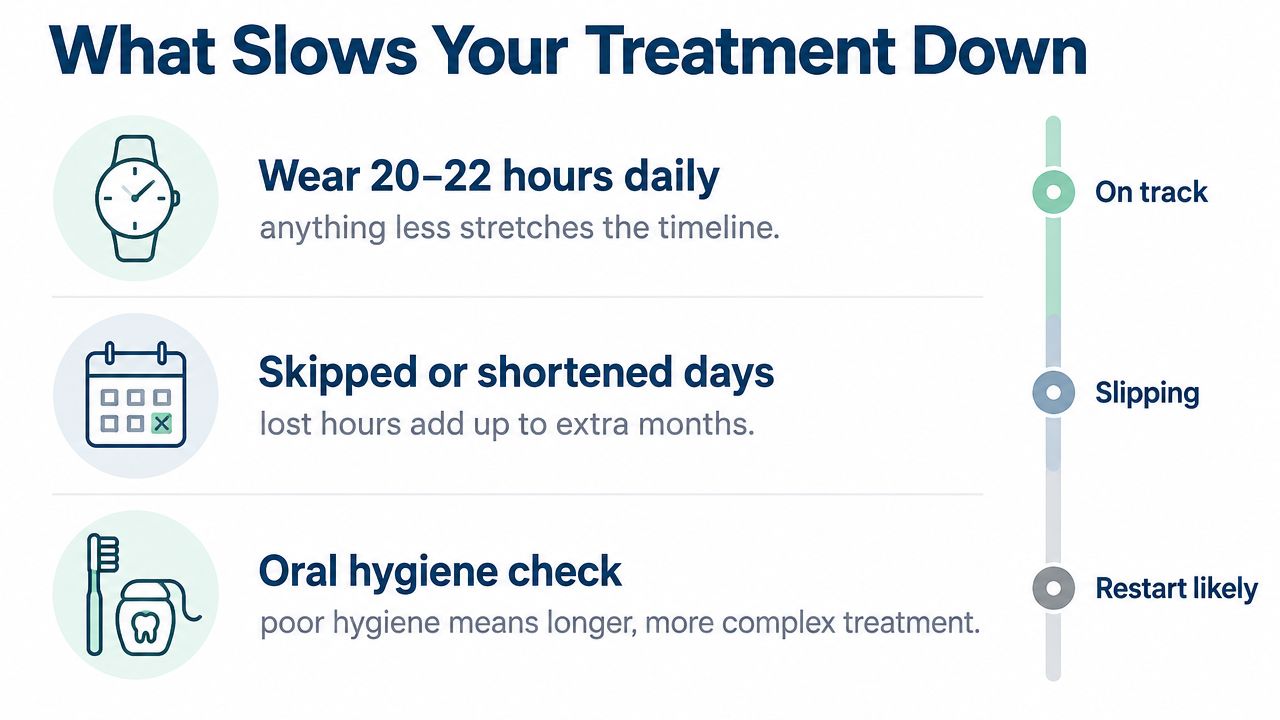
A removable aligner can be well designed and still fall behind if it spends too much time outside the mouth. A 2023 review states that clear aligners need to be worn for almost the entire day, specifically 22 to 23 hours, with patients commonly moving to a new set every week or two as directed by the orthodontist. Read the review of clear aligner protocols
Removable treatment needs a reliable routine
Meals, snacks, brushing, sports, and accidental loss all create opportunities for non-wear. One missed period may seem harmless, but repeated shortened days can prevent a tray from fitting correctly. When that happens, the patient may need to remain in an earlier aligner, repeat a stage, or receive additional planning.
A 2023 review describes the wear requirement as nearly the entire day, while teen guidance commonly emphasizes 20 to 22 hours daily as the key to staying on schedule. Review teen Invisalign wear guidance The exact instruction comes from the treating orthodontist, and families should follow that instruction rather than trying to create their own schedule.
Age and habits affect execution
Teens can benefit from active growth, but growth doesn't remove the need for cooperation. Teen patients may forget trays at school, remove them for activities, or misplace them during busy days. Fixed braces eliminate the wear-time decision, although they still depend on careful cleaning, safe food choices, rubber bands when prescribed, and regular appointments.
Adults often manage aligners consistently because they control their routines, but work travel, meetings, frequent snacking, or long days away from home can create similar problems. Braces can also be delayed by chewing ice, biting pens, breaking brackets, skipping elastics, or missing adjustment visits.
The practical formula is simple:
- Aligners: Wear them as directed, change them on schedule, store them safely, and report poor fit promptly.
- Braces: Protect brackets and wires, use elastics exactly as prescribed, clean carefully, and keep appointments.
- Both options: Follow the orthodontist's instructions and maintain a healthy oral environment.
The appliance sets the ceiling for possible progress. The patient's habits set the floor.
Side by Side Comparison of Invisalign and Braces
Invisalign and braces both move teeth through planned force, but they place different responsibilities on the patient and orthodontic team. Brackets and wires stay attached, while aligners follow a series of removable stages. Neither mechanism is faster for every movement.
| Factor | Invisalign | Traditional braces |
|---|---|---|
| Mechanism | A sequence of clear trays guides planned tooth movements | Brackets and archwires apply fixed forces and are adjusted in office |
| Average treatment length | Published studies show mixed results, including 18 months in one 2024 comparison and 1.7 years in a 2021 randomized study | Published studies show mixed results, including 24 months in one 2024 comparison and 1.3 years in a 2021 randomized study |
| Tray or wire schedule | Trays are commonly changed every week or two as directed | Wires and brackets are adjusted during scheduled visits |
| Typical monitoring | Appointments may be spaced farther apart when progress is tracking properly | Visits monitor wires, brackets, movement, and any needed elastics |
| Removability | Removed for eating, drinking choices, brushing, and flossing | Remains attached throughout treatment |
| Food routine | Fewer appliance-related food restrictions, but trays must be removed for meals | Hard or sticky foods can damage brackets and wires |
| Best-fit cases | Selected mild or moderate alignment problems and some relapse cases | Broad range of movements, including many complex bite and tooth-control needs |
The research table above illustrates why averages can conflict. A retrospective sample of finished cases averaged 13.35 months with Invisalign and 19.1 months with fixed appliances, while other studies found the opposite or no meaningful difference. Those figures describe study groups, not a guaranteed timeline for a patient in Delaware.
A family comparing options should ask three practical questions:
- Which movements are required? Alignment, rotation, extrusion, root control, bite correction, and space closure don't place the same demands on an appliance.
- Which routine is realistic? A removable system requires dependable wear. Fixed braces require protection, cleaning, elastics when prescribed, and attendance.
- What happens if progress falls behind? The plan should explain how the orthodontist will respond to poor tracking, broken appliances, or missed appointments.
Adults can explore the practical scheduling considerations in how long braces take for adults, then bring specific questions to an examination rather than choosing from a generic timeline.
When Invisalign May Be Faster and When Braces Win
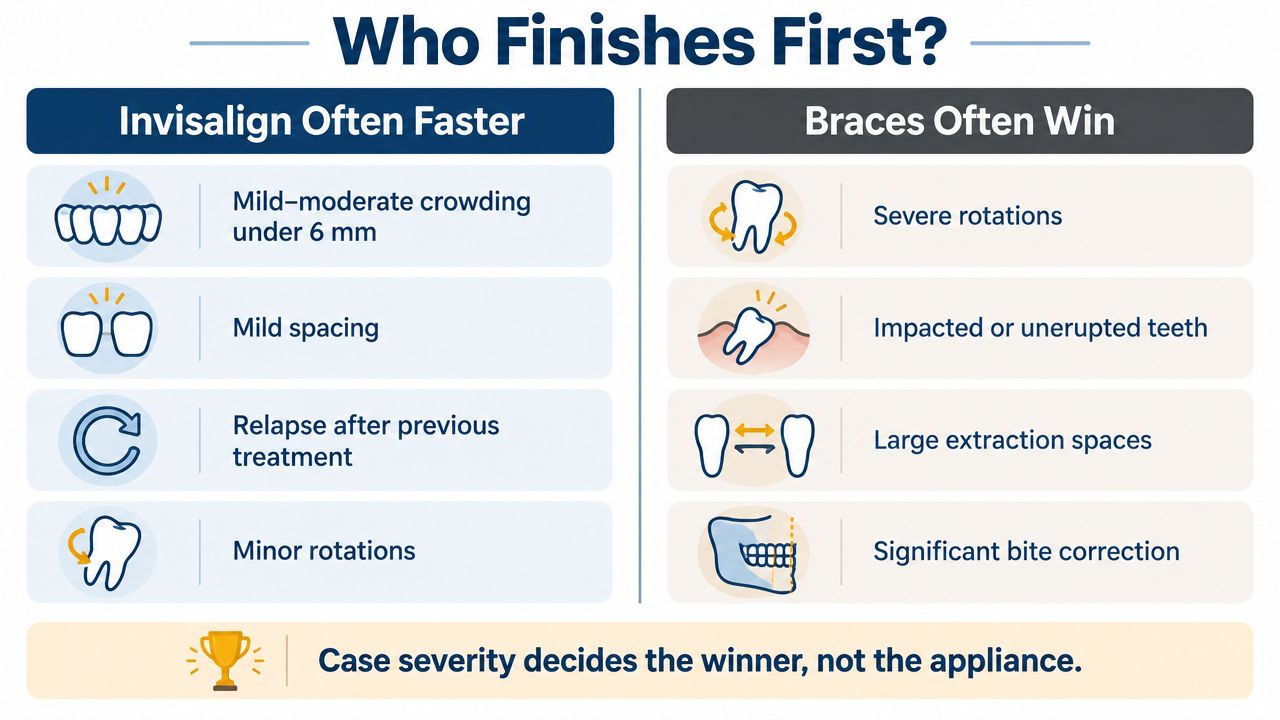
A useful clinical comparison starts with the movement, not the brand. Invisalign may finish sooner in a mild case with limited crowding, modest spacing, a small relapse after earlier treatment, or a minor cosmetic refinement. The trays can stage straightforward changes without the patient needing brackets and wires.
For example, a 4 mm gap may be a reasonable aligner scenario when the roots, bite, and surrounding spaces support that approach. The orthodontist still needs to check the complete relationship, because the visible gap doesn't reveal every required movement.
Situations where aligners may have an advantage
Clear aligners may be efficient when:
- Crowding is mild to moderate: Limited movement can be divided into manageable stages.
- Spacing is modest: Trays can guide teeth toward a planned arrangement when the space pattern is suitable.
- Relapse is limited: A patient whose teeth shifted after earlier treatment may need a focused correction.
- Rotations are minor: Small corrections are different from severe rotations of rounded teeth.
Situations where braces often win
Fixed appliances may be more predictable, and sometimes faster overall, for:
- Severe rotations: Rounded teeth can resist the gripping and turning forces needed for correction.
- Impacted or unerupted teeth: The orthodontist may need controlled guidance as the tooth enters the arch.
- Large extraction spaces: Closing and coordinating spaces can require strong anchorage control.
- Significant bite correction: Overbite, underbite, crossbite, and major jaw relationships may require multiple coordinated forces and elastics.
A 10 mm overjet combined with bite correction usually presents a more demanding problem than a small gap. Fixed wires may offer the control needed to coordinate that type of correction, but only a clinical evaluation can determine the actual route.
The decision isn't a consumer contest. An orthodontist evaluates photographs, digital scans, X-rays when indicated, tooth roots, eruption, jaw relationships, and the patient's ability to follow instructions. The fastest reasonable plan is the one that controls the required movements without creating avoidable refinements or instability.
Faster Is Not Always Better and How to Move Forward
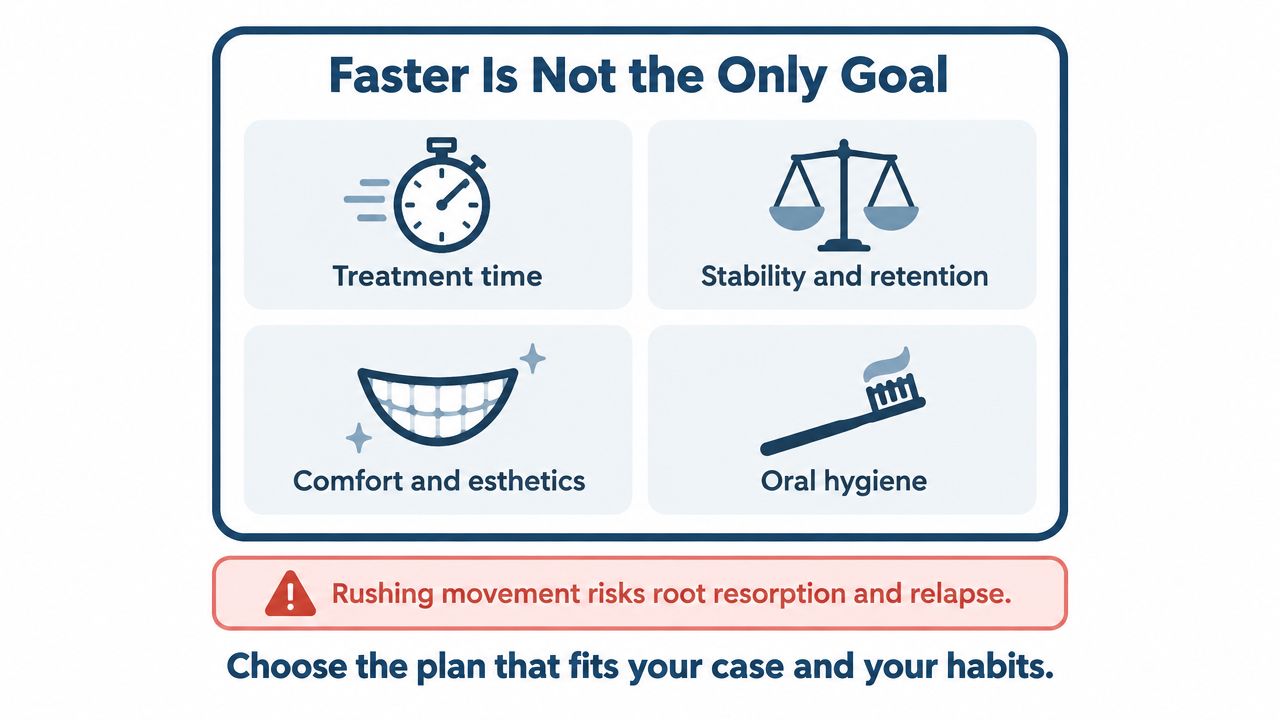
Treatment time deserves attention, but it shouldn't become the only scorecard. Stability, retention, comfort, appearance, oral hygiene, and predictable movement all matter. A patient who finishes quickly but needs substantial correction afterward hasn't necessarily received the better or faster treatment.
Rushing tooth movement can create clinical concerns, including root resorption, relapse, and compromised occlusion. Treatment planning must balance the desired schedule with how the teeth, roots, bite, and supporting tissues are responding. The final appointment matters less than whether the result remains functional and stable after active treatment.
A practical decision path
Start with records. A consultation should establish the diagnosis using an appropriate examination and digital records. An iTero digital 3D scan can help the orthodontic team evaluate the current tooth arrangement and plan treatment, while other records may be needed depending on the case.
Ask for a range. Patients should request a projected treatment range for the recommended appliance and a clear explanation of what could extend it. Useful questions include whether refinements, elastics, extractions, impacted teeth, or missed wear could affect the schedule.
Match the appliance to the routine. A teen who can't reliably wear removable trays may achieve a more predictable course with braces. An adult who can maintain aligner wear and has a suitable diagnosis may value removability and appearance.
Choose predictable execution. The best plan is not necessarily the one with the shortest headline estimate. It's the plan the patient can follow and the orthodontist can use to complete the required movements safely.
Families considering care with Stellar Orthodontics can book a free consultation at one of the Delaware offices in North Wilmington, Middletown, Dover, or Millsboro. The orthodontic team can evaluate the specific movements, compare Invisalign with braces, and provide a case-based treatment estimate. Visit Stellar Orthodontics to schedule that consultation and take the guesswork out of the timeline.