
A school dental note is sitting on the kitchen table after dinner. It mentions crowding, or a bite that looks a little off, and the question lands with the dishes. Does that mean braces on children's teeth right away, or does it mean watch and wait?
That worry is common, and a screening is not a verdict. Teeth and jaws may only need a closer look while a child is still growing. The decision really has three audiences. The child wants to know how treatment will feel. The parent wants timing, options, and a plan that fits school and sports. The insurer, or a public program, decides what "covered" means on paper, which is not always the same as a start date.
Table of Contents
- Why Parents Are Asking About Braces for Kids
- The Right Age for Braces and When to Book a Check-Up
- Metal, Ceramic and Invisalign Teen Options Compared
- Benefits and Drawbacks to Weigh Before Treatment
- What Happens From First Visit to Retainer
- Paying for Braces With Medicaid, Insurance or a Monthly Plan
- Daily Care, Comfort and Fixing Common Problems
- Book a Free Consultation to Plan Your Child's Next Step
Why Parents Are Asking About Braces for Kids
The note usually points at malocclusion. That word means the teeth and jaws do not fit together as well as they could. Crowding, an uneven bite, or a jaw that seems to slide are the versions families notice at home. A screening raises a question. It does not schedule brackets.
How widespread is the issue? A 1973 CDC survey of U.S. children aged 6 to 11 found that 24.4% had normal occlusion and 39.0% had only minor manifestations of malocclusion. About 22% had definite malocclusion. The report estimated that about 2.5 million children in that age group probably needed orthodontic treatment, and that about 590,000 had already had their teeth straightened. Need was not limited to one kind of community.
Plenty of those children were candidates for a look, not for braces the next week. The pages ahead cover age and warning signs, three appliance choices, trade-offs, the visit sequence, payment paths, and daily care. By the end, you will know what to ask, what to watch, and what to do next.
The Right Age for Braces and When to Book a Check-Up
The American Association of Orthodontists recommends an orthodontic check-up by age 7, even when no braces are needed yet. That date is an evaluation deadline, not a rule that every 7-year-old starts treatment. Many children are only monitored while they grow.
Age is only the starting point. The American Academy of Pediatric Dentistry says timing should follow the child's dentition stage and the specific problem, not a birthday alone. Clinicians watch dental and skeletal development through eruption because early care can reduce adverse growth, limit worsening disharmony, and address a posterior or anterior crossbite. Early treatment is not right for every child.
Practical rule: Age 7 means "get a baseline," not "bond brackets this month."
What each stage usually means
Mixed dentition is the stretch when baby teeth and permanent teeth share the mouth. That mix is when an orthodontist can spot developing problems in tooth position, jaw growth, extra or missing teeth, impacted teeth, or teeth coming in the wrong direction. Active treatment most often begins between ages 9 and 14. Some problems need earlier care, and some can wait.
| Age range | Dental stage | What usually happens | What parents can do |
|---|---|---|---|
| Age 6 to 7 | Early mixed dentition | First orthodontic check-up, even without visible problems | Book an evaluation and ask whether monitoring is needed |
| Age 7 to 9 | Mixed dentition, baby and permanent teeth | Orthodontist tracks jaw growth and tooth position | Ask about space needs after early baby tooth loss |
| Age 9 to 11 | Mixed to early permanent dentition | Early treatment considered for some bite or crowding problems | Compare early limited treatment with waiting |
| Age 11 to 14 | Most permanent teeth erupting | Most common window for active comprehensive braces | Review timing, options, and the treatment estimate |
| Age 15 to 17 | Mostly permanent dentition | Braces or clear aligners still possible, growth often slowing | Confirm the commitment needed for removable options |
From 6 to 7, the visit sets a baseline. From 7 to 9, the useful question is space. If a baby tooth is lost early and space is regained, it may need to be held until the neighboring permanent tooth has fully erupted, or until definitive treatment begins. Around 9 to 11, some children get limited treatment and others keep waiting. From 11 to 14, most permanent teeth are in, so full braces are the common plan. Teens from 15 to 17, and adults, can still be candidates. Growth is often slowing, so a removable option needs a real daily commitment.
A specialist may recommend observation, space maintenance, limited treatment, or full braces. Records such as an exam, radiographs, and models or digital scans set the order of care as permanent teeth erupt.
Signs that should not wait for a birthday
Book sooner when any of these show up.
- Crowding that looks worse each year: Growing overlap is not something to shrug off as "just baby teeth."
- A crossbite: Front or back teeth meet the wrong way.
- Early or late loss of baby teeth: Timing can steal space or hide a permanent tooth that is stuck.
- Teeth erupting the wrong way: A tooth behind the row, or off to the side, needs a look.
- Jaw shifting or clicking, or trouble chewing or speaking: Function matters as much as a photo.
More signs are laid out in this guide to how to know if your child needs braces. A free consultation at Stellar Orthodontics in North Wilmington, Middletown, Dover/West Dover, or Millsboro can sort monitoring from treatment for a Delaware child.
Metal, Ceramic and Invisalign Teen Options Compared
All three approaches move teeth with the same idea: steady, controlled pressure. The choice is about appearance, whether the appliance comes out, and how much daily responsibility a child can carry. It is not a contest over which method is "stronger" on paper.
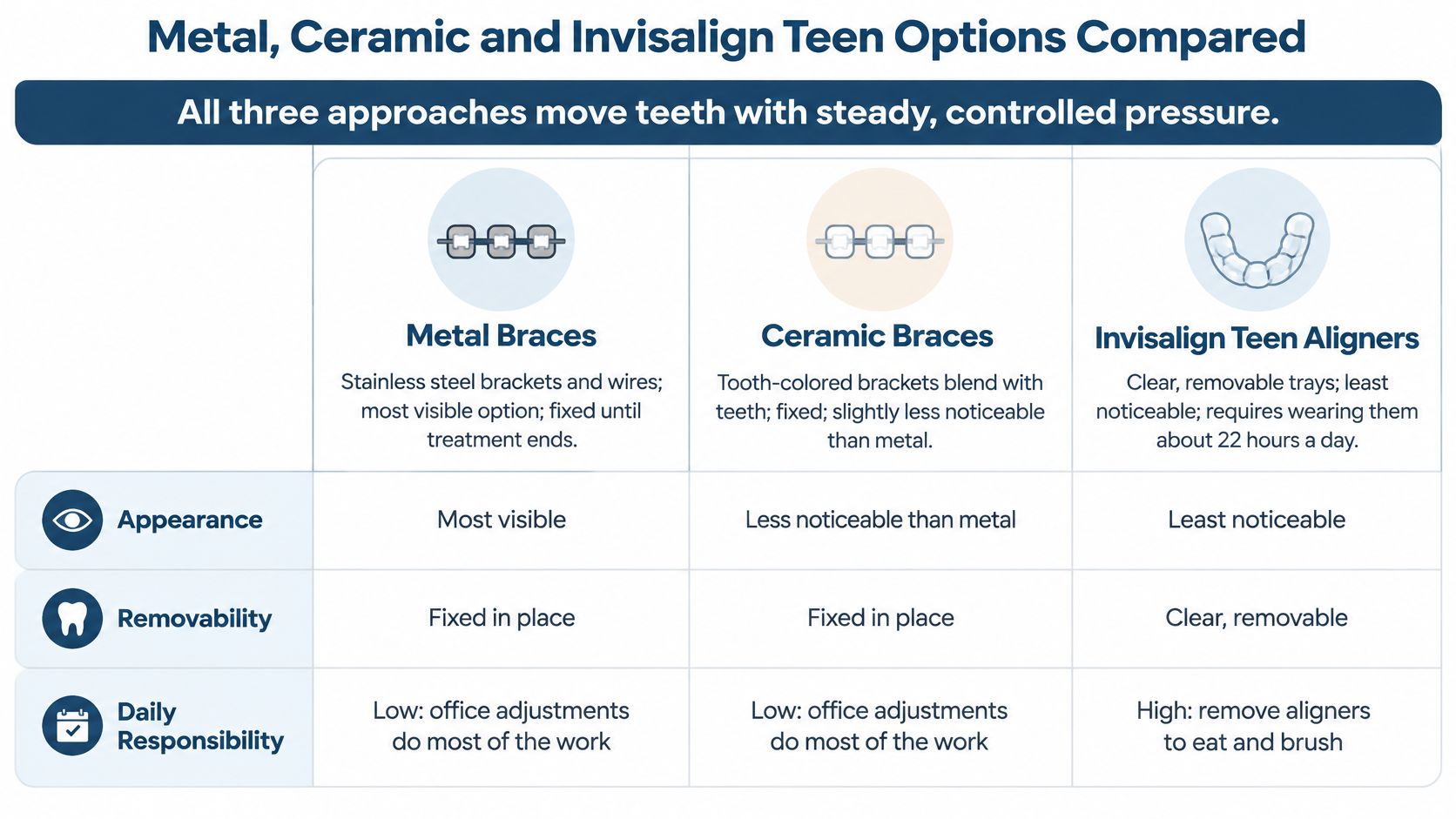
| Option | Appearance | Main trade-off | Daily demands |
|---|---|---|---|
| Traditional metal braces | Stainless steel brackets and wires, most visible | Most visible of the three options | Brush around brackets, avoid sticky and hard foods |
| Clear ceramic braces | Tooth-colored or clear brackets, less noticeable | Brackets can be more fragile | Avoid biting hard foods |
| Invisalign clear aligners for teens | Removable clear trays, hard to see | Works only when worn most of the day | Wear about 20 to 22 hours a day, remove to eat and brush |
Metal braces as fixed scaffolding
Traditional metal braces are like sturdy scaffolding. Stainless brackets and a wire stay on the teeth and do most of the work between visits. A child does not have to remember to put anything back in after lunch. That is why they often fit a younger child, a contact-sport season, or a bite that needs constant guidance. They are the most visible option, and food and plaque collect around the hardware.
Ceramic braces as the same scaffolding, quieter in photos
Clear ceramic braces use that same fixed setup, with brackets chosen to blend with the teeth. School photos and close conversations look different, which matters to a self-conscious teen. The trade-off is fragility. Hard bites need more care, because a bracket that chips means an extra visit. Daily brushing is the same job as with metal. The brackets do not clean themselves because they are tooth-colored.
Clear trays and the teen who keeps the case
Invisalign clear aligners work like a series of custom clear trays, swapped in stages, often every one to two weeks. They are hard to see, and they come out for meals and brushing, which many teens like. They only move teeth when they are worn, typically about 20 to 22 hours a day. A teen who keeps trays in a case, not a napkin, is a better match than a teen who loses things between classes.
Stellar Orthodontics offers traditional metal braces, clear ceramic braces, and Invisalign. A free consultation can compare them for one child rather than for a catalog.
Some complex movements or bite problems still favor fixed braces. The orthodontist decides after records, not from appearance alone. Ask which movements the plan needs, what happens if wear slips, and how sports mouthguards fit each option.
Benefits and Drawbacks to Weigh Before Treatment
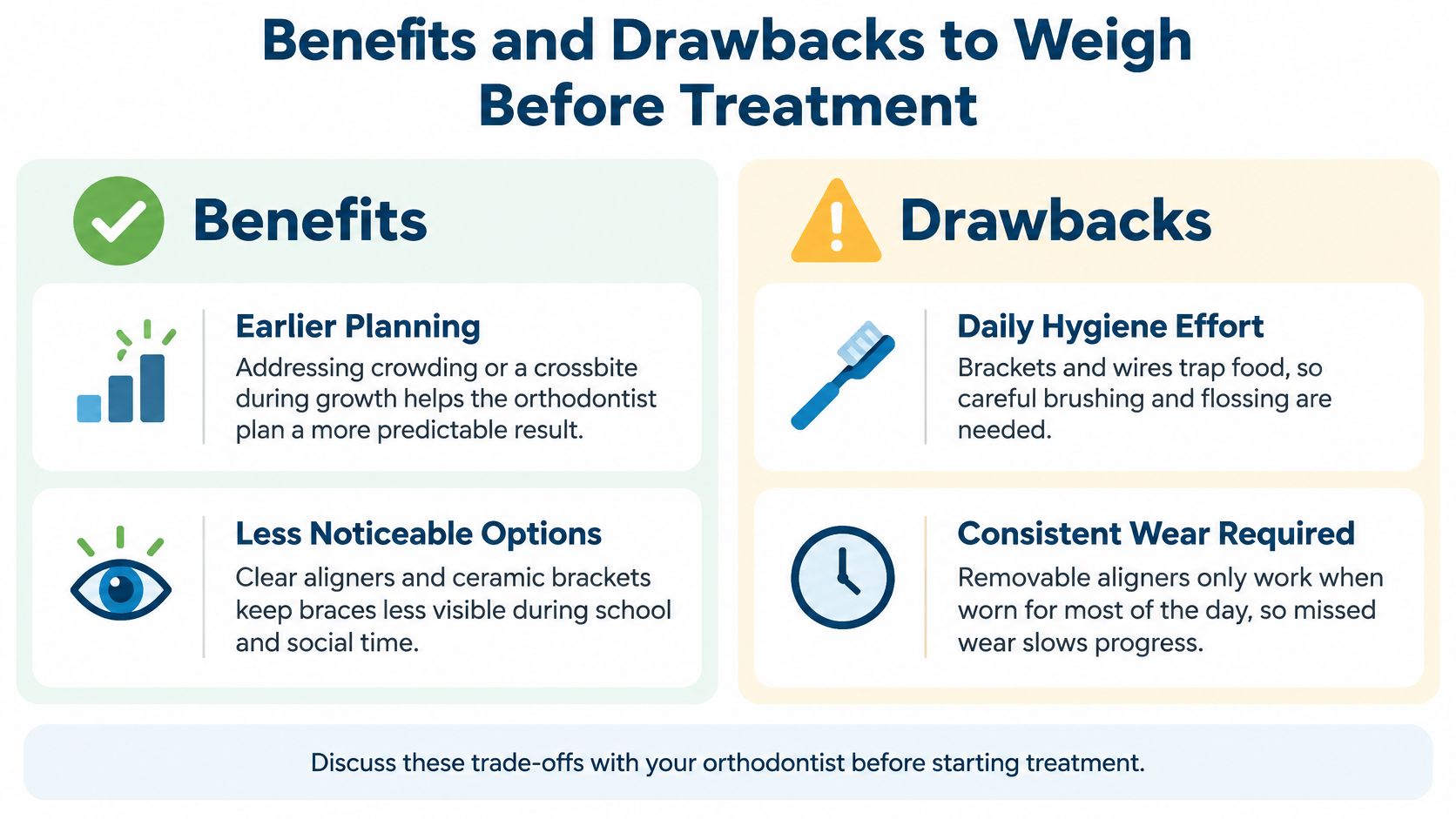
Addressing crowding or a crossbite while a child is still growing can help the orthodontist plan a more predictable result. Clear aligners or ceramic brackets can also keep treatment less noticeable for a teen who hates standing out. Those are possibilities to discuss, not promises. No appliance guarantees a perfect bite, a pain-free month, or a finish date that never moves.
What daily life actually costs
The drawbacks are the part families feel every week.
- Sore days after tightening: Discomfort often lasts a few days. Soft foods help, and a child should say when pain is not the usual ache.
- A shorter menu: Sticky and hard foods are off the list so brackets and wires survive.
- Extra cleaning time: Brushing and flossing take longer once hardware is in the way.
- Plaque around brackets and wires: Surfaces are harder to clean. If brushing slips, decay and gum irritation become more likely.
- Missed visits: Skipped adjustments can stretch treatment.
- Aligner commitment: Trays that stay in a backpack do not move teeth.
Fixed braces create controlled forces that gradually remodel the periodontal ligament and nearby bone. The same hardware is a plaque trap, so children need targeted daily hygiene and professional checks.
Root changes are real, and the rates are not one number
Root resorption is shortening of a tooth root that can occur during orthodontic treatment. A Cochrane review of crowded-teeth treatment includes study findings of palatal root resorption in 6.25% of affected teeth in one group versus 21.87% in another, and proximal resorption in 6.25% versus 20.31%. Those figures come from individual studies. They are not a universal risk, and they should not be applied to every child.
Reported percentages describe specific study groups. They do not predict one child's roots.
Risk depends on tooth anatomy, how far and in which direction teeth move, how long treatment lasts, any history of trauma, and what radiographs show. That is why scheduled X-ray reviews matter. Children should report unusual pain or mobility, skip damaging foods, and brush carefully around brackets. If root changes look concerning, the clinician may change force levels or mechanics.
Ask how these factors apply to your child before anyone starts. A good answer names the tooth, the movement, and the review schedule. A vague "it's rare" is not enough.
What Happens From First Visit to Retainer
Treatment follows a sequence, and the first visit does not have to wait on a dentist's referral. The American Association of Orthodontists notes that parents can arrange an assessment directly. Orthodontists may use panoramic X-rays to see below the gumline, including extra teeth, missing teeth, impacted teeth, and teeth moving the wrong way. A glance at the front teeth can miss all of that.
At Stellar Orthodontics, the first visit is a free consultation with a digital iTero 3D scan at North Wilmington, Middletown, Dover/West Dover, or Millsboro. The scan is a digital stand-in for traditional impression trays.
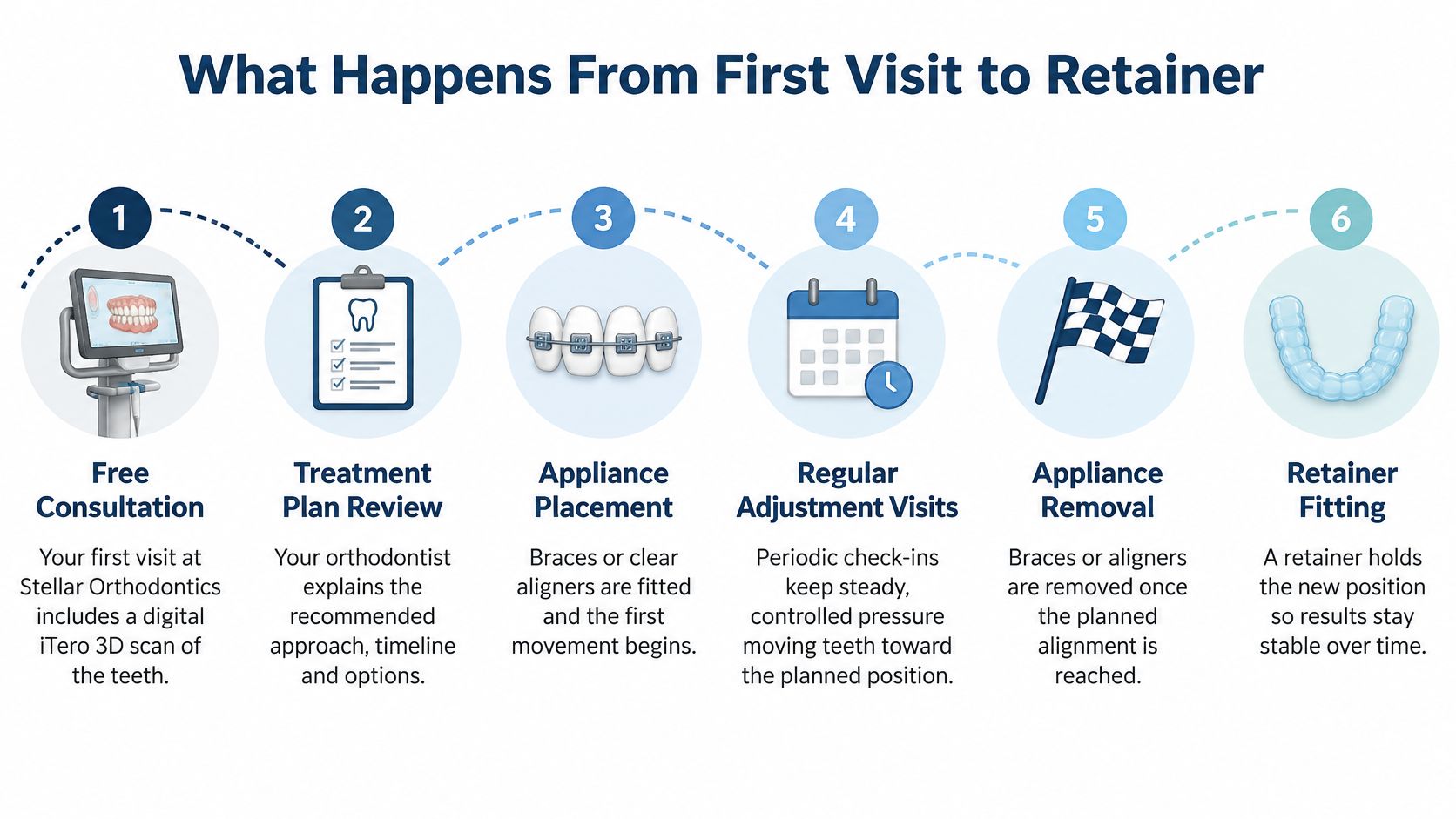
Seven steps, and why each one matters to a child
- Free consultation and iTero scan. The team looks at the bite and captures a 3D picture. The child learns what the visit is, and what it is not.
- Records review. Photos, X-rays, and the scan are studied for problems the smile does not show. Here, "wait" or "start" gets a reason.
- Treatment plan and written estimate. Appliances, timing, and replacement fees are reviewed with the parent before anything is bonded. No one should start on a verbal price alone.
- Placement visit. Brackets are bonded, or aligner attachments are set. The child should know the first days feel different.
- Adjustment visits. On the schedule the orthodontist sets, wires are changed or the next trays begin. Each visit has a job, not a mystery.
- Active treatment. Length varies by child and is estimated in the plan. Growth, wear, and broken hardware can change the calendar.
- Debonding and retainer fitting. Appliances come off and a retainer goes on, with written wear instructions. The new position needs a holder.
A short video can make the hardware feel less abstract before that placement visit.
Parents own scheduling and cost questions. The child should ask what will hurt, what each appointment changes, and how much say they have. Clinical responsibility stays with the orthodontist. Including a child is not the same as handing them the diagnosis.
A 2025 qualitative study found that patients and parents most often described good care through communication (30% of responses), information at the right time (25%), pain during treatment (12%), clinician competence (11%), and respect or mutual trust. Children wanted a friendly orthodontist and clear information. Parents weighted expertise and current guidelines more heavily. Straight teeth were not the whole definition of a good experience.
After braces go on, day-to-day soreness and food rules are covered in what to expect after getting braces.
Paying for Braces With Medicaid, Insurance or a Monthly Plan
Many Delaware children qualify for orthodontic coverage. Eligibility does not make treatment automatic. Covered and obtainable are different outcomes. Paperwork, medical-necessity rules, and which offices participate can matter as much as the benefit itself.
Delaware First Health states that dental services for members under 21 are available with no copay, and that orthodontic work such as braces is covered when medically necessary. Highmark Health Options states that children age 20 and younger have no yearly limits for covered dental care, no referral requirement, and orthodontic services that include braces and retainers. Stellar Orthodontics accepts AmeriHealth Caritas Delaware, Highmark Health Options, Delaware First Health, and CHIP.
A recent look at orthodontic insurance access found that preauthorization was required for 50% of surveyed cases, and that approval delays postponed treatment for 35.9% of respondents. The same analysis found that commercially insured adolescents were six to seven times more likely to receive orthodontic services than Medicaid-enrolled adolescents, even with public dental benefits. Plan for weeks of records and waiting, not a same-week start.
A card in the wallet is not a green light. Approval, and a participating specialist, still have to line up.
| Coverage path | Who it applies to | What to check first | How Stellar handles it |
|---|---|---|---|
| Delaware Medicaid plans | Children and teens under 21 enrolled in AmeriHealth Caritas Delaware, Highmark Health Options, or Delaware First Health | Eligibility, medical necessity, documentation, and approval | Accepts all three Delaware Medicaid plans |
| CHIP | Eligible children in the children's health insurance program | Plan eligibility and orthodontic benefit terms | Accepts CHIP |
| Private dental insurance | Families with employer or marketplace dental plans | Orthodontic maximums, waiting periods, and preauthorization | Accepts most major dental insurance |
| Monthly payment plan | Families paying out of pocket or covering a gap | Monthly amount, total cost, and plan length | Confirm terms with the office, including plans with $0 down |
Five checks before treatment starts
Work through these in order. Each one answers a question the insurer will ask even if the child never hears it.
- Confirm the child's plan and eligibility. Match the card to the child, the age limit, and the current enrollment month.
- Ask whether orthodontic authorization is required. Half of surveyed cases needed it, so do not assume a cleaning benefit covers braces.
- Request the records the plan needs. Exams, radiographs, and photos often have to exist before a reviewer says yes.
- Clarify covered appliances and replacement fees. A lost retainer or a broken bracket may not sit inside the same benefit.
- Get a written estimate before starting. Include what happens if coverage ends mid-treatment.
For private insurance, check the orthodontic maximum and any waiting period. For a gap or a full out-of-pocket balance, ask about a monthly plan. The office can screen coverage before you sit down. Plan details live on the insurance page.
Daily Care, Comfort and Fixing Common Problems
The routine is simple and easy to rush. Brush after meals and at bedtime. Angle the brush along the gumline and around each bracket. Use a floss threader or an interdental brush between the wire and the teeth. Braces make plaque harder to remove, so a ten-second scrub is the slip that causes the most trouble.
Skip popcorn, hard candy, ice, caramel, gum, and hard raw vegetables. Cut apples into small pieces instead of biting them. For the first few days after placement or a tightening visit, soft foods are kinder. Ask the child's dentist or physician which pain reliever is appropriate. Do not guess from a sibling's old bottle.
School, sports, and a child who gets a vote
Pack a small kit for lunch: orthodontic wax, floss, and a toothbrush. Contact sports need a mouthguard that fits over the appliance. Let the child name the wax and say what worries them. A child who can point to a poking wire is easier to help than a child who stays quiet until the cheek is cut.
| Problem | First action at home | When to call the office |
|---|---|---|
| Wire poking the cheek | Cover the end with orthodontic wax | If it keeps irritating or cutting the skin |
| Loose or broken bracket | Keep the wire in place and avoid chewing on it | Call the same day or as soon as possible |
| Sore cheeks or lips | Use wax on the bracket and rinse with warm salt water | If soreness lasts beyond a few days |
| Pain or looseness in a tooth | Eat soft foods and avoid chewing on that side | Promptly, since this can signal a problem |
| Lost or damaged retainer | Wear the spare if one exists and keep the case | As soon as possible to avoid tooth movement |
Unusual pain, a tooth that feels loose in a new way, or a broken appliance should be reported promptly. As the earlier section on root changes explained, early review lets the orthodontist adjust mechanics before a small issue grows. Home wax is first aid. It is not a substitute for a visit when the table says to call.
Book a Free Consultation to Plan Your Child's Next Step
The useful next step is a free consultation that answers one question. Should this child be monitored, or treated now? Stellar Orthodontics sees families at North Wilmington (2304 Concord Pike), Middletown (818 Kohl Avenue), West Dover (125-2 Greentree Drive), and Millsboro (26670 Centerview Drive). The visit includes an iTero digital 3D scan, and the team can review Medicaid and CHIP questions beforehand with the payment checklist above.
Bring a short parent list: the dental screening note, the insurance or Medicaid card, questions on timing, options, and cost, and any history of trauma or tooth problems. The child's list can be smaller. One question they want answered, and one thing they want to know about how treatment will feel.
You can ask for a written estimate before any treatment starts. Booking the visit does not lock anyone into brackets.
Stellar Orthodontics offers traditional metal braces, clear ceramic braces, and Invisalign for children and teens, plus free consultations with digital scanning at four Delaware offices. If a school note has you weighing braces on children's teeth, timing, and coverage, that visit is the cleanest way to separate monitoring from treatment and to see what a plan will approve. Visit Stellar Orthodontics to book a free consultation and bring your questions for your child, yourself, and the insurer.