.png)
A grandparent notices a front tooth turning inward. A child complains that biting into an apple feels awkward. A dentist mentions crowding during a routine cleaning, and suddenly a parent is searching how to know if your child needs braces before the car reaches home.
The first decision doesn't need to be “braces now or never.” The useful questions are whether the bite, jaw growth, tooth eruption, or daily function needs attention, and whether treatment is appropriate now or better monitored. The American Association of Orthodontists recommends an initial orthodontic check-up by age 7, when children typically have both primary and permanent teeth, but that visit is a screening milestone, not a command to start braces immediately. The AAO explains the purpose of an age-seven evaluation.
Table of Contents
- What parents usually notice first
- Everyday signs worth a closer look
- What the first orthodontic visit actually covers
- Timing options from age 7 to the teen years
- Making the plan realistic for your family
- Getting ready for the consultation
- Booking the free consultation that fits your family
What parents usually notice first
Parents often notice a small detail before they see a larger pattern. A child may turn a cheek away in photographs because one front tooth looks crowded. A sibling may point out that the lower jaw moves to one side during a smile. At dinner, the child may chew on one side or avoid foods that require biting.
Those observations deserve attention, but they don't diagnose a need for braces. Crooked-looking teeth can be harmless spacing that changes as permanent teeth erupt, or they can signal a bite relationship that needs timely assessment. The difference usually becomes clearer when an orthodontist evaluates the teeth together with jaw growth, facial proportions, eruption, and function.
The right question isn't “Do the teeth look perfect?” It's “Is a problem affecting function or development, and what happens if the family waits?”
An early appointment may produce one of several sensible recommendations. The orthodontist may advise periodic monitoring, suggest early treatment for a developing bite or space problem, or recommend returning later when more permanent teeth have erupted. Some children need appliances, while others need observation and good routine dental care.
Parents shouldn't wait for every baby tooth to fall out before asking. The AAO notes that an orthodontic problem rarely corrects itself without assessment, and certain concerns are easier to evaluate while the child is still growing. At the same time, an evaluation doesn't create a treatment obligation. It gives the family a clearer answer about now, later, or no orthodontic treatment.
Everyday signs worth a closer look
A quick home check can help a parent decide whether to request an evaluation. The signs below don't prove that braces are necessary. They show that a professional should examine the bite and developing dentition.
Start with the bite
Look at the teeth when the child closes naturally. Notice an underbite, deep overbite, crossbite, open bite, or teeth that don't meet normally. A child who struggles to bite through food, chews around a specific area, or regularly bites the cheek or roof of the mouth deserves more than a cosmetic opinion.
Parent action: If the bite problem affects eating or remains obvious during ordinary closing, schedule an evaluation rather than relying on photographs or guesswork.
Check how the teeth are arranged
Crowding, overlapping, large spaces, a tooth erupting behind another, or a permanent tooth that seems blocked can all justify a closer look. Delayed, early, or uneven loss of baby teeth can also change how a parent interprets what appears to be a simple crooked tooth.
Parent action: Note which tooth is affected and whether the change is progressing. Bring that observation to the orthodontist and the family dentist.
Watch the jaw move
Ask the child to open and close slowly. A jaw that shifts to one side, a noticeably uneven closing path, or facial asymmetry that appears during the bite can matter more than a single rotated tooth. Persistent clicking or discomfort also deserves discussion with a dental professional.
Parent action: Don't force the jaw into position or repeatedly test it. Record what happens naturally and arrange an examination if the movement continues.
Notice habits and breathing patterns
Persistent mouth breathing, thumb-sucking that affects tooth position, and changes in speech can influence the developing bite. A child who sleeps or rests with the mouth open may need evaluation of the habit as well as the teeth.
Parent action: Mention the habit, how often it occurs, and whether it affects sleep, speech, chewing, or tooth position.
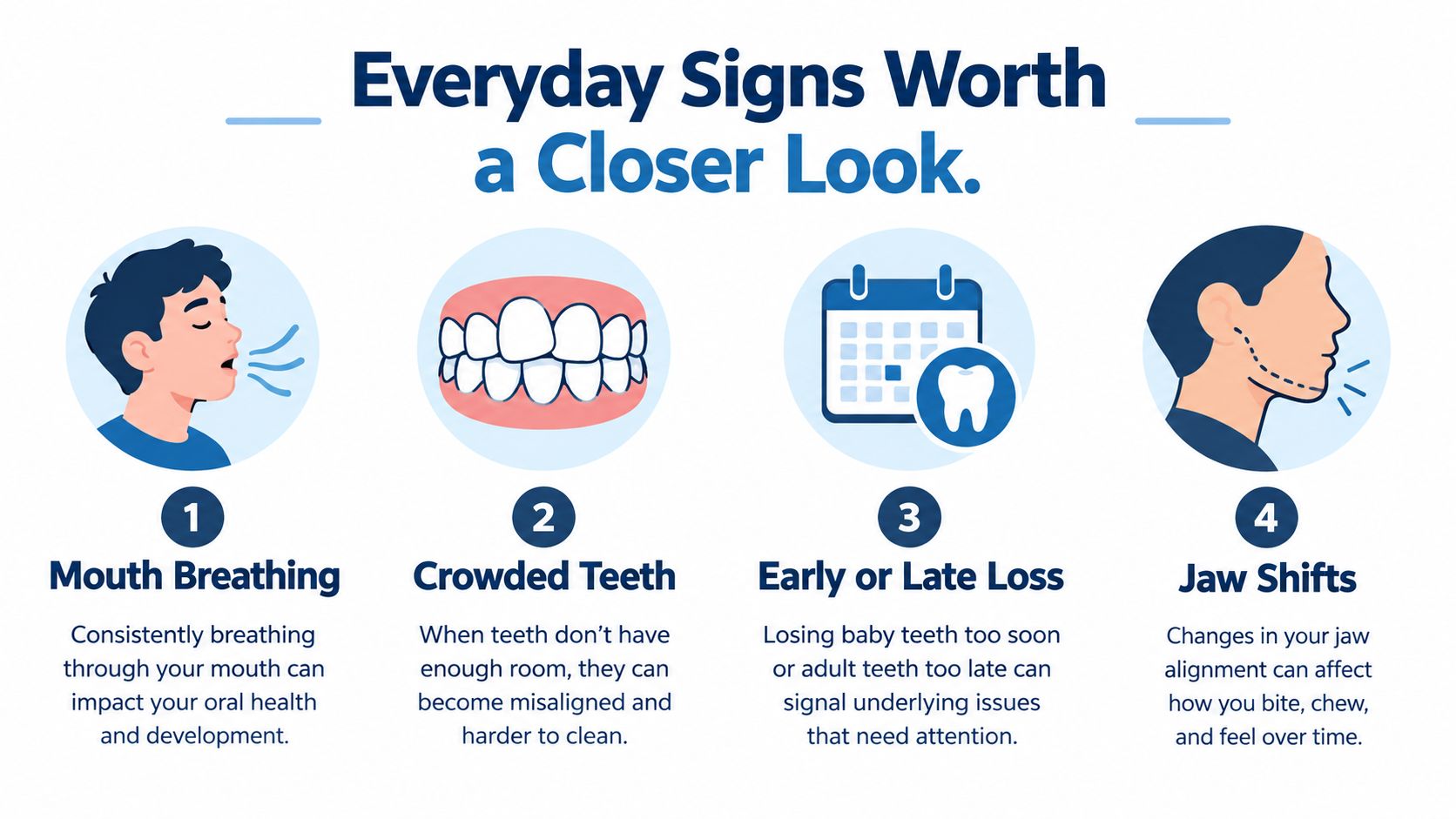
Difficulty biting or chewing, trouble cleaning crowded areas, and teeth that don't meet normally are practical reasons to seek professional advice, even when appearance isn't the main concern. The NHS overview of orthodontic assessment explains that evaluation considers how misalignment affects everyday activities, not just how a smile looks.
A free consultation is useful precisely when the answer isn't obvious. The appointment can separate a problem that needs action from one that only needs observation.
What the first orthodontic visit actually covers
A first appointment should replace uncertainty with a diagnosis, not pressure. The clinician examines the teeth, bite, facial balance, eruption pattern, and jaw relationships, then connects those findings with the child's dental history and daily habits.
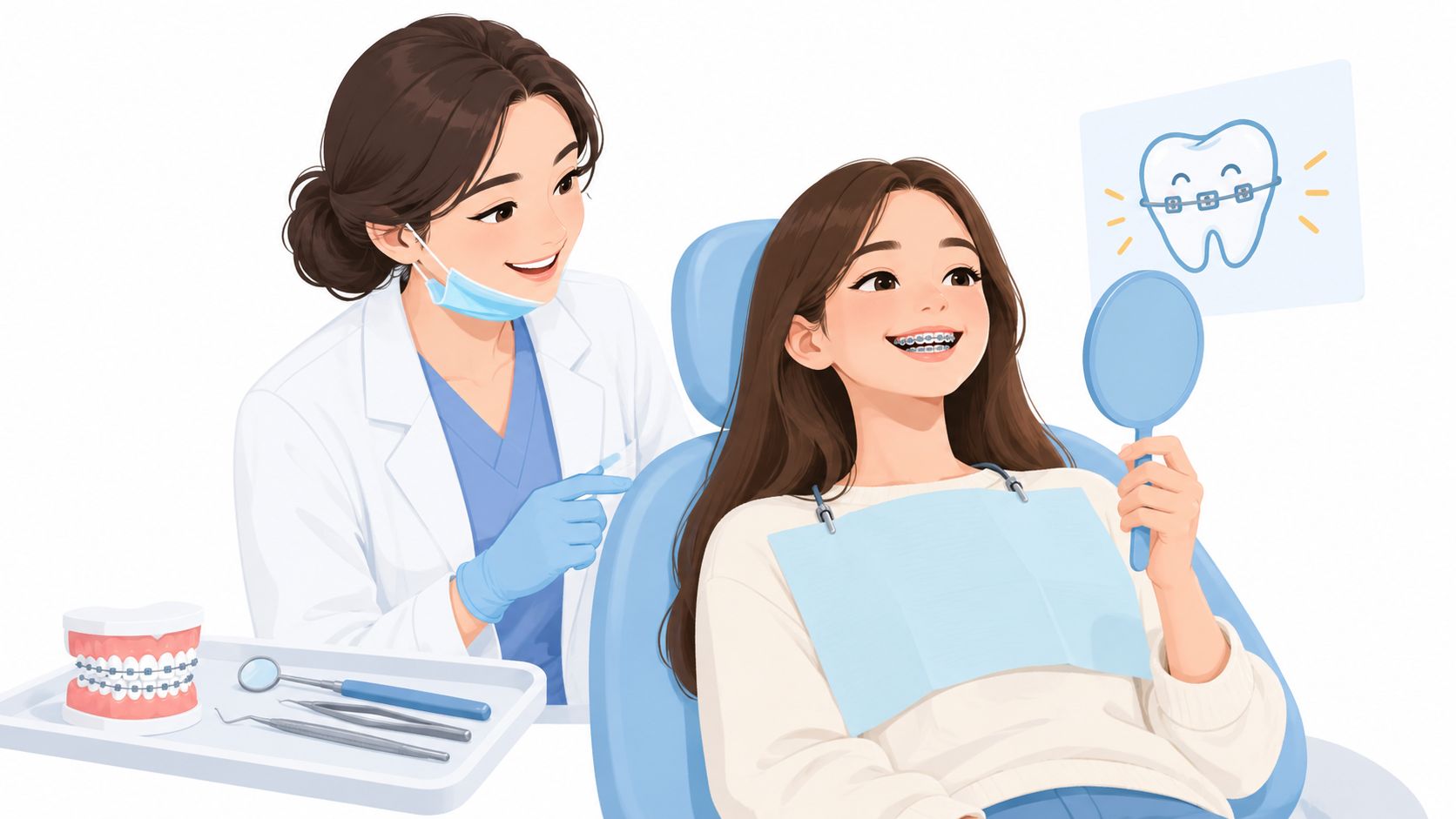
At Stellar Orthodontics, families can review what to expect at the first visit, including the assessment process and the questions that help shape a treatment recommendation. A digital 3D scan can show the arches without the discomfort of traditional impression material. Photographs document facial and dental relationships, while X-rays may be recommended when the orthodontist needs to evaluate roots, unerupted teeth, or jaw position.
What the orthodontist is deciding
Pediatric orthodontic diagnosis is broader than counting crooked teeth. The American Academy of Pediatric Dentistry describes an assessment that includes oral health, alignment, bite relationships, facial growth, and jaw proportions. Treatment planning should also account for available options, motivation, and the child's readiness to participate. AAPD guidance on developing dentition supports that full-scope approach.
Parents should expect the clinician to explain:
- Which specific finding creates concern.
- Whether the issue affects function, eruption, growth, or cleaning.
- What could happen if the family monitors it.
- Which records support the diagnosis.
- Whether the child needs treatment now, later, or not at all.
A sound consultation can end with a monitoring plan rather than appliances. It can also identify a need for early intervention, or recommend returning after more permanent teeth erupt. The parent should receive a clear explanation of the reasoning and the next checkpoint, not a rushed decision based only on a visual glance.
The family should also ask how the child will participate. Braces and aligners require hygiene, appointment attendance, and cooperation with instructions. A technically suitable plan can still be the wrong plan if the child isn't ready to keep up with it.
A useful consultation ends with clarity. Parents should leave knowing what the orthodontist found, why the timing makes sense, and what the family needs to do before the next step.
Timing options from age 7 to the teen years
A child may be seven and need only observation, or seven and need timely treatment. Age starts the conversation, but the finding determines the recommendation. The AAO age-seven guidance offers a useful screening point, while most children begin treatment around ages 12 or 13, after more permanent teeth have erupted. Earlier care deserves attention when a crossbite, narrow upper jaw, blocked eruption, or jaw-growth discrepancy is developing. The evidence summary on treatment timing supports matching timing to the problem instead of applying one age to every child.
The first question for parents is, “Does this need treatment now, or should we monitor it?” The second is, “Can our family follow through with the proposed plan?” Those answers often matter more than the child's birthday.
Three practical paths
Monitoring only suits a bite that is developing acceptably and a concern likely to change as permanent teeth erupt. Periodic examinations, photographs, or updated records let the orthodontist check whether the situation remains stable. Ask when the next review should occur and which change would trigger treatment.
Early interceptive treatment may be appropriate during mixed dentition when the goal is to guide space, correct a crossbite, or address a developing jaw-width or eruption problem. A consensus review identifies ages 7 to 10 as a period when expansion may have more favorable bony effects in selected cases. That finding does not mean every crowded smile needs expansion. The consensus review on early expansion focuses on structural indications, not a universal deadline.
Adolescent treatment commonly begins after more permanent teeth are present. Braces or clear aligners can then address tooth alignment and the bite together, provided the child can maintain hygiene and follow instructions.
| Path | Typical age | Common duration | Appliances used | Visit frequency |
|---|---|---|---|---|
| Monitoring | Around the mixed-dentition years | Until the next developmental checkpoint | Usually none | Periodic reviews |
| Early interceptive treatment | Often ages 7 to 10 when indicated | A focused phase followed by reassessment | Selected expansion or space-guiding appliances | Scheduled adjustment and review visits |
| Adolescent treatment | Commonly around ages 12 or 13 | Determined by the diagnosis and cooperation | Braces or clear aligners | Regular treatment visits |
Use this table to prepare questions, not to select treatment. A systematic review comparing early treatment started at ages 6 to 9 with later treatment at ages 10 to 14 included 11 studies and 749 patients and found no uniform advantage for one timing strategy. The best choice depends on growth stage, appliance type, and severity. Parents should ask: Which path fits this child, and what specific finding makes it appropriate?
Families considering early care can review the pros and cons of early orthodontic treatment before the consultation. Choose early treatment when it addresses a defined developmental problem. Choose monitoring when immediate treatment would add work without a clear benefit.
Making the plan realistic for your family
A sound orthodontic recommendation must fit your child's health, your schedule, and your ability to follow the instructions. Ask the question that matters: Can our family complete this plan consistently?
Review transportation, appointment frequency, work schedules, school commitments, daily brushing, and your child's willingness to cooperate. A treatment plan can be clinically appropriate and still fail if visits are difficult to attend or appliances are not cared for. Ask the orthodontic office to explain the expected visit pattern, what happens after a missed appointment, and which responsibilities belong to the child.
Dental coverage and orthodontic benefits may differ. Confirm what the plan includes, what it excludes, and whether diagnostic records or retainers carry separate costs. Stellar Orthodontics accepts most major dental insurance, offers flexible monthly payment plans with $0 down, and accepts all three Delaware Medicaid plans, AmeriHealth Caritas Delaware, Highmark Health Options, and Delaware First Health, along with CHIP. Families can review how Medicaid coverage for children's braces works and confirm eligibility and benefits directly with the practice.
A cheaper plan that a family cannot attend consistently can cost more in time, stress, and interrupted treatment.
Location is part of treatment readiness
Choose the office that fits your normal route:
- North Wilmington on Concord Pike for families in the Brandywine Valley.
- Middletown on Kohl Avenue for the MOT corridor.
- West Dover on Greentree Drive for Kent County.
- Millsboro on Centerview Drive for Sussex County.
Convenience affects follow-through. Missed adjustments, broken appliances, inconsistent elastic use, and poor retainer habits can interrupt progress. Choose a location and appointment schedule your family can maintain after the first visit feels new.
Start treatment with a healthy mouth. CDC surveillance found that nearly 18% of U.S. children ages 6 to 8 had at least one primary tooth with untreated decay. CDC dental surveillance data supports treating the consultation as an oral-health review, not only a cosmetic assessment. Active cavities, gum inflammation, or poor hygiene may need attention before appliances are placed.
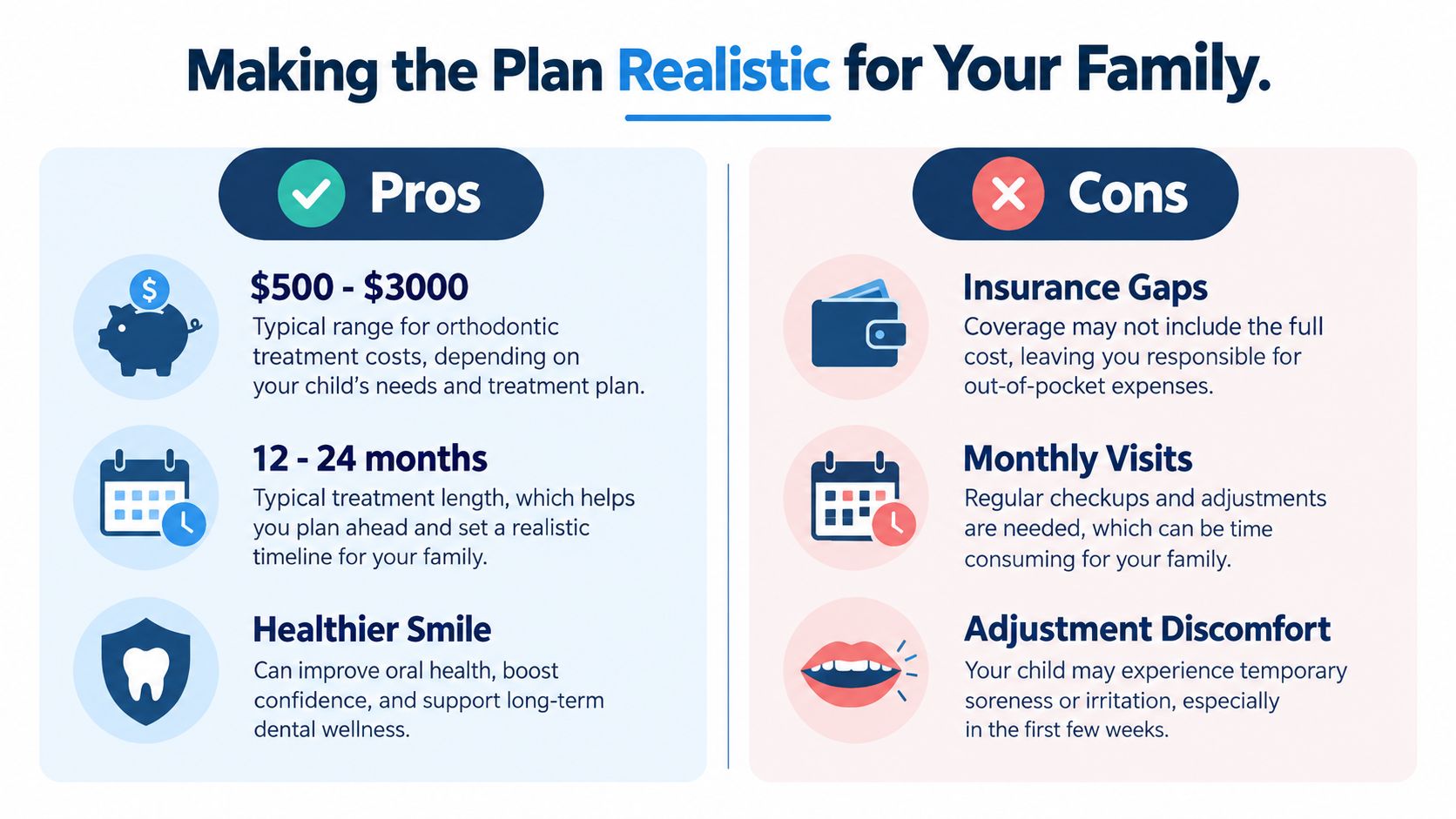
Before signing, request the all-in cost, insurance estimate, payment schedule, retainer policy, expected visit pattern, and instructions for missed appointments. The right plan protects your child's oral health while fitting the family's actual routine.
Getting ready for the consultation
The night before the appointment, gather a small folder and write a short list. Your goal is to give the orthodontist useful context about what you have noticed, not to arrive with a diagnosis.
The simple appointment checklist
Bring available records. Pack the insurance card, Medicaid ID if applicable, and recent dental X-rays if your family has copies. Include the family dentist's contact information in case records need to be requested.
Write down observations. Note chewing discomfort, mouth breathing, thumb-sucking, jaw shifting, delayed tooth loss, speech changes, or trouble cleaning crowded areas. Record when each concern began. A few clear details are easier to use than a rushed recollection in the chair.
Prepare three questions. Ask, “Does treatment need to start now?”, “What happens if we monitor this?”, and “What would my child need to do successfully?” These questions keep the discussion focused on timing, possible consequences, and readiness. They also address the two issues families often overlook: whether treatment is needed now and whether the household can follow the plan.
Prepare your child calmly. Explain that the appointment includes looking at the teeth and taking records. Any treatment should follow an appropriate discussion and consent. A small reward afterward can make the visit feel routine rather than intimidating.
Schedule a dental cleaning before the orthodontic examination if your child's mouth needs attention. Active decay, gum inflammation, or poor hygiene may need treatment with the family dentist before appliances are considered. The CDC's fast facts on children's dental health place orthodontic decisions within the wider context of preventive dental care, including the need to address tooth and gum health first.
Bring questions about comfort, school routines, sports, meals, cleaning, and follow-up. The answers will help you judge whether a proposed plan fits your child's daily habits and your family's ability to maintain appointments and instructions.
You do not need perfect records or perfect questions. A clear description of what your child does, feels, or struggles to clean is enough to begin a productive evaluation.
Booking the free consultation that fits your family
A free consultation turns a vague worry into a clear next step. The visit may include an orthodontic examination and an iTero digital 3D scan, followed by a practical discussion: does your child need treatment now, should the bite be monitored, or would it make more sense to return after more permanent teeth erupt?
Choose an office that fits your weekly route, not merely the one closest on a map. North Wilmington serves Brandywine Valley families, Middletown fits the MOT corridor, West Dover supports Kent County, and Millsboro serves Sussex County. A manageable drive makes regular follow-up easier.
Ask directly about insurance, Medicaid or CHIP eligibility, payment options, appointment frequency, hygiene expectations, and retainers. Transportation, work schedules, sports, and school commitments belong in this conversation too. A treatment plan only works when your child and household can follow it consistently.
Many children begin treatment around ages 12 or 13, after permanent teeth have erupted, while some concerns need attention earlier. Age alone cannot determine the right timing. The evaluation should consider development, severity, whether treatment is needed now or can be monitored, and whether your child is ready to participate. The treatment-timing evidence supports considering these factors together.
The first visit isn't a commitment to braces. It's a way to learn whether treatment belongs in the present, the future, or not at all.
Select the Delaware location that fits your family's routine and request the free consultation. Stellar Orthodontics can assess your child's bite, alignment, growth, and readiness, then explain the next step without requiring a same-day treatment decision.
Book a free consultation at Stellar Orthodontics to discuss braces now, monitoring, or treatment later. Bring questions about timing, coverage, and follow-through.