
A parent in Middletown may be comparing braces with clear aligners while a teenager worries about school photos. An adult in Wilmington may be weighing the same options around work, meals, and a busy calendar. Both decisions start with a reasonable question: which appliance can correct the overbite without creating a treatment routine that's difficult to maintain?
Table of Contents
- Choosing Braces or Invisalign for an Overbite
- Understanding Overbites and Correction Goals
- How Braces and Invisalign Differ
- What Clinical Evidence Says About Effectiveness and Time
- Understanding Cost, Insurance, and Daily Commitments
- Which Option Fits Children, Teens, and Adults
- Making a Confident Recommendation
Choosing Braces or Invisalign for an Overbite
Consider a family reviewing different treatment recommendations. One plan emphasizes removable aligners and a digital preview. Another recommends fixed braces for better control of the bite. Neither recommendation can be judged by appearance alone.
The useful comparison is braces vs Invisalign for overbite correction in that particular mouth. The orthodontist needs to identify which teeth must move, in which direction, and how reliably the appliance can produce those movements. The patient's ability to follow the plan matters just as much.
Research supports both approaches for selected deep bites, but it doesn't establish that they're interchangeable. The clinical differences become especially important when the front teeth need substantial vertical movement or the bite involves more than tooth position.
The decision behind the appliance
A helpful consultation separates clinical requirements from personal preferences:
- Bite mechanics: Does correction depend mainly on moving front teeth, changing back-tooth height, or managing a jaw-related discrepancy?
- Daily reliability: Can the patient follow a removable-appliance routine consistently?
- Treatment flexibility: What happens if the teeth don't move as planned?
- Long-term stability: What retention plan follows active correction?
Appearance, comfort, and cost belong in the conversation, too. A less visible appliance may matter greatly to an adult who speaks publicly. A parent may place more weight on avoiding lost trays or repeated reminders after school lunch.
Practical rule: Choose the treatment plan before choosing the appliance's appearance.
There's also a difference between preferring aligners and being well suited to aligner treatment. Likewise, recommending braces shouldn't mean dismissing a patient's concerns about visibility or daily care.
A sound recommendation connects the examination and treatment records to a realistic routine. The appliance name alone doesn't explain what the bite needs, how progress will be checked, or what adjustments may become necessary.
Understanding Overbites and Correction Goals
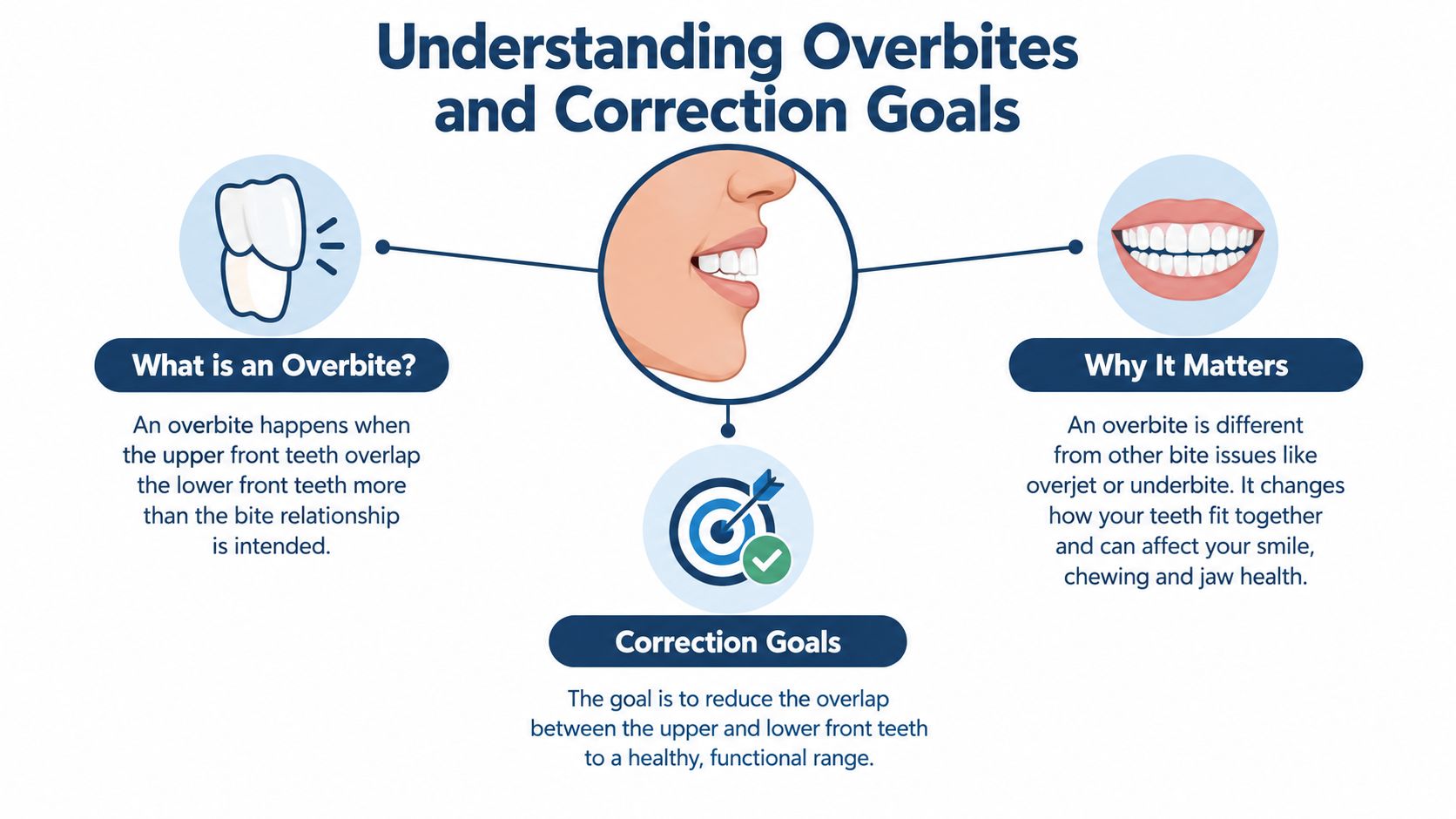
Overbite describes the vertical overlap of the upper front teeth over the lower front teeth. Some overlap is expected. A deep overbite means that overlap is greater than intended for the patient's bite relationship.
That's different from overjet, which describes how far the upper front teeth sit ahead of the lower front teeth horizontally. Spacing concerns gaps between teeth, while an open bite involves teeth that don't meet vertically. A patient can have more than one of these concerns, so the label “overbite” isn't a complete diagnosis.
The illustration distinguishes the overlap itself from the goals of correction.
Dental position versus jaw relationships
A dentoalveolar overbite primarily involves the teeth and their supporting structures. A skeletal discrepancy involves the underlying jaw relationship or vertical facial pattern. That distinction helps determine whether moving teeth alone can reasonably meet the correction goals.
The planned movements also need plain-language explanations:
- Incisor intrusion: Moving a front tooth farther into its supporting bone rather than just tipping it.
- Molar extrusion: Moving a back tooth farther into the bite, changing how the teeth meet vertically.
- Combined correction: Coordinating front- and back-tooth movements rather than relying on a single change.
A systematic review of 18 studies on clear-aligner deep-bite treatment reported bite opening of 0.4 to 3.8 mm and planned-correction accuracy of 33% to 48.88%, with evidence rated low quality. Those findings support measured expectations, not a promise that every patient will achieve the same amount of correction.
Defining a useful result
Correction goals should describe more than straighter-looking front teeth. The assessment should address how the teeth meet, the intended incisor positions, and whether the proposed changes suit the patient's jaw relationships.
Appearance, biting concerns, and reported speech difficulties can all be discussed. None should be promised to improve without determining what causes the concern. A useful plan identifies the starting problem and the specific bite relationship the orthodontist intends to achieve.
How Braces and Invisalign Differ
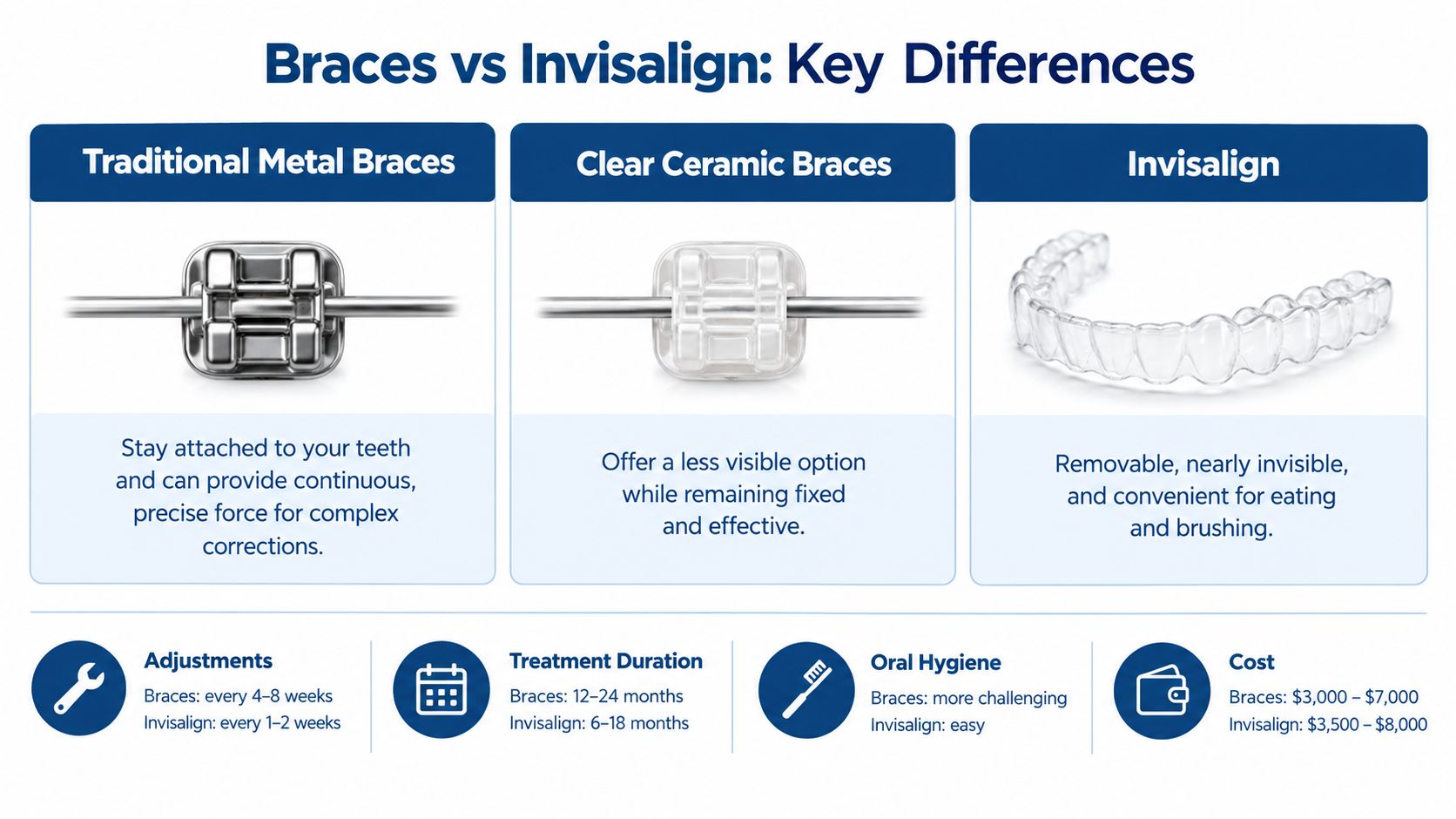
Metal braces and clear ceramic braces remain attached to the teeth. Invisalign uses removable aligners. Ceramic brackets offer a less conspicuous fixed option, but their suitability still depends on the planned mechanics rather than color alone.
Braces and Invisalign compared for overbite correction
| Question | Braces | Invisalign | What to confirm during the exam |
|---|---|---|---|
| Which bites may suit treatment? | Often favored for complex vertical control | Reasonable for selected dental deep bites | Whether the discrepancy is dental or skeletal |
| How is movement controlled? | Attached brackets and wires provide continuous control | Trays may require attachments, bite ramps, or elastics | Which movements are essential |
| Is treatment automatically faster? | No universal timeline | No guaranteed speed advantage | Whether the estimate includes adjustments |
| How visible is treatment? | Metal is noticeable; ceramic is less conspicuous | Clear trays may still include visible attachments | The complete appliance setup |
| What changes at meals? | Appliances stay in place | Trays are removed | Food guidance and the daily routine |
| How is cleaning managed? | Cleaning must account for brackets and wires | Trays come out for tooth cleaning | A workable hygiene routine |
| Can the plan change? | Mechanics may need adjustment | Additional aligners may be needed | How progress and extra treatment are handled |
| What follows active treatment? | A retention plan | A retention plan | Retainer responsibilities and follow-up |
The visual comparison highlights the appliance formats.
Control matters more than the preview
Fixed appliances give the orthodontist an attached system for managing three-dimensional tooth movement. That can be valuable when the treatment requires difficult vertical changes, extraction-space management, or coordinated movements across the bite.
Aligner treatment may use tooth-colored attachments to help engage teeth, bite ramps to support bite-opening mechanics, or prescribed elastics. These features aren't incidental details. Families should understand whether the proposed result depends on them.
In a clinical study of Invisalign overbite correction and refinements, completed cases achieved a mean 38.54% of the overbite correction initially planned, and refinement sets contributed additional correction. That percentage describes the amount of planned movement expressed, not the percentage of patients successfully treated.
Living with the appliance
Neither option deserves an automatic comfort advantage. Patients should ask about pressure, rubbing, appliance edges, and how the team handles problems rather than assuming removable treatment will be effortless.
For braces, the conversation should include cleaning around the appliance and avoiding foods that could damage it. For aligners, removal makes access for brushing straightforward, but trays also require care and prompt replacement after meals.
The accompanying video offers another way to consider the comparison.
Office visits should be discussed as part of the actual plan, not inferred from the appliance category. Monitoring still matters with removable treatment. A convenient appointment schedule isn't a substitute for checking whether the intended bite changes are occurring.
What Clinical Evidence Says About Effectiveness and Time
A shorter published average can be appealing, especially when treatment must fit around school or work. It's useful information, but it isn't a personal completion date.
A 2024 systematic review comparing Invisalign with fixed appliances found that both could successfully treat severe deep overbite without supporting universal interchangeability; an included cohort reported approximately 1.4 years with Invisalign versus 1.7 years with fixed appliances, a difference described as about four months. The same review reported less favorable Invisalign outcomes for several bite measures and greater relapse among Invisalign patients.
Faster according to which endpoint?
Treatment duration is meaningful only when the intended endpoint is clear. Straight front teeth, reduced overlap, and satisfactory contacts across the bite aren't identical outcomes.
For a patient comparing estimates, the important questions include:
- Completion criteria: Does the estimate cover full bite correction or primarily alignment?
- Additional treatment: Are likely refinements already included?
- Tracking checks: How will the clinician identify a gap between planned and achieved movement?
- Stability: What must happen after active treatment to maintain the result?
The accuracy findings discussed earlier help explain why an attractive simulation shouldn't be treated as a guarantee. A digital plan shows the prescribed sequence. Clinical records and progress checks establish what the teeth do.
A credible timeline includes room for clinical judgment, not just a tray count.
Vertical movement can change the schedule
A dental deep bite that needs limited, achievable tooth movement presents a different challenge from a skeletal vertical discrepancy. If the desired result depends on movements that are difficult to express, the initial schedule may need revision.
A review of clear-aligner movement predictability identifies intrusion and extrusion as less reliable than buccolingual tipping. In plain language, moving a tooth vertically can be harder to achieve predictably than changing its inward or outward tilt.
That doesn't mean aligners can't work. It means the orthodontist should explain why the proposed movements are reasonable and how progress will be verified. The patient should also understand whether the estimate assumes an uncomplicated first course or anticipates further adjustment.
The discussion of Invisalign for deep bite can help families prepare more focused consultation questions. The useful issue isn't whether a treatment can sometimes finish sooner, but whether the proposed schedule is credible for the required correction.
Finally, retention deserves its own discussion rather than being treated as an afterthought. The relapse finding above makes long-term follow-through part of the comparison, even when active treatment appears efficient.
Understanding Cost, Insurance, and Daily Commitments
A useful price comparison starts with written treatment plans, not advertised starting fees. Case complexity, appointments, additional treatment, and retention can affect what the quoted fee includes. Families should compare the scope of care before deciding that one appliance represents better value.
Check the full financial arrangement
A consultation should produce clear answers in several areas:
- Included services: Request an explanation of records, visits, appliance adjustments, refinements, retainers, and follow-up.
- Insurance benefits: Verify orthodontic coverage, appliance restrictions, remaining benefits, and any authorization requirements.
- Payment arrangements: Ask whether flexible monthly payments are available and review the complete terms.
- Public coverage: Delaware families considering Medicaid or CHIP should verify eligibility, clinical requirements, and benefits for the proposed treatment.
- Unexpected changes: Clarify how lost trays, damaged appliances, or an extended plan could affect charges.
Insurance acceptance doesn't establish that every treatment is covered. Likewise, a payment arrangement changes how a fee is paid, not what the treatment requires clinically.
The guide to ceramic braces versus Invisalign cost offers a useful starting point for discussing less visible options. An individual estimate remains necessary.
Put the routine on the calendar
A clinical review of clear-aligner treatment identifies roughly 20–22 hours of daily wear, or about 400 hours per aligner, as important for effective treatment. The prescribed change schedule must still come from the treating orthodontist rather than a calculation made at home.
For a teenager, the practical question is whether trays will return to the mouth after lunch, snacks, and activities. For an adult, repeated coffee breaks or extended meals deserve an honest discussion before treatment begins.
Family planning check: Evaluate an ordinary busy day, not an unusually organized day.
Braces remove the need to remember tray reinsertion, but they don't remove patient responsibilities. Cleaning, appliance care, appointments, and prescribed elastics still require cooperation.
Families should also discuss sports protection, where trays will be stored when removed, and whom to contact after appliance damage or a lost tray. These aren't minor lifestyle details if they repeatedly interfere with the plan.
The better financial choice is the treatment that can reasonably deliver the agreed correction within a routine the patient can maintain. A lower initial quote isn't automatically better value if important services or responsibilities remain unclear.
Which Option Fits Children, Teens, and Adults
Age informs the recommendation, but it doesn't decide it. A cooperative teenager with a dental deep bite may be a reasonable aligner candidate. An adult with a more demanding vertical problem may need the control of fixed treatment despite a strong preference for clear trays.
These are representative decision situations, not reports of patient outcomes.
Children need a growth-aware assessment
For a child whose teeth are still erupting, the orthodontist must account for a changing bite. Growth, developing tooth positions, and cooperation influence both treatment selection and timing.
Parents shouldn't assume that an early evaluation automatically means immediate braces or aligners. A useful assessment explains what needs attention, what may be monitored, and how future changes could affect the recommendation.
Information about orthodontics for kids can help parents prepare for that conversation. The clinical discussion should remain specific to the child rather than borrowing expectations from adult studies.
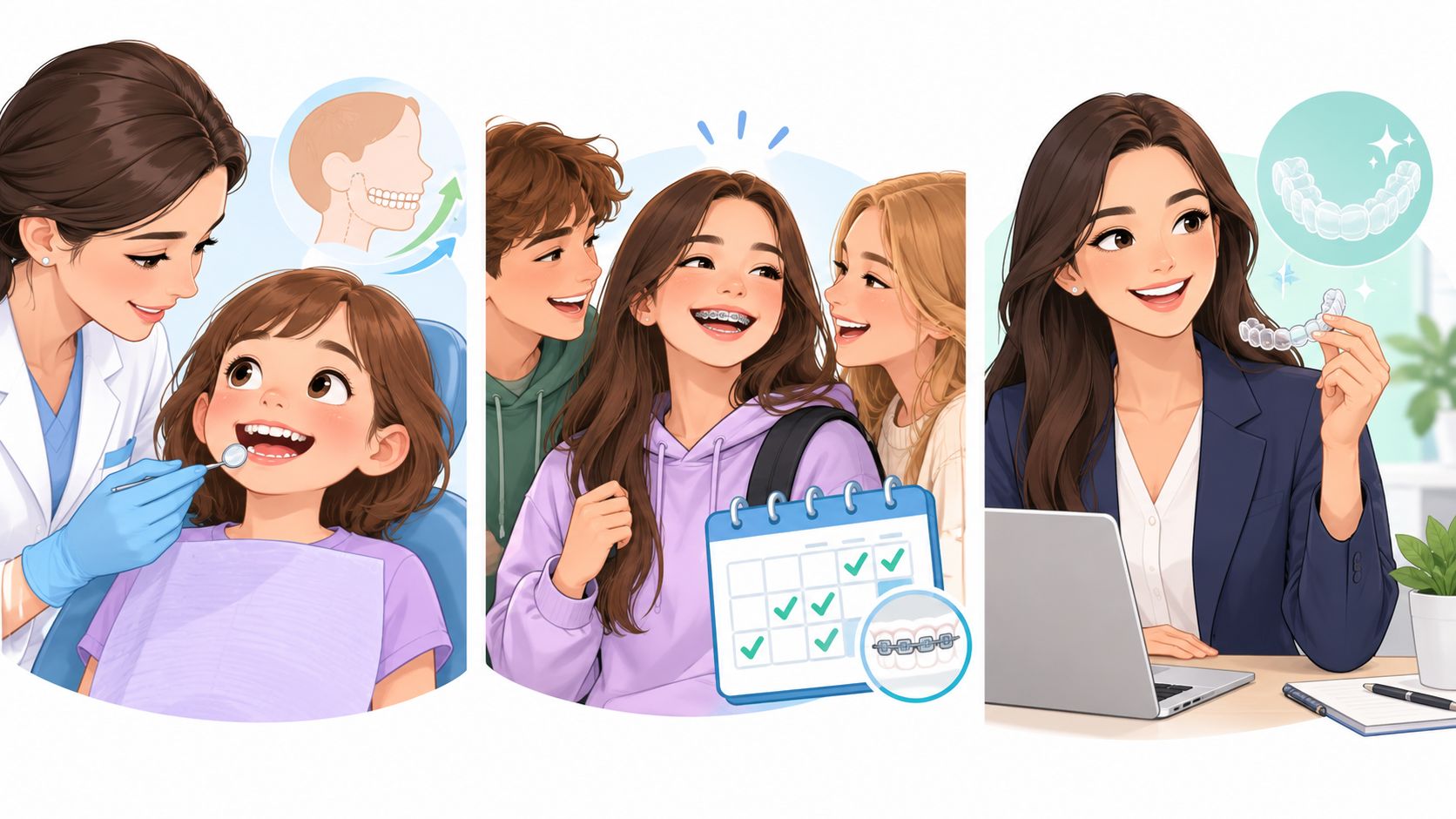
The illustration shows the evaluation and appliance choices without implying that every patient follows the same path.
Teenagers need a realistic routine
For a teen with a mild dental overbite who consistently manages personal responsibilities, aligners may fit both the bite and daily life. The orthodontist should still confirm that the necessary movements are suitable.
For another teen, school meals, sports, and frequent misplaced belongings may make removable treatment harder to maintain. Braces can reduce that particular source of uncertainty, although other care requirements remain.
Appearance deserves respectful discussion rather than dismissal. A teen's preference can support cooperation, but enthusiasm about clear trays isn't evidence that the daily routine will work.
Adults need movement-specific planning
An adult consultation should examine incisor position, periodontal support, and whether the problem is mainly dental or skeletal. A treatment preview that depends heavily on front-tooth intrusion deserves a detailed explanation of feasibility.
In a comparative study of severe adult deep overbite treated without extractions, fixed braces primarily used approximately 1.5 mm of lower-incisor intrusion plus molar extrusion; Invisalign relied on approximately 1.0 mm of upper-incisor intrusion and 2.0 mm of lower-incisor intrusion, without meaningful molar intrusion. These findings describe different biomechanical pathways, not a recipe applicable to every patient.
For an adult needing substantial posterior vertical change, that distinction may favor fixed-appliance planning. For an adult whose needs are mainly dental and compatible with aligner mechanics, removability may be a reasonable trade-off.
The strongest recommendation explains why the selected pathway fits the person's anatomy and circumstances. Chronological age alone can't provide that explanation.
Making a Confident Recommendation
Braces may be favored when complex vertical control or coordinated three-dimensional movement is central to the plan. Invisalign may be reasonable for selected mild-to-moderate dental deep bites when consistent wear and additional refinement treatment are realistic.
Neither appliance should be presented as an automatic solution to a skeletal discrepancy. A substantial jaw-related problem requires an explanation of the limits of tooth movement and whether the proposed treatment addresses the underlying concern or compensates for it.
A pooled analysis of six retrospective studies involving 177 patients reported average aligner overbite reduction of 1.79 mm, but a prediction interval of −0.78 to 4.36 mm showed substantial variation. That variation reinforces the need for an individual assessment rather than an appliance-wide promise.
What a clear recommendation should include
Before accepting a plan, patients and parents should be able to identify:
- The diagnosis: Initial overbite measurement and whether the main discrepancy is dental or skeletal.
- The records: Examination findings, digital records, and any other records needed for planning.
- The mechanics: Intended tooth movements and the purpose of attachments, bite ramps, or elastics.
- The adjustment strategy: How progress will be checked and when refinements or other changes may be considered.
- The retention plan: The responsibilities that follow active correction.
- The financial agreement: Total quoted cost, included care, verified insurance benefits, and payment terms.
A recommendation is more reassuring when the clinician explains its limits. Families should feel comfortable asking why a less visible option is suitable, why braces are preferred, or what finding would change the plan.
Patients across Delaware can bring the same questions to a consultation in North Wilmington, Middletown, Dover/West Dover, or Millsboro. The most useful outcome isn't a choice between brackets and trays. It's a clear understanding of the required correction, the likely trade-offs, and the patient's role in making treatment work.
Stellar Orthodontics offers braces and Invisalign evaluations with free consultations and iTero digital 3D scanning in North Wilmington, Middletown, West Dover, and Millsboro. Families and adults comparing overbite treatment are invited to visit Stellar Orthodontics to book a free consultation at a convenient Delaware location and discuss which approach fits the bite and daily routine.