.png)
A lot of Delaware families end up at the same point. A parent is standing at the kitchen counter after dinner, a teen is smiling with lips closed in school photos, and someone has finally said, "The front teeth cover too much." The next question usually isn't just whether teeth can look straighter. It's whether Invisalign for deep bite can correct the bite, and whether the digital preview is something a family can count on.
That's the right question to ask. A deep bite can be simple and mostly tooth-related, or it can be more complicated and tied to jaw pattern and facial growth. Those two situations don't behave the same way, and they shouldn't be explained the same way. Families deserve a clear answer about what aligners can do, where they struggle, and why some cases need more than trays alone.
Table of Contents
- What a Deep Bite Means and Why Families Ask About Invisalign
- How Invisalign Actually Moves Teeth to Open a Deep Bite
- Attachments, Elastics, Bite Ramps, and TADs Explained
- What the Evidence Says About Real-World Accuracy
- Two Delaware Case Examples, Mild and More Complex
- When Braces or Surgery Are the Better Answer
- What to Ask at Your Free Consultation
- Key Takeaways and Booking Your Next Step
What a Deep Bite Means and Why Families Ask About Invisalign
On a school morning in Delaware, the concern often looks small at first. A teen grabs breakfast, laughs, and a parent notices that the top front teeth almost hide the bottom front teeth. Sometimes the family has already heard words like “overbite” and “deep bite,” but the meaning still feels fuzzy.

A deep bite means there is too much vertical overlap of the front teeth. In plain language, the upper front teeth sit too far down over the lower front teeth when the teeth come together. Some families notice it because the smile looks “closed.” Others notice signs that feel more practical, such as front teeth wearing down, lower teeth contacting gum tissue, or chewing that doesn't feel balanced.
Mild dental deep bite and skeletal deep bite aren't the same
Many readers get tripped up here. A mild dentoalveolar deep bite is mostly about tooth position. The teeth may be tipped, overerupted, or crowded in a way that deepens the overlap. A skeletal deep bite involves the underlying jaw pattern and facial proportions, which usually makes treatment less straightforward.
That difference matters because aligners tend to work best when the problem is mainly dental. A 2025 systematic review of clear aligners for deep bite screened 829 records and included 18 studies. Across those studies, clear aligners produced about 0.4 to 3.8 mm of bite opening, and the accuracy of planned correction ranged from 33% to 48.88%. The review concluded that aligners may be effective for mild-to-moderate dentoalveolar deep bites, while effectiveness versus fixed appliances remains uncertain for skeletal deep bites.
What parents should hear in that data: the computer plan is a guide, not a promise.
What an orthodontic exam is really trying to answer
During an exam, the orthodontist isn't just asking, “Can these teeth be straightened?” The bigger questions are:
- What is causing the deep bite
- How much of the correction depends on front-tooth movement
- Whether jaw pattern makes the case less predictable with aligners
- How likely refinement will be before the bite is finished
That's why two patients can both ask about Invisalign and get different recommendations. One may be an ideal aligner case. The other may need braces, a hybrid approach, or a different sequence entirely.
How Invisalign Actually Moves Teeth to Open a Deep Bite
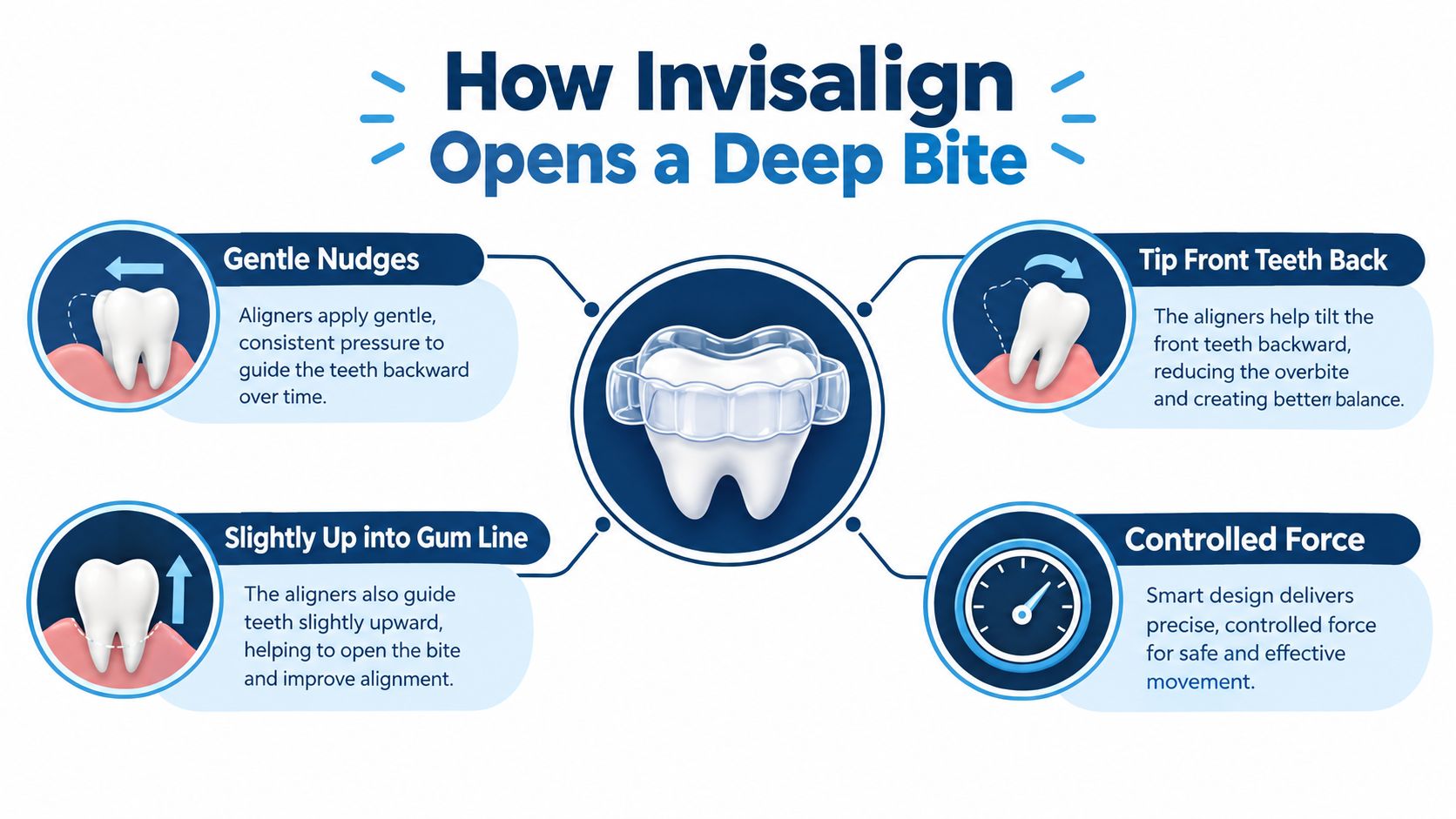
Many families picture aligners as clear shells that "push teeth straight." Deep-bite correction is more specific than that. The trays apply small, repeated forces over time, and the treatment plan decides where those forces go.
The basic mechanics in plain language
In most deep-bite aligner cases, the goal is not dramatic jaw change. The goal is usually to move the front teeth in a controlled way while protecting the position of the back teeth. That often means intruding the incisors, which means moving them slightly upward into the bone, and managing the posterior teeth so the bite opens in a stable way.
A useful mental model is this: each aligner is a gentle nudge, not a hard shove. One tray may do very little by itself. A full sequence creates the cumulative change.
A 30-patient clinical study on aligner biomechanics for deep bite correction showed this clearly. Mean overbite decreased from 5.5 ± 0.7 mm to 2.3 ± 0.6 mm, with about 1.7 mm of upper-incisor intrusion, 1.4 mm of lower-incisor intrusion, and only 0.6 mm of molar extrusion. That tells families something important. The bite was opened mainly through front-tooth intrusion, not by heavily erupting the molars.
Why vertical control is harder than simple tipping
Tilting a tooth is usually easier than moving it vertically. Intrusion asks the aligner to deliver a very controlled force to a very specific part of the tooth movement. That's why deep-bite treatment can look easy on a screen but behave differently in a real mouth.
Several planning details matter more than the brand name on the box:
- Attachment geometry gives the aligner something to grip.
- Posterior anchorage helps prevent unwanted side effects.
- Sequencing determines which teeth move first and which wait.
- Staging spreads movement across a series rather than trying to do too much at once.
Families who want the bigger picture can also read how Invisalign works in everyday terms.
A deep bite doesn't open because a tray is clear. It opens because the plan controls force, timing, and anchorage well enough for the teeth to track.
Why “more intrusion” isn't the whole answer
If a patient isn't tracking well, adding more programmed intrusion may not solve the problem. The orthodontist also has to consider root position, gum support, the original cause of the deep bite, and whether the back teeth are staying where they should. That's why treatment planning for Invisalign for deep bite is less about a dramatic before-and-after animation and more about careful mechanics.
Attachments, Elastics, Bite Ramps, and TADs Explained
Families often hear a string of new terms at a consult and leave thinking the case sounds more complicated than it really is. Most of these add-ons are just tools. Each one solves a different problem.
A simple side-by-side guide
| Adjunct | What It Looks Like | What It Does in a Deep Bite Plan |
|---|---|---|
| Attachments | Small tooth-colored bumps bonded to certain teeth | Help the aligner grip teeth better so planned movements are more controlled |
| Elastics | Small rubber bands connecting upper and lower teeth | Add directional force between the arches when the bite relationship needs extra guidance |
| Bite ramps | Built-in raised areas on the aligner behind front teeth | Help disengage the bite and create room for planned front-tooth movement |
| TADs | Temporary mini-anchors placed by the orthodontist | Provide stronger anchorage when the case needs movement that aligners alone may not control well |
What each one means for daily life
Attachments are usually the easiest for families to understand once they see them. They're small handles for the aligner. They don't mean treatment is failing. They usually mean the orthodontist wants better control. Readers who want a closer look can review how Invisalign attachments work.
Elastics add a second layer of force. If the upper and lower arches need to coordinate better while the bite is opening, elastics can help. They also depend heavily on wear consistency.
Bite ramps can be confusing because patients may feel them before they understand them. These are little built-in platforms that change how the teeth meet, which can support bite opening in selected cases.
When the case needs stronger anchorage
TADs sound dramatic, but the concept is straightforward. They give the orthodontist a firm anchor point when tooth-borne force alone may not be enough. That can be helpful in cases where stronger intrusion control or more stable mechanics are needed.
- For a mild case: attachments and bite ramps may be enough.
- For a mixed-mechanics case: elastics may be added to coordinate the bite.
- For a tougher vertical problem: TADs may be considered when more control is needed.
Parent-friendly translation: more parts in the plan don't automatically mean something is wrong. They often mean the orthodontist is trying to make the movement more precise.
What the Evidence Says About Real-World Accuracy
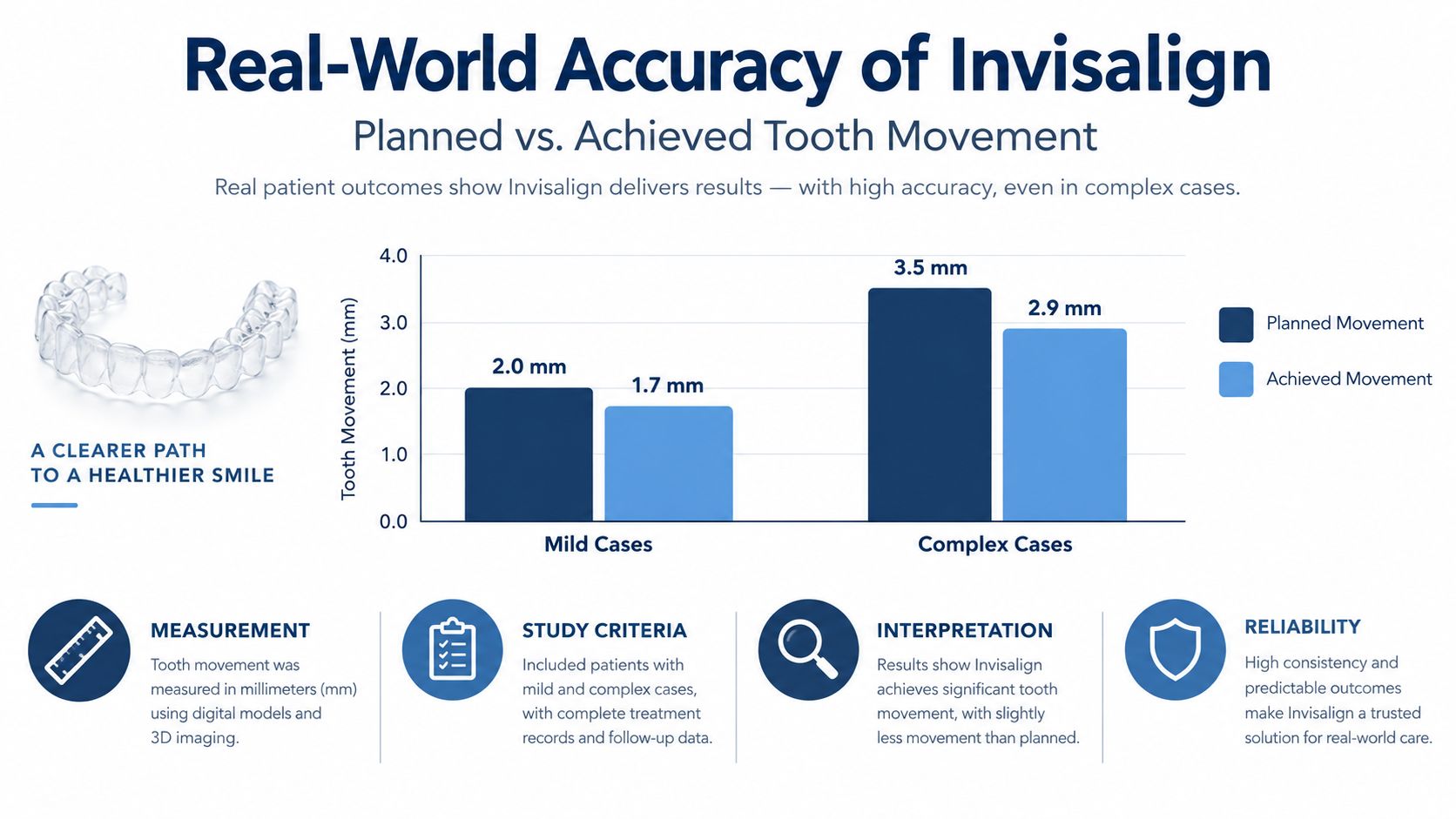
The hardest part of aligner marketing for families is this. The digital plan looks exact, but tooth movement in real life isn't perfectly exact. That doesn't mean aligners don't work. It means the software forecast and the achieved movement are not the same thing.
What “accuracy” actually measures
In published studies, accuracy usually means how much of the planned tooth movement was achieved. For parents, the practical translation is simple. If a plan says a tooth should move a certain amount, the mouth may deliver only part of that movement before the next decisions need to be made.
A 2024 retrospective study of 20 Invisalign deep-bite patients gives a good example of why treatment is monitored in phases. The patients averaged 32.63 years old and started with an average overbite of 5.09 mm. The first aligner series corrected about 37.63% of the planned movement. Later series mainly addressed residual discrepancies, and the biggest measurable improvement came during the first round.
Why refinement aligners are normal
Families sometimes hear “refinement” and assume the original plan failed. That's not the right way to read it.
Refinement is often the expected next step when:
- A tooth didn't track fully with the first series
- The bite improved but didn't settle completely
- Smaller finishing movements are easier to see after the larger early changes happen
- The orthodontist wants to reassess instead of forcing the old plan to continue unchanged
That staged approach is especially important in deep-bite treatment because vertical movements can be less predictable than simple alignment.
How parents can use accuracy numbers wisely
Accuracy figures are not a verdict on any one child or adult. They are planning tools. They help frame honest expectations.
- Best use of the digital simulation: as a treatment map
- Worst use of the digital simulation: as a guarantee
- Best mindset for a family: expect monitoring, rescans, and adjustments if needed
Published accuracy data doesn't tell a family whether a child is a candidate. It tells them why careful follow-up matters.
That's the takeaway for Invisalign for deep bite. If the bite opens well in the first series, great. If the case needs refinement, that can still be part of normal treatment rather than a surprise.
Two Delaware Case Examples, Mild and More Complex
A deep bite can look similar in a selfie and behave very differently in treatment. That's why example cases help. The appliance may still be clear aligners in both situations, but the plan behind them changes a lot.
Example one, a milder teen case
A parent in North Wilmington or Middletown may bring in a teen whose main issues are crowding and a moderate deep bite that appears mostly tooth-related. The smile may look crowded, the front teeth may overlap too much, but the jaw pattern may not suggest a major skeletal problem.
In a case like that, aligners might focus on leveling the arches, controlling the front teeth, and using attachments or bite ramps to improve tracking. Published evidence suggests the average amount of bite opening with clear aligners in selected non-extraction deep-bite cases is modest, not magical. A large evidence summary on clear aligners for deep-bite correction found an average overbite reduction of about 1.79 mm, with about 1.37 mm of lower-incisor intrusion and 0.70 mm of lower-molar extrusion.
That's useful because it matches what many parents need to hear. For a mild dental case, a moderate amount of carefully planned movement may be enough.
Example two, a more complex adult case
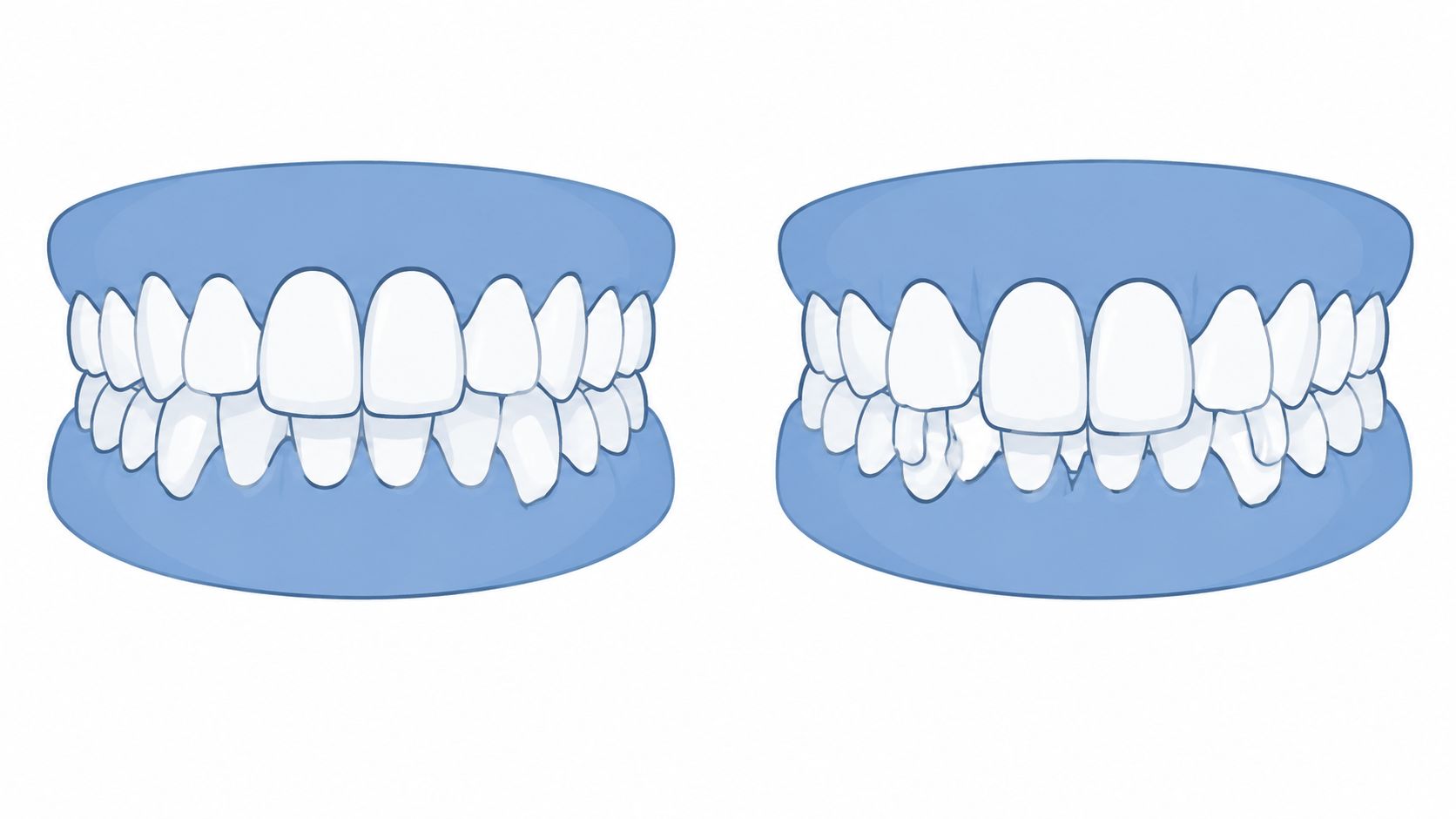
Now consider an adult in West Dover or Millsboro with a deeper bite, a history of grinding, worn front teeth, and signs that the bite problem may be more than simple crowding. That patient may still ask for Invisalign, and sometimes aligners can still play a role. But the plan may need elastics, stronger anchorage, or a different appliance entirely if the mechanics look less predictable.
This kind of case often raises questions about what aligners can and can't change. The visual below helps families hear those questions from another angle before a consult.
Why the free scan matters more than the label on the box
A free iTero scan can help show crowding and tooth position, but the exam still has to answer the bigger question: is the deep bite mainly dental, or is it tied to the jaw pattern and function? At that point, one option families in Delaware may discuss is care through Stellar Orthodontics at North Wilmington, Middletown, Dover/West Dover, or Millsboro, where free consultations include digital 3D scanning and evaluation of whether aligners fit the individual bite.
The point isn't that every mild case should get aligners or every harder case should avoid them. The point is that same appliance doesn't mean same plan.
When Braces or Surgery Are the Better Answer
Clear aligners are appealing, but clear doesn't always mean simpler. Some deep bites need more control than trays alone can predictably provide.
Situations where braces may offer stronger control
Braces may be the better answer when the deep bite is severe, when the problem appears more skeletal, or when tooth positions require movements that need stronger continuous control. Fixed appliances can also help when the front teeth are significantly rotated or tipped, because difficult vertical corrections often depend on very steady mechanics.
A retrospective study of 24 patients treated with planned intrusion overcorrection found an average overbite reduction of 3.3 mm, but overall intrusion accuracy was only 52.2%. Canine intrusion was less predictable, at roughly 23% to 29% of planned movement. Those numbers don't mean aligners can't work. They do mean some movements are harder to deliver than the software image suggests.
Cases where surgery may enter the conversation
Surgery is not part of most deep-bite discussions, but it can become relevant when the bite reflects a substantial jaw discrepancy rather than a problem that tooth movement alone can solve. In those situations, families should evaluate the recommendation, not just the appearance of the appliance.
A few practical questions help clarify the choice:
- Is the problem mostly dental or mostly skeletal
- Does the plan rely on precise intrusion of several teeth
- Will the patient realistically wear aligners as directed every day
- Would braces create more direct control with fewer compromises
Readers comparing treatment styles may also find it helpful to review clear aligners and traditional braces side by side.
A tray can be more comfortable to wear and still be the wrong tool for a specific bite.
That's an important point for Delaware families. The right recommendation is the one that gives the most controlled path to a stable bite, even if it isn't the most cosmetic-looking appliance on day one.
What to Ask at Your Free Consultation
A strong consultation isn't a sales pitch. It's a chance for a family to understand the diagnosis, the mechanics, and the trade-offs. Parents don't need technical language. They need the right questions.
Smart questions that make the visit more useful
- Ask about the cause first: Is the deep bite mainly from tooth position, or does jaw pattern play a role?
- Ask what teeth are expected to move: Deep-bite aligner correction often depends more on the front teeth than the back teeth. A clinical comparison of Invisalign deep-bite mechanics reported about 1.0 mm of upper-incisor intrusion and 2.0 mm of lower-incisor intrusion, rather than major posterior change.
- Ask what add-ons may be needed: Attachments, bite ramps, or elastics can change how predictable the plan becomes.
- Ask how progress will be checked: Monitoring matters because tracking issues may not be obvious to a parent looking in the mirror.
- Ask what refinement usually means in that office: Not every refinement reflects the same kind of adjustment.
- Ask what the fallback option is: If the bite doesn't track as expected, will the recommendation shift to braces, a hybrid plan, or added anchorage?
What families should listen for
The most helpful answer is usually not “yes” or “no.” It's a clear explanation of why aligners are being recommended, what movements matter most, and what signs would trigger a change in plan.
A useful consultation should also leave room for practical concerns:
- School and sports routines
- Daily wear habits
- Cleaning and compliance
- Insurance or payment logistics
- Whether another appliance might be more predictable
That conversation can happen at the office closest to home, whether that's North Wilmington, Middletown, Dover/West Dover, or Millsboro. Families usually feel more confident once the bite is explained in plain language rather than in software screenshots.
Key Takeaways and Booking Your Next Step
The evidence gives families a balanced answer. Invisalign for deep bite can help many mild-to-moderate dentoalveolar cases, especially when the correction is mainly about tooth position and the plan is monitored closely. It is not a guarantee that every programmed movement will happen exactly as shown on a screen.
That's why accuracy matters so much in this conversation. Published studies show that planned and achieved movement often differ, especially for vertical changes. Families shouldn't read that as bad news. They should read it as a reason to choose a treatment plan that includes reassessment, possible refinements, and honest discussion about alternatives.
Braces remain a strong option for more difficult cases. In some patients, they may provide the control needed for a better result. In others, aligners with attachments, bite ramps, elastics, or added anchorage may still make sense. The deciding factor is the diagnosis, not the popularity of the appliance.
For Delaware families, the next step is usually simple. Get the bite evaluated in person, ask what is causing it, and ask how the plan will be monitored if the teeth don't move exactly as predicted. A free consultation with digital 3D scanning can make that conversation much easier to follow, especially for parents comparing choices for a child or teen.
Stellar Orthodontics also makes that next step more accessible for working families with free consultations, flexible monthly payment plans with $0 down, and acceptance of most major dental insurance. The practice is also one of the few Delaware orthodontic offices that accepts all three state Medicaid plans plus CHIP for eligible children and teens under 21.
Families who are wondering whether a deep bite is a good fit for aligners can book a free consultation at Stellar Orthodontics in North Wilmington, Middletown, West Dover, or Millsboro. The team offers iTero digital 3D scans, braces and Invisalign options, and practical guidance for Delaware parents who want an honest answer about what their child's bite will really take to correct.