
Can Invisalign fix a crossbite? Sometimes. Clear aligners may correct a crossbite caused by tooth position, while one caused by a narrow upper jaw may need a different approach.
The key distinction is whether the teeth are out of position or the jaw itself is too narrow. Moving teeth is like sliding pieces into place; changing jaw width involves a different kind of treatment. A smile that looks straight is not necessarily a stable bite, so the plan must address what caused the crossbite as well as how the teeth meet.
Table of Contents
- Short Answer and What a Crossbite Actually Is
- Crossbite Types and Whether Aligners Can Correct Each
- When Aligners Need Expanders, Elastics or Attachments
- When Surgery or Specialist Care Comes Into Play
- Clear Aligners Versus Braces for a Crossbite
- Keeping the Correction Stable After Treatment
- Confirm Your Crossbite Plan at a Free Consultation
Short Answer and What a Crossbite Actually Is
Can Invisalign fix a crossbite? Sometimes. The answer depends on whether the crossbite comes from tooth position or from the width and relationship of the jaws. A straight-looking smile does not always mean the bite is balanced or likely to stay stable after treatment.
A crossbite describes how your upper and lower teeth meet when you close. It doesn't explain why they meet that way, and the cause shapes which treatment may work.
The upper teeth should sit just outside the lower teeth, like a lid fitting around a box. In a crossbite, some upper teeth sit inside the lower arch instead. One upper front tooth might tuck behind the lower front teeth, or a section of teeth on one side might sit inside the lower teeth.
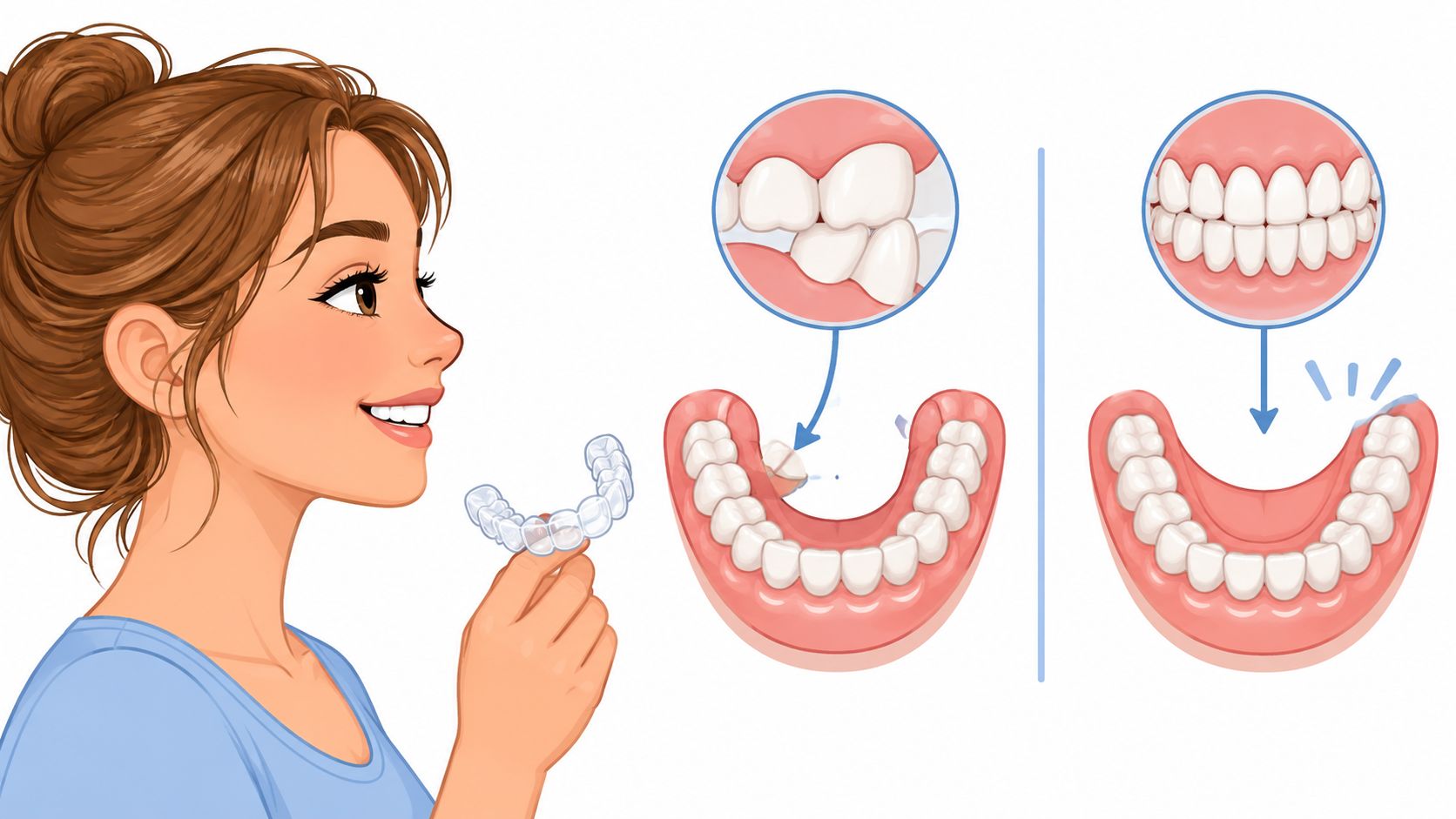
Anterior means the front teeth. Posterior means the premolars and molars farther back. A crossbite can affect one side or both. When the back teeth cross on both sides, the cause may involve jaw width rather than just a few teeth sitting out of line.
A crossbite can lead to uneven tooth wear because a few teeth take more force than they should. A tooth out of line may also be harder to clean and more prone to gum irritation. In a growing child, the lower jaw may shift sideways to find a comfortable closing position, which can affect how the bite develops.
What the evidence does and doesn't show
The evidence is stronger for mild to moderate tooth-position problems than for severe differences in jaw structure, according to a clinical review of clear-aligner outcomes. That review describes a small case series in which children's anterior crossbites were corrected with clear aligners. It also reports patient and parent satisfaction rates of 85% to 92%.
The same review discusses a 2023 systematic review and meta-analysis that found evidence of aligner effectiveness insufficient across several investigations, despite promising results in mild to moderate cases. These findings suggest potential, not a guarantee for every type of crossbite.
Research involving children is still developing. A 2025 scoping review of clear aligners in young patients found that aligners improved some crossbites, but concluded that the evidence was not yet strong enough to determine which mixed-dentition cases benefit most. It also describes a meta-analysis of eight adolescent studies that reported transverse arch expansion and anterior crossbite correction, while calling for cautious interpretation and more high-quality research.
So the honest answer to whether Invisalign can fix a crossbite is a qualified yes. The key is identifying what is causing it and whether the planned correction will create a bite that holds, not just teeth that look straight.
Crossbite Types and Whether Aligners Can Correct Each
A crossbite can come from tooth position, jaw shape, or both. The difference matters: moving a tooth into line may correct a dental crossbite, while a jaw-related crossbite may need a different approach.
| Crossbite type | Main cause | Aligners alone? | Usual add-on |
|---|---|---|---|
| Anterior dental crossbite (front teeth) | Upper front teeth tipped behind lower teeth | Often yes in mild to moderate cases | Bite ramp attachments |
| Posterior dental crossbite, mild to moderate | Upper back teeth tipped toward cheek or tongue | Often yes if upper arch width is adequate | Attachments, sometimes elastics |
| Skeletal crossbite (narrow upper jaw) | Upper jaw too narrow for the lower jaw | Usually no in growing patients | Palatal expander first, then aligners or braces |
| Functional shift crossbite | Lower jaw slides sideways to close | Aligners may move the teeth, but the shift needs assessment | Jaw evaluation, often combined treatment |
| Complex or asymmetric crossbite | Several teeth plus jaw differences on one or both sides | Usually no; fixed braces give more control | Braces, elastics, possible specialist referral |
A dental crossbite is about where the teeth sit. A skeletal crossbite involves a difference in jaw shape or width. Clear aligners can reposition teeth and create limited arch expansion, mainly by tipping teeth. A systematic review of clear-aligner treatment found stronger support for mild to moderate malocclusions than for complex or severe cases.
For example, an adult with one upper front tooth tipped behind the lower teeth may have a dental crossbite. If the arch has enough room and the tooth movement is limited, aligners may be suitable. A teen with several upper back teeth sitting inside the lower teeth may have a jaw-width difference, which calls for a different assessment.
A crossbite can also involve a functional shift. The lower jaw slides to one side as the teeth come together, much like a door shifting on its hinges. An orthodontist checks how the teeth meet, along with scans, photographs and, when needed, imaging to assess the jaws. That helps distinguish a tooth-position issue from a bite that shifts during closure.
What to ask at the consultation: Is the crossbite mainly in the teeth, the jaws, or both? Does the lower jaw shift when the teeth close?
When Aligners Need Expanders, Elastics or Attachments
The question parents ask most often is whether their child will need an expander before Invisalign. The answer depends on whether the crossbite is dental, functional or skeletal. Age, growth potential, asymmetry and the width of the discrepancy matter far more than the brand on the box.
The American Association of Orthodontists explains that growing patients with a crossbite may need a palatal expander to widen the upper jaw, followed by braces or clear aligners to reposition teeth. Recent clinical evidence sharpens that point. In young children, aligner-based expansion appears to produce mainly dentoalveolar changes, such as buccal crown tipping, rather than true orthopedic widening of the jaw. That makes aligners more predictable for moderate transverse discrepancies than for major skeletal constriction.
Add-on tools used with aligners for a crossbite
| Tool | What it does | Typical case |
|---|---|---|
| Bite ramp attachment | Lifts the bite so upper front teeth can move forward | Front (anterior) crossbite |
| Tooth-colored attachments | Give aligners a grip to push, tip and turn teeth | Rotations and tipping of teeth in any crossbite |
| Elastics | Small bands that add directed force between upper and lower teeth | Bite relationship and fine positioning |
| Palatal expander | Widens the upper jaw | Narrow upper jaw, usually in growing children |
| Temporary anchorage device | Provides a fixed point to move teeth against | Cases where stronger, controlled movement is needed |
Bite ramps are the quiet workhorses of front crossbite correction. A published scoping review of clear-aligner crossbite treatment identified bite-ramp attachments as useful during anterior crossbite correction, which shows that treatment involves more than wearing smooth trays.
Attachments do a different job. These small tooth-colored bumps give the tray something to push against, which matters for rotations and for teeth that need to tip in a controlled direction. The mechanics behind them are worth understanding before treatment starts, and this explanation of how Invisalign attachments work covers what they are and why a plan calls for them.
Elastics add force across the arches, and temporary anchorage devices give a fixed point for stronger movement when a tooth needs to travel without dragging its neighbors along, as Invisalign's guidance on complex cases describes.
A palatal expander is different in kind. It's usually used in growing patients, while widening an adult upper jaw is more involved and may use surgery-assisted methods.
A scan alone can't decide treatment. An examination, and imaging when the jaw is involved, is what separates tooth movement from jaw correction.
One practical warning. Attachments and elastics only work when they're worn exactly as directed. Missed wear slows progress, and the plan doesn't shrink to match.
When Surgery or Specialist Care Comes Into Play
Some crossbites involve the jaw's shape, not just tooth position. If the upper jaw is too narrow, shifting teeth within the arch may make them look straighter without correcting the underlying width. That distinction matters because a straight-looking result is not always a stable bite.
For example, a growing child with a narrow upper jaw and a sideways shift as the teeth come together may need an orthodontist to assess jaw growth and discuss expansion. In adults, widening the upper jaw can be more involved because the palate has finished growing. An orthodontist may discuss surgery-assisted expansion or a plan that includes an oral surgeon.
Four signs that deserve a prompt visit:
- Recurring chewing discomfort on one side.
- A lower jaw that shifts sideways as the teeth come together.
- Uneven tooth wear, such as flat canine surfaces or chipped front edges.
- A child whose upper jaw looks narrow, with back teeth inside the lower teeth on both sides.
A photograph cannot show how the bite functions or whether jaw width is involved. An examination, digital scans, and imaging when the jaw may be involved help the orthodontist assess the cause and choose a treatment approach. Some crossbites may be treated with tooth movement, while others need expansion or specialist care.
If cost is part of the worry, Delaware Medicaid's auto-qualifying conditions for braces include severe crossbite with functional impact. Other qualifying conditions include cleft lip and palate, impacted maxillary anterior teeth, severe deep overbite with palatal impingement, severe traumatic deviations from accident or injury, and certain documented developmental craniofacial conditions. A consultation can help determine whether your child's condition may fit one of these categories.
Clear Aligners Versus Braces for a Crossbite
A crossbite plan depends on what needs to move. Aligners can shift teeth and offer a discreet, removable option. Braces stay attached and can suit complex bites, severe crowding, or detailed tooth rotations.
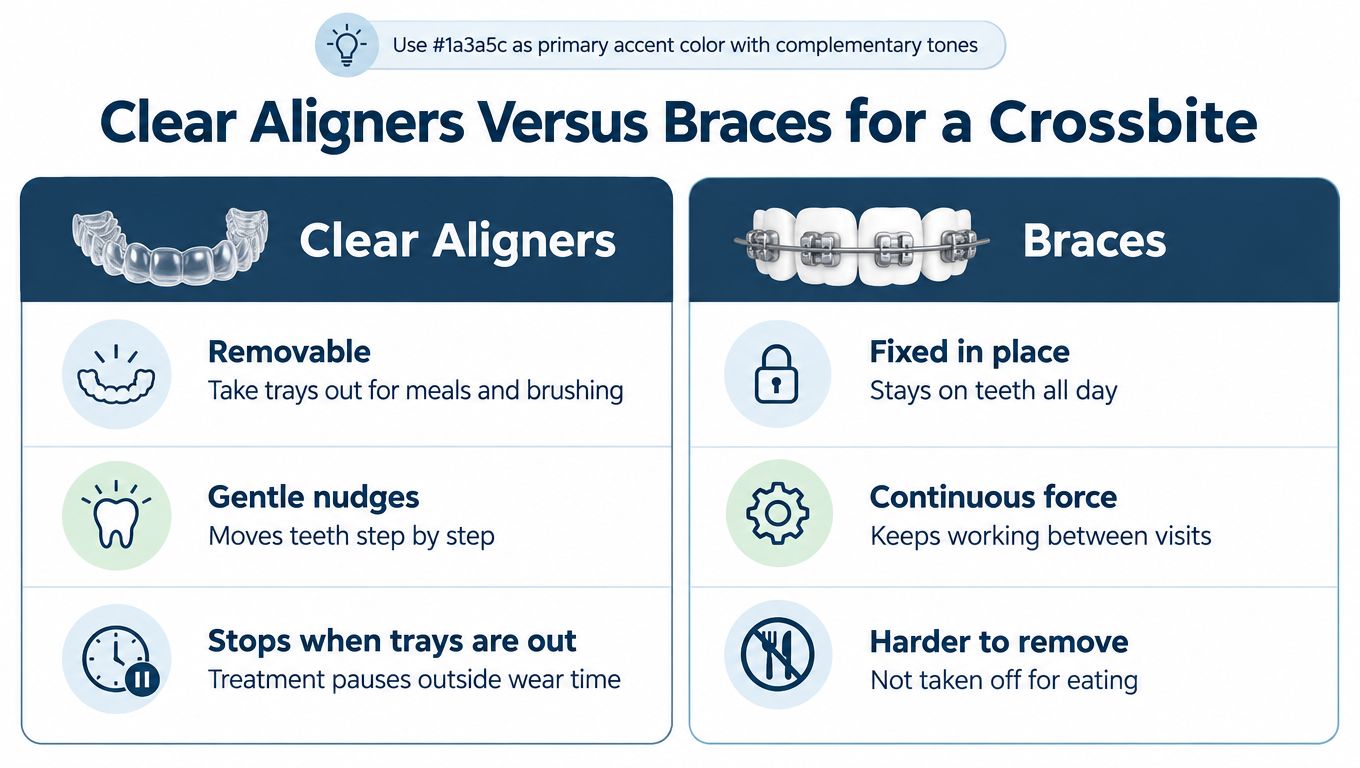
Clear aligners and braces compared for a crossbite
| Factor | Clear aligners | Fixed braces |
|---|---|---|
| Can the patient remove it? | Yes, for meals, brushing, and sports | No, they remain attached during treatment |
| Best fit | Many mild to moderate cases, when the arch has enough width | Complex bites, severe crowding, or detailed tooth rotations |
| Jaw widening | May need an expander or another appliance | May be paired with an expander when the jaw needs widening |
| Simple front crossbite timing | In a study of 30 children aged 7 to 12, treatment averaged 3.21 months, plus or minus 0.75 months | The study did not report a braces comparison |
| Typical total treatment | A 2025 clinical-guidelines review reported 12 to 24 months for aligner treatment | Most braces cases finish in 18 to 30 months |
| Daily responsibility | Wear as directed for most of the day | Keep appointments and take care not to damage brackets or wires |
The study timing applies to selected children with a simple front crossbite. It does not predict treatment time for posterior crossbites, jaw-width problems, or adults. For adults, Invisalign treatment often finishes in 6 to 18 months, while most braces cases finish in 18 to 30 months.
Aligners work like removable nudges: they move teeth while in place, then pause when taken out. Braces remain attached, so they keep applying force between visits. With aligners, wearing them as directed is part of the treatment. With braces, the daily routine means keeping appointments and protecting the brackets and wires.
The deciding question is what must change. If the plan depends on jaw width or complex movement across several teeth, braces or a combined approach may be a better fit. If the movement is limited and the arch is wide enough, aligners may work well. A straight-looking result alone does not show whether the bite is stable.
For a broader overview of the practical differences, read this guide to clear aligners versus traditional braces.
Keeping the Correction Stable After Treatment
Straight teeth are easy to see. A stable bite is not, and the two don't always arrive together.
Clear aligners can move the visible teeth into a neat line while the relationship between the jaws stays exactly as it was. That's camouflage, and it's worth naming out loud. A tooth that crosses over can be shifted into a prettier position while a sideways jaw shift or a narrow upper arch continues underneath, doing the same quiet work on wear and gum health it always did.
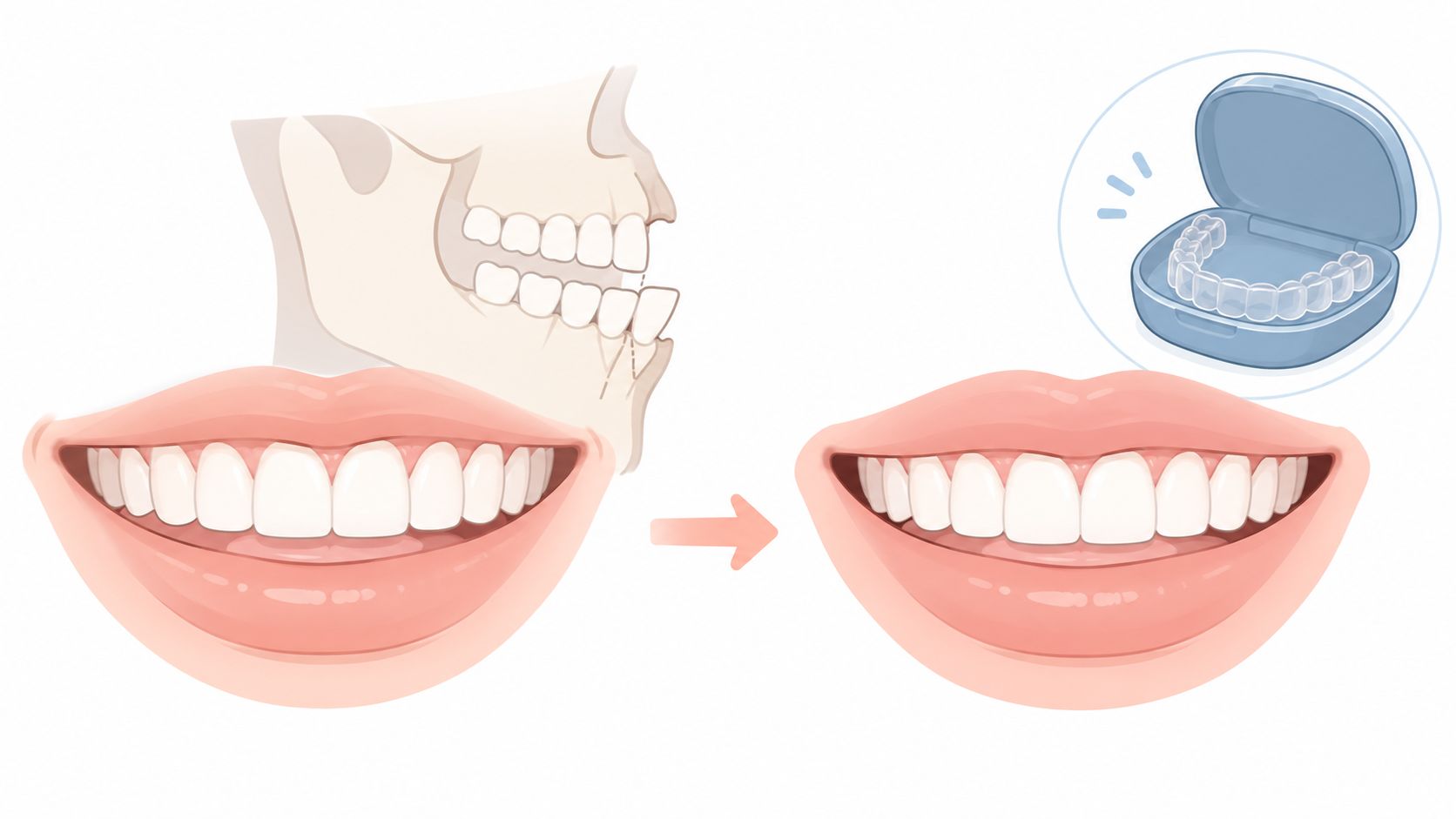
The evidence here is encouraging but modest. A retrospective report published in Frontiers in Dental Medicine followed 18 growing patients aged 8.3 to 9.9 and found anterior crossbite resolved within 12 months using clear aligners alone, with improved bite measurements and preserved periodontal tissues. The authors also named the limits plainly: a small sample, short follow-up, and a call for research on long-term stability. The same report states that successful correction required appropriate diagnosis and strong patient compliance.
What protects the result
Retention isn't optional, and it isn't a formality. Teeth shift throughout life, and growing children keep changing. A retainer plan and monitoring visits are what keep a correction from drifting back.
Practical rule: a finished case is not a closed case. Book the retention checks and wear the retainer exactly as instructed, even once the trays feel like a distant memory.
A post-treatment bite check should cover three things:
- How the upper and lower teeth meet, not just how they look from the front.
- Whether the jaw still shifts sideways on closing.
- Whether arch width has held, so the correction isn't resting on tipped crowns.
Understanding how long to wear retainers after braces gives a realistic picture of that phase, because aligner patients follow the same logic.
The fair promise is this. Aligners can be effective in selected front crossbite cases, and current data don't establish universal predictability or long-term stability. Ask any practice to be specific about which scenario applies to you.
Confirm Your Crossbite Plan at a Free Consultation
A useful consultation answers more than whether aligners might move a tooth. It clarifies what is causing the crossbite, what the treatment options are, and how the orthodontist will check that the bite is working as intended.
Stellar Orthodontics offers a free consultation with the orthodontist who would treat your case. The visit covers Invisalign, braces, timing, and financing in plain language. Some patients learn that they do not need orthodontic treatment.
The orthodontist examines how your teeth meet and uses digital 3D scanning to show your teeth on screen, along with a visual preview of the planned result. Bring past X-rays if you have them, and note any symptoms or questions about jaw movement, treatment options, or retainers.
Stellar Orthodontics offers consultations at four Delaware locations: North Wilmington, 2304 Concord Pike; Middletown, 818 Kohl Avenue; West Dover, 125-2 Greentree Drive; and Millsboro, 26670 Centerview Drive. A free visit can give you a clear explanation of your options before you decide what to do next.
Book a free consultation at Stellar Orthodontics.