
Yes, teeth can be treated again with braces, and a second course is often shorter and more targeted than the first, depending on the diagnosis. If straight teeth were meant to stay straight forever, why would retainer care continue long after the braces came off?
That question gets to the heart of orthodontic retreatment. A returning gap or crowded tooth doesn't automatically mean the original treatment failed, or that a patient must start over. For Delaware families considering another course of care, the useful question is what changed, why it changed, and whether a small intervention can address it before more movement occurs.
Table of Contents
- Yes, You Can Get Braces Again and Why Teeth Move
- Situations That Lead to a Second Course
- How Much Teeth Move Over Time in Research
- Retreatment Options From Retainers to Full Braces
- What Happens at a Retreatment Assessment
- Retainer Habits That Help Prevent Relapse
- Book a Free Consultation to Review Your Options
Yes, You Can Get Braces Again and Why Teeth Move
A person can receive orthodontic treatment again, provided an examination shows that moving the teeth is appropriate. Orthodontists call this retreatment, and the plan should reflect the mouth's current condition rather than repeat the original approach. Think of it as checking the present map before choosing the route again. Teeth may look like they are fixed in place, but the supporting bone and tissues keep adapting, and growth, aging, and bite changes can influence position over time.
A concrete example is a retainer left in its case for a month. It may still look fine, but if it no longer sits comfortably, the teeth may already be trying to shift. That early fit change is worth a check before a small drift becomes a visible gap or crowded front teeth. Retainers help maintain alignment, but they do not stop every biological change.
Why alignment can change
Several factors can contribute to movement:
- Normal aging: Teeth can gradually change position as the mouth changes over time.
- Jaw growth and bite changes: The relationship between the upper and lower teeth may develop differently after treatment.
- Gum and bone factors: Changes in supporting tissues can affect stability and treatment planning.
- Retention problems: A retainer may stop being worn, become damaged, or no longer fit correctly.
Long-term research shows why follow-up matters. A Cochrane review discussing long-term stability reported that satisfactory alignment was not maintained by many patients over the long term. That finding does not predict what will happen to one child or adult. It explains why the end of active treatment begins a longer retention process, with periodic checks when a retainer feels different or teeth start to look less even.
Important distinction: Some relapse doesn't mean a person needs full braces again. The amount of movement and its effect on the bite matter more than the label.
Small changes may be monitored, managed with targeted care, or addressed with full retreatment when the diagnosis calls for it. The useful question is whether the bite and tooth positions have changed enough to need a new plan, and what can be done before the movement goes farther.
Situations That Lead to a Second Course
A small front-tooth gap and a changed bite can both bring a patient back to an orthodontist, but they don't necessarily require the same response. The visible change is only the starting point.
For example, a parent may notice that a child's lower front teeth look slightly crowded after retainer wear stopped. If the bite remains suitable, the discussion may focus on holding the current position or correcting a limited area. An adult whose back teeth no longer meet comfortably needs a broader evaluation, even if the front teeth still look straight.
Common situations, causes and usual next steps
| Situation | Typical cause | Usual next step |
|---|---|---|
| Front teeth drift after retainers stop | Normal tooth movement and inconsistent retainer wear | Replacement retainer or limited correction after an exam |
| Bonded retainer detached or distorted | Retainer failure over time | Rebond or replace the retainer soon |
| Removable retainer lost, broken or no longer fits | Damage, loss or poor wear | New retainer with a fit check, possibly short alignment |
| Bite changes after growth or tooth loss | Jaw growth, aging or missing teeth | Full diagnostic work-up before choosing a plan |
| Gum or bone changes around teeth | Periodontal factors | Periodontal evaluation; findings determine the plan |
| Original goals not fully met | Limited first course or changed goals | Reassessment to set a new objective |
A bonded retainer deserves attention even when it still appears attached. A review of unexpected movement with bonded retainers describes how teeth can move despite a fixed retainer remaining in place, with severe cases sometimes requiring additional orthodontic care. A wire that looks present isn't necessarily functioning as intended.
A new retainer and active correction do different jobs
A retainer generally holds teeth; active treatment moves them. If the current alignment is acceptable, replacing a failed appliance may be enough. If a tooth has rotated or a gap needs closing, merely making a retainer around that position won't necessarily achieve the patient's goal.
A removable retainer that no longer seats properly also needs a fit check. Patients shouldn't force it into place, bend a wire themselves, or assume that discomfort means it's correcting the problem.
Gum changes require particular care. Bleeding, recession, or looseness should be reported because supporting-tissue health can influence whether treatment should begin and how it should proceed.
Not every retainer problem is an emergency. Still, a loose wire, newly tight appliance, or changing bite deserves an assessment rather than a guess about whether another full course is unavoidable.
How Much Teeth Move Over Time in Research
A loose retainer wire and a shifted tooth are two different events, and research measures them separately. Confusing the two is the most common reason relapse statistics look scarier than they are. A bonded retainer works like a fence rail: the rail can crack while the fence line stays straight, and the line can drift while the rail looks intact. Appliance failure describes the rail. Tooth movement describes the line. Neither one, on its own, tells you whether braces are needed again.
Timing shapes the numbers just as much. A study that follows patients for two years measures a different slice of life than one that follows them for twenty. Teeth have more opportunity to move in longer windows, so a higher figure at a longer follow-up does not mean things suddenly got worse. It often means more time passed.
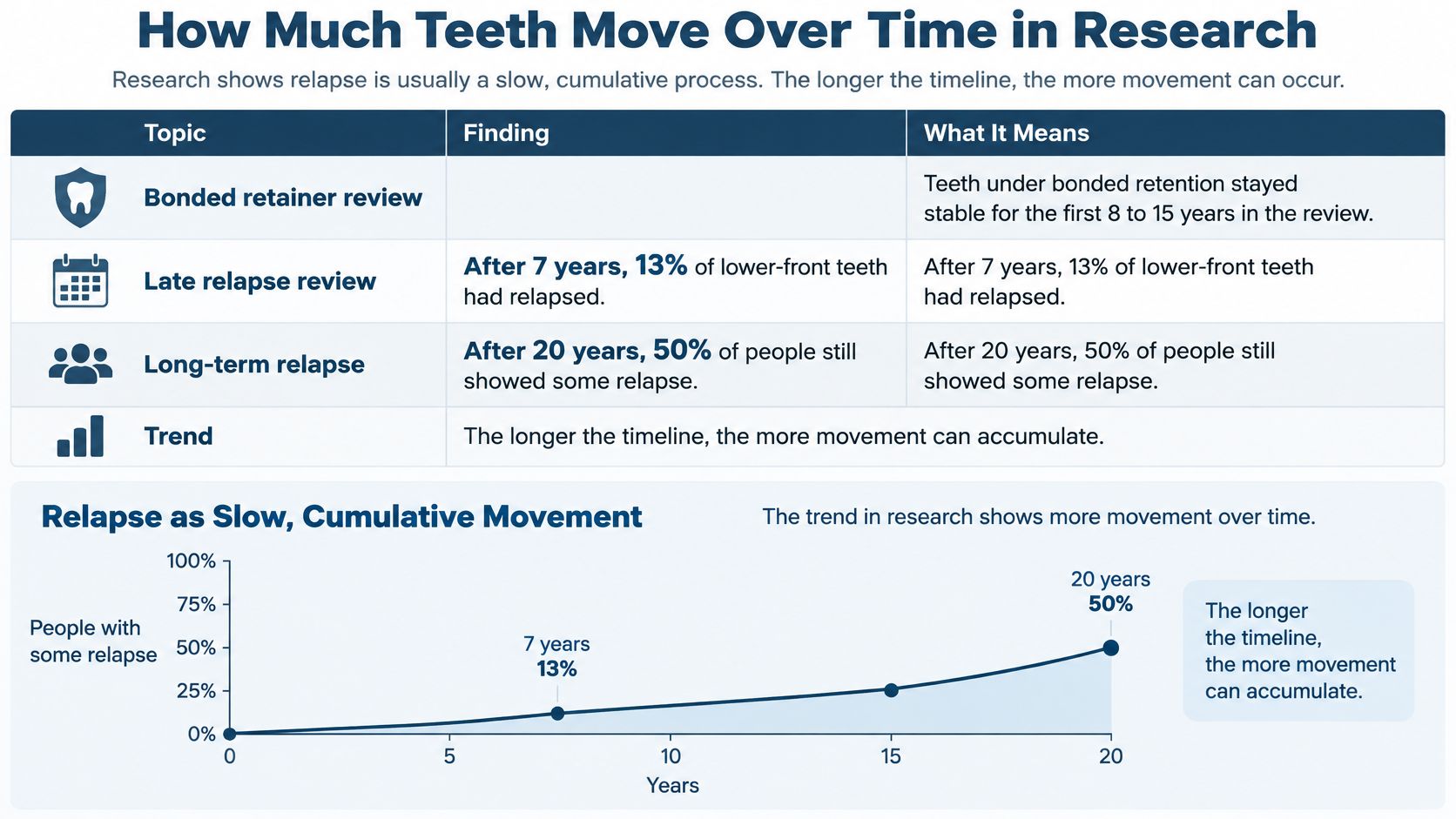
Relapse and stability figures from published studies
| Source | Follow-up | Reported figure |
|---|---|---|
| Bonded retainer systematic review | Short term | Appliance failures appear within the first years of wear |
| Bonded retainer systematic review | Medium term | Failures accumulate as time in retention increases |
| Bonded retainer systematic review | Long term | The longest follow-up shows the highest failure rate |
| 2025 prospective study of 148 patients | 24 months | 31.8% relapse, or 47 patients |
Read the first three rows as a pattern rather than as exact odds. The pattern is steady: the longer a bonded retainer is in place, the more chance it has to loosen, detach, or break. That is a statement about hardware, not about teeth. Some patients in those studies kept perfect alignment despite a failed wire, because the movement had not happened yet when the failure was found. That gap between failure and movement is exactly why early checks matter.
What these results mean for a family
The 31.8% relapse figure above describes measured tooth movement in one study population across 24 months. It does not mean 31.8% of those patients needed braces again. Some changes were small enough to watch. A measurement on a study scale can be real and still invisible when the patient smiles.
The early window carries extra weight. In a long-term study of 1,016 orthodontic patients, nearly half of the total observed relapse occurred during the first two years after retention. Think of retention like the first years after concrete is poured: the material keeps settling longest in the period right after the work ends, which is why the early review appointments exist at all. Later movement still happens, just usually at a slower pace.
Two practical conclusions follow. First, the months right after braces come off are when consistent retainer wear does the most work, because that is when teeth are most inclined to drift. Second, a change caught at six months is often a small conversation, while the same change found at six years may be a larger one.
A percentage can describe a patient group. Only an examination can show whether a particular patient needs observation, a new appliance, or active correction.
Checking a developing problem early gives the orthodontist room to decide whether a larger correction is needed, while the correction is still small.
Retreatment Options From Retainers to Full Braces
Think of retreatment as a set of steps, from smallest to broadest. The right step depends on the diagnosis, not just the tooth that looks out of place. A patient hoping to preserve acceptable alignment has different needs from someone whose bite requires correction.
A replacement retainer may address an appliance problem without moving teeth. Limited aligners or braces provide active correction in selected cases. Full treatment addresses a broader problem rather than just the most noticeable crooked tooth.
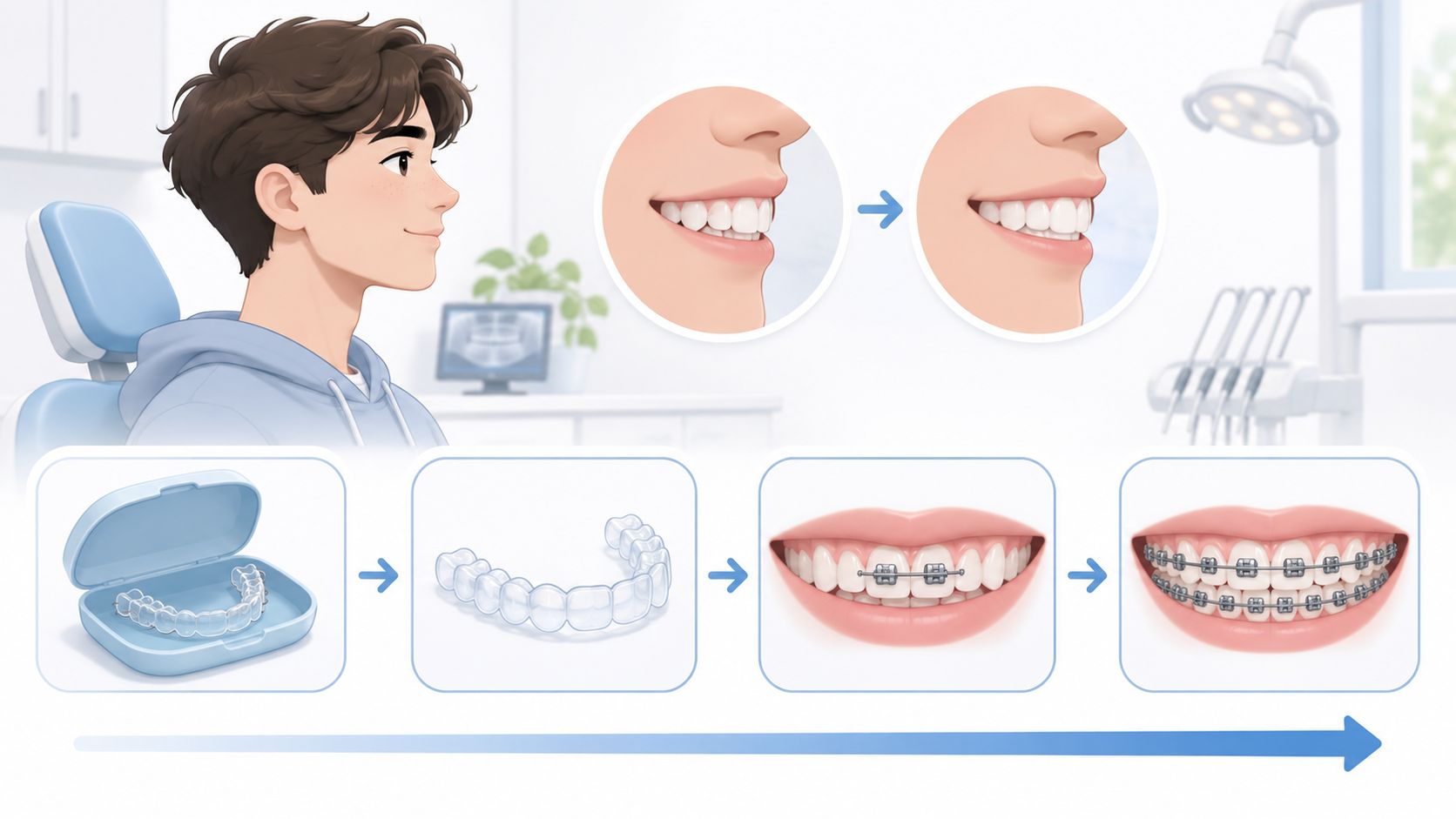
Retreatment options matched to the situation
| Option | Usually considered when | Retention afterward |
|---|---|---|
| Replacement or rebonded retainer | Retainer failed but teeth have moved little | Wear as prescribed and recheck fit |
| Limited aligner treatment | Minor shifting in a few teeth | Replacement retainer after treatment |
| Limited braces | Localized crowding or rotation | Replacement retainer after treatment |
| Full braces for broad bite problems | Broad bite problems or substantial movement | Full retention protocol with ongoing monitoring |
Limited aligner treatment may suit a small alignment change when the bite and required movements make it appropriate. Because aligners are removable, the patient's ability to follow the prescribed wear schedule belongs in the decision.
Limited braces may be considered when a localized problem benefits from fixed control. A small-looking rotation can still require careful planning, especially when nearby teeth must move to create space. Complex bite issues, severe crowding, or cases requiring detailed tooth rotation may respond better to fixed braces.
Why a smaller plan isn't always the better plan
Straightening the visible front teeth without considering how the upper and lower teeth meet can leave an important concern unresolved. Full care may be recommended when a limited approach wouldn't adequately address the bite or the patient's objectives. It works like repairing the whole door frame instead of painting over one crooked edge.
Neither aligners nor braces eliminate the need for retention. A 2024 systematic review comparing relapse after aligner and fixed-appliance treatment found average relapse after about two years. Those averages, discussed above, don't establish which option is best for a particular mouth. Retention remains lifelong, with custom retainers worn full-time at first and the schedule tapering over the first year.
Patients whose earlier treatment involved clear aligners may also find the explanation of braces after Invisalign helpful when considering a change in appliance type. At Stellar Orthodontics, clear ceramic braces and classic metal braces are both available, and the choice depends on priorities such as appearance and budget. The deciding factors include the cause and amount of movement, gum and root health, and the result the patient hopes to achieve.
What Happens at a Retreatment Assessment
A retreatment assessment isn't a check of whether teeth look crooked again. The orthodontist needs to establish what changed, whether movement is safe, and what treatment would accomplish.
Previous records can help, but missing records shouldn't prevent a family from arranging an evaluation. Current findings are essential because an old treatment plan may no longer match the patient's needs.
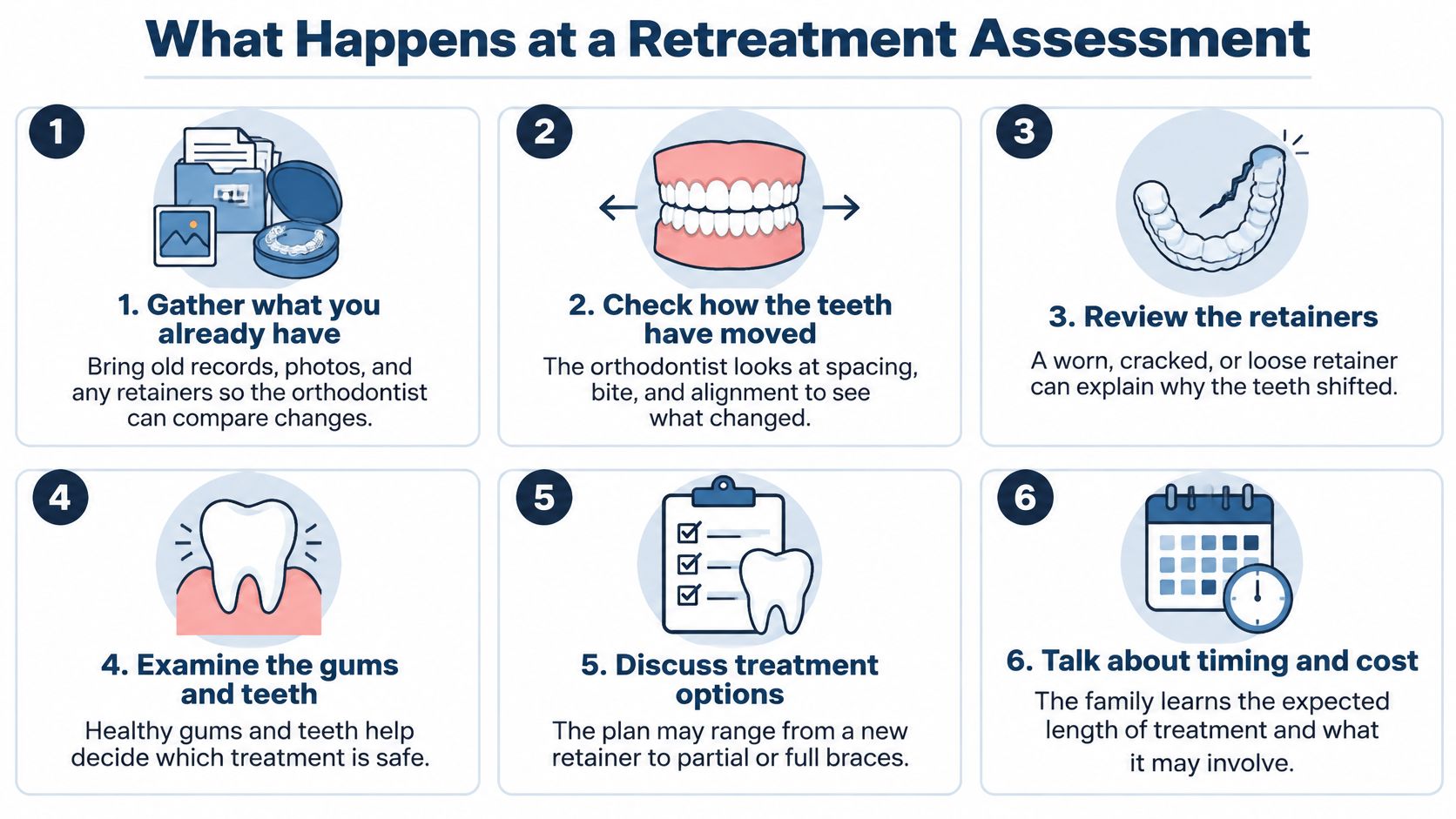
Preparing for the examination
Gather what is already available. Families can bring old treatment records, photographs, and any retainers, including broken ones. These help the orthodontist compare previous alignment with the current position and inspect possible appliance problems.
Describe when the shifting started. A note about a new gap, crowded spot, or bite change can make the history clearer. Timing helps distinguish gradual change from a problem noticed after a retainer broke or stopped fitting.
Report symptoms as well as appearance changes. Pain, clicking, gum concerns, and trouble chewing should be mentioned even if they seem unrelated to the crooked tooth. They may identify issues that need checking before orthodontic movement is considered.
Understanding the clinical checks
Record the current alignment and bite. The orthodontist uses photographs, an examination inside the mouth, and bite analysis, with radiographs when indicated. These establish the extent of the change rather than relying on memory or a single photograph.
Evaluate the teeth and their support. Gum and bone health, root condition, and other relevant dental findings help determine whether teeth can be moved safely. Treatment may need coordination with other dental care before active correction begins.
Match the findings to a clear objective. The orthodontist compares the current result with the patient's original and present goals. The plan should specify whether the aim is to preserve alignment, correct a localized change, or address a broader bite problem.
A study of adults seeking orthodontic care provides context for reassessing previously treated patients rather than assuming that earlier care settles today's treatment needs. Cosmetic alignment and functional correction can be different objectives, and patients should understand which one the proposed plan addresses.
At Stellar Orthodontics, patients see the same orthodontist at every visit. If one orthodontist is out, another can provide continuity of care.
The consultation should also clarify expected timing, costs, and follow-up responsibilities. A second course may be shorter than the first, but its length depends on today's diagnosis, not on the fact that the patient has worn braces before.
Retainer Habits That Help Prevent Relapse
Retainer wear can slip because daily life gets in the way. A child may dislike wearing an appliance at school, while a teen may forget it after a late practice or during travel. Treating those barriers as practical problems is more useful than assigning blame.
A 2025 pediatric study discussing retention adherence reported relapse in 16.3% of patients who consistently followed retention instructions, compared with 61.1% among those with poor compliance. The same source discusses daytime wear as an adherence barrier among young people, underscoring why families need a workable routine.
Maintenance includes the appliance itself
Even a carefully worn or bonded retainer needs monitoring. A systematic review and meta-analysis of 34 studies involving 3,484 participants found an overall bonded-retainer failure rate of 35.22%, with reported failure increasing from 24.18% in short-term studies to 40.09% in medium-term studies and 53.85% in long-term studies.
That isn't a reason to distrust retainers. It's a reason to treat them as appliances that may need professional maintenance, rather than permanent fixtures that can be forgotten.
A separate systematic review of fixed-retainer failure found that failures occurred most often during the first three to six months of retention. Scheduled checks are particularly useful while a family is establishing its routine.
Simple habits that make retention easier
- Keep the case accessible: A designated spot beside the bed helps with nighttime routines; the case should travel with the patient when the appliance is removed away from home.
- Use a reminder: A phone alert or an established bedtime task can help prevent forgotten wear.
- Check fit weekly: Families can notice whether the retainer seats normally, without forcing it over teeth that have changed position.
- Report a loose wire promptly: A bonded retainer needs review if it detaches, bends, or feels different.
- Avoid hot water: Heat can distort removable retainers, so cleaning should follow the office's appliance-specific directions.
At Stellar Orthodontics, custom retainers are worn full-time initially, with the wear schedule tapering over the first year. Retention is lifelong, and the practice's information about retainer care and ongoing retention explains this maintenance phase.
When fit changes: A lost, broken, painful, or poorly fitting retainer calls for contact with the office, not improvised adjustments at home.
Early review gives the orthodontist a chance to determine whether repair or replacement is enough before assuming active correction is necessary.
Book a Free Consultation to Review Your Options
The answer to “Can you get braces twice?” is yes, but the useful answer depends on the diagnosis. Think of retention as the long tail of treatment. A retainer problem, a small shift, and a changed bite can look similar from the outside, yet each calls for a different response. An assessment can sort out whether a replacement retainer, limited correction, or another course of braces fits the situation.
Before the visit, gather previous records, photographs, and retainers, including damaged ones. A brief note about when the change began, what feels different, and whether chewing or comfort has changed can make the conversation clearer.
A low-pressure starting point in Delaware
At Stellar Orthodontics, the consultation stays free whether or not the patient proceeds with treatment, whether insurance covers care, or whether a child qualifies for Medicaid braces. A free Medicaid braces evaluation is available at all four offices, and the visit can clarify the clinical findings without assuming a particular recommendation.
Families noticing shifting, a loose retainer, or a changed bite can book a free consultation rather than waiting until the concern becomes more noticeable. An examination gives the orthodontist a chance to see whether retention alone is enough or whether active correction should be discussed. Bringing current or broken retainers helps make that review more specific.