
Yes, you can kiss with braces, and modern braces don't lock together during ordinary kissing. The caveat is comfort: tender teeth or irritated lips after placement or an adjustment can make waiting the better choice.
But if braces don't prevent kissing, why might a school dance still feel poorly timed? For Delaware families considering orthodontic treatment, the useful question isn't whether kissing is possible. It's whether the mouth feels comfortable, the appliance is in good condition, and any sore spots need attention.
Table of Contents
- Yes, You Can Kiss With Braces
- When Kissing Is Comfortable and When to Wait
- How to Kiss Comfortably Step by Step
- Mouth Sores, Hygiene and When to Call Your Orthodontist
- Braces Type and Kissing Comfort
- Confirm Your Braces Plan at a Free Consultation
Yes, You Can Kiss With Braces
Kissing with braces is generally safe. Even when both people wear braces, the familiar fear of becoming permanently stuck together isn't a realistic expectation during ordinary, gentle contact.
The American Association of Orthodontists explains that modern brackets are smaller and sleeker than older designs and aren't magnetic, so they don't attract each other. The locked-braces scenario is considered extremely unlikely with contemporary appliances. That reassurance addresses how braces work, not a promise that every kind of contact will feel comfortable.

A useful comparison is a shoe rubbing against a blister. The shoe isn't dangerous because it touches the foot, but pressure against an already irritated area can hurt. Likewise, a rubbing bracket or sharp wire matters more than the idea of braces locking.
The practical ground rules
- Start gently. Closed-mouth or low-pressure contact gives both people a chance to notice discomfort without forcing the moment.
- Keep pressure off the hardware. Teeth shouldn't be pressed together hard, and contact shouldn't pull on brackets or wires.
- Stop when something catches or hurts. A painful wire or loosened component needs the orthodontic office's attention, not a home repair.
Practical rule: Comfortable affection is reasonable. Pushing through appliance-related pain isn't.
Most braces cases finish in 18 to 30 months. That treatment period doesn't mean putting normal relationships on hold. It means learning to recognize comfortable days, keeping appliances clean, and taking a pause when something needs checking.
For parents, a calm response can help a teen ask a genuine health question without embarrassment. There's no need to turn it into a warning about an unlikely accident.
When Kissing Is Comfortable and When to Wait
Braces in good condition, with no soreness or rubbing, usually allow gentle, closed-mouth contact. A recent appointment changes the comfort question because teeth and surrounding tissues may be tender even when nothing is broken.
A day-by-day soreness guide
A systematic review summarized in Stellar Orthodontics' guide to getting braces estimated average soreness onset at about 4.1 hours after placement, with discomfort often highest around 24 hours, lower by day three, and minimal by day seven; the same guide describes adult studies finding increased pain for roughly one to three days after placement or adjustment visits.
These are typical patterns, not a countdown that every patient follows. Feeling fine immediately after placement doesn't guarantee that the mouth will remain equally comfortable later that evening. Likewise, reaching the end of the usual adjustment period doesn't mean a persistent sore spot should be ignored.
For a teen preparing for a school dance, the practical approach is to leave room for recovery rather than assume an appointment and an important event will fit comfortably together. If scheduling allows, the later part of the recovery window may be easier. Families shouldn't skip an adjustment or change the treatment schedule without discussing it with the orthodontic team.
Kissing situations and what to do
| Situation | Kissing guidance | Next step |
|---|---|---|
| Braces in normal condition, no soreness | Gentle, closed-mouth contact is fine | Keep normal care |
| First 1 to 3 days after placement | Wait for tenderness to ease if possible; soreness often peaks around 24 hours | Use orthodontic wax on any rubbing spot |
| 1 to 3 days after an adjustment | Expect possible increased pain; keep contact light | Plan close contact for the later part of the window |
| Mouth ulcer or sore spot | Avoid pressure on the sore area | Wax the irritating component; call if the sore persists |
| Poking wire or loose bracket | Stop kissing until it is checked | Call the orthodontist promptly; don't cut or bend it at home |
| Cold sore or contagious illness | Avoid kissing | Wait until fully healed; for illness, wait until no longer contagious |
| Bleeding or swollen gums | Avoid close contact | Call the office if bleeding or swelling continues |
A sore spot needs a different response from general tooth tenderness. Wax cushions the component that rubs, while avoiding pressure gives the irritated tissue a break. Wax doesn't fix a displaced wire or secure a loose bracket.
A cold sore is also different from an ulcer caused by friction. When the cause of a mouth lesion isn't clear, postponing kissing and asking for clinical advice is more sensible than assuming every sore comes from braces.
Suppose a teen has an adjustment shortly before a dance. If eating and talking are comfortable and there's no sharp spot, gentle contact may be reasonable. If a wire hurts during an ordinary smile, the next step is an appliance check, not trying to tolerate extra pressure.
An event date doesn't determine whether the mouth is ready. The patient's comfort and the appliance's condition do.
Persistent or unusually severe pain deserves a conversation with the treating orthodontist, even when it occurs during an otherwise expected recovery period.
How to Kiss Comfortably Step by Step
A comfortable approach starts before close contact. Columbia University's Go Ask Alice guidance emphasizes gentle kissing, attention to irritated tissues, and stopping when sharp pain or an appliance problem develops.
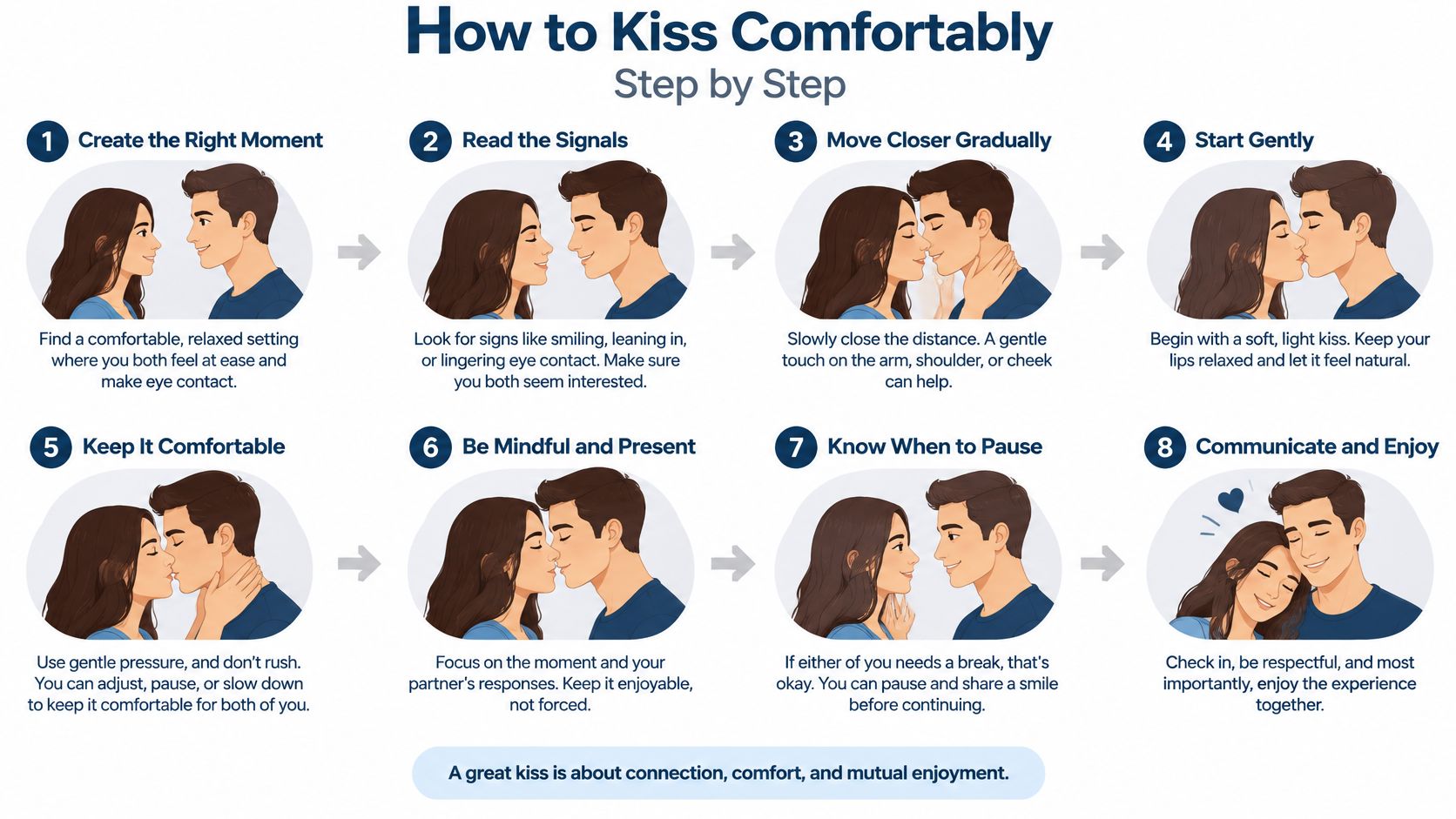
A gentle routine
Check for rubbing before starting. A mirror can help identify a bracket or wire pressing into the lip or cheek. A small piece of orthodontic wax over an intact, rubbing component creates a temporary cushion; a visibly displaced or loose part needs professional advice.
Choose a comfortable moment. When there's a choice, waiting until initial tenderness eases removes an avoidable source of discomfort. Being able to talk, smile, and move the lips comfortably is more useful than feeling obliged to meet a particular deadline.
Begin with light, closed-mouth contact. This limits contact between delicate mouth tissues and the appliance. Slow movement also makes it easier for either person to notice discomfort and pause.
Avoid force against teeth and hardware. Pressing teeth together or pulling against brackets and wires adds unnecessary pressure. Neither person should try to push past a catch or snag.
Keep lips relaxed and manage dryness. Lip balm may help dry lips feel more comfortable, but it doesn't shield the inside of the mouth from a rubbing bracket. Appliance protection and lip care serve different purposes.
Stop at sharp pain. A poking wire, caught bracket, or bleeding is a reason to pause rather than change position repeatedly and keep trying. An orthodontic evaluation is appropriate when the appliance appears damaged or the discomfort doesn't settle.
The routine applies whether one person or both people wear braces. Neither person needs to make contact more intense to prove that the braces aren't a problem.
Comfort also includes willingness. A simple explanation that the mouth feels tender is enough reason to wait, and either person can stop at any point.
The useful distinction is between mild awareness of the appliance and a clear warning sensation. Brackets may feel unfamiliar, but sharp pain isn't something to practice through. When something feels wrong, checking the appliance is safer than attempting to bend, cut, or reposition it without professional instructions.
Mouth Sores, Hygiene and When to Call Your Orthodontist
Mouth sores during braces treatment aren't unusual. A 2024 clinical review of orthodontic mucosal ulcers reports that approximately 51%–63% of orthodontic patients develop mucosal ulcers during treatment, with brackets and wires recognized as sources of lip and cheek irritation.
That figure describes ulcers during treatment generally, not injuries caused by kissing. It helps explain why a patient can have intact braces yet still find pressure against the lips uncomfortable.
Daily cleaning supports comfort
Fixed appliances add places where plaque and food can collect. A 2024 review of orthodontic treatment and oral microorganisms describes increases in decay-associated and periodontal bacteria during treatment, reinforcing the importance of careful daily cleaning.
Useful habits include:
- Brush with fluoride toothpaste. Clean above and below the brackets rather than brushing only the visible biting surfaces.
- Clean between teeth. Floss with an appropriate threading aid or use an interdental brush suited to the available spaces.
- Remove trapped food. Check around wires and brackets after eating, especially before close contact.
The NHS braces guidance recommends brushing in the morning, at night, and after meals, alongside daily cleaning between teeth and around brackets. Stellar Orthodontics' guide to brushing with braces offers a practical reference for building that routine.
Brushing beforehand can clear food debris, but it doesn't make a cold sore or contagious illness safe for kissing. Hygiene supports healthy teeth and gums; it isn't a substitute for waiting when an infectious lesion is present.
Symptoms that need a call
A small friction-related sore should become more comfortable once the rubbing is addressed. Persistent or recurring symptoms need review, particularly:
- An ulcer that doesn't settle, or repeatedly returns in the same place.
- Recurring bleeding or swelling, rather than a brief, isolated irritation.
- A sharp or displaced wire, or a bracket that has loosened.
A broken component isn't a home repair project. The orthodontic office can explain whether an appointment is needed and what temporary protection is appropriate.
Good mouth care should support ordinary relationships, not make patients feel that braces require social isolation.
Braces Type and Kissing Comfort
The most useful distinction is fixed versus removable appliances. Metal and ceramic braces stay attached to the teeth, while clear aligner trays can be removed according to the treatment instructions.
Appearance alone doesn't predict contact comfort. A less noticeable bracket can still rub an irritated lip, and a removable appliance still requires consistent cleaning and wear.
Appliance type and kissing considerations
| Option | Hardware in the mouth | Contact precautions | Notes |
|---|---|---|---|
| Traditional metal braces | Metal brackets bonded to teeth, connected by wires | Use wax on rubbing spots; keep contact gentle | Most direct application of the fixed-appliance precautions |
| Clear ceramic braces | Tooth-colored brackets bonded to teeth, connected by wires | Same precautions as metal braces | Lower-profile look; bracket-wire contact still applies |
| Clear aligners (Invisalign) | Removable trays; no bonded brackets | Bracket-wire contact is generally eliminated | Remove for cleaning as the clinician instructs |
Ceramic braces offer a lower-profile look, not an exemption from checking sore spots. The tooth-colored brackets remain fixed appliances, so the same attention to lip pressure and wire condition applies.
Clear aligners remove the particular issue of bracket-wire contact. That doesn't mean a patient should change the prescribed wear schedule for a date or special event. Any removal should remain consistent with the treating clinician's instructions.
Choosing for the whole treatment
The best appliance choice considers the bite, the tooth movements needed, daily habits, and the patient's priorities. Kissing comfort can be part of that conversation, but it shouldn't be the deciding factor on its own.
For example, a patient concerned about visible hardware may prefer a discreet appearance, while a patient with a demanding bite correction may need a different treatment approach. The orthodontist determines which options fit the clinical case.
Families comparing categories can use Stellar Orthodontics' overview of braces types for adults to prepare questions. For either fixed option, the practical standard remains a comfortable mouth and an intact appliance, rather than the bracket's color.
Confirm Your Braces Plan at a Free Consultation
A question about kissing is a reasonable orthodontic question. Parents and teens don't need technical vocabulary or a long explanation to ask about soreness, a rubbing bracket, or timing before an important event.
A short list makes the conversation more useful:
- Describe the spot. Note whether discomfort comes from a tooth, the inside of the lip, the cheek, or a particular component.
- Bring the event date. A school dance or other occasion gives the team context for discussing expected tenderness.
- Ask about the next appointment. Understanding what's planned can help families prepare without changing treatment on their own.
Stellar Orthodontics has Delaware locations in North Wilmington, Middletown, Dover/West Dover, and Millsboro, so families can choose the most convenient office. The team can assess a specific sore spot, determine whether a loose component needs attention, and explain expectations around an adjustment.
Stellar Orthodontics provides braces and Invisalign across Delaware. The consultation is free regardless of whether the patient proceeds with treatment, whether insurance covers any of it, or whether a child qualifies for Medicaid braces.
For families considering treatment, a free consultation at Stellar Orthodontics is a straightforward opportunity to discuss both the treatment plan and everyday comfort. Current patients with a sharp wire or loose bracket should contact the office promptly rather than wait for a consultation.
Stellar Orthodontics offers braces and Invisalign for Delaware patients, with guidance on everyday concerns such as soreness, appliance care, and comfortable close contact. Families can visit Stellar Orthodontics to book a free consultation and discuss a treatment plan that accounts for both dental needs and daily life.