
Ceramic brackets can sometimes go on bottom teeth, and the bite is what decides whether they should. Lower placement carries a few extra risks: the upper teeth close down on the lower arch like a lid, and a bracket sitting in that path can chip or come loose. If tooth-colored brackets look like a good fit on the upper teeth, why wouldn't the same choice automatically work below?
The answer depends on where the teeth meet. For Delaware families considering orthodontic treatment, the lower teeth need their own assessment because upper teeth can strike brackets attached below. A less noticeable appliance is only a useful choice when its position, maintenance needs, and removal plan suit the patient.
Table of Contents
- Can Ceramic Braces Go on Bottom Teeth
- Why Bite Contact Changes the Picture
- What the Lower-Arch Studies Show
- Removing Ceramic Brackets from Lower Teeth
- Mixing Materials and Questions to Ask Your Orthodontist
- Confirm Your Lower-Teeth Plan at a Free Consultation
Can Ceramic Braces Go on Bottom Teeth
Ceramic braces on bottom teeth work only when the brackets clear opposing teeth. The orthodontist checks that clearance first; how the bracket blends with the tooth color comes later.
The upper and lower teeth meet every time a person bites and chews. Lower brackets add material to the front surfaces of the lower teeth, so they can sit directly in the path of the upper teeth. That makes lower placement a separate decision, even when ceramic brackets suit the upper arch.
Where ceramic brackets on lower teeth tend to fit
| Bite or case situation | Ceramic on lower teeth | Usually a better fit |
|---|---|---|
| Mild crowding, no deep bite | A reasonable choice once the bite check confirms clearance | Ceramic or metal, decided by the bite |
| Deep bite or strong contact between upper and lower front teeth | Generally a poor fit without changes to the bite | Metal lower brackets or a bite-opening appliance |
| Complex bite, severe crowding, or detailed tooth rotation | Harder to justify on lower teeth | Traditional fixed metal braces |
| Heavy biting or grinding habits | Extra review of enamel contact needed | Metal lower brackets if the bite calls for it |
| Appearance is the main concern, upper teeth only | Ceramic on upper teeth may suit | Mixed approach with ceramic on top and metal on bottom |
The orthodontist makes the diagnosis; this table frames the questions. Crowding alone doesn't show whether ceramic will work below, and a complicated tooth position doesn't automatically rule it out. What matters is where each bracket will sit once the planned movement is finished.
Why a deep bite needs special attention
A deep bite means the upper front teeth overlap the lower front teeth substantially. Depending on the tooth positions, their edges can land near the lower brackets instead of clearing them.
A 2025 laboratory study of ceramic-bracket hardness found an average of 2,267 Vickers hardness units, at least six times the reported hardness of enamel, and recommended avoiding mandibular ceramic brackets or using bite elevation such as turbo-bites. The study didn't measure long-term clinical outcomes or fully account for individual bite forces and bracket positioning.
That distinction matters. Laboratory hardness identifies a reason for caution; it does not prove that every patient with lower ceramic braces will develop damage. Deep bites, crossbites, and strong front-tooth contact call for an individual plan.
For a parent weighing the options, the useful checkpoints are the overall bite, the amount of overlap, and the clearance planned around each lower bracket. Once those three are answered, the tooth-colored appearance can factor into the choice.
Why Bite Contact Changes the Picture
A hard tile sliding against a stone step offers a useful comparison. When hard surfaces rub together, the softer surface can lose material. When an upper tooth rubs against a ceramic bracket below, enamel is the softer surface.
Say a teenager closes comfortably but moves the jaw sideways while chewing. An upper tooth might clear the lower bracket during straight closure, then brush against it during that sideways movement. Checking only how the teeth meet in a still photograph could miss that contact.
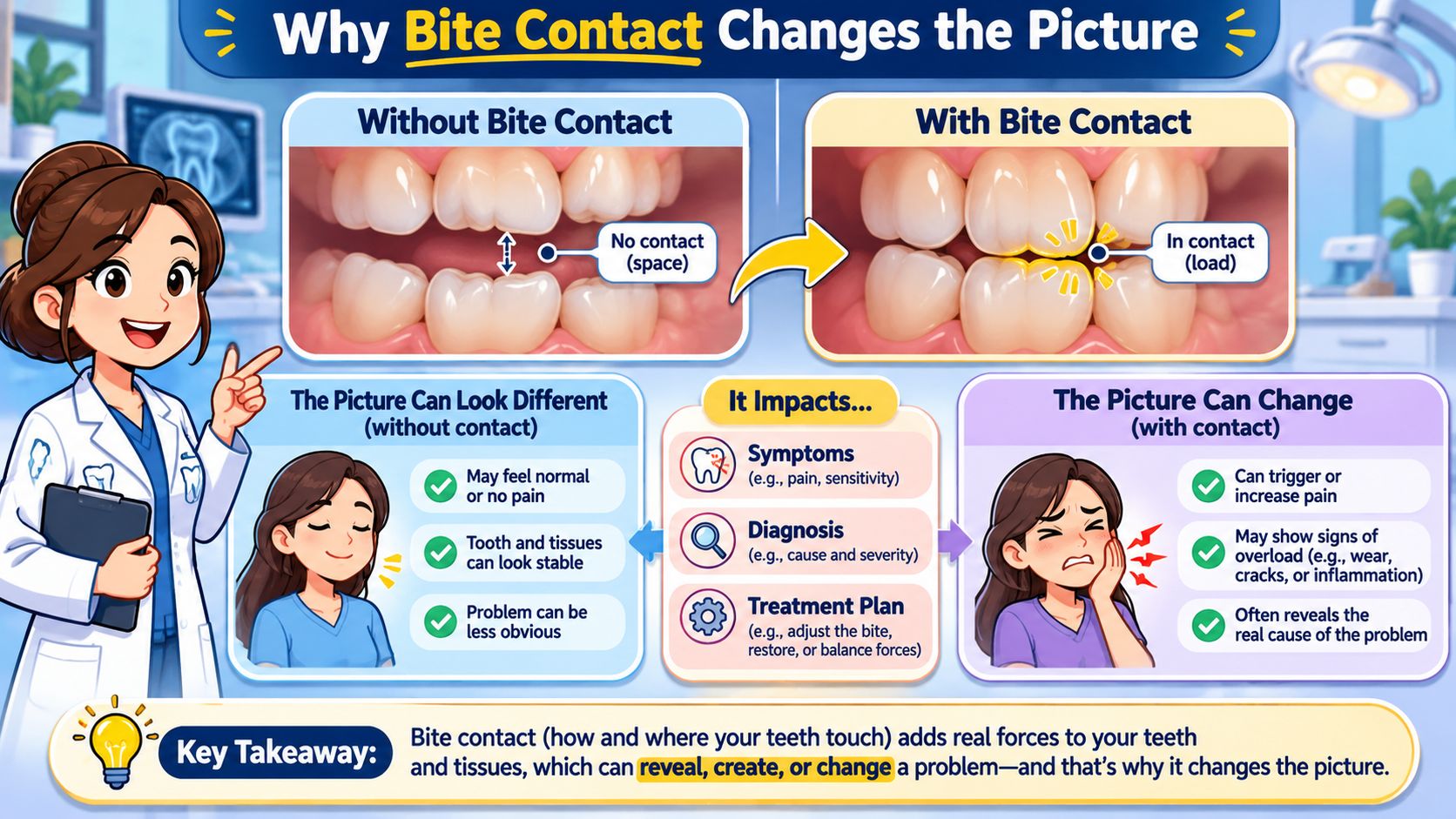
An artificial-mouth study comparing enamel abrasion used approximately 2 lb of chewing force at one cycle per second and found significantly greater abrasion against ceramic than stainless-steel brackets. This simulated contact doesn't predict the exact wear an individual patient will experience.
The mechanism is straightforward: an opposing tooth makes direct contact, the surfaces slide, and repeated rubbing can remove enamel. Ceramic's hardness makes that contact more concerning than comparable contact against metal. The issue isn't having ceramic in the mouth. It's where the ceramic touches during function.
What the orthodontist checks
The assessment needs to include more than the appearance of straight teeth:
- Overbite: How far the upper front teeth overlap the lower teeth, and where their edges land.
- Grinding habits: Whether clenching or side-to-side grinding may repeatedly bring enamel against brackets.
- Front and side contacts: Whether upper incisors or premolars strike the proposed lower brackets during closure or movement.
Families can find additional context in the explanation of how braces fix an overbite. Bite correction and bracket selection are related decisions, but they aren't interchangeable. A plan to correct an overbite still needs to protect the teeth while treatment is underway.
At home, parents should contact the orthodontic team promptly about new bite interference, sharp bracket edges, or chewing discomfort. A child saying that a tooth suddenly lands on a bracket is giving useful information, not merely reporting routine tightness.
The team can assess whether a bite adjustment, protection from contact, or a different bracket material is appropriate. Patients shouldn't file a bracket, bend the appliance, or try to alter the bite themselves.
What the Lower-Arch Studies Show
The lower arch deserves a separate look because it works in a tighter space. Lower front teeth are narrow, crowded, and constantly near the upper teeth during chewing and speaking. Bracket color affects how braces look, but bite contact and tooth position decide whether a ceramic bracket is a sensible choice on bottom teeth.
A prospective clinical trial comparing metal and ceramic brackets followed 80 patients for 12 months, with 40 patients in each group. Across 800 metal brackets and 800 ceramic brackets, researchers recorded 73 metal-bracket failures and 127 ceramic-bracket failures. The study reported a P value below 0.0001, meaning the difference in failure rates was statistically significant.
Location mattered in that trial. The failure figures covered all brackets evaluated, not lower teeth alone. Even so, location analysis found significantly more ceramic failures in the mandibular arch, with failures concentrated toward the back teeth. That detail is useful for parents because lower back teeth take part in heavy chewing forces.
A laboratory and review report on bracket mechanics measured static friction at 267.5 ± 54.2 gf for metal versus 428.7 ± 87.3 gf for ceramic, about 60% higher for ceramic. The same evidence reported enamel fractures in 13.3% of debonded ceramic samples in a cited comparison. These are separate measurements, each answering a different question.
Lower-arch bracket results: metal versus ceramic
| Measure | Metal brackets | Ceramic brackets |
|---|---|---|
| Bracket failures across 800 bonded brackets, 12-month trial | 73 failures | 127 failures |
| Static friction in bracket-wire bench tests, gf | 267.5 ± 54.2 | 428.7 ± 87.3 |
| Enamel fractures when debonded, laboratory review | Not reported in the cited comparison | 13.3% of debonded samples |
A bracket failure is a treatment-maintenance event. Static friction describes how the wire moves against the bracket, which can matter during sliding mechanics. An enamel fracture during debonding relates to removal, not to how well the braces guided the teeth during treatment. Combining those outcomes into one prediction would blur the differences.
The prospective clinical trial comparing metal and ceramic brackets also reported that most bracket failures happened within the first month, while round wires were being used. That timing gives families a practical rule: a loose lower bracket early in treatment should be reported promptly instead of left for the next adjustment.
Higher bench-test friction can lead an orthodontist to adjust force selection, archwire sequencing, or bracket design. It does not show that one child's treatment will take longer. A laboratory result is a controlled measurement, while treatment depends on the bite, diet, bonding technique, bracket design, and patient habits.
The balanced reading is that ceramic offers an appearance benefit, usually with a lower-profile look than metal brackets. The lower arch still needs a careful check because tooth position and contact patterns can raise maintenance concerns, especially when upper teeth or back-tooth function puts repeated pressure near ceramic brackets.
That makes the decision more specific than choosing the less noticeable option. For some patients, the aesthetic benefit outweighs the added maintenance attention. For others, metal brackets are the simpler choice. Ceramic and traditional metal braces are equally effective overall, so the decision rests on the patient's priorities for appearance and budget, with the lower-arch bite checklist guiding where each bracket can be placed.
Removing Ceramic Brackets from Lower Teeth
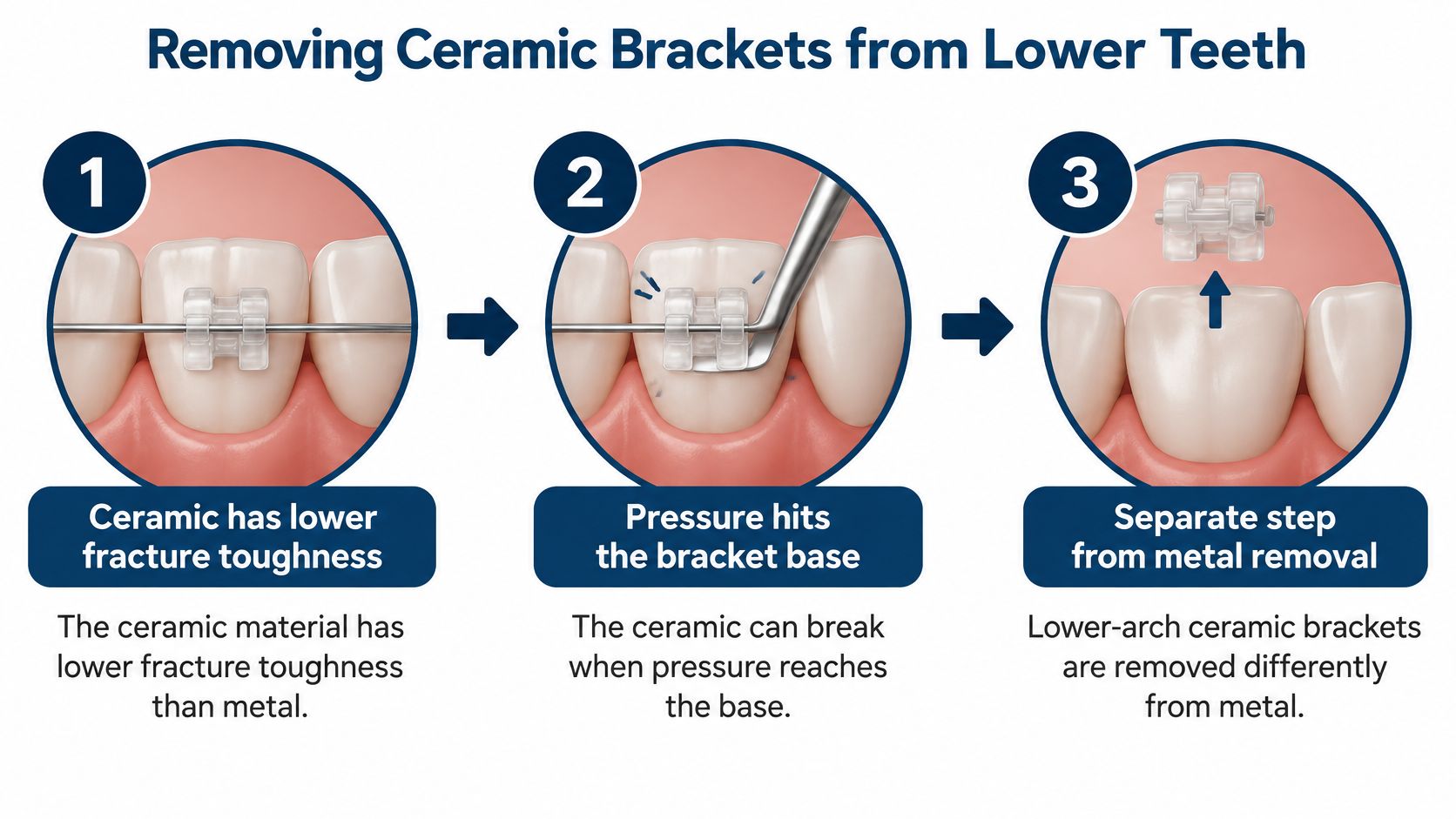
Ceramic-bracket removal deserves its own plan. Ceramic has lower fracture toughness than stainless steel, meaning it's more vulnerable to breaking when removal forces reach the bracket base. Hardness and resistance to fracture aren't the same property: a material can resist scratching yet still break under concentrated pressure.
A 2020 survey of orthodontists in the United States found that mechanical debonding was the most common approach and that 86.5% of respondents used instruments specifically designed for ceramic brackets. Bracket design, instrument choice, and force direction therefore matter during the removal visit.
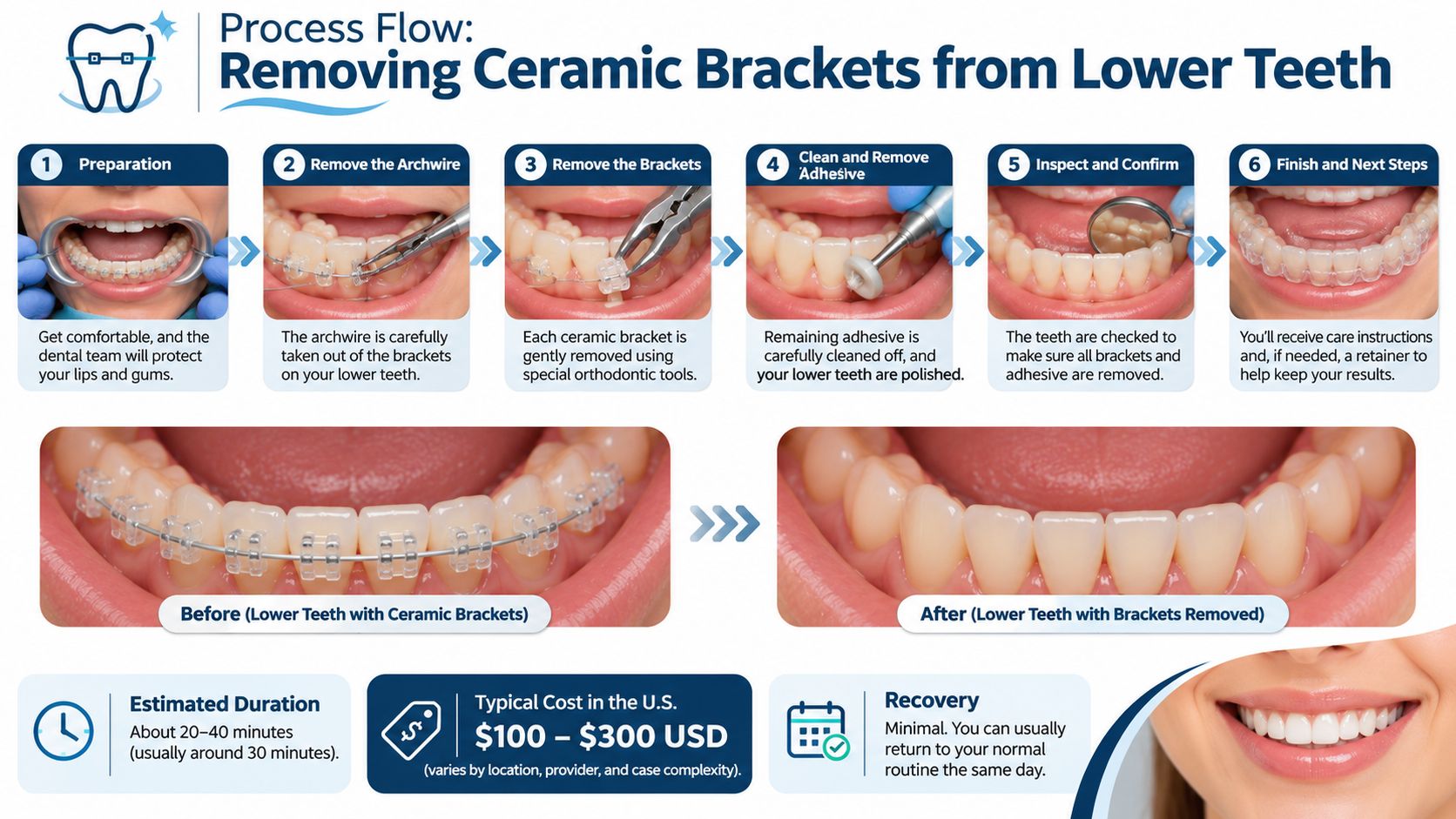
The professional removal sequence
The treating team adapts the technique to the bracket manufacturer's design and the condition of the tooth. A typical sequence follows this order:
- Check the enamel first. The clinician assesses visible enamel condition, existing chips, restorations, and any concerns recorded before treatment.
- Confirm the bracket type and bond. The removal technique must suit the actual ceramic system rather than treating every bracket alike.
- Use a ceramic-specific instrument. The clinician controls the force at the bracket base in the direction appropriate for that design.
- Remove remaining adhesive carefully, distinguishing bonding material from the tooth surface.
- Polish and recheck the tooth. The team examines the cleaned surface and confirms that no bracket fragments remain.
At Stellar Orthodontics, braces are removed in a single appointment, and the covered services include the removal visit and a final cleaning. That appointment still involves several technical tasks, rather than lifting every bracket off in the same way.
What enamel findings mean
A systematic review of 14 studies on enamel microcracks associated bracket removal generally with average increases of 3.50 microcracks where counted, 3.09 mm in crack length, and 0.39 micrometers in width. Evidence was stronger for an increase in crack number than for changes in width, and these aren't guaranteed outcomes for an individual patient.
A review describing a laboratory comparison of 75 extracted premolars identified ceramic-sample fractures particularly when debonding strength exceeded 40 MPa. Extracted-tooth findings explain why controlled bonding and removal matter, but they don't establish a child's personal risk.
Removal planning belongs in the initial appliance discussion, not only at the final visit.
Mechanical and laser-assisted removal
A 2025 systematic review of laser-assisted ceramic debonding described 16 studies in which shear-bond strength fell from approximately 13–23 MPa to 7–12 MPa, and 25 studies assessing adhesive remnants in which laser groups commonly scored 2–3, with failure mainly at the bracket–adhesive interface. Carbon-dioxide and erbium:YAG lasers were the most frequently studied systems.
Ceramic bracket removal methods compared
| Removal approach | What the evidence shows | Enamel and bracket notes |
|---|---|---|
| Mechanical debonding with ceramic-specific instruments | Most common surveyed method; specialized instruments were widely used | Ceramic fracture and enamel microcracks warrant controlled technique; the laboratory fracture finding isn't a personal forecast |
| Laser-assisted removal | Studied reductions in the force needed to separate the bond | Adhesive-remnant assessments commonly placed failure at the bracket–adhesive interface |
| Availability in local offices | Laser removal isn't established as routine in every office | The treating team should explain its method and why it suits the bracket |
Laser assistance isn't shown to be necessary for every patient. Families should request an explanation of the planned method at Stellar Orthodontics without assuming that a particular technology is offered or required.
Mixing Materials and Questions to Ask Your Orthodontist
Mixed-material braces follow a straightforward idea: place the less noticeable material where it shows, and the more forgiving material where the bite hits hardest. For many patients, that means ceramic brackets across the upper arch and metal below.
A review available through the National Library of Medicine describes less enamel abrasion with stainless-steel brackets and advises keeping mandibular ceramic brackets out of occlusion, with bite planes as a preventive option for deep bites. A mixed arrangement applies that principle while preserving a lower-profile look where it matters most to the patient.
Whether lower brackets show at all depends on the individual mouth. Some smiles reveal only the upper teeth, while speech or a lower lip position exposes the bottom brackets clearly. Cost belongs in the same calculation. Medicaid coverage includes repairs to broken brackets on traditional metal braces, while a ceramic upgrade is paid privately, so a fractured lower ceramic bracket can mean an extra privately paid repair visit. For a family weighing an upgrade that may stay hidden, the practical question is whether the aesthetic gain justifies the added repair and removal considerations.
For a teenager whose upper teeth dominate the smile, ceramic above and metal below can be a sensible balance. Another patient may display the lower teeth prominently and find the ceramic discussion there worth having. The broader ceramic braces pros and cons can help frame those preferences before the visit.
Questions worth bringing to the visit
- Contact: Will the upper teeth strike the proposed lower brackets during chewing or sideways movement?
- Appearance: Would metal lower brackets noticeably change this patient's smile?
- Repairs: What repair needs are expected for the proposed appliance?
- Removal: How will the team remove these ceramic brackets?
- Deep-bite management: Is a bite-opening appliance appropriate?
During Stellar Orthodontics' treatment-plan step, patients see their teeth in 3D on a screen alongside a visual preview of their final smile. That gives families a concrete way to compare bracket options on the actual tooth positions, while recognizing that a preview isn't a guarantee of an exact outcome.
Confirm Your Lower-Teeth Plan at a Free Consultation
Lower ceramic braces may be an option, but the decision starts with the bite. A bracket has to sit in a tiny space where the upper teeth, lower teeth, tongue, lips, and chewing path all meet. That is why an exam can answer questions a smile photo cannot.
The orthodontist should explain how the proposed brackets fit the patient's tooth positions, bite contact, and treatment goals. Clear ceramic braces use tooth-colored brackets and have a lower-profile look than traditional metal brackets. Stellar offers both clear ceramic braces and classic metal braces, so the discussion can include appearance, function, and budget together.
Clear ceramic braces and traditional braces are equally effective. The choice depends on what the patient prioritizes, such as a less noticeable look or a lower-cost option, along with what the bite needs. For complex bite issues, severe crowding, or cases requiring detailed tooth rotation, fixed braces may respond better. That makes the lower arch worth reviewing on its own instead of treating it as a smaller version of the upper arch.
Bring one checklist to the visit
Use this list to keep the conversation focused on the patient's actual teeth and daily routine:
- Contact: Will the upper teeth strike the proposed lower brackets?
- Appearance: Would lower metal brackets be visible when this patient smiles or talks?
- Bite pattern: How do overbite, deep bite, or side-to-side movement affect bracket choice?
- Grinding or clenching: Mention known habits, even if they don't cause pain.
- Enamel history: Identify chipped teeth, existing restorations, or previous concerns about the tooth surfaces.
- Chewing discomfort: Explain where it happens and whether the bite feels uneven.
- Cleaning: Can the patient clean around each bracket consistently?
- Repairs: What repair needs are expected for the proposed appliance?
- Removal: How will the team remove these ceramic brackets?
- Deep-bite management: Is a bite-opening appliance appropriate?
- Coverage: Is this a ceramic upgrade paid privately, or is traditional metal braces coverage being considered?
During Stellar Orthodontics' treatment-plan step, patients see their teeth in 3D on a screen and a visual preview of their final smile. That helps the family discuss tooth positions, bracket placement, and the reason one material may be recommended over another.
Keep coverage separate from suitability
Delaware Medicaid generally doesn't cover clear ceramic braces, which are an upgrade paid privately. Traditional fixed metal braces may be covered when pre-authorization is approved, including diagnostic records, scheduled adjustment visits, repairs during treatment, removal, and initial retainers. Ceramic upgrades are private pay, so families should separate the clinical fit from the payment method before treatment begins.
Stellar Orthodontics' consultation is free regardless of whether the patient proceeds with treatment, whether insurance covers any of it, or whether a child qualifies for Medicaid braces. Appointments are available in North Wilmington, Middletown, Dover/West Dover, and Millsboro. Most braces cases finish in 18 to 30 months, and braces placement is a 60 to 90 minute appointment in which brackets are bonded to the front of each tooth and the first archwire is placed. There are no injections, no drilling, and no pain during placement.
Bring the checklist, any photos the patient wants to discuss, and a note of what has been noticed while eating, speaking, or sleeping. Then use your free consultation to review the lower-teeth plan with the orthodontist and confirm which bracket arrangement fits the bite, the smile, and the family's payment preferences.