
If ceramic braces are chosen for their tooth-colored appearance, why can the small rings around them start looking yellow? The answer often lies in a distinction families haven't been shown: the bracket and the ligature are different parts made from different materials.
Understanding ceramic braces ligatures helps Delaware parents and patients separate an appearance concern from a repair problem. It also makes clear which habits belong at home and which decisions belong with the orthodontic team.
Table of Contents
- Elastic and Wire Ligatures Side by Side
- Why Ceramic Brackets Hold Up While Ligatures Change
- How Fast Ligatures Discolor Between Visits
- When and How Often Rings Are Changed
- Foods, Habits and Daily Care
- Ligature Problems and How to Handle Them
- Book a Free Consultation to Plan Your Ligature Choice
Elastic and Wire Ligatures Side by Side
A ligature holds the archwire inside a bracket, much like a hair tie keeps a ponytail in place. The archwire is the metal wire running through the brackets that helps guide tooth movement. An elastic ligature wraps around each bracket to keep that wire engaged.
Because a ceramic bracket blends with tooth color, the ring around it can become the more noticeable part. Clear rings aim for a natural appearance, while colored rings deliberately add contrast. A stainless steel tie is another option, but it isn't an elastic ring.
Ligature types compared for ceramic braces
| Ligature type | Appearance | Staining behavior | Typical use |
|---|---|---|---|
| Clear elastomeric ligature | Nearly invisible when new | Can yellow or darken within weeks | Chosen for a natural look on ceramic braces |
| Colored elastomeric ligature | Visible color chosen by the patient | Can change color; darker shades may make staining less obvious | Chosen when color is preferred over transparency |
| Stainless steel wire tie | Metallic, not transparent | Doesn't absorb dietary pigments like an elastic ring, but can collect surface deposits | Used in some cases; the orthodontist decides |
The table separates appearance preference from treatment function. A patient may prefer a certain elastic color, but the orthodontist chooses the ligature type needed to hold the wire appropriately.
Clear and colored elastics aren't necessarily interchangeable with wire ties for every movement. Nor does a darker ring stop aging because discoloration is harder to see.
Practical distinction: Color can be a patient preference. Wire engagement is a clinical decision.
Identifying the tie on existing braces
A small elastic loop around the bracket usually places that bracket in one of the elastic categories. A thin metallic tie with a tucked end belongs in the wire-tie category. Some appliances may use different arrangements in different areas.
The safest way to identify an unfamiliar tie is to have the orthodontic team point it out during a visit. Patients shouldn't tug on it to find out whether it stretches.
Knowing the type matters because advice about yellowing primarily concerns elastomeric ligatures. A metallic tie that feels rough raises a different question from a clear ring that has gradually lost transparency.
Why Ceramic Brackets Hold Up While Ligatures Change
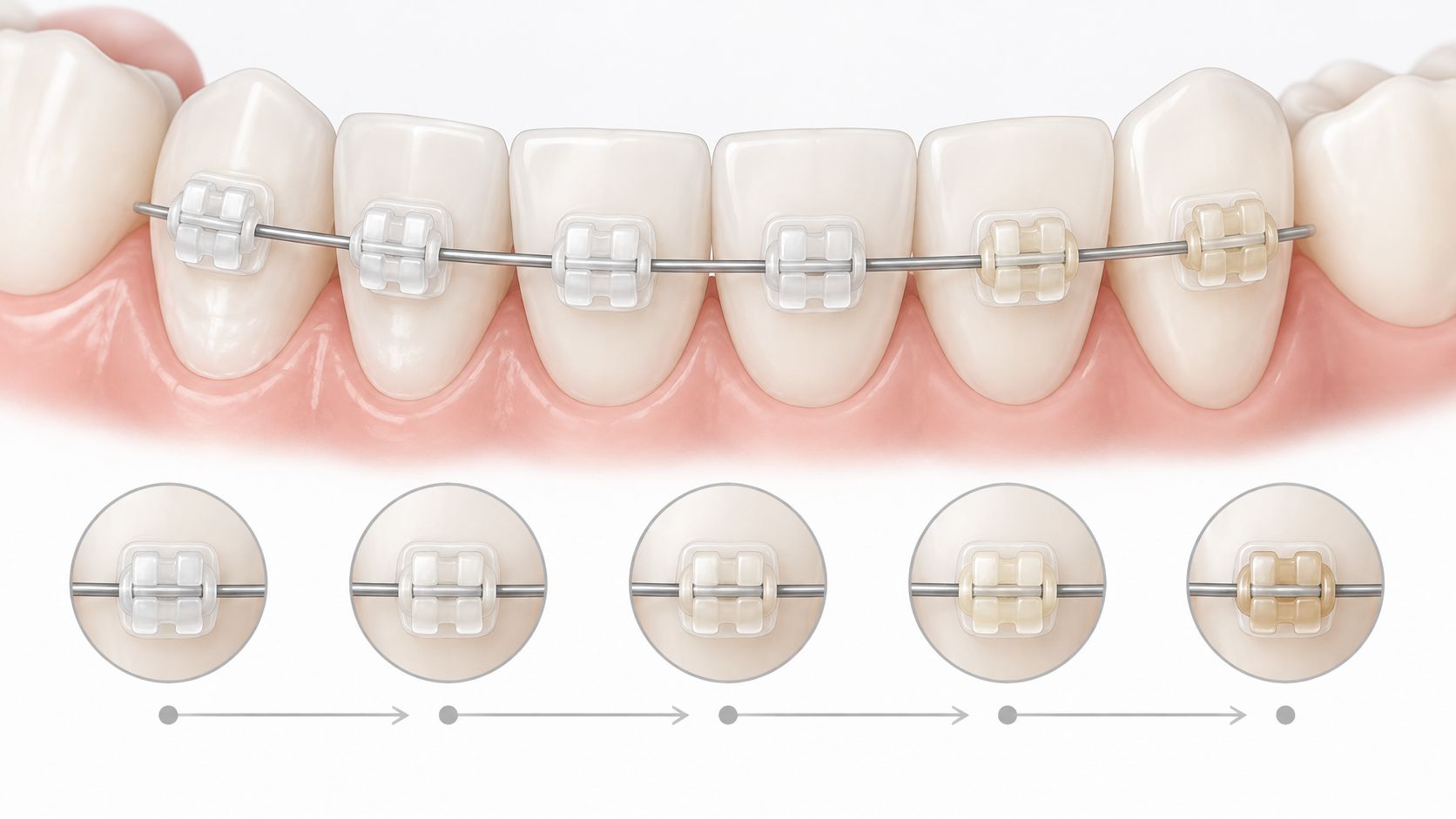
Ceramic brackets and the small elastic rings around them are two different materials sitting side by side. The bracket is a dense ceramic made to blend with tooth color, while the ring is a soft elastomer that holds the archwire in place. Because the materials differ, the same cup of tea treats them differently.
A glazed ceramic mug and the cloth napkin beside it behave the same way. Coffee wipes off the glaze but soaks into the fabric. On braces, the bracket plays the role of the glaze and the elastic ring plays the role of the cloth.
The illustration shows the small rings that sit around each bracket.
What the laboratory comparison found
A 2016 laboratory study described in a review of ceramic brackets and ligature discoloration tested four initial ligature colors: pearl, pearl blue, pearl white, and colorless. The samples spent 72 hours immersed in five solutions, including distilled water, coffee, tea, and Coca-Cola. Every tested ligature color changed in appearance, while the ceramic brackets showed comparatively little color change.
A 72-hour soak is a harsher test than sipping a drink at lunch. The experiment demonstrates the material difference between elastic and ceramic. It gives no timetable for one child's rings, and it says nothing about the effect of a single glass of juice.
A yellow ring tells you about the elastic, not the bracket.
What families should take from the distinction
Clear braces are several surfaces rather than one. The ceramic bracket, the elastic ring, and the bonding material can each respond differently to the same meal, so a change in one area does not mean the whole appliance has discolored.
Material, diet, and time in the mouth shape what families see. Food choices and brushing are the parts a patient controls at home; the bracket itself asks little of them. Families weighing that daily reality against the lower-profile look can read Stellar Orthodontics' page on ceramic braces pros and cons before deciding.
How Fast Ligatures Discolor Between Visits
How quickly does a clear ring start to look off? Light staining or a dull tone can appear well before the next adjustment, even without heavy exposure to dark foods. What families will not find is a single day when every ring turns visibly yellow, and the research below shows why the timing varies.
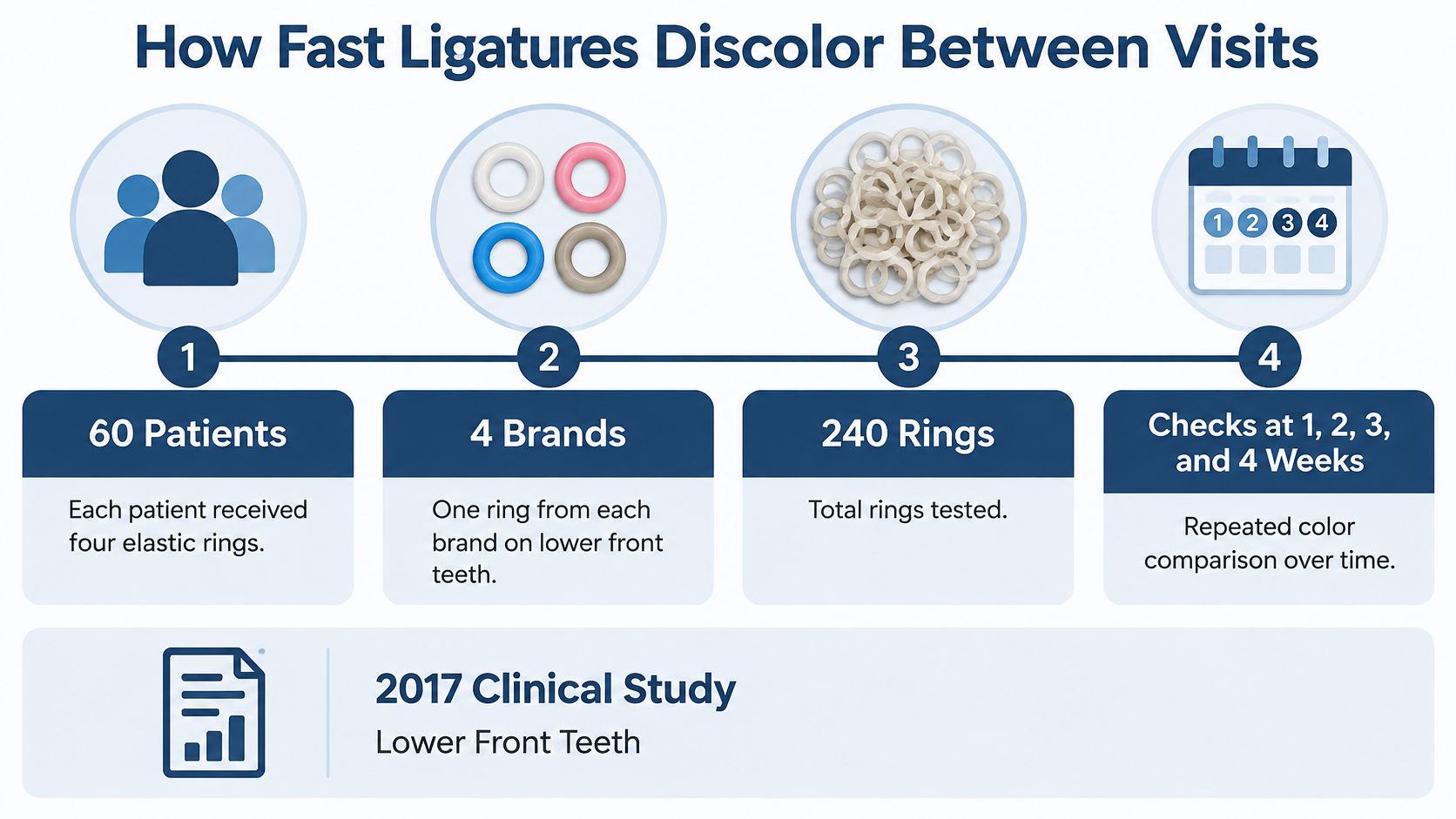
In a 2017 clinical study, 60 patients each received rings from four brands on the lower front teeth, producing 240 examined modules, assessed after 1, 2, and 4 weeks, according to the clinical report on esthetic ligature color stability. Every brand discolored during use, yellowness was the component most affected, and the strongest change occurred at the final assessment.
The diagram illustrates the study's patient-and-ring comparison.
What studies observed as ligatures stay in the mouth
| Time in mouth | What studies observed | What it means for you |
|---|---|---|
| 1 week | Early discoloration was observed in the clinical comparison; every tested brand changed during use | Early change can start; mention noticeable discoloration |
| 2 weeks | White rings reached their greatest observed discoloration around this point in the 2017 clinical comparison | White rings may look substantially changed relatively early |
| 4 weeks | The clinical comparison recorded its strongest color change at this assessment | Visible yellowing may occur before a monthly visit |
| 28 days | A separate clinical study found considerable discoloration across all evaluated brands | Appearance concerns are reasonable to raise with the orthodontist |
The final row reflects a 2025 clinical study that reported considerable discoloration across evaluated brands after 28 days in a BMC Oral Health article on ligature changes during oral exposure. Each comparison measured a different setup, so the timelines differ by study.
Reading the timeline without treating it as a deadline
Brand performance differed substantially in the 2017 comparison, and individual patients also showed considerable differences. Even the most stable esthetic groups across that month of wear showed measurable color change by the final assessment. Some variation is normal.
A parent therefore shouldn't compare a child's rings with another patient's rings and assume the darker set reflects worse cleaning. Material formulation, starting shade, stretching, diet, and oral conditions all affect how a ring looks on any given day.
It also helps to keep the two parts of the appliance separate in your mind. The ceramic bracket is the fixed component, bonded once and expected to hold its shade. The elastic ring is the replaceable component, the part that absorbs daily exposure to food and drink and the part the orthodontist resets at each visit. Families influence the ring's appearance at home; the office controls when it gets swapped.
For families planning around a monthly visit, less transparency before the appointment is a realistic possibility. If the change bothers the patient, the next visit is a good opportunity to discuss whether fresh rings or a different available shade would fit the treatment plan.
When and How Often Rings Are Changed
Rings come off and go on during regular adjustment visits, and the orthodontist sets that timing rather than following a color-change deadline. What drives the decision is wire engagement, planned tooth movements, plaque buildup, and where the patient sits in the appointment schedule.
At each visit the clinician works through a short check. Is the archwire still seated fully in each bracket slot? Does every ring still grip, or has one stretched, cracked, or loosened enough to let the wire lift? A ring that looks slightly dull but still seats the wire snugly can stay until the scheduled visit. A fresh-looking ring that has lost its elasticity may need replacing sooner.
Color change tells the family something about appearance. The fit check tells the orthodontist something about function, and function is what sets the schedule. Stellar Orthodontics' guide to how often braces need to be tightened explains what else happens at these visits and why keeping the assigned schedule matters more than matching appointments to ring color.
Questions for the next appointment
- Replacement timing: When are the current rings expected to be changed?
- Planned materials: Which ligature type and color are planned for the next stage?
- Appearance concerns: What should the patient do if a ring looks dull before that visit?
A parent can note whether the change appeared gradually, followed a particular meal, or came with looseness or discomfort. That description helps the team separate an appearance concern from something that needs an earlier check.
Foods, Habits and Daily Care
A ceramic bracket keeps its tooth-colored shade from the day it is bonded until the day it comes off. The clear elastic ring stretched around it is the part that meets coffee, curry, and sports drinks at every meal, so daily habits shape how the ligature looks between visits far more than anything that happens to the bracket itself.
Certain foods and drinks carry enough pigment to tint clear rings:
- Coffee and black tea
- Red wine, for adult patients
- Cola
- Curry and tomato-based sauces
- Berries and richly colored juices
- Colored sports drinks
A clinical article examining esthetic ligature discoloration describes particularly strong pigmentation from black tea, wine, and coffee, and reports that white modules showed peak discoloration around two weeks in one in-mouth study. Those three drinks stood out above the rest, which is why they deserve the most attention in a family's routine.
The practical response is simple: limit coffee and cola to meals, and rinse with water afterward. Sipping a dark drink across an afternoon bathes the front rings in pigment for hours, while the same drink finished with lunch gives it far less contact time. Families don't need to turn every meal into a test of whether treatment is going well.
A practical cleaning routine
- Brush morning and evening. A soft toothbrush angled toward the gumline helps clean the tooth surfaces above and below brackets. Gentle, deliberate brushing is preferable to scrubbing harder at a discolored ring.
- Floss beneath the archwire. A floss threader helps pass floss under the wire so the patient can clean between teeth.
- Use a straw when practical. For suitable cool dark beverages, a straw may limit contact with the front brackets.
- Rinse with water after colored foods. This is a useful habit when brushing isn't immediately practical.
- Avoid sticky and very hard foods. Caramel-like foods can tug at the appliance, while biting hard items can damage components. Cutting suitable foods into manageable pieces is safer than biting directly into them.
- Keep scheduled adjustments. Home care supports treatment but doesn't replace professional checks.
Stellar Orthodontics' foods to avoid with braces list offers additional guidance for meal and snack planning.
What brushing can and cannot do
Brushing removes food and plaque from accessible surfaces. That is where its reach ends, because yellowing that has settled into the elastic material itself sits beyond the bristles. Scrubbing harder won't lift that deeper stain, and household cleaners or bleaching attempts can damage the ring, so the toothbrush stays on the teeth rather than working overtime on the ligature.
Some of the change inside a ring has nothing to do with food at all. Heat and moisture can reduce elastic force and leave permanent deformation, as documented in a study of elastomeric ligature properties. Rings also absorb moisture and can accumulate calcium- and phosphorus-containing deposits during ordinary time in the mouth.
An eight-week laboratory investigation of elastic ligatures found that force declined fastest during the first 24 hours, yet the modules still held the wire under the tested early-treatment conditions.
Home-care priority: Clean the teeth and appliance carefully, rather than trying to scrub an aged ring back to its original shade.
Say a teenager in Middletown notices a dull ring the week before an adjustment. If the ring is intact and nothing feels loose or uncomfortable, careful cleaning continues as usual and the change is worth mentioning at the scheduled visit, where the rings get replaced anyway.
Ligature Problems and How to Handle Them
Gradual color change is mainly an appearance concern. A ring that slips, breaks, or disappears deserves a different response because the wire may no longer be held as intended.
Parents don't need to diagnose the appliance at home. They need to describe what changed, identify discomfort, and contact the office when a component seems loose or is poking.
Ligature symptoms, likely causes and what to do
| Symptom | Likely cause | What to do |
|---|---|---|
| Ring looks yellow or dull | Pigmented food or drink, and natural aging of the material | Brush and floss well, limit strong pigments, and mention it at the next visit |
| Ring is loose, slipping or missing | Ring stretched, broken or pulled during eating | Call the office; don't reposition or replace the ring |
| Rough, crusty deposit on the ring | Plaque or mineral buildup on the ring | Brush gently around brackets and ask whether professional cleaning is needed |
| Sore spot on the cheek or lip | Bracket edge or ring rubbing the soft tissue | Place orthodontic wax over the rubbing area and call the office |
| Wire poking or bracket feels loose | A displaced or damaged wire, or a loose bracket | Contact the office promptly for assessment and repair |
These are possible explanations, not diagnoses. A rough spot may be difficult to identify without an examination, especially when the patient can't clearly see the back of the mouth.
What helps while awaiting advice
For a rubbing area, orthodontic wax can provide a temporary barrier. The patient can gently dry the accessible area and press a small piece of wax over the irritating edge, without pulling on the ring or wire.
A phone call should describe whether the problem involves pain, a missing ring, a moving bracket, or a wire extending into the cheek. If practical, a clear photograph can help the team understand the location, although it doesn't replace an examination.
A ring that appears intact may still need attention during an adjustment. In a laboratory comparison of ceramic-bracket ligation methods, conventional elastic ligatures produced more friction than lower-friction designs across nearly all tested combinations. That finding supports professional selection of the tie, not home experimentation with how tightly it sits.
The no-home-fix rule
Patients should never remove, replace, or reposition a ligature themselves. Tweezers, toothpicks, and improvised elastic rings aren't substitutes for orthodontic instruments and an assessment of wire position.
A cosmetic concern can be discussed calmly. Anything loose, broken, or poking should prompt a call to Stellar Orthodontics for guidance about the next step.
Book a Free Consultation to Plan Your Ligature Choice
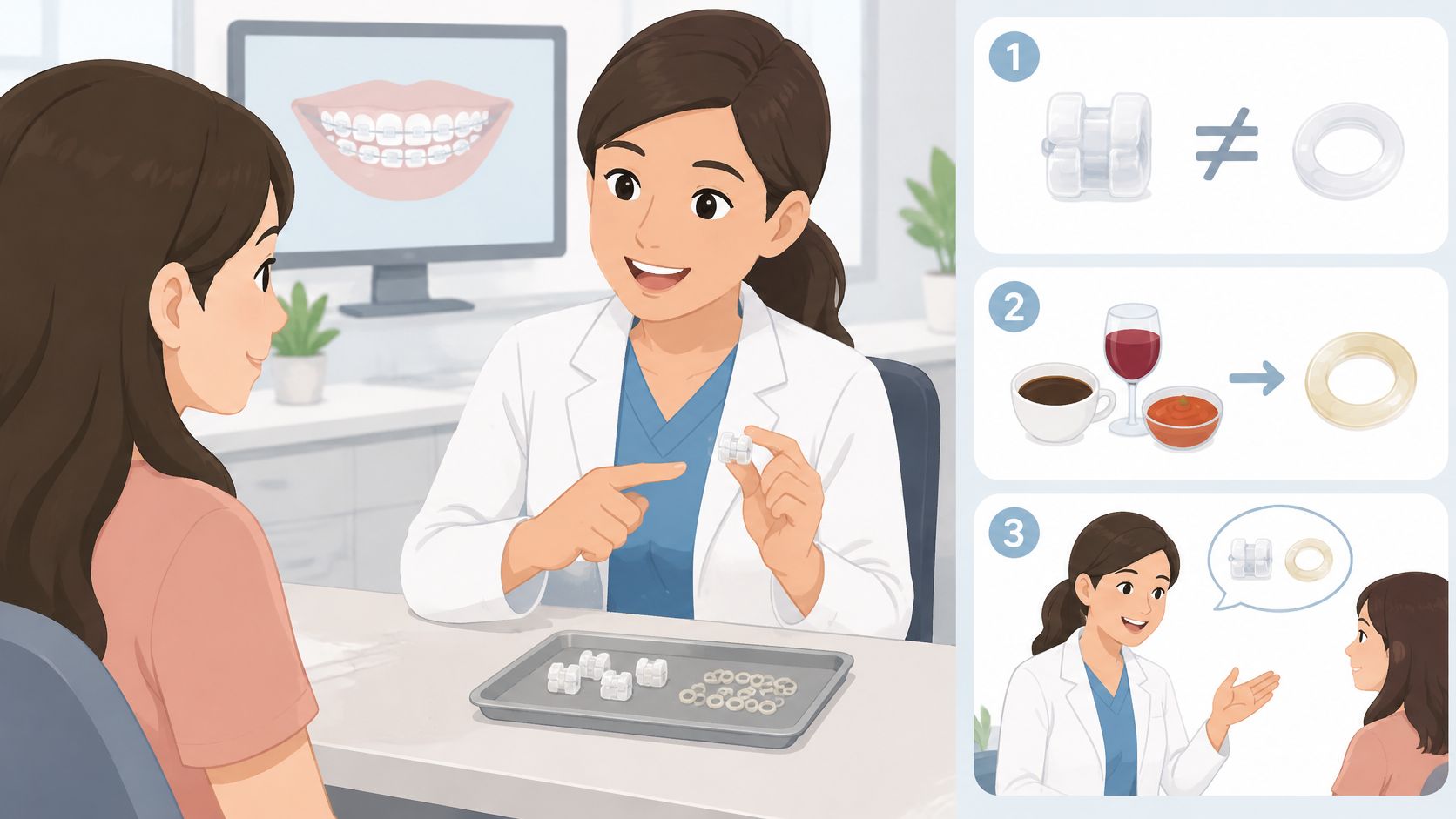
A useful consultation connects the desired appearance with the actual movements the orthodontist plans. Families can discuss school routines, coffee habits, cleaning challenges, and how much visible color change would bother the patient.
The illustration shows the kind of bracket-and-ring explanation that can make the options easier to understand.
Questions worth bringing
- Treatment fit: Which ligature type supports the planned movements?
- Checks and replacement: How will the team assess the rings during appointments?
- Color choices: Which available shades fit the patient's preferences and daily habits?
- Between-visit concerns: What should happen if a ring becomes dull, uncomfortable, or loose?
Clear ceramic braces and traditional braces are equally effective; the choice depends on the patient's priorities for aesthetics and budget. At Stellar Orthodontics, the consultation is free regardless of whether the patient proceeds with treatment, whether insurance covers any of it, or whether a child qualifies for Medicaid braces.
The accompanying video offers another way to become familiar with orthodontic care before an appointment.
Families can bring these questions to a consultation in North Wilmington, Middletown, Dover/West Dover, or Millsboro. A specific conversation about ligatures helps set expectations without requiring a commitment to treatment.
Stellar Orthodontics offers free consultations to help Delaware families understand ceramic braces, ligature choices, and care between adjustments. Visit Stellar Orthodontics to book at North Wilmington, Middletown, Dover/West Dover, or Millsboro and discuss an approach that fits the patient's treatment needs and daily life.