.png)
Yes, ceramic braces almost always use small rubber bands called ligatures to hold the wire in each bracket, and laboratory testing found 29% to 63% of an elastic's force can fade during the first day. Those little rings are routinely replaced at adjustment visits, even when they still look perfectly fine.
A teen may come home from an appointment with fresh clear rings around every tooth, while a parent wonders whether the bands are there for color, comfort, or something more important. Then coffee, tea, or a favorite dark sauce can make one ring look yellow, and a second question appears: if the bands are working, why does progress sometimes seem slow?
The answers are less alarming than many families expect. Ceramic-brace rubber bands are small, replaceable parts of a larger system. Staining usually affects the elastic tie, not the ceramic bracket, and slow progress often calls for a careful look at wear habits, placement, and appointment timing rather than an assumption that the braces have failed.
Table of Contents
- Why Parents Notice Rubber Bands on Ceramic Braces
- What Rubber Bands Actually Do on Ceramic Braces
- Two Kinds of Elastics and When Each Is Used
- Why Bands Are Replaced at Every Adjustment Visit
- Staining and What It Means for a Clear Look
- When Progress Seems Slow Despite Wearing the Bands
- Setting Expectations and Your Next Step in Delaware
Why Parents Notice Rubber Bands on Ceramic Braces
A teen arrives home after a braces adjustment and smiles at the kitchen table. The brackets look nearly invisible, but each one has a tiny clear or colored ring wrapped around it. The parent sees new hardware and naturally asks, “What does that little band do?”
The small ring is called an elastomeric ligature, or a ligature. It holds the archwire inside the bracket attached to the front of the tooth. Depending on the orthodontist's chosen system, ceramic braces may use clear, tooth-colored, or colored ligatures, and the rings are generally changed during adjustment visits.
The color can make the bands seem decorative, especially when a teen chooses a brighter shade. Their purpose, however, is mechanical. The ring helps keep the wire seated in the bracket so the wire and brackets can guide the teeth according to the treatment plan.
The questions families ask first
Parents commonly notice the rings for one of three reasons:
- A fresh appearance: New clear ligatures can blend with the tooth-colored brackets.
- A color change: A clear ring may become yellow or darker after exposure to pigmented foods and drinks.
- A change in the mouth: A broken or stretched ring may feel different, move, or irritate the cheek.
None of those observations tells the whole story by itself. A band can look intact while its material has changed inside the warm, moist mouth. A band can also look discolored while the ceramic bracket beneath it remains suitable for treatment.
Practical rule: A stained ligature usually represents a replaceable appearance issue, not permanent staining of the ceramic bracket.
Families in North Wilmington, Middletown, Dover and West Dover, and Millsboro can bring questions about ceramic braces rubber bands to a free consultation at Stellar Orthodontics. The discussion can cover the difference between ligatures and larger bite elastics, what happens when a ring breaks, and which appearance options fit the orthodontist's plan. The explanations ahead keep the language simple, because a parent shouldn't need a dental dictionary to understand a child's braces.
What Rubber Bands Actually Do on Ceramic Braces
A useful way to picture braces is as a small railroad system.
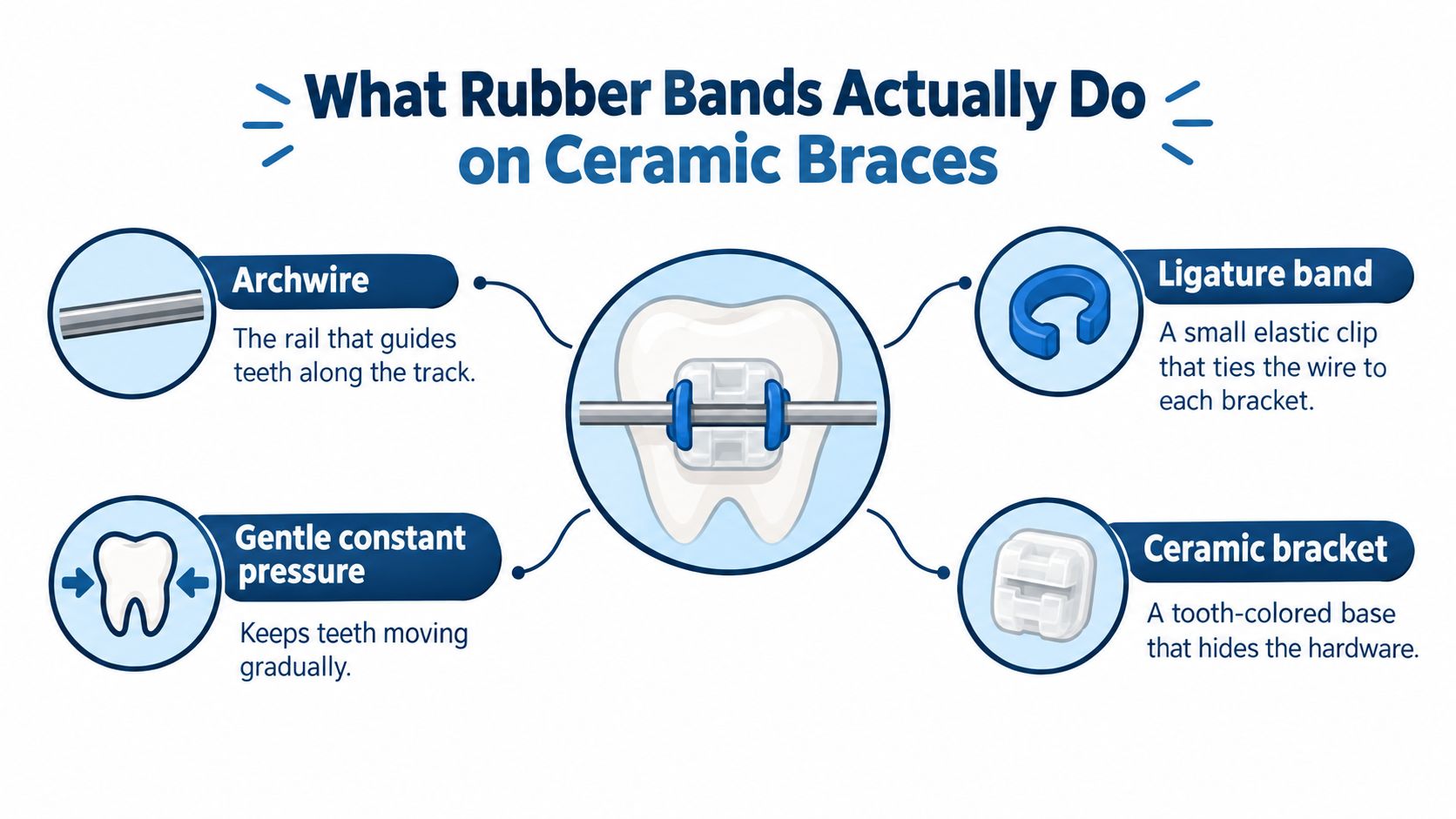
The archwire is the rail. It runs through the brackets and provides the guiding shape for tooth movement. Each ceramic bracket is the track base bonded to a tooth. The ligature is the clip that keeps the rail snugly inside that base.
Each part has a different job
The bracket stays attached to the tooth. The wire passes through the bracket's slot and supplies the guiding force selected by the orthodontist. The ligature wraps over the wire and holds it in position, much like a clip stopping a rail from lifting out of a track.
That means the ring isn't there to make braces look colorful. Its contact with the wire and bracket can influence how easily the wire slides. A 2013 laboratory study conducted 480 friction tests on monocrystalline ceramic brackets and found that conventional elastomeric ligatures generally produced significantly more friction than nonconventional ligatures, including tests using 0.012-inch and 0.014-inch nickel-titanium wires and different simulated tooth movements in the laboratory research on ceramic-bracket ligation.
The result doesn't mean that a particular color or brand guarantees faster treatment. Laboratory conditions are controlled, while a real mouth includes saliva, chewing forces, tooth position, wire size, bracket design, and aging of the ligature.
Why the distinction matters
A parent considering treatment for an overbite may see the small rings and assume they are the same as the larger rubber bands that connect upper and lower teeth. They're not. The small ligature secures the wire to an individual bracket, while a larger interarch elastic may provide additional bite guidance when prescribed.
The wire, bracket, and ligature work as one arrangement. Families interested in how that arrangement relates to bite correction can also read how braces help fix an overbite. The important point is straightforward: the little ring may be subtle, but it can affect the resistance the orthodontic system encounters while guiding teeth.
Two Kinds of Elastics and When Each Is Used
“Rubber bands on braces” can describe two very different items. Confusing them can make a treatment instruction sound more complicated than it is.
The first type is the ligature. It is the small ring placed around an individual bracket, often on nearly every bracket in a traditional ceramic-brace setup. Its basic job is to keep the archwire seated in the bracket slot.
The second type is the interarch elastic. It is larger and stretches between hooks on the upper and lower teeth. The orthodontist may prescribe it to help guide the bite, but not every patient needs one. The pattern can vary according to the bite and the stage of treatment.
A simple comparison
| Elastic type | Where it sits | Main purpose |
|---|---|---|
| Ligature | Around one bracket | Holds the archwire in the bracket |
| Interarch elastic | Between upper and lower hooks | Adds bite guidance when prescribed |
The two components also behave differently in daily life. Ligatures are placed and replaced by the orthodontic team during appointments. Interarch elastics may be removable and may require a specific pattern, replacement routine, and wear schedule.
That schedule can't be chosen from a general online rule. The orthodontist may ask for a particular arrangement during waking hours, sleep, meals, school, or other activities, depending on the treatment stage. A family should follow the exact pattern provided for that patient rather than copying a sibling's configuration.
Why an orthodontist may choose another ligation method
The way the wire is held affects friction. A peer-reviewed review reported that, in tested ceramic brackets, conventional ligation produced frictional forces 5.82 times higher than self-ligating ceramic systems in its review of bracket friction.
That comparison doesn't make one system automatically right for every patient. It explains why the orthodontist may select a conventional ligature, a different ligature design, or another bracket approach for a particular movement. Appearance is one consideration, but the treatment plan also has to account for how the wire and bracket interact.
Why Bands Are Replaced at Every Adjustment Visit
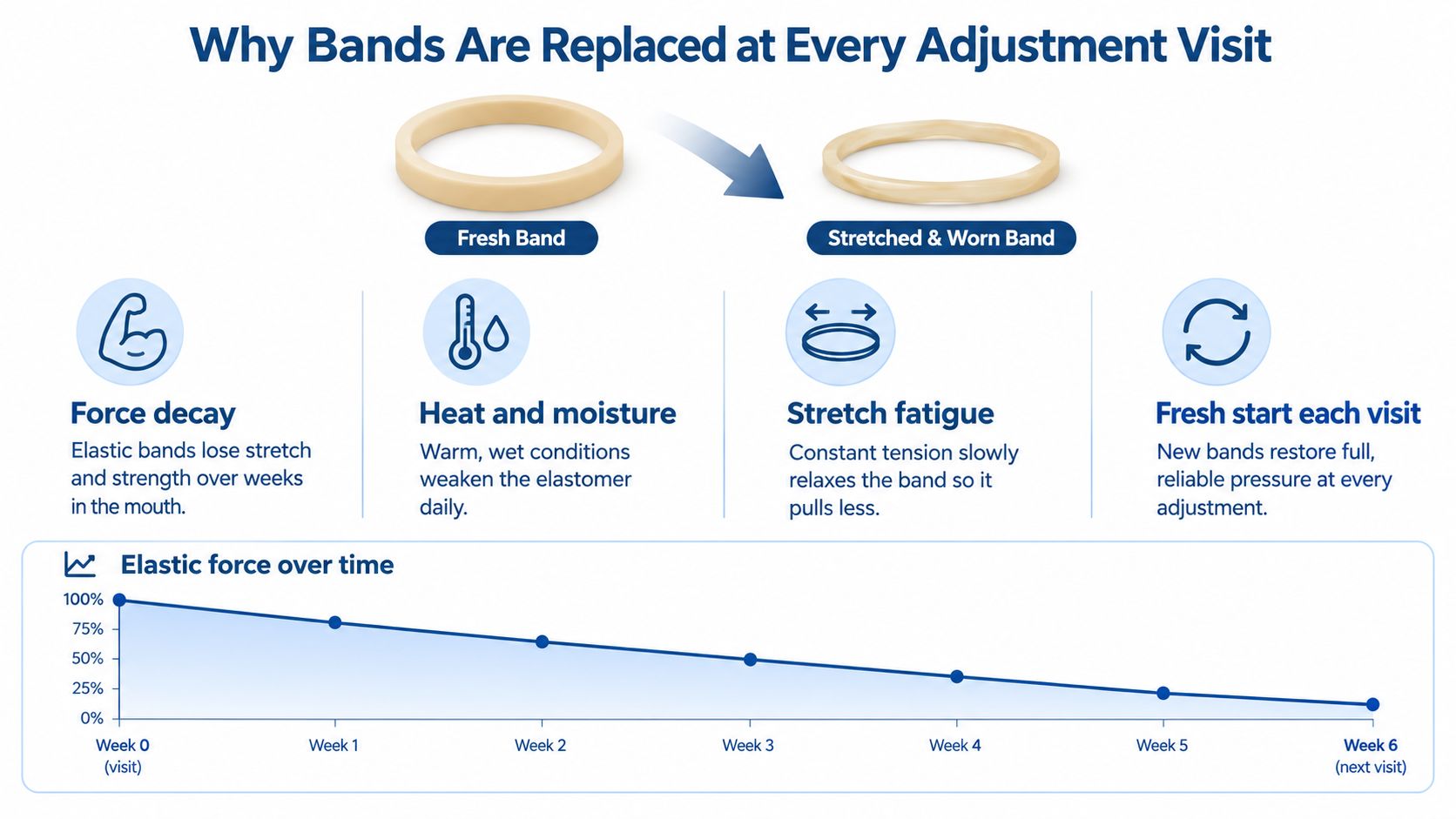
A clear ring can look fresh enough to a parent while behaving differently from the day it was placed. Elastomeric material stretches, relaxes, and responds to heat and moisture. The mouth is a busy environment, so appearance alone can't show whether a ligature is still performing exactly as intended.
What laboratory testing shows
In one laboratory study of stretched ligatures, 29% to 63% of force loss occurred during the first 24 hours, after an initial 11% to 18% reduction within the first three minutes. A separate eight-week evaluation found an average force loss of about 49.9% during the first day and about 75.7% by week eight in the laboratory evaluation of elastic force decay.
Those figures describe controlled testing, not an individual child's appointment calendar. The orthodontist decides when to replace ligatures based on the wire, planned movement, hygiene, tooth position, and treatment stage.
A separate study found that placing elastomeric samples in synthetic saliva at 37°C with a pH of 6.84 changed force decay and permanent deformation over 28 days, supporting the practical effect of heat and moisture in the mouth in the study of elastomer behavior in synthetic saliva. The result is another reason these components aren't interchangeable accessories.
What families should do
Adjustment appointments keep the orthodontic team connected to changes that a mirror can't reveal. Families shouldn't try to judge a ring's condition by how tight it feels, and they shouldn't remove or replace ligatures at home.
The sensible response to a broken or badly stretched ring is to contact the orthodontic office for direction. A loose ring can allow the wire to shift or irritate the cheek, while a missed appointment can leave aging components in place longer than planned.
The video below offers a visual explanation of elastic behavior and replacement.
Staining and What It Means for a Clear Look
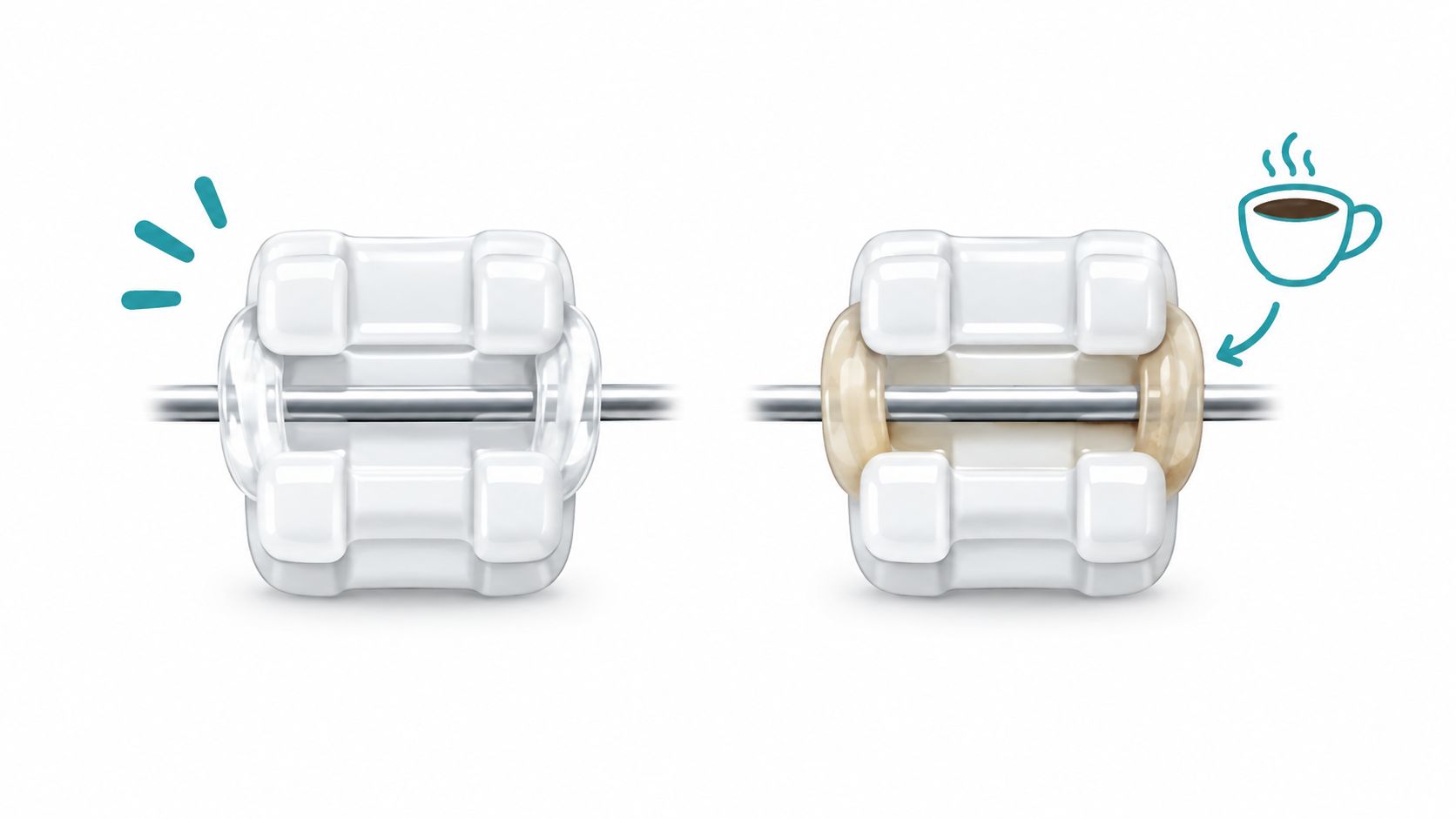
The most common appearance surprise is also the easiest to misunderstand. A parent may see a yellowish ring and conclude that the ceramic bracket has stained. In many cases, the replaceable clear or tooth-colored ligature has changed color while the bracket remains relatively color-stable.
A peer-reviewed in-vitro study found that every tested shade of esthetic ligature changed color after exposure to common foods and drinks. Black tea, wine, and coffee produced the greatest pigmentation in that testing in the study of esthetic ligature discoloration.
The bracket and the ring are different materials
The ceramic bracket is bonded to the tooth and forms the solid base of the system. The ligature is a flexible elastomer that can absorb or hold onto pigment. That difference explains why “clear braces” don't always look equally clear throughout the time between appointments.
The study used controlled exposure for 72 hours, so it shouldn't be treated as a schedule predicting exactly when a particular teen's bands will change color. Diet, material, oral hygiene, smoking exposure, and time since the last adjustment can all affect the appearance.
Brushing remains important for healthy braces and teeth, but scrubbing can't always return a pigmented elastic to its original shade. The usual solution is having the orthodontic team replace the ligatures at an appointment, not trying to pry them off or whiten them at home.
Keeping the cosmetic surprise manageable
A family can ask about clear, tooth-colored, or colored ligature options before placement. Darker colors may make dietary pigmentation less noticeable, while clear rings may provide the least visible starting appearance. The choice depends on what the orthodontist considers suitable for the treatment system.
Families comparing ceramic braces with Invisalign can discuss how ligature options fit a teen's plan during a Stellar Orthodontics consultation. Practical care guidance is also available in this guide to caring for ceramic braces. The central reassurance is simple: a stained ring is usually temporary and replaceable, and it doesn't automatically signal damage to the ceramic bracket.
When Progress Seems Slow Despite Wearing the Bands
A teen may insist that every prescribed elastic has been worn, yet the next appointment still brings a conversation about slow bite changes. That situation can be frustrating for everyone, but “the bands must be too weak” isn't the only explanation, and it may not be the most useful first assumption.
A systematic review found that objectively measured wear of removable orthodontic appliances was often lower than self-reported wear. One evidence summary reported an average discrepancy of about five hours per day for headgear wear in the systematic review of appliance compliance.
That finding doesn't accuse a child of lying. A teen may honestly remember wearing the elastics most of the day while overlooking time at school, during meals, during sports, or while sleeping. Small gaps repeated across many days can make the prescribed pattern different from the actual pattern.
A practical check before blaming the braces
Families can calmly review the routine with the orthodontic team:
- Placement: The elastic must connect to the instructed hooks. A similar-looking pattern may create a different force direction.
- Freshness: Stretched-out or broken elastics may not behave as intended. The office can clarify how often the patient should replace them.
- Daily interruptions: School, meals, sports, sleep, and travel can create forgotten periods. A small supply in an approved storage place can make the routine easier.
- Understanding: A demonstration can reveal whether the patient is using the correct hooks and method.
If an elastic breaks, the patient should follow the office's specific replacement instructions or call for guidance. If an elastic is forgotten, doubling up without instruction isn't a safe way to “catch up,” because two bands can create a different force from the one prescribed.
Pain that persists, a loose bracket, repeated breakage, or difficulty placing the elastic deserves a call to the orthodontic office. The goal isn't to improvise harder. It's to identify the practical obstacle and restore a clear, realistic routine.
Setting Expectations and Your Next Step in Delaware
Ceramic braces rubber bands are normal parts of many treatment plans. The small rings hold the wire in place, can influence friction, may change color, and are replaceable. Larger elastics between upper and lower teeth are different, and they're used only when the orthodontist includes them in the bite plan.
Families can also expect the appearance to change between visits. A clear ligature may become less clear after exposure to pigmented foods or drinks, while the ceramic bracket remains relatively stable. Fresh ligatures at an adjustment visit usually address that cosmetic concern, so a temporary color change doesn't mean the braces have stopped working.
The parts families can control are practical:
- Keep appointments: The orthodontist needs regular opportunities to assess the wire, brackets, ligatures, and bite.
- Follow the prescribed pattern: The correct hooks, timing, and replacement routine matter more than a generic schedule.
- Report problems early: A broken ring, loose bracket, persistent pain, or confusing instruction deserves office guidance.
- Ask about appearance options: Teens may be able to choose among available ligature colors when the treatment system allows it.
Stellar Orthodontics offers free consultations with iTero digital 3D scanning at locations in North Wilmington, Middletown, West Dover, and Millsboro. Eligible children and teens can receive care through accepted dental insurance, flexible payment plans, all three Delaware Medicaid plans, and CHIP. Families can learn more about what happens during a free orthodontic consultation and ask whether ceramic braces or Invisalign fits the patient's needs.
Stellar Orthodontics provides clear ceramic braces and Invisalign evaluations, with free consultations and iTero 3D scanning at its Delaware locations. Families can bring questions about stained ligatures, broken ceramic-brace rubber bands, or confusing elastic instructions and visit Stellar Orthodontics to book a consultation.