.png)
Clear braces elastics are small polyurethane rings that hold the archwire in place. They're designed to blend with ceramic braces, but they naturally absorb color over a few weeks and are normally replaced during adjustment visits.
A teenager may leave an orthodontic appointment delighted that the new ceramic braces are barely noticeable. A few weeks later, a parent may spot a yellowish tint around the brackets and wonder whether coffee, tomato sauce, or brushing habits caused a problem. That observation is common, and it doesn't automatically mean the braces haven't been cleaned properly.
Clear elastics have a functional job first and a cosmetic job second. Their material can change in the mouth, so families considering clear ceramic braces should expect periodic color changes, routine replacement, and a care plan that protects both appearance and oral health.
Table of Contents
- Why Clear Braces Elastics Look Different Than You Expect
- What Clear Braces Elastics Actually Do
- Why Clear Elastics Change Color Over Time
- How Brand and Material Affect Color Stability
- Daily Care and Foods to Watch
- When to Replace Elastics and What Happens Between Visits
- Next Steps for Delaware Families Considering Clear Braces
Why Clear Braces Elastics Look Different Than You Expect
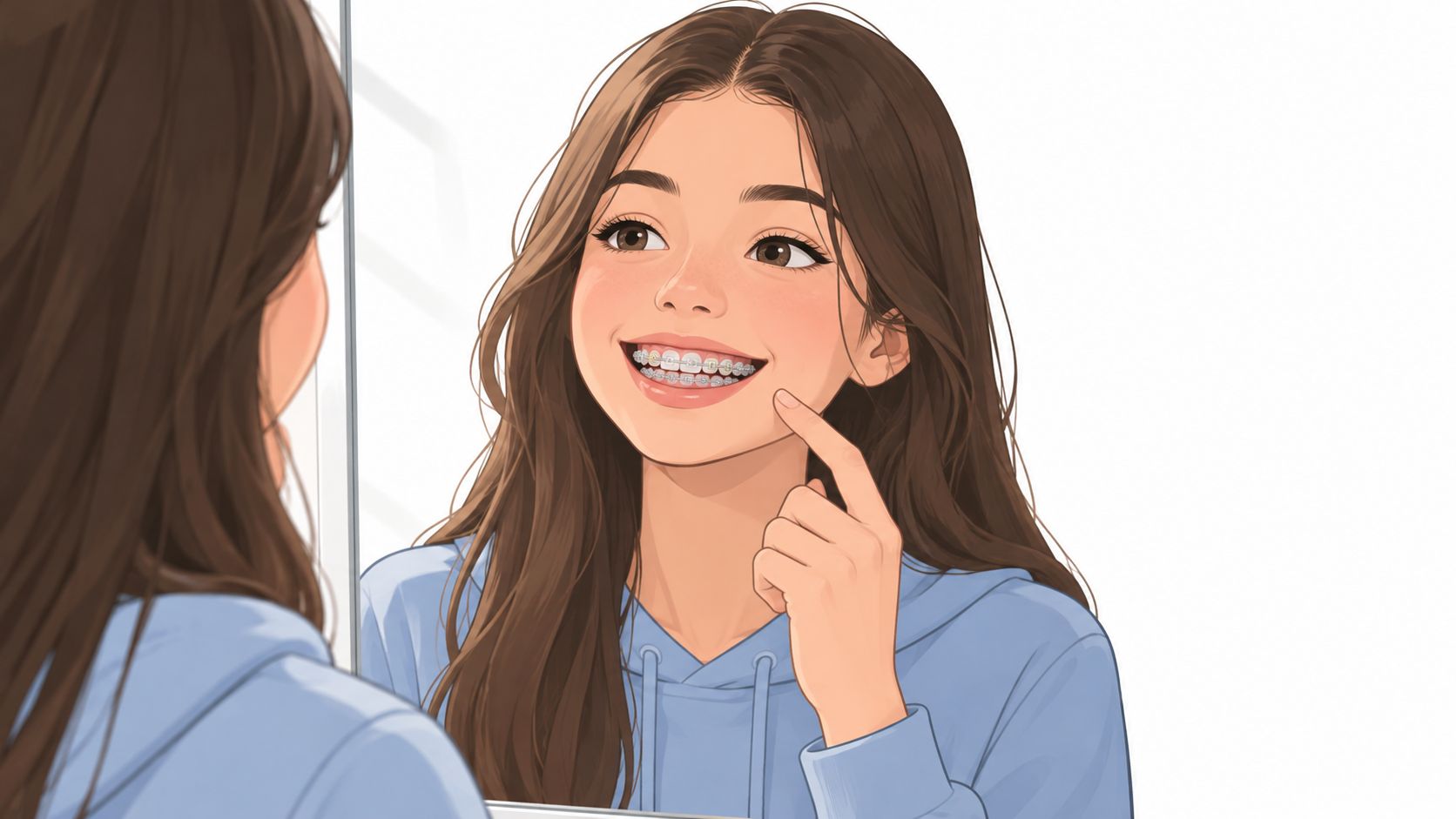
A young patient may look in the mirror after receiving ceramic braces and see an almost invisible smile. Later, the ceramic brackets still look tooth colored, but the small rings around them appear cream or yellow. The change can be disappointing, especially before school photos, a family event, or a holiday meal.
That reaction makes sense, but discoloration isn't necessarily a hygiene failure. Clear braces elastics, also called esthetic elastomeric ligatures, are polyurethane-based modules that secure the archwire to orthodontic brackets. Their exact formulation varies by manufacturer, while polyurethane remains the dominant material in contemporary orthodontic ligatures. The same flexible polymer that makes the rings convenient to place can absorb or retain color from the oral environment, as described in this historical overview of orthodontic elastomeric ligatures.
The rings are not the brackets
Parents often blame the ceramic brackets when the visible yellowing comes from the elastic ligatures. The brackets are bonded to the teeth, while the small rings sit around the bracket wings and remain exposed to saliva, food pigments, warmth, and everyday movement.
Metal ties can look more noticeable, but clear modules offer a lower-visibility appearance. They're also consumable components, not permanent parts of the appliance, so the orthodontic team normally removes and replaces them during adjustment visits.
Practical rule: Clear means less noticeable when placed. It doesn't mean permanently colorless.
The useful expectation is simple. Clear braces elastics can help ceramic braces blend with the smile, but some visible change during treatment is normal. A stained ring usually calls for discussion at the next appointment, not embarrassment or aggressive brushing.
What Clear Braces Elastics Actually Do
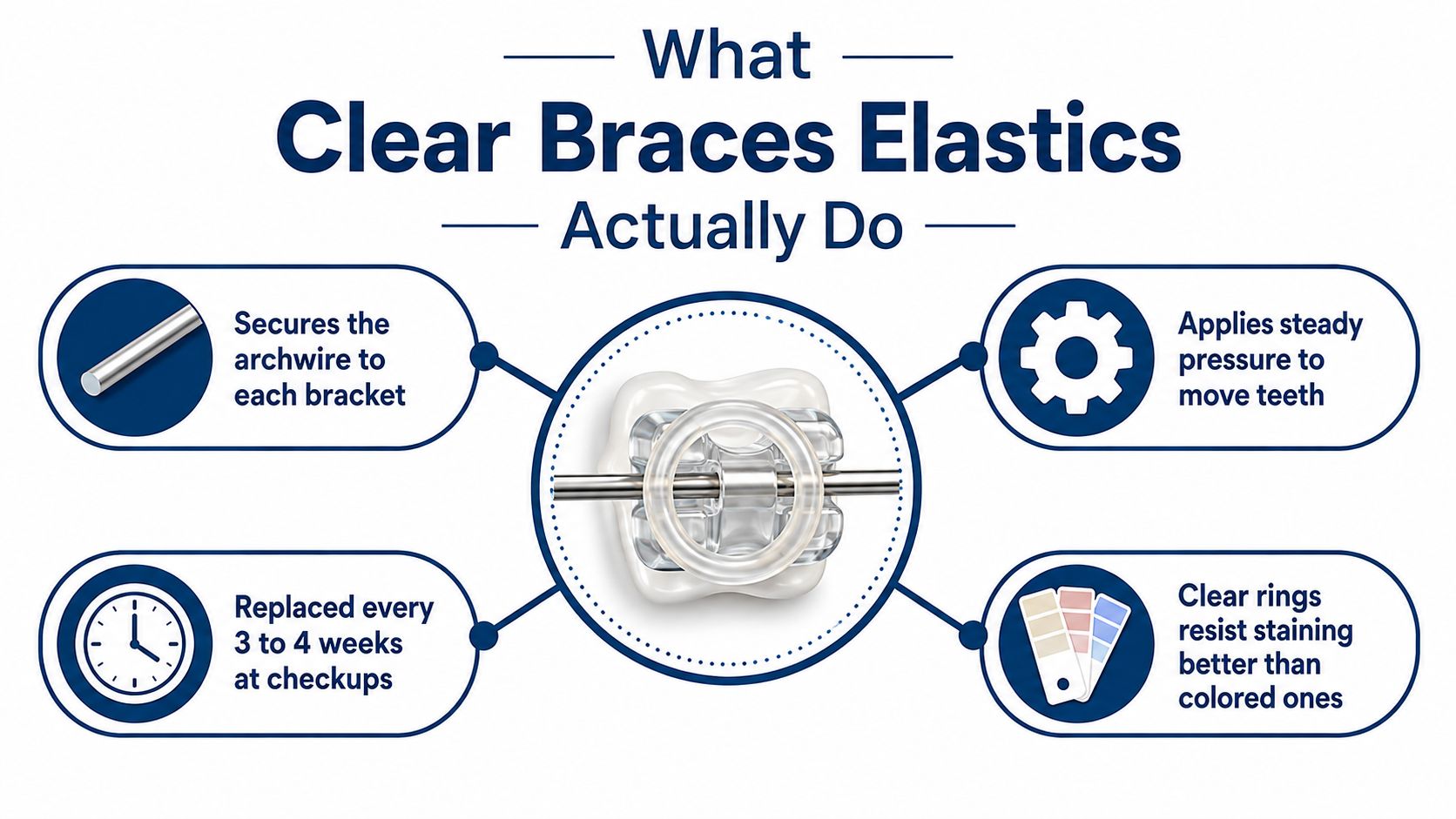
Clear braces elastics are small rubber-like rings that hold the archwire inside each bracket. A simple analogy is a fastening loop. The bracket provides the channel, the archwire provides the guiding structure, and the ligature keeps the wire seated where the orthodontic team placed it.
That connection matters because the archwire delivers controlled forces through the brackets. The clear ring isn't a decorative accessory added after the mechanics are complete. It helps keep the wire engaged with the bracket so the planned appliance can work.
Three parts families often confuse
Ligatures are the tiny rings attached directly around individual brackets. They stay in place between appointments unless one breaks or the orthodontic team removes it.
Interarch elastics are larger removable bands that a patient may hook between the upper and lower arches for bite correction. They're different from the clear rings around brackets and follow a separate wear and replacement schedule prescribed for the individual patient.
Clear aligner trays are removable plastic appliances. They don't use the same small bracket ligatures, even though families sometimes use “clear braces” as a general term for several kinds of discreet orthodontic treatment.
Why replacement is part of normal care
Laboratory testing found that every tested elastomer showed some color change over an eight-week period, although color stability differed significantly among materials. The same study measured an average residual force of 1.45 ± 0.18 N after eight weeks, as reported in this study of orthodontic elastomeric ligatures.
That finding doesn't mean a ring suddenly stops working at a particular date. It means the material changes over time, so the orthodontic team evaluates the appliance during scheduled visits. Replacement supports the treatment plan and refreshes the cosmetic appearance.
Families shouldn't pick at, cut, stretch, or replace these rings with household materials. If a ring is missing or broken, the patient should contact the orthodontic office for specific guidance.
Why Clear Elastics Change Color Over Time
Clear elastics can discolor through more than one pathway. Early color change may reflect chemical degradation of the polymer in the oral environment. Later, pigments from food and drinks can contribute to mechanical staining, especially when the material remains in place between appointments.
Clinical evidence shows that the change can occur within a routine orthodontic interval. In a split-mouth study of 20 adult patients, four commercial brands were checked when placed and again after 30 days of intraoral exposure. All four showed statistically significant staining, with differences reported at P < 0.001 in this clinical study of clear orthodontic ligature staining.
What the color measurements showed
Three brands had a median staining score of 1, interpreted as slight pigmentation. The Brazilian brand Morelli reached a median score of 3, interpreted as heavy pigmentation. Lab testing also found statistically significant changes on both the green-red and blue-yellow color axes, with P < 0.001.
The mean blue-yellow shifts ranged from 3.17 to 4.52 units, indicating increased yellowness. Those results help explain why a patient may notice a difference before the next adjustment, even when the rings looked clear at placement.
The result isn't a reason to blame the teenager or parent. The material itself has limited color stability, and the degree of change varies with the brand, exposure, and length of time in the mouth.
A clear ring can become visibly different before the next appointment without the patient having done anything wrong.
What families should expect
Clear braces elastics should be viewed as temporary components with a predictable tendency to age. Careful brushing helps remove plaque and debris around the appliance, but it can't reverse color changes embedded in the polymer.
Replacement at an adjustment visit is therefore routine maintenance. The orthodontic team can remove stained rings, assess the archwire and brackets, and place fresh ligatures as treatment progresses.
How Brand and Material Affect Color Stability
Not every clear elastic behaves the same way. Differences in polymer formulation, manufacturing, exposure, and mechanical handling can produce different appearance results, even when two patients follow similar care routines.
The thirty-day clinical study showed that three brands had slight pigmentation while Morelli reached heavy pigmentation. That comparison doesn't establish a universal ranking for every patient or treatment plan, but it does show why “clear” isn't one standardized material category.
| Brand/Group | Staining Score After 30 Days | Key Susceptibility Notes |
|---|---|---|
| Three tested brands | Median score of 1, slight pigmentation | Showed measurable staining after intraoral exposure |
| Morelli | Median score of 3, heavy pigmentation | Showed greater pigmentation in the reported clinical comparison |
| Clear ligature groups in laboratory testing | Varied by material | Coffee and red wine produced the strongest discoloration, while fruit juice produced an intermediate effect |
The controlled laboratory work found that early discoloration was associated mainly with chemical degradation, while later changes increasingly reflected mechanical staining. Ethanol-related color change occurred mainly during the first few hours of testing, while methylene-blue staining continued throughout the test period, according to this laboratory study of clear ligature discoloration.
Exposure matters, but it isn't the whole story
Coffee and red wine produced the strongest discoloration in the laboratory work, while fruit juice produced an intermediate effect. Strongly colored foods and pigmented sauces can also affect the appearance of exposed elastomeric material.
Stretching didn't generally change staining susceptibility, although one clear-ligature brand absorbed more pigment when stretched. That result supports a balanced message for families. Food and drink choices can influence appearance, but clear elastics also have inherent color instability.
Parents can ask the orthodontic team which material is being used and whether a different option is appropriate for the child's appliance. The decision may involve appearance, handling, treatment mechanics, and the timing of routine replacements.
Daily Care and Foods to Watch
A practical routine protects the braces and keeps the area around each elastic cleaner. Patients should brush gently around every bracket, wire, and ring, then floss according to the orthodontic team's instructions. Careful cleaning reduces plaque and trapped debris, but it won't restore a ring's original clarity once pigments have entered the polymer.
Whitening toothpaste shouldn't be treated as a solution for stained ligatures. Aggressive brushing may irritate the gums or damage the appliance without removing color that has changed within the elastic.

A simple home routine
- Clean around each bracket: Use a soft brush and small, controlled movements around the wire and elastic rather than scrubbing across the appliance.
- Floss carefully: Remove food from between teeth and around the bracket areas where a brush may not reach.
- Rinse after strongly colored foods: Water can help clear loose residue, although it can't prevent every material-related color change.
- Leave the rings in place: Patients shouldn't pull, cut, or stretch a ligature at home.
- Report a missing ring: The office can decide whether the patient needs an earlier visit or can safely wait for the scheduled appointment.
For more appliance-specific guidance, families can review this resource on how to take care of ceramic braces.
Foods that can damage braces
The American Association of Orthodontists advises patients with braces to avoid hard, sticky, crunchy, or chewy foods that can damage brackets or become trapped around the appliance. Examples include popcorn, nuts, caramel, taffy, hard candy, hard pretzels, and taco chips, as outlined in its guidance on life during orthodontic treatment.
Coffee, tea, and red wine can stain teeth, while tap water and milk are identified as better choices during treatment. These recommendations address two separate concerns. Strong pigments can affect appearance, while hard or sticky foods can damage brackets or lodge around the elastics.
A stained elastic usually isn't an emergency. A broken bracket, sharp wire, significant discomfort, or a missing ligature should prompt a call to the orthodontic office so the team can provide case-specific instructions.
When to Replace Elastics and What Happens Between Visits
Clear ligatures age because synthetic elastomeric polymers respond to moisture, heat, stretching, and repeated movement. Their behavior is described through viscoelasticity, creep, and stress relaxation, which means the force isn't perfectly stable throughout the entire time a ring remains in the mouth.
Laboratory testing found that the fastest force loss occurred during the first 24 hours. By eight weeks, tested elastomers retained approximately 1.14 to 1.64 N, equivalent to about 116 to 167 gf, according to this research on force decay in orthodontic elastomers.
Why the orthodontist decides the timing
The residual force in the tested conditions was still sufficient to retain an archwire in the bracket slot, but that doesn't create a universal replacement schedule. The team also considers plaque accumulation, deformation, the material used, the archwire, and the patient's treatment mechanics.
The same testing found greater degradation when modules were stretched by 1 mm rather than stretched uniformly. That's why clinicians avoid unnecessary over-stretching during placement and why patients shouldn't manipulate the rings.
Clinical decision: A ring can still look intact while its material, force behavior, or cleanliness has changed.
Clear elastics also create a hygiene issue when plaque and food debris gather around brackets, wires, and rings. Inadequate cleaning is associated with enamel demineralization, white-spot lesions, periodontal problems, and halitosis. A systematic review comparing elastomeric and steel ligatures indicates that the choice involves more than appearance, so periodontal considerations belong in the orthodontic conversation.
What to do between appointments
Patients should keep scheduled adjustment visits even when the elastics haven't broken. Scientific literature describes ligatures as commonly changed about every 3 to 4 weeks because of force decay, deformation, and pigmentation, while another clinical study evaluated changes after 28 days and found considerable discoloration across tested brands. Families can read the clinical trial on elastomeric ligature color change.
If one ring breaks, the patient shouldn't replace it with a household rubber band or double another ring. The safest step is to contact the office, describe what happened, and follow the orthodontic team's instructions.
For families wanting more detail about the role of these components, Stellar Orthodontics provides information about ceramic braces rubber bands.
Next Steps for Delaware Families Considering Clear Braces
Clear braces elastics offer a discreet way to secure the archwire to ceramic brackets, but they aren't permanently clear. Their appearance can change during an adjustment interval, and their force behavior also changes as the material ages. Good home care helps control plaque and debris, while routine appointments allow the orthodontic team to evaluate and replace the rings.
Parents can use a consultation to ask focused questions:
- Material choice: Which clear ligature material is planned for the child's braces?
- Appearance: How might coffee, tea, red wine, sauces, or school events affect the rings?
- Replacement schedule: When will the orthodontic team normally replace the ligatures?
- Broken rings: What should the family do if one elastic is missing or breaks?
- Hygiene: Which brushing and flossing methods fit the child's appliance and dexterity?
- Treatment options: Would clear ceramic braces or clear aligners better fit the child's goals?
Stellar Orthodontics offers free consultations at its Delaware locations in North Wilmington at 2304 Concord Pike, Middletown at 818 Kohl Avenue, West Dover at 125-2 Greentree Drive, and Millsboro at 26670 Centerview Drive. Families can discuss clear braces elastics, replacement expectations, and whether ceramic braces are appropriate for the child's treatment plan. Information about treatment choices for younger patients is available in this guide to clear braces for kids.
The practice accepts most major dental insurance, offers flexible monthly payment plans with $0 down, and accepts all three Delaware state Medicaid plans, AmeriHealth Caritas Delaware, Highmark Health Options, and Delaware First Health, plus CHIP for children and teens under 21. Families should confirm current coverage and payment details during the consultation.
Stellar Orthodontics provides clear ceramic braces and other orthodontic options, with free consultations at locations in North Wilmington, Middletown, West Dover, and Millsboro. Families can visit Stellar Orthodontics to discuss clear braces elastics, replacement timing, hygiene, and the treatment choice that fits the patient's needs.