.png)
A Delaware parent and a teenager may arrive at an orthodontic consultation with the same question: should the braces be less noticeable, or should the treatment focus on maximum durability? The choice between clear ceramic braces and traditional metal braces isn't about appearance. It can also involve the type of tooth movement needed, the patient's daily routine, food habits, sports, music, budget, and comfort with visible brackets.
Both options are fixed appliances, and both can help straighten teeth when selected for an appropriate case. Clear braces use tooth-colored ceramic brackets, while metal braces use stainless steel brackets. The brackets may look different, but the orthodontic plan determines far more than the material alone.
Families often search for “clear braces metal” while comparing treatment at home, yet the most useful question is usually more specific: which system fits this patient's teeth and lifestyle? This guide explains the practical differences in appearance, friction, strength, care, removal, cost considerations, and treatment timelines. It also addresses why an orthodontist may recommend one option for a child, teen, or adult.
Fixed-appliance demand remains substantial. One market forecast estimated global orthodontic braces demand at US$1.66 billion in 2026, with a projection of US$2.77 billion by 2034, representing a projected 6.61% CAGR from 2026 to 2034. Another forecast estimated US$1.8 billion in 2026 and US$2.7 billion by 2033, with a projected 5.6% CAGR. The same market reporting placed North America at 50% of the orthodontic braces market in 2025 in one forecast, showing why U.S. families often influence braces adoption and pricing conversations (orthodontic braces market overview).
Stellar Orthodontics serves families through locations in North Wilmington, Middletown, Dover/West Dover, and Millsboro. The information below can help families organize their questions before a consultation and decide what matters most.
Table of Contents
- Introduction to clear braces and metal braces for Delaware families
- How clear braces and metal braces actually work
- Clear braces versus metal braces head to head
- Treatment timelines and when each option is recommended
- Which option fits your child teen or adult lifestyle
- Daily care cost and keeping your braces looking great
- Making your final choice with Stellar Orthodontics
Introduction to clear braces and metal braces for Delaware families
A teenager preparing for school photos may immediately prefer clear ceramic brackets. A parent watching a younger child play sports may focus instead on durability and the possibility of a broken bracket. Neither reaction is unreasonable. Each family is weighing a different part of the same treatment decision.
The appearance question is real, especially for teens and adults who want fixed braces to blend more naturally with the smile. Clear ceramic brackets are designed for that purpose. Metal brackets remain more visible, but many children and teens like the familiar look, colored elastic ties, and straightforward maintenance.
The harder question comes when appearance meets treatment demands. A patient with mild crowding may have several suitable fixed-appliance choices, while a patient needing more complex bite correction may benefit from the material that offers greater strength and more predictable handling. The orthodontist must consider the whole treatment plan, not just the bracket color.
A quick comparison
| Criteria | Clear ceramic braces | Traditional metal braces |
|---|---|---|
| Appearance | Tooth-colored brackets blend more naturally with teeth | Brackets are more visible |
| Function | Fixed brackets and wires guide tooth movement | Fixed brackets and wires guide tooth movement |
| Durability | Strong, but ceramic can be more vulnerable to damage in some situations | Generally durable for active daily routines |
| Friction | Ceramic brackets can create more sliding resistance, depending on design and wire | Metal brackets generally create less friction |
| Staining | Brackets resist visible discoloration, but elastic ties can stain | Metal brackets don't stain like ceramic ties |
| Removal | Requires careful debonding because enamel damage risk can be higher | Usually less difficult to remove cleanly |
| Best fit | Patients prioritizing appearance when the case allows | Patients prioritizing durability, efficiency, or complex movement |
The choice isn't a contest with one universal winner. A consultation gives the orthodontist a chance to assess the bite, tooth positions, habits, and treatment goals. Families can use this guide to identify priorities, then bring those priorities to Stellar Orthodontics in the Brandywine Valley, the MOT corridor, Kent County, or Sussex County.
How clear braces and metal braces actually work
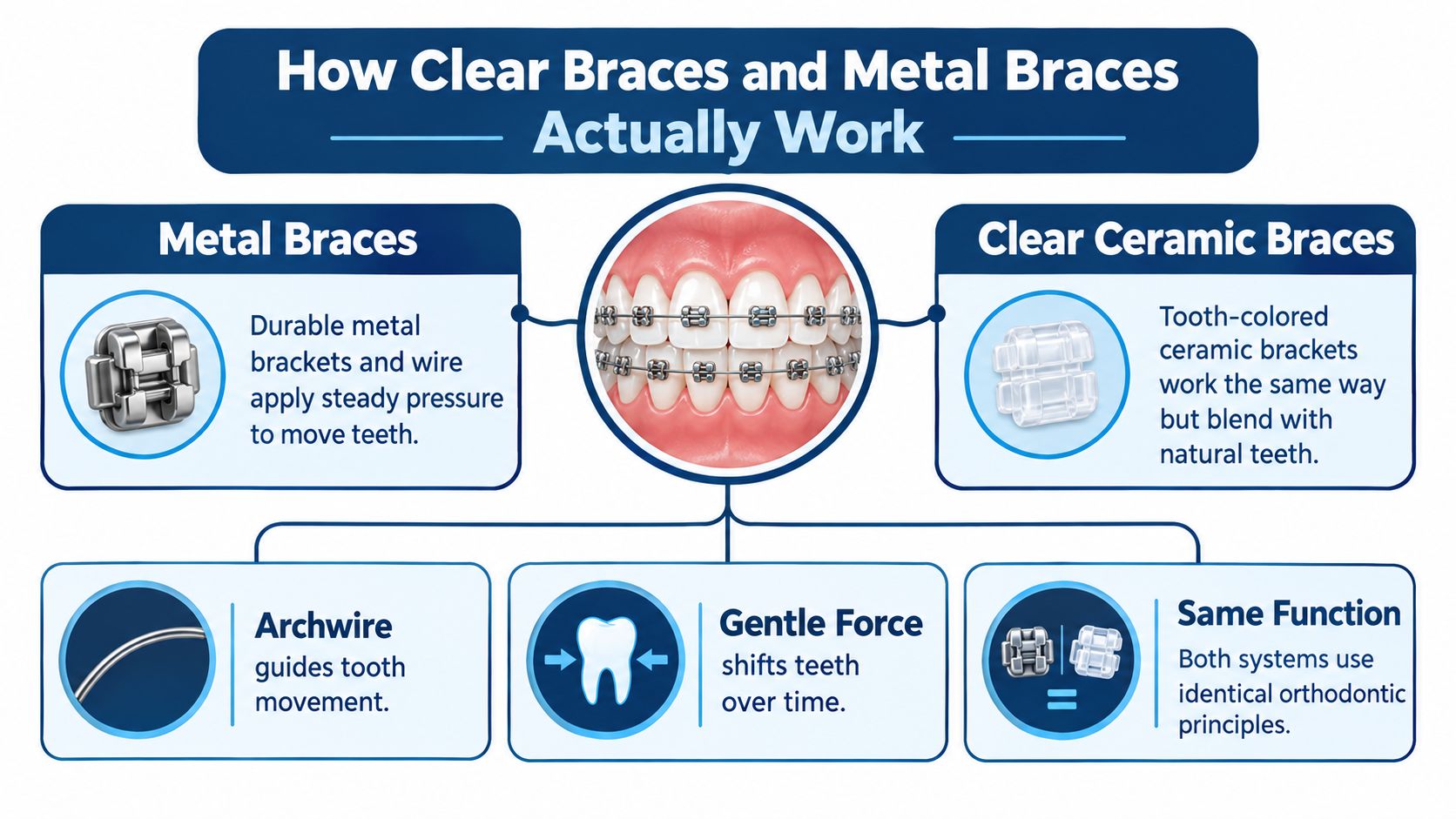
Both systems use the same basic orthodontic idea. Small brackets attach to the teeth, and an archwire connects the brackets. The wire applies controlled pressure, while the orthodontist changes or adjusts the appliance as the teeth move.
Metal braces use stainless steel brackets. Clear braces use ceramic brackets that are closer to the natural color of teeth. The materials change the appearance and some mechanical features, but clear braces aren't removable trays or aligners. They stay attached to the teeth throughout treatment.
The basic process
Brackets attach to the teeth. The orthodontic team bonds each bracket in a planned position. That position helps guide how the tooth responds to the wire.
The archwire connects the brackets. The wire follows the planned shape of the dental arch. As it returns toward that shape, it provides force that supports tooth movement.
The orthodontist makes adjustments. Visits occur every few weeks so the team can monitor progress and change wires, ties, or other parts of the appliance as needed. The exact schedule depends on the treatment plan.
The patient protects the appliance. Braces work as planned when brackets remain attached, wires stay in place, and the patient follows care instructions. Hard or sticky foods can create problems for either system, with added concern for ceramic brackets in some situations.
Families who want a closer look at fixed appliance designs can review this guide to different types of metal braces. The key point remains simple: both clear and metal braces use fixed brackets, archwires, and planned pressure to guide teeth.
The orthodontist also monitors the bite, not just whether individual teeth appear straighter. A pleasing smile and a stable bite require coordinated planning, which is why the same bracket material won't be right for every patient.
Clear braces versus metal braces head to head
The clearest comparison starts with the features families notice every day, then moves into the mechanical differences that may affect treatment handling. Ceramic brackets can make braces less visible, but metal brackets often offer a more forgiving option for patients with active routines or demanding movements.
Appearance and confidence
Clear ceramic brackets blend more closely with the teeth than stainless steel brackets. That difference can matter to a teen who feels self-conscious during school, an adult who meets with clients, or a parent who wants a less noticeable fixed appliance.
The brackets themselves are less likely to show obvious discoloration. However, the elastic ties that hold the wire in place can stain after exposure to coffee, tea, red wine, tomato sauce, and other dark foods or drinks. Those ties are usually replaced at adjustment visits every 4 to 6 weeks, so staining is generally temporary (ceramic braces staining guidance).
Strength and removal
Metal brackets generally tolerate everyday bumps well. Ceramic brackets are strong enough for many treatment plans, but the material can be more susceptible to damage in situations involving heavy forces, contact, or poor eating habits.
Bond strength creates another difference. One comparative study reported mean shear bond strength of 20.68 ± 3.89 MPa for ceramic brackets and 12.15 ± 1.32 MPa for metal brackets. Another reported median debonding strengths of 31.85 to 37.37 MPa for ceramic brackets compared with 20.30 to 23.06 MPa for metal brackets, and noted that ceramic removal was more susceptible to enamel fracture (comparative bracket bond-strength study).
Practical rule: Stronger bonding can help a bracket stay attached, but it also means the orthodontist must use controlled removal techniques at the end of treatment.
Friction and comfort
Friction describes resistance between the bracket and archwire as the wire slides through the bracket. In vitro testing found mean static friction of 428.7 ± 87.3 gf for conventional ceramic brackets compared with 267.5 ± 54.2 gf for conventional metal brackets, a reported 60.3% increase for ceramic brackets. The same study reported ceramic brackets producing 1.6 to 2.3 times higher friction across archwire configurations (ceramic and metal bracket friction study).
That doesn't mean ceramic braces can't move teeth effectively. It means the orthodontist may need to account for the bracket material when planning sliding mechanics, leveling, or space closure. Bracket design also matters. A summary of mechanical comparisons reported that metal-slot ceramic brackets created significantly lower friction than all-ceramic brackets.
| Treatment concern | Clear ceramic braces | Metal braces |
|---|---|---|
| Visibility | Lower visual contrast with teeth | Higher visual contrast |
| Sliding resistance | Can be higher, particularly with some ceramic designs | Often lower |
| Active lifestyle | Requires careful attention to impact and food habits | Often more forgiving |
| Enamel removal concerns | Careful debonding is especially important | Removal concerns still require professional care |
| Tie appearance | Clear ties may discolor between visits | Colored or metal components remain visible |
The most important distinction isn't “modern versus old-fashioned.” It's appearance versus mechanical forgiveness, balanced against the specific treatment plan.
Treatment timelines and when each option is recommended
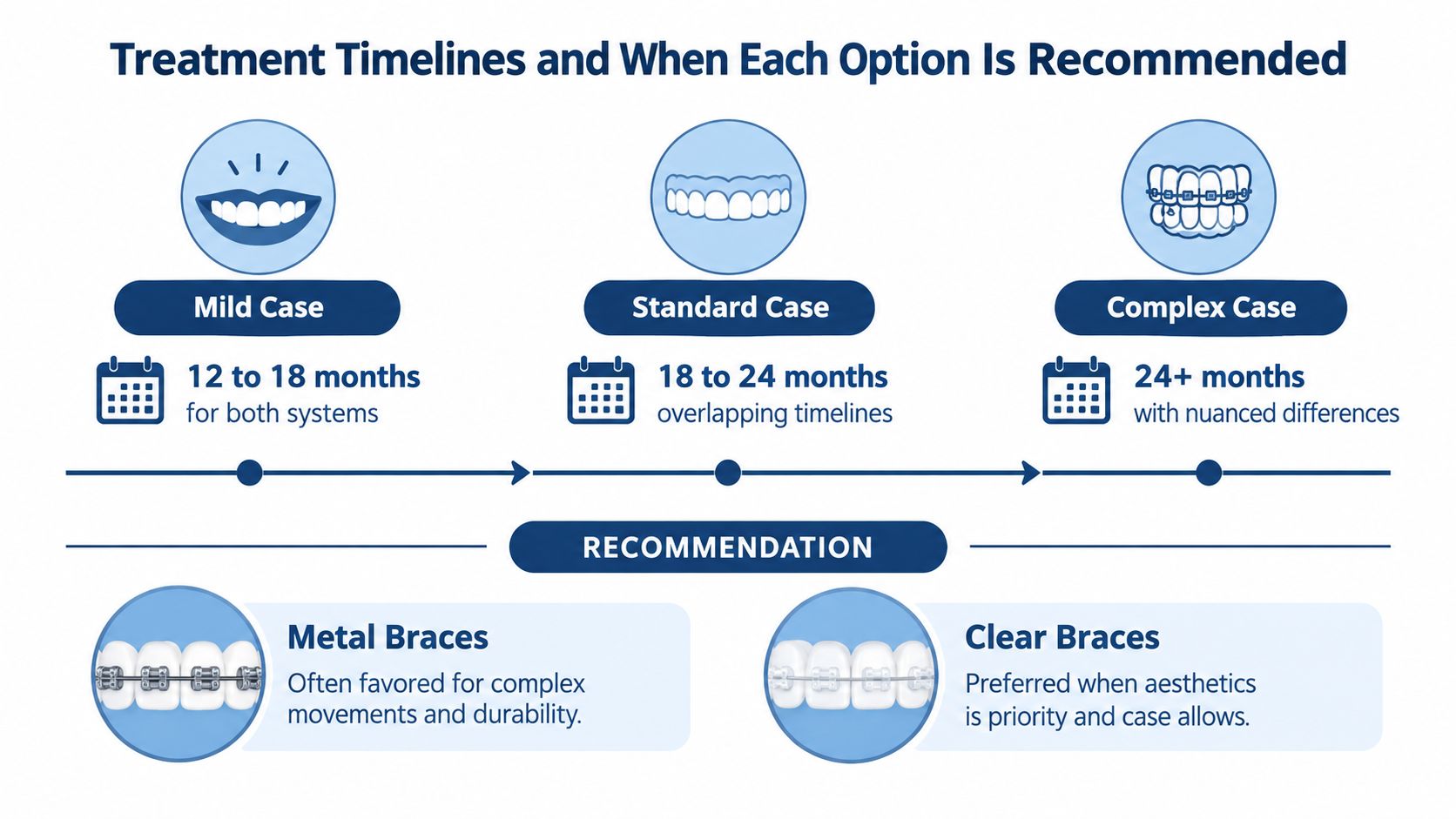
Families often expect clear braces to take either much longer or much less time than metal braces. In practice, treatment timelines can overlap. A timeline guide lists mild cases at 10 to 14 months, standard cases at 18 to 24 months, and complex cases at 24 to 30 months for both metal and clear ceramic braces.
Those ranges are planning examples, not a promise for any individual patient. Tooth movement depends on the bite, crowding, spacing, jaw relationship, growth, cooperation, broken brackets, missed appointments, and how the teeth respond to treatment.
Why case complexity changes the conversation
Clear braces can treat many of the same orthodontic concerns as metal braces, particularly when the case is appropriately selected. Mainstream patient guidance notes that clear braces may be less strong and can sometimes take slightly longer, while metal braces may be favored for more complex movements requiring durability and predictable force delivery (clear braces patient guidance).
The reason is mechanical rather than cosmetic. Higher friction can make a wire slide less freely through a ceramic bracket, especially during space closure or with larger wires. That resistance doesn't automatically make treatment unsuccessful, but it can influence the orthodontist's appliance selection and adjustment strategy.
A mild alignment case may allow clear ceramic brackets to meet the patient's appearance goals without creating a meaningful planning problem. A more involved bite correction may lead the orthodontist to recommend metal brackets, either throughout treatment or for particular teeth that need more demanding movement.
What can lengthen treatment
A patient can extend treatment by repeatedly breaking brackets, missing adjustment visits, or not following instructions about elastics and food. Clear brackets may need extra protection when the patient participates in contact sports, chews hard foods, or has habits that place stress on the appliance.
The best timeline estimate comes from the treatment plan, not from the bracket color.
Families can read more about the factors that influence how long braces take to work. The orthodontist can then explain whether the selected appliance is expected to support the required movements efficiently and safely.
Which option fits your child teen or adult lifestyle
A bracket decision becomes easier when families connect it to ordinary routines. A young child who rushes through brushing and plays active sports may need a different balance than an adult who wants a discreet smile at work. The right choice should fit both the teeth and the patient's ability to care for the appliance.
Children and young teens
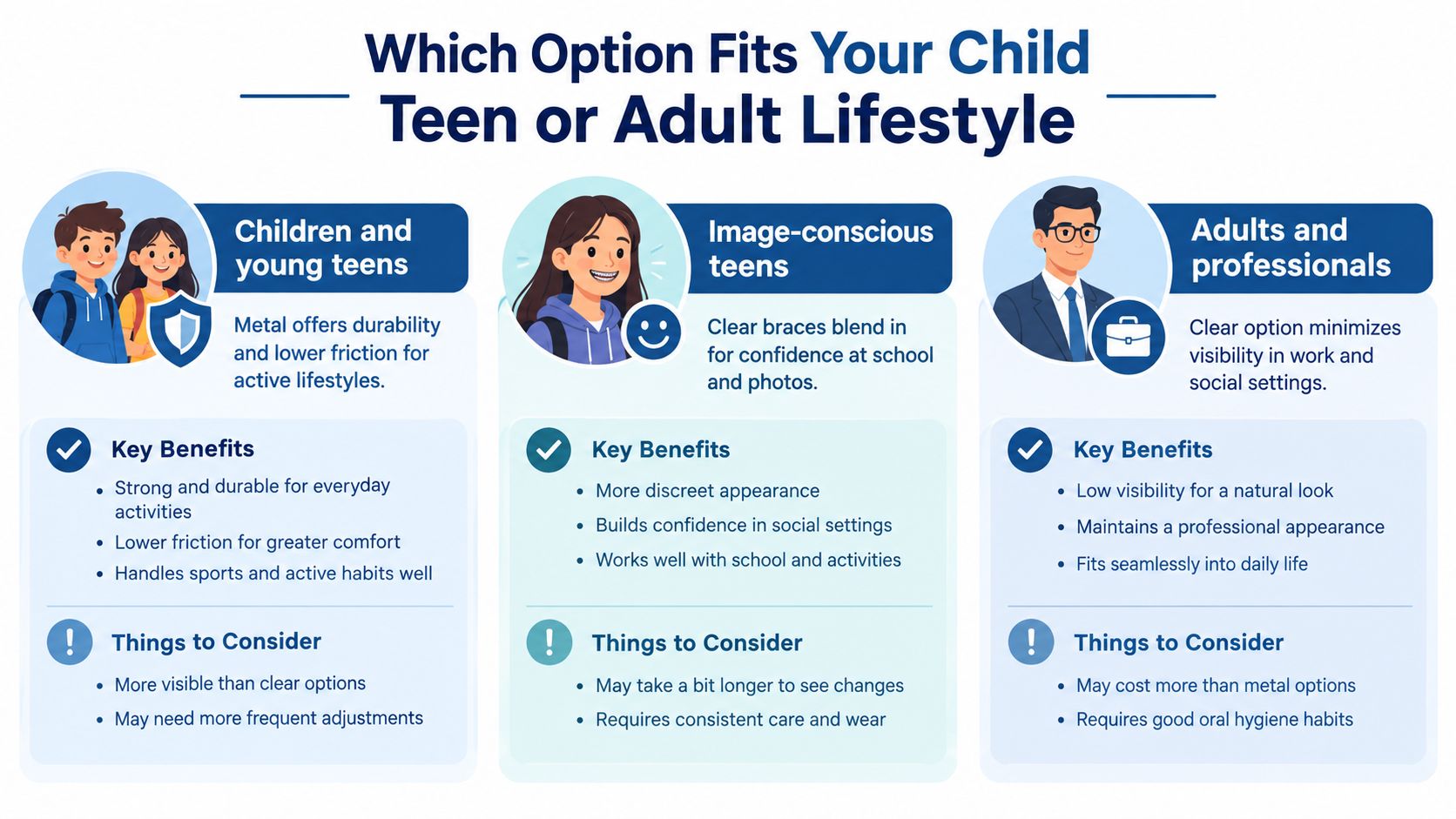
Metal braces may suit a child or young teen who needs a durable fixed appliance and has a busy routine. They may also make sense when the treatment involves movements where lower friction and bracket strength matter.
Parents should still consider maturity and habits. A child who follows food and brushing instructions may do well with either option, while a child who frequently bites hard objects or skips cleaning may face more appliance problems with ceramic brackets.
Image-conscious teens
A teen who worries about school photos, social events, or visible orthodontic treatment may place a high value on ceramic brackets. The less noticeable appearance can support confidence, provided the teen can manage careful brushing, avoid risky foods, and attend adjustments.
Clear braces can also be a reasonable option for a teen whose case allows them. The orthodontist still needs to assess the bite and planned movements before treating appearance as the deciding factor.
Adults, athletes, and musicians
Adults often weigh workplace visibility and social comfort. Clear brackets may blend more naturally with the smile, but adults with demanding treatment needs shouldn't assume that appearance alone determines the best appliance.
Athletes need to discuss mouth protection and contact risk. Musicians who play instruments that contact the lips may also want to discuss comfort, bracket placement, and adaptation. These conversations help the orthodontist match the appliance to real activities rather than making a decision from a brochure.
| Lifestyle priority | Option that may fit | Question to ask |
|---|---|---|
| Frequent sports or rough play | Metal may offer a more durable starting point | How should the appliance be protected during activity? |
| Strong concern about visibility | Clear ceramic may fit when the case allows | Will the planned movements work predictably with ceramic brackets? |
| Complex bite correction | Metal may be favored for strength and force control | Which movements make metal more suitable? |
| Careful teen or adult routine | Either may be appropriate | What daily habits will protect the selected appliance? |
| Medicaid or CHIP coverage needs | Confirm eligibility and covered treatment details | What documentation and benefits should the family bring? |
Stellar Orthodontics accepts most major dental insurance, offers flexible monthly payment plans with $0 down, and accepts all three Delaware state Medicaid plans, AmeriHealth Caritas Delaware, Highmark Health Options, and Delaware First Health, plus CHIP for eligible children and teens under 21. Coverage and eligibility should be confirmed for the individual patient.
Daily care cost and keeping your braces looking great
Good care protects the brackets, wires, gums, and the appearance of the smile during treatment. Fixed braces create more places for food and plaque to collect, so brushing and flossing require more attention than usual.
A practical daily routine
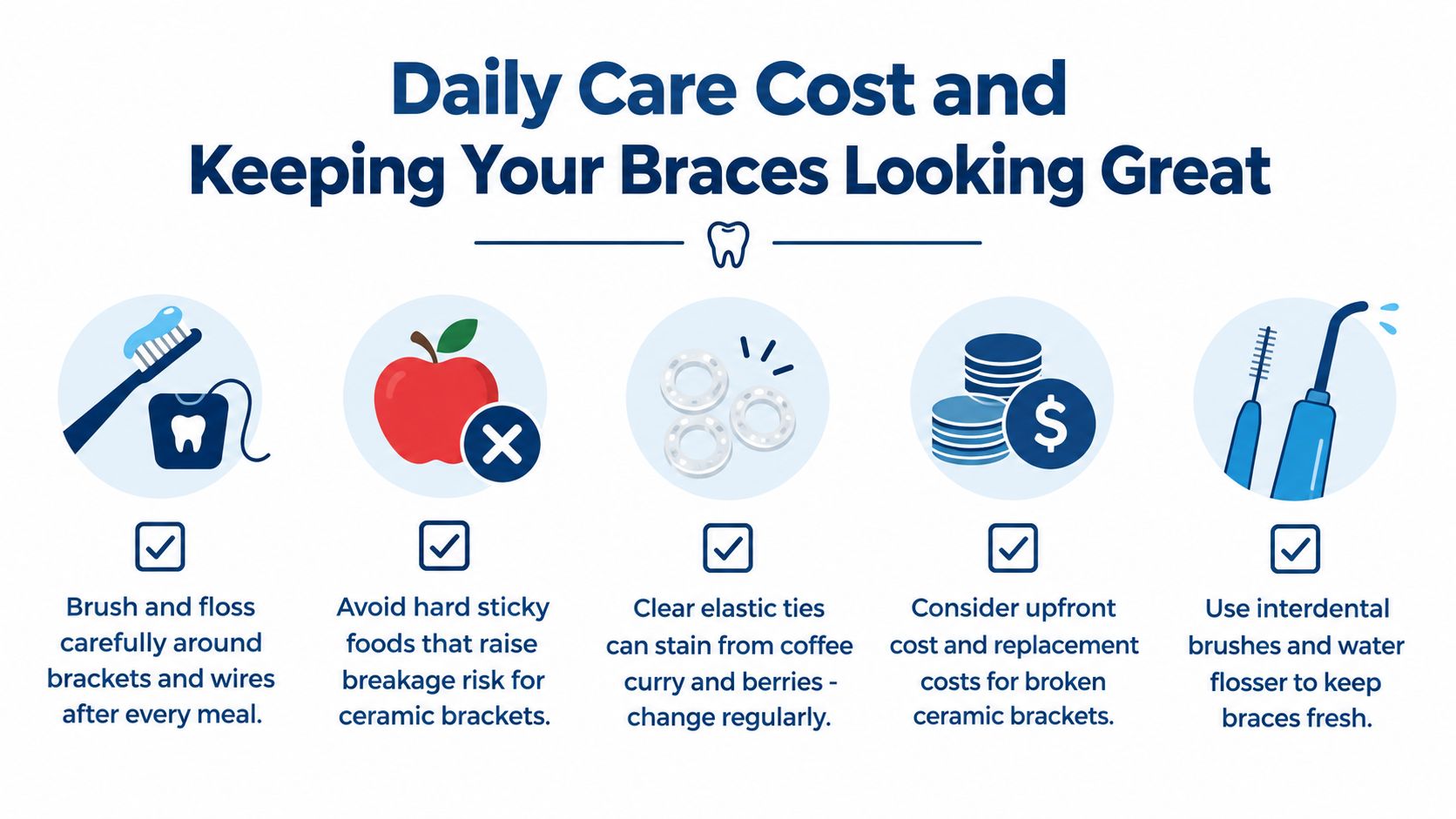
Brush around every bracket: Angle the toothbrush around the top, bottom, and sides of each bracket. Cleaning after meals helps remove food before it hardens around the appliance.
Clean between the teeth: Floss threaders, interdental brushes, or a water flosser can help reach spaces that a standard toothbrush misses. The orthodontic team can demonstrate the safest technique.
Choose foods carefully: Hard and sticky foods can loosen brackets or bend wires. Ceramic brackets deserve particular care because replacement may be more complicated if a bracket breaks.
Watch dark foods and drinks: Coffee, tea, red wine, tomato sauce, and other dark items can stain clear elastic ties. The ceramic bracket itself generally resists visible discoloration better than the tie.
Keep adjustment visits: Elastic ties are typically changed every 4 to 6 weeks, and these visits allow the orthodontist to check movement, replace components, and address problems (ceramic braces staining guidance).
Cost involves more than the initial appliance choice. Families should ask whether insurance contributes, whether replacement brackets have separate charges, what payment options exist, and whether Medicaid or CHIP applies to the child's treatment.
A family considering ceramic braces can use this guide to care for ceramic braces. The practice can also explain monthly payment arrangements and the details of coverage before treatment begins.
Making your final choice with Stellar Orthodontics
A sound decision usually comes from three questions:
What does the bite require? Ask whether the planned movements are mild, moderate, or complex, and whether ceramic brackets provide the desired control.
What can the patient maintain? Consider brushing, food choices, sports, music, school, work, and the likelihood of protecting the appliance.
What matters most emotionally and financially? Appearance, durability, treatment predictability, insurance, monthly payments, and replacement policies all deserve an open conversation.
A free consultation at Stellar Orthodontics includes an evaluation and iTero digital 3D scanning at any of the four Delaware locations. Families can bring questions about clear versus metal braces, treatment fit, care expectations, insurance, Medicaid, CHIP, and payment options.
The practice serves patients from North Wilmington and the Brandywine Valley, Middletown and the MOT corridor, Dover and Kent County, and Millsboro and Sussex County. The best choice depends on the patient's case complexity, lifestyle, and priorities, not on a single feature.
Stellar Orthodontics offers consultations for children, teens, and adults considering traditional metal braces or clear ceramic braces, with iTero digital 3D scanning available at four Delaware locations. Families can visit Stellar Orthodontics to book a free consultation and discuss which fixed-braces option fits the patient's smile, routine, and treatment needs.