
Invisalign trays are changed about once every 7 days, and each aligner is worn at least 22 hours a day. The prescribed interval can range from about 5 to 14 days, but that range only applies when the treating orthodontist sets it for a specific smile.
The schedule question has been asked in orthodontic offices since clear aligners hit the commercial market in 1999, and it still doesn't have one universal answer. A 2018 clinical study that pushed tray changes to a mean of 4.75 days described that pace as a 66% reduction from a 14-day interval, and the same report was careful to note that tray timing stays a prescription rather than a personal decision (Preprints.org clinical review). Faster is possible. Faster is not the same as better.
What follows is the practical version of that answer: the intervals you'll see in a treatment plan, what makes an orthodontist stretch one out or tighten one up, why a tray that feels loose is a poor signal, and what a calm change-day routine looks like at home.
Table of Contents
- How often most patients change Invisalign trays
- What can stretch or shorten the interval
- Why a loose tray is not a green light
- Teen and adult schedules in real life
- How to switch trays on change day
- Office visits between home tray changes
- Book a free consultation for your tray plan
How often most patients change Invisalign trays
Families usually arrive at this question with a number already in mind, and the number is usually seven. Most patients change Invisalign trays approximately every 7 days, and they wear each aligner at least 22 hours per day, taking it out only to eat, drink anything besides water, and brush. The American Association of Orthodontists explains that each tray applies controlled force that moves teeth only a fraction of a millimeter, so jumping ahead early can leave teeth under-moved and the next aligner fitting poorly.
That fraction is the whole reason a calendar exists. Each tray is molded for where the teeth are supposed to be on a specific date, not for where they were last week. If the mechanics of that handoff are still fuzzy, this walkthrough of what Invisalign is and how it works shows how one tray passes the job to the next.
Common Invisalign tray-change intervals
| Change interval | Often used for | Daily wear | What studies report |
|---|---|---|---|
| About 7 days | Most modern teen and adult plans | At least 22 hours | A randomized trial comparing 7-, 10-, and 14-day schedules found the weekly group finished months sooner with overall accuracy judged comparable |
| 10 days | A middle interval when a bit more time is wanted | At least 22 hours | One review found front-tooth movement similar across 7-, 10-, and 14-day intervals |
| 14 days | Harder movements or incomplete tracking | At least 22 hours | Still widely prescribed when a single tray carries more work per step |
| About 5 days | Only when the orthodontist monitors fit and movement | Full-time, as prescribed | Supervised study settings have used sub-weekly changes safely; not a do-it-yourself shortcut |
| Every 2 to 3 weeks | Some plans for growing patients | As prescribed | Most reviewed studies in growing patients used weekly changes, with a smaller share using every 2 or 3 weeks |
Weekly earned its place by winning the comparison. In a randomized clinical trial, patients were assigned to change aligners on 7-, 10-, or 14-day schedules and were followed through the end of treatment. The weekly group reached the finish line months sooner, while the overall accuracy of tooth movement stayed comparable across all three schedules. The slowest schedule did measure slightly better on a few back-tooth movements, including intrusion and crown-tipping control, but those differences stayed below the size clinicians treat as meaningful.
Why the five-day row gets misread
Short intervals exist in the research record, and they always come attached to monitoring. The patients who switched ahead of a week were in supervised studies where someone confirmed that tooth movement and aligner fit were adequate before each step. A tray that slides off easily on a Tuesday at home is a different situation entirely, and a number pulled from a study page was never meant to be borrowed for a kitchen-table decision.
Where the two- and three-week plans come from
Some plans, especially ones written for children who are still growing, deliberately slow the pace. A 2025 systematic review of clear aligner treatment in growing patients found that 12 included studies recommended weekly tray changes, while 5 recommended changes every 2 or 3 weeks (Frontiers in Oral Health review). Both choices come out of the same math: how much movement the orthodontist is asking a single tray to deliver.
Weekly is still the row families recognize first, partly because it is easy to live with. Change day lands on the same weekday every time, so it slides into a routine the way trash night does. That convenience is a bonus; the interval exists because the biology needs it.
The line that settles every argument: the date written on the patient's own plan overrides both the most common interval in any table and how loose the current tray happens to feel.
What can stretch or shorten the interval
A weekly tray change is where most plans begin, and plenty of plans stay on seven days from first tray to last. The interval is still a clinical decision, built from the type of movement planned, how the bone and ligament respond, and how many hours the aligner spends on the teeth. Change any one of those and the right number of days moves with it.
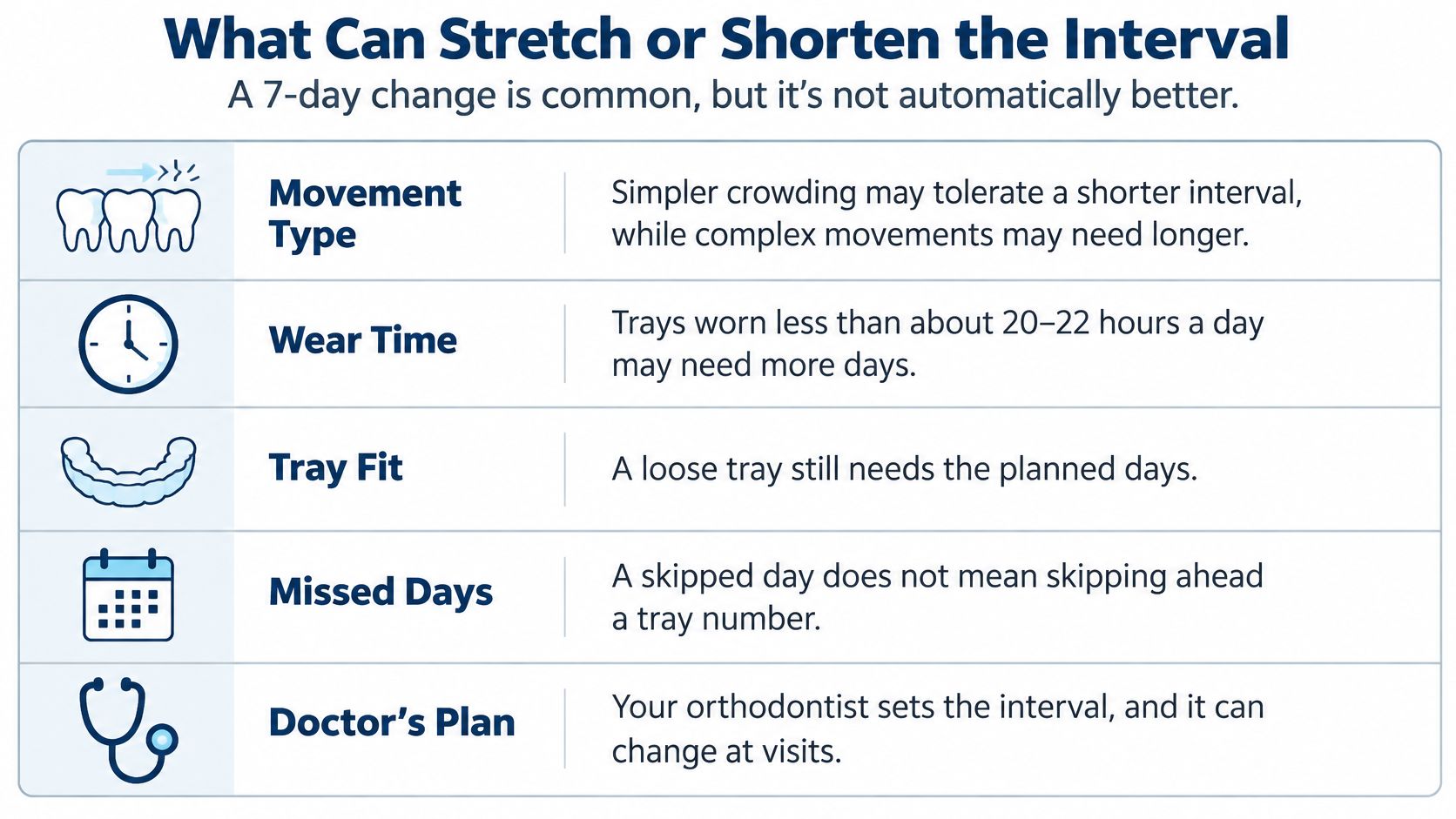
Factors that change a tray interval
| Factor | May support the shorter prescribed interval | Often means stay longer |
|---|---|---|
| Type of movement | Mild crowding or simpler tipping when the tray seats fully | Rotations, torque, or difficult back-tooth movements |
| Expansion | Only if the orthodontist already planned a weekly expansion stage | Widening stages, which have shown better accuracy on longer intervals in adult research |
| Age and response | Many teen plans are written as weekly | Slower schedules, which matched or exceeded weekly results for older adults in trials |
| Hours worn | At least 22 hours, with attachments staying on | Under 18 hours a day, linked with a higher chance of attachment loss |
| How the tray fits | Current tray fully seated and attachments engaged on the assigned day | New tray won't seat, an attachment misses its window, or the current tray is still very tight |
Movement type and the 7 to 14 day band
A review of aligner schedules found that most studies adopted 7- to 14-day wear periods, with 14 days the most frequently reported, and described a personalized approach in which simpler tooth movements may use shorter intervals while complex movements such as rotations or back-tooth torque may require longer wear (review of clear aligner protocols). In practice, one patient can be weekly for the front teeth and slower for a stubborn molar rotation inside the same plan. The schedule follows the hardest movement in the stage, because rotating a root inside bone takes more sustained pressure than sliding a tilted tooth upright.
Expansion and the extra week
Widening the arch is a bigger ask per tray than straightening a crooked front tooth, so it behaves differently on the calendar. A 2024 retrospective cohort study of 120 adult Invisalign patients, split into three groups of 40, compared 1-week and 2-week tray-change regimens and found that 2-week regimens provided better expansion accuracy (adult Invisalign cohort study). When a plan includes a widening stage, the extra days are part of the prescription.
Wear hours and adult response
Wear time is the factor families control directly, and it changes the math. Aligners are generally prescribed for at least 22 hours daily, and observational evidence links wearing them fewer than 18 hours per day with a higher probability of attachment loss (Orthodontics and Craniofacial Research trial report). If hours get missed, the safer move is to extend the current tray rather than jump ahead to catch up.
Age plays a role as well. In clinical trials of older adults, seven-day and fourteen-day schedules both reduced crowding, and the two-week groups sometimes gained more correction on crowded lower-front teeth within the study window. Biology answers at its own pace, which is why the same brand of tray can carry different change dates from one patient to the next.
Fit is the tiebreaker
If a new tray refuses to seat completely, an attachment isn't engaging its window, or the previous tray still feels unusually tight on change day, the safe move is to keep the current tray and call the office. Every row in the table is something an orthodontist weighs when writing or adjusting the schedule, and the date can shift again later in treatment as tracking improves or a harder stage begins. Through all of it, the dated plan from the orthodontist decides each change.
Why a loose tray is not a green light
Picture a staircase rather than a light switch. Each aligner is one small step, and the plastic is shaped a fraction of a millimeter ahead of where the teeth sit today. The tooth, the bone around it, and the ligament that anchors it need days of steady pressure to travel that distance. When the tray starts to feel easy to pop out, the plastic has usually seated onto the teeth. It doesn't mean the root has finished moving into its new position.
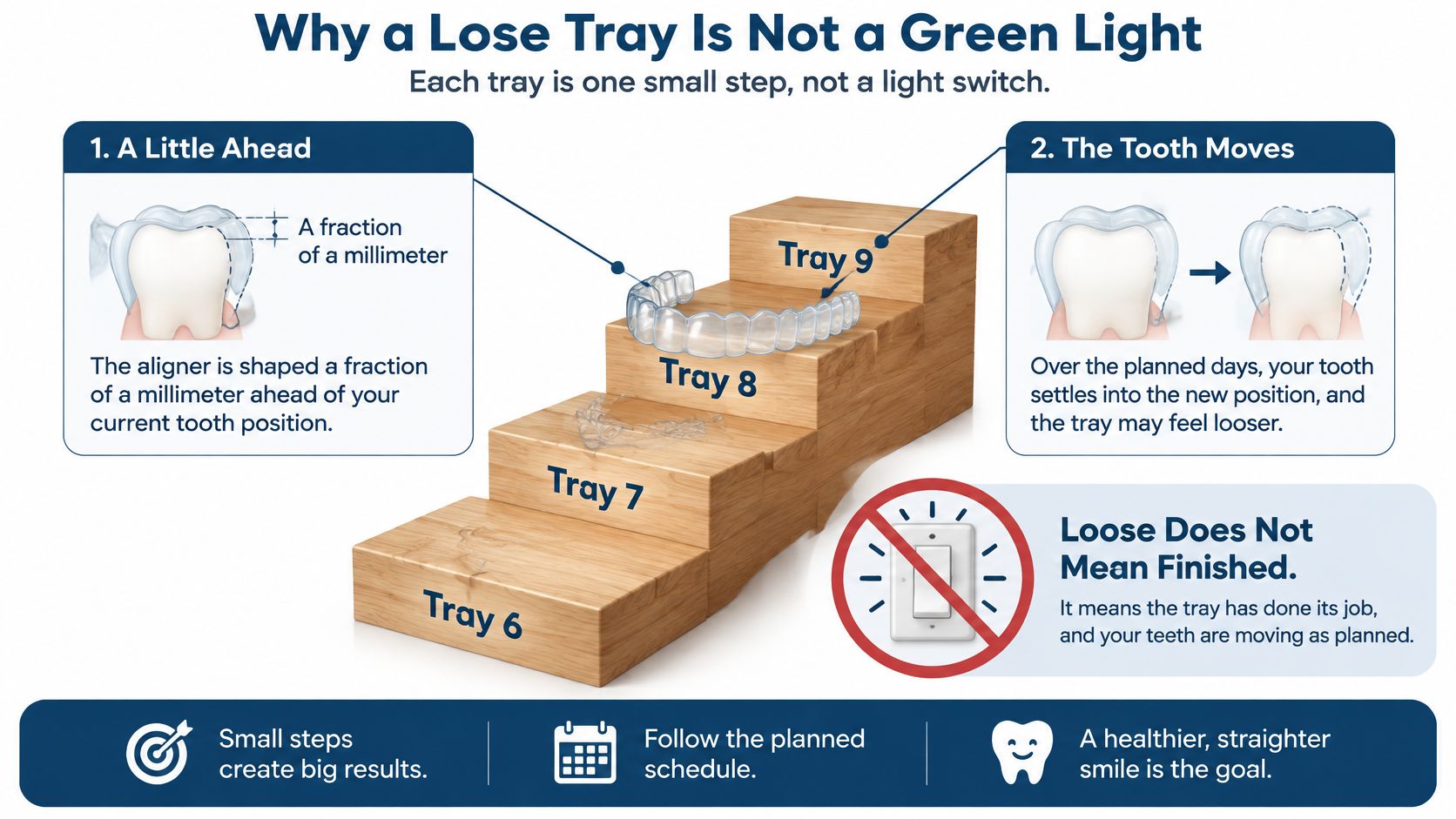
What happened when researchers shortened the schedule safely
The interesting question isn't whether trays can change faster than a week. It's what has to be true first. A 2024 randomized clinical trial conducted through Harvard School of Dental Medicine compared individualized progression with the conventional 7 to 14 day range. The study enrolled 76 patients, with 48 completing the protocol, and evaluated 10 trays per participant.
Patients who used digital monitoring and received individualized change instructions progressed at an average of 4.315 to 5.370 days per tray, faster than the standard schedule, with the difference statistically significant at p<0.01. Full-time wear groups averaged 4.407 days per tray, compared with 5.310 days for half-time wear groups. Use of a vibration device did not produce a statistically significant difference (Harvard School of Dental Medicine clinical trial).
Notice what made the shorter average possible. A clinician was reviewing movement and fit, tray by tray, and adjusting the instructions. Tray changes may sometimes occur in fewer than 7 days, but only when the orthodontist confirms that tooth movement and fit are adequate.
Change on the assigned day unless the office says otherwise.
The checks that comfort can't replace
A tray that looks clear and feels easy can still be ahead of the biology, so use the checks that don't depend on sensation.
- Full seating: the aligner is all the way down, with no visible gap along the biting edges.
- Attachments engaged: every tooth-colored attachment sits inside its matching window in the plastic.
- Wear hours: the day reached roughly 20 to 22 hours, not 14 with a long lunch and a nap.
- The plan date: the calendar says today, not "soon."
Manufacturer-style guidance still describes a common 1 to 2 week range and leaves the specific schedule to the prescribing doctor. For children, teens, and adults alike, the practical rule is to follow that doctor's schedule rather than changing trays early based on comfort or appearance. If a first tray still feels foreign, these tips on getting used to Invisalign help without touching the calendar.
Teen and adult schedules in real life
Three households, three calendars, one shared principle: the plan wins. Here is how the same seven-day or fourteen-day question looks on a real family schedule.

The Middletown teen on a weekly plan
A 14-year-old starts tray 8 on a Monday night and changes again the following Monday night. Between those two dates the aligner lives in its case during lunch and soccer practice, goes back in after every meal, and still lands near 22 hours because the routine is the same every day. Eight trays later, the orthodontist looks at tracking and decides whether the next stretch stays weekly or stretches longer.
The full arc for adults is usually shorter than parents expect. Invisalign for adults often finishes in 6 to 18 months, so even a weekly rhythm is a season of life rather than a years-long habit.
The adult with an expansion stage
An adult in Dover whose plan includes widening the upper arch stays on 14 days for that stage. Nothing has stalled. Widening movements ask more of the tissue around each tooth, and a longer interval gives that slower work time to finish before the next tray takes over. When the plan moves into alignment, the orthodontist shortens the interval again.
The growing patient on two or three weeks
A younger child whose doctor chose a slower pace changes every two to three weeks. That cadence is not an outlier and not a sign that something is wrong. Slower schedules are a routine part of aligner care, especially while a mouth is still growing and the plan is timing movements around incoming adult teeth.
Both rhythms are normal across a whole practice
A 2024 Australian survey of general dentists reported recommending fortnightly tray changes for 50.9% of adult cases and 33.9% of adolescent cases, while weekly changes were recommended for 45.6% of adult cases and 40.3% of adolescent cases (survey of aligner prescribing habits). Weekly and fortnightly plans are both in everyday use, often in the same office on the same afternoon.
These three scenes are illustrations, not instructions. A family in North Wilmington, Middletown, Dover, West Dover, or Millsboro follows the dates on their own plan, because that plan was built for one specific set of teeth.
How to switch trays on change day
Change day has a routine, and the routine is short. Do it in the evening, follow the same order every time, and the transition stops being a source of anxiety for the whole household.
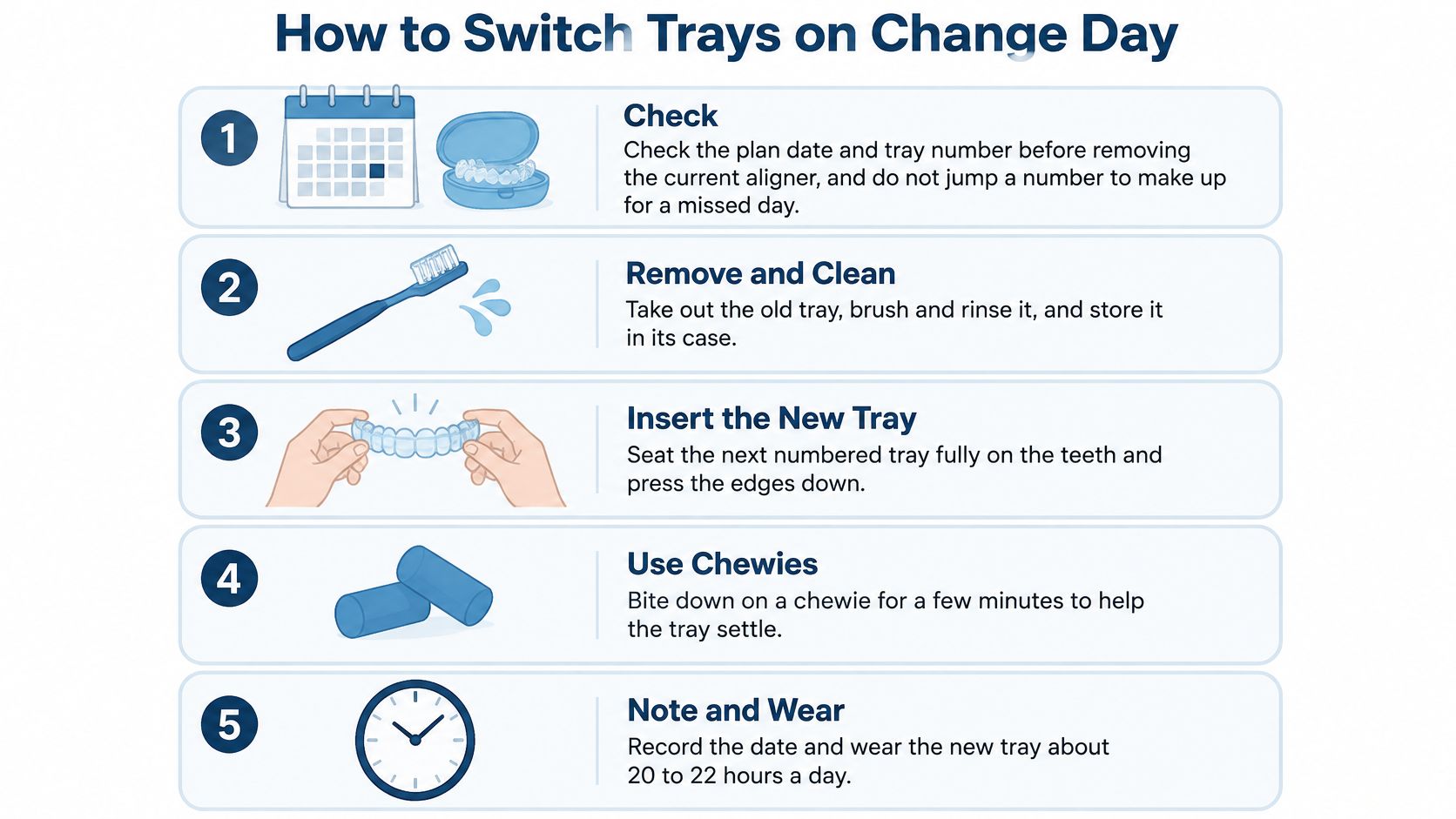
- Check the plan date and tray number before you take the current aligner out. The number on the package has to match the number on the schedule. Don't jump ahead to make up for a missed day.
- Brush and floss first. Food trapped under a fresh tray sits against the teeth for hours.
- Seat the new tray with fingertip pressure, front to back, until it feels even. Biting it down hard or reaching for unapproved tools can bend the plastic.
- Look at every attachment. Each one should sit inside its matching window. A tray resting on top of an attachment instead of around it will never settle properly.
- Switch at bedtime when the plan allows. A new aligner may feel tighter or create mild pressure when it's first inserted, and wearing it overnight lets the patient sleep through the adjustment (Invisalign guidance on week one versus week two).
- Expect mild pressure, and know what isn't normal. Tightness that eases within a day or two is ordinary. Pain that keeps someone from seating the tray at all is a reason to call.
- Wear the new tray about 22 hours the next day. Take it out for meals and brushing only, and store the previous tray in its case in case the office asks the patient to step back one.
- Stop if the tray won't seat, an attachment won't engage, or a long stretch of wear was missed. Contact the treating orthodontist instead of forcing the next number. The first two weeks of treatment may feel different from later changes, but every tray is still one planned step in a sequence.
Families run this routine at home between visits, and it never replaces the doctor's date. The seating process in motion looks like this.
The step people skip: rinsing and storing the old tray. If a new tray turns out not to seat, having the previous one clean and in its case is what lets the orthodontist give a calm answer instead of improvising.
Office visits between home tray changes
The home schedule runs weekly or every 14 days, while the office schedule runs every 6 to 8 weeks. At Stellar Orthodontics, adjustment visits take place every 6 to 8 weeks, last about 30 minutes each, and are with the same orthodontist at every appointment. That slower clock is the checkpoint: the person who wrote the dated plan is the person checking whether the teeth are following it.
The arithmetic makes the gap feel less mysterious. Across an eight-week stretch, a weekly wearer goes through about eight trays at home, and a 14-day wearer goes through about four. The visit measures tracking, confirms attachments are still bonded, spots a tray that never fully seated, and decides whether the next batch stays weekly, slows down, or holds a stage so a tooth can catch up.
What the visit is for
First come seating and tracking, then the small hardware problems: a lifted attachment, an aligner edge that rubs, a tray that fits on one side but not the other. Wear time gets an honest look too, because several short days can make a perfectly good tray look like a bad plan. If the assigned orthodontist is out, another orthodontist in the practice can provide continuity of care, so care stays continuous inside the same treatment plan.
When to call instead of waiting for the visit
Call between visits for a lost aligner when no previous tray was saved, for wear that stayed well under the prescribed hours for several days, or for a new tray that will not seat. Mild pressure on night one is expected and is not by itself a reason to come in. When teeth resist even with solid wear, the answer may be refinements, the planned extra round described in what Invisalign refinements are.
Book a free consultation for your tray plan
Only an exam sets a person's change day. Every interval in this article is a range that an orthodontist narrows after looking at the teeth, the bite, and the treatment goal, which means the answer to how often to change Invisalign trays for one specific child or adult can't come from a chart or a group chat.
Stellar Orthodontics offers free consultations at four Delaware offices: North Wilmington, Middletown, Dover/West Dover, and Millsboro. A free consultation walks patients through Invisalign, braces, timing, and financing in plain language, and it follows six steps.
- Check-in, about 5 minutes.
- Meeting the orthodontist, who explains the options, about 5 minutes.
- A clinical exam of teeth and bite, about 10 minutes.
- A digital 3D iTero scan and any x-rays the plan needs, about 15 minutes, with no traditional impression tray.
- A treatment plan reviewed on screen, about 15 minutes, showing the teeth in 3D and a preview of the final smile.
- A financial walkthrough, about 10 minutes, covering costs and monthly payment options.
Two questions are worth asking out loud at that visit: whether the child, teen, or adult is a candidate, and what change interval that particular smile would use. Families should also know that Delaware Medicaid generally does not cover Invisalign or clear aligners, which are an upgrade option requiring private payment, with monthly financing available.
Then the routine begins: wear the trays as prescribed, change on the given day, and call the office if a tray won't seat.
Stellar Orthodontics treats children, teens, and adults at four Delaware locations in North Wilmington, Middletown, West Dover, and Millsboro, with Invisalign and braces available at every office. The team can look at a smile, explain what a realistic tray schedule would look like, and put the change dates in writing so nobody has to guess from how a tray feels. Book a free consultation with Stellar Orthodontics and leave with a plan instead of a rule of thumb.