
The first tray is in, the mirror check looks fine, and then real life starts. Lunch is in twenty minutes, a teen has to answer a question in class, and a parent is wondering whether that tight feeling is normal or a reason to call. That's the moment when how to get used to Invisalign stops being about the plastic itself and becomes about routines.
Most adjustment is short and predictable. Soreness fades, speech settles, and removing the trays gets easier with practice. The part that trips families up is usually the public routine, taking trays out at school, restaurants and sports, and knowing what to do after a missed day. A clear plan for those moments makes the first weeks feel manageable.
Table of Contents
- Your First Two Weeks at a Glance
- The Daily Wear Routine That Makes Adjustment Stick
- Speaking and Eating Through the Adjustment
- Carrying Aligners Through School, Meals and Sports
- Cleaning Your Trays Step by Step
- Fixing Missed Wear and Problem Symptoms
- Book a Free Consultation to Check Your Progress
Your First Two Weeks at a Glance
Most of the physical adjustment happens early. A new tray feels tight, teeth feel tender when biting, and speech may sound slightly different. Those changes don't mean treatment is failing. They're the normal signs of a mouth adapting to something new, and each later tray usually brings a milder version of the same cycle.
What the timeline looks like
In a study reported in the 2021 European Journal of Orthodontics study comparing clear aligners with fixed appliances, orthodontic pain peaked on the first day and gradually decreased afterward, and the clear-aligner group reported lower pain than the fixed-appliance group on several early treatment days and during the first two weeks. That pattern helps parents set expectations. Day one can feel like a lot, then the pressure usually eases rather than builds.
Speech follows a similar arc. Many patients adapt within 7 to 14 days, while a smaller number need longer. Chewing tenderness also tends to be strongest early, which is why soft foods help at first. Wear time is different. It doesn't ramp up slowly. The full daily target starts on day one, even while the mouth is still getting used to the trays.
| Adjustment area | Usually starts | Typical timing | What helps |
|---|---|---|---|
| Soreness and pressure | Day one of each new tray | Peaks on day one, eases over the first week | Cool water and a new tray at bedtime |
| Speech changes | Day one | Most patients adapt within 7 to 14 days; some take 30 to 60 days | Reading aloud and everyday conversation |
| Chewing discomfort | First few days | Peaks in the first week | Soft foods for the first days |
| Daily wear time | Day one | Ongoing, 20 to 22 hours per day | Insert trays after brushing and carry the case |
Tray changes restart a smaller adjustment cycle. A set is commonly changed on the schedule the orthodontist sets, often every one to two weeks, and the new tray can feel tight again for a short time. That return of pressure is expected. It doesn't mean the previous tray didn't work.
Normal versus worth a call
Mild pressure, extra saliva, a slight lisp and tender chewing fit the normal early picture. A different set of signals calls for advice.
- Severe or persistent pain: Discomfort that stays intense or keeps getting worse needs review.
- Sharp edge: A tray that cuts the cheek or gum should not be ignored.
- Damaged tray: A crack, tear or tray that no longer fits needs an office decision.
A useful rule for parents is simple. Expected discomfort trends downward. Pain that trends upward deserves a call.
Families shouldn't change the prescribed wear schedule on their own because a tray feels uncomfortable or, just as important, because it feels fine. The orthodontist can tell the difference between normal adaptation and a fit problem, and that distinction keeps treatment on track.
The Daily Wear Routine That Makes Adjustment Stick
Physical comfort is only half of adjustment. The other half is habit. Aligners move teeth only while they're in place, so a routine that protects wear time matters more than willpower in the moment. The steps below work because each one removes a common reason trays stay out too long.
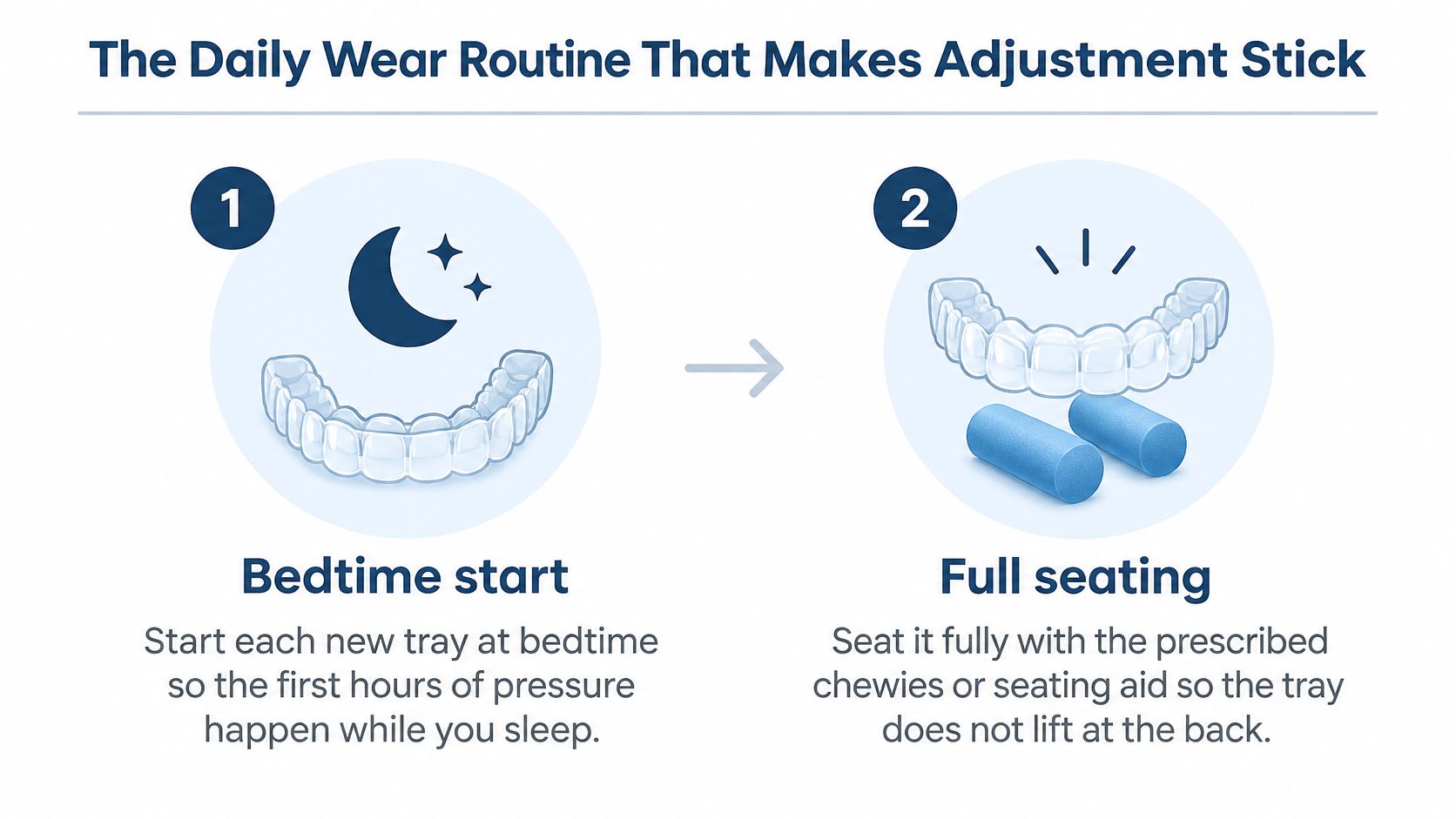
The visual summary shows the first two habits in the routine.
The seven steps
- Start each new tray at bedtime. The first hours of pressure happen during sleep, when there's no talking, eating or temptation to take the tray out. By morning, the tightest stretch is often already past.
- Seat the tray fully. Clean hands go first, then the tray is pressed into place with the prescribed chewies or seating aid. A tray that still lifts at the back isn't seated, and a partially seated tray can't apply pressure as planned.
- Hit the daily target. A pediatric clear-aligner review describing approximately 22 hours per day as the usual recommendation estimates that about 400 total hours of wear may be needed for aligners to work effectively during an early treatment phase. Clinical guidance commonly puts the range at 20 to 22 hours per day. Trays come out mainly for eating, drinking anything besides water, brushing and flossing.
- Clean teeth before reinsertion. Brushing and flossing first keeps food and bacteria from sitting trapped under the plastic for hours. When a full brush isn't possible away from home, a thorough rinse is better than leaving the tray out.
- Use the case every single time. A spare case belongs in a backpack, purse or lunch bag pocket. A tray wrapped in a napkin looks exactly like trash, and that's how many trays get thrown away.
- Log missed time for the first month. A phone note or a paper calendar on the fridge works. Writing it down reveals patterns fast, such as long weekend lunches or trays left out after sports practice.
- Change trays on schedule, not on feel. A tray that feels comfortable hasn't necessarily finished its job. Moving ahead early can cut the wear hours a phase needs, so the next tray waits until the orthodontist's schedule says so.
Practical rule: If trays go back in right after brushing, most of the day takes care of itself. Delays, not meals, are what usually eat into wear time.
Why small delays add up
Say a teen takes trays out for lunch and forgets them until after the next class. That single delay can cost more time than the meal itself. Repeated a few times a week, it creates a real gap between prescribed wear and actual wear. Removing aligners repeatedly or leaving them out for long stretches can reduce tracking, meaning teeth stop following the tray's plan closely, and treatment can stretch out.
The fix is boring and effective. Case in a fixed pocket, trays back in right after eating, and a quick note when something goes off script. Parents of younger patients may need to supply reminders at first, but the routine itself is the same for teens and adults. Once those habits hold for a few weeks, adjustment stops feeling like a project and starts feeling like part of the day.
Speaking and Eating Through the Adjustment
A slight lisp on day one catches many patients off guard. It isn't a sign that the tray fits badly. The tongue has a new surface to work around, and it needs practice to adjust. Talking more in the first days, not less, speeds that process up.
Speech drills that help
The 2023 systematic review of speech effects with clear aligners found effects involving sounds such as /s/, /z/, /sh/, /th/ and /ch/, with 52% to 85% of patients reporting some speech alteration across the studies. Many recovered within 7 to 14 days, although a smaller number took 30 to 60 days. Lisping, slurring or slightly altered articulation were the common reports.
Short, regular practice works better than one long session.
- Read aloud twice a day: Five minutes from a book, homework or song lyrics gives the tongue steady practice.
- Target the hard sounds: Words packed with s and sh sounds, repeated slowly, train the exact movements that feel awkward.
- Keep normal conversation going: Ordinary talking at home and school is practice too, and it builds confidence faster than staying quiet.
Most listeners notice far less than the speaker does. A teen who feels the lisp is obvious often sounds nearly normal to classmates. That gap between how speech feels and how it sounds shrinks as adaptation continues.
Eating in the first week
Trays come out before anything except water. That's essential, because eating with trays in traps food against teeth and can damage the plastic. The meal itself can stay normal in most ways, with one early adjustment. Teeth that are tender from a new tray handle soft foods better for the first few days.
Soup, pasta, scrambled eggs, yogurt and mashed foods ask little of sore teeth. Harder foods don't have to disappear entirely. Cutting them into smaller pieces reduces the bite force needed and often makes chewing comfortable enough. As the week goes on and tenderness fades, regular foods usually come back without much thought.
After eating, teeth get brushed and the tray goes back in. That sequence matters because a clean mouth under a tray protects both teeth and gums during the long wear hours ahead.
Two signs justify a call here. Speech problems that get worse instead of better, or that stay well past the typical adaptation window, should be discussed with the orthodontist. Chewing pain that doesn't improve with soft foods and time deserves the same check.
Carrying Aligners Through School, Meals and Sports
Ask families what adjustment really involves, and soreness rarely tops the list after the first week. The harder problem is logistics. Trays have to come out in cafeterias, restaurants and locker rooms, places where a teen would rather not draw attention. A 2025 consumer-perception study of aligner users found the main difficulty was the inconvenience of removing aligners for eating and drinking in public, while speech problems were generally absent or temporary.
That finding reframes what successful adjustment means. It's less about whether a lisp disappears and more about whether the removal and reinsertion routine holds up away from home. A teen with a reliable public routine protects wear time without stress. A teen without one starts skipping, delaying or losing trays.
The photo below shows the most common daily test of that routine, the school lunch table.

A routine for each moment
At school lunch, the whole process fits in about two minutes. Tray out, straight into the case, eat, rinse with water, tray back in. The case lives in one dedicated pocket, never loose in a lunch bag where it can be tossed with wrappers. At a restaurant, the case goes in a jacket or purse before food arrives, not on the table where a server clearing plates can sweep it away.
For sports, families should talk with the coach about a water bottle and a safe locker spot in advance. The risk isn't practice itself. It's a tray forgotten in a gym bag for the whole afternoon, costing hours of wear. For sleepovers and field trips, a second case and a travel toothbrush packed the night before remove the morning scramble.
| Moment | Where the tray goes | Rinse and reinsert |
|---|---|---|
| School lunch | Dedicated case pocket, never a lunch bag | Two-minute window; rinse with water, then reinsert |
| Restaurant | Case in jacket or purse before food arrives, not on the table | Remove before eating; rinse, then reinsert |
| Sports practice | Case in locker or coach-approved spot, not a gym bag | Water bottle for drinks; reinsert after practice |
| Sleepover or field trip | Second case packed in advance | Travel toothbrush for cleaning before reinsertion |
The video below walks through daily aligner handling for families who want to see the removal and storage steps in action.
A thirty-second morning check helps parents support the routine without hovering. Case in the pocket, trays in the mouth, water bottle filled. If the school day keeps making the daily target hard to hit despite a solid routine, the orthodontist can help adjust the plan. That's a better conversation than accepting shrinking wear time.
Cleaning Your Trays Step by Step
Clean trays feel better, look clearer and smell neutral. Dirty trays do the opposite, and buildup happens faster than most families expect because the plastic sits against teeth for most of the day. Cleaning isn't a separate chore bolted onto treatment. It's part of the same daily rhythm as brushing.
The everyday clean
Each time a tray comes out, it gets rinsed. Before it goes back in, it gets brushed gently with a soft-bristled toothbrush. The Invisalign cleaning system instructions recommend rinsing aligners and brushing them with a soft-bristled toothbrush before reinserting them, and removing them before consuming anything other than water because food and drinks can stain them. Lukewarm water is the safe choice, since hot water can affect the aligner material.
The deeper clean in four steps
- Fill a container with warm water. Warm means comfortable to the touch, not hot from the tap.
- Add the cleaning crystals. About 20 seconds of gentle shaking or stirring dissolves them fully.
- Soak the tray for 15 minutes. That's long enough for the solution to do its work without extra scrubbing.
- Rinse thoroughly. All residue comes off before the tray goes back in the mouth.
For a fuller walkthrough of products and habits, the guide on cleaning Invisalign trays at home covers the routine in more detail. Families don't need a shelf of products. Consistency with the basic steps beats occasional deep cleaning after buildup has already set in.
Storage matters just as much as washing. A tray that's out of the mouth belongs in its clean case, never wrapped in a napkin and never left loose on a counter. The case protects against loss, damage and contamination in one habit.
A tray should have exactly two locations, in the mouth or in the case. Every other spot is where trays get lost or broken.
The safety line
- Severe or lasting pain: Call the orthodontist rather than waiting it out.
- Sharp edge: A rough spot that cuts tissue needs professional attention.
- Visible damage: Cracks or warping mean the office decides the next step.
One firm boundary protects the tray and the treatment. Nobody should file, trim or cut aligner plastic at home, even for a small rough edge. A home fix can change how the tray fits and create a bigger problem than the one it solved.
Fixing Missed Wear and Problem Symptoms
A tray left on a bathroom counter overnight. A full day at a tournament with the case sitting at home. These lapses happen in almost every treatment, and they're fixable when families know the recovery rule. What causes trouble isn't the lapse itself. It's guessing what to do next.
The missed wear rule
The rule has three parts. Keep the current tray in. Don't jump to the next tray just because the calendar date arrived. Tell the orthodontist, at the next visit or sooner if the tray no longer seats well. Clinical staff decide whether a tray gets extended, replaced or changed, because progression isn't purely a calendar event. A tray worn too few hours hasn't finished its planned movement, and advancing anyway asks the next tray to do double work.
There's comfort in the numbers on this. A review of aligner compliance reported that only 37% of patients wore aligners for more than 22 hours per day, and a recent clinical protocol required patients who failed to wear an aligner for the full recommended duration to extend that tray before advancing. Falling short sometimes is common. Hiding it from the orthodontist is the part that slows treatment down.
Teens face the most predictable lapses. Sleepovers, sports days and forgotten cases are part of a normal schedule, not personal failures. A backup routine helps, with reminders on a phone, a case that lives in one pocket, and a plan for what happens after a snack away from home. Families who lose a tray entirely can find next steps in the guide to what to do after losing an Invisalign aligner.
Symptoms and first steps
| Symptom | Likely cause | What to do |
|---|---|---|
| Tray lifts at the back | Tray not fully seated | Reseat with chewies; call the office if it still lifts |
| Tray will not seat | Warped tray or wrong tray | Do not force it; call the office |
| Sharp edge or cut | Rough tray edge | Contact the orthodontist promptly |
| Pain that stays or grows after week one | Pain beyond normal adjustment | Call the office for review |
| Missed a full day of wear | Forgotten or left-out tray | Keep the current tray in and tell the office at the next visit |
| Lisp past 14 days | Slower speech adaptation | Discuss with the orthodontist; some patients take 30 to 60 days |
A tray that lifts slightly at the back usually needs proper seating with chewies before it needs anything else. A tray that still lifts after careful seating, or one that won't go on at all, shouldn't be forced. Force can crack the plastic or hurt a tooth, and neither outcome speeds anything up.
Most off-track moments have simple fixes. An extra few days in the current tray, a reseating lesson, a replacement ordered early. The fixes get harder only when problems sit unreported for weeks. A quick call keeps a small detour from becoming a long one.
Book a Free Consultation to Check Your Progress
Adjustment questions rarely need guesswork. A free consultation at Stellar Orthodontics gives families a place to review progress, check how a tray is tracking and talk through whether Invisalign or braces suits the patient best. The visit walks patients through Invisalign, braces, timing and financing in plain language, and it includes a full orthodontic exam, a 3D iTero scan and a printed treatment plan with transparent pricing before the patient leaves.
Coming prepared makes the conversation more useful. A short list helps the orthodontist give precise answers instead of general ones.
- Current daily wear time: Honest hours, including the days that fell short.
- Which tray is in now: The set number and when it started.
- Speech or soreness concerns: What's improving and what isn't.
- Missed or unseated trays: Any tray that was lost, skipped or no longer fits.
Those details matter because clinical staff, not online advice, decide whether a tray should be extended, replaced or changed. Parents of teens can also ask directly about school lunches, sports schedules and sleepovers, and build the public routine around real answers. During active treatment, adjustment visits take place every 6 to 8 weeks, last about 30 minutes each, and are with the same orthodontist at every appointment.
The photo below shows the kind of unhurried conversation families can expect when reviewing aligner progress.

Stellar Orthodontics sees families across Delaware at four locations, North Wilmington, Middletown, Dover/West Dover and Millsboro, so most patients can pick the office closest to home or school. Families ready to ask questions in person can book a free consultation and bring their list along. Getting used to Invisalign is mostly a matter of weeks and habits, and a short visit can confirm that everything is moving the way it should.
Stellar Orthodontics helps Delaware families at every step, from fitting the first aligner tray to building the school, sports and sleepover routines that keep wear time on track. Anyone starting treatment, supporting a teen through the first weeks, or wondering whether a symptom needs attention can get clear, in-person answers at a free consultation. Visit Stellar Orthodontics to book at the North Wilmington, Middletown, Dover/West Dover or Millsboro location and start with confidence.