.png)
An adult notices the same detail in every photo: one front tooth sits slightly forward, a few lower teeth overlap, or a gap appears whenever the smile opens. The goal isn't a dramatic makeover. It's a straighter, more balanced smile without returning to the metal braces many adults remember from childhood.
That's why Invisalign adults before and after results deserve a realistic explanation. The visible change matters, but so do the daily habits, bite corrections, refinements, and long-term retention that make the result worth keeping.
Table of Contents
- Why Adults Are Choosing Clear Aligners
- Real Adult Invisalign Before and After Examples
- Steps to Start Your Clear Aligner Journey
- Tips for Wearing Aligners Comfortably
- Maintaining Your Results After Treatment
- Book Your Free Consultation in Delaware
Why Adults Are Choosing Clear Aligners
A parent may want straighter teeth before family photos. A professional may want treatment that fits meetings and presentations. Another adult may have completed orthodontic treatment years ago and noticed gradual shifting. These patients often share the same concern, they want improvement without brackets and wires becoming the first thing people notice.
Clear aligners answer that concern with removable trays that fit over the teeth and guide planned movement. Adults can take them out for meals, brushing, and important occasions, although consistent wear remains essential. That combination of discretion and flexibility has helped make clear-aligner treatment a mainstream adult option rather than a niche service.
Adult demand is no longer secondary
The scale of adult treatment tells an important story. Align Technology was founded in March 1997, and the FDA cleared Invisalign in 1998 for patients with permanent teeth. By 2025, the company reported more than 22 million Invisalign patients worldwide, over 295,000 active Invisalign-trained doctors, and more than 2.4 billion clear aligners manufactured globally in its reported Invisalign commercial history.
Adults now make up the largest part of the clear-aligner audience. Industry forecasts for 2025 placed adult market share between 65% and 70%, while other estimates placed it at 74.58% or 64.16%, depending on the measurement method, as summarized in clear-aligner market forecasts. The exact estimate varies, but the direction is clear. Adults are a central part of modern orthodontic care.
Practical rule: The best treatment is the one that fits an adult's bite, schedule, and ability to follow instructions, not simply the one that looks least noticeable.
The discreet appearance is only one advantage. Adults also value the ability to remove trays before eating and to maintain normal brushing and flossing routines. Still, clear aligners aren't automatically right for every bite. Complex movements may require a different plan, refinements, or another orthodontic approach. A proper examination matters more than a polished online gallery.
Real Adult Invisalign Before and After Examples
Before-and-after photos can make treatment look effortless. Real adult cases are more nuanced. The starting problem, the type of tooth movement, the bite relationship, and daily wear all influence what the final result can look like.
The following profiles are representative treatment scenarios, not promises about an individual patient.
Deep bite and excessive overlap
An adult with a deep bite may have upper front teeth covering too much of the lower teeth. The visible concern can be a short-looking smile, but the orthodontic concern is how the upper and lower teeth meet.
A 2026 systematic review and meta-analysis examined dual-arch Invisalign treatment for adult deep-bite cases. It included six retrospective studies involving 177 adults, with mean ages ranging from 24.5 to 40.0 years. The pooled mean overbite reduction was 1.79 millimeters, with a 95% confidence interval from 1.03 to 2.54 millimeters and a reported p value below 0.001, according to the adult deep-bite treatment analysis.
That result shows that adult aligner treatment can produce a measurable bite change. It doesn't mean every deep bite will respond identically. The orthodontist must assess tooth position, supporting structures, and how much correction the planned trays can deliver.
Open bite and incomplete closure
An adult with an open bite may notice that the front teeth don't meet when the back teeth are together. This can affect biting into food and may create a visible gap in the smile.
A 2025 scoping review summarized a multicenter retrospective Invisalign cohort of 76 adults whose mean pretreatment overbite was negative 1.48 millimeters, plus or minus 1.21 millimeters. The group achieved an average of 66.7% of the programmed open-bite closure in the initial aligner sequence, as described in the review of adult clear-aligner open-bite treatment.
That finding is especially useful for setting expectations. A digital plan may show the intended final movement, but the first sequence may not deliver all of it. Refinements or additional planning can be part of responsible treatment, particularly when vertical bite correction is involved.
Crowding and overlapping teeth
An adult with mild or moderate crowding may have overlapping front teeth, rotated teeth, or areas that are harder to floss. Clear aligners can often improve alignment by guiding teeth through many small, planned movements. More severe crowding or a bite that requires substantial control may need a different recommendation.
Each tray applies pressure to selected teeth rather than moving the entire smile at once. A review of clear-aligner mechanics notes that many systems use a standard maximum linear displacement of 0.25 millimeters per aligner, which helps explain why the before-and-after change develops gradually through a sequence of trays. The review of clear-aligner movement mechanics provides the technical context.
The visual result may include less overlap, improved spacing, and a more even smile line. The functional result depends on the bite, not just the front teeth.
A gallery can help adults understand the range of possible starting points and outcomes. Stellar Orthodontics provides a smile gallery with orthodontic before-and-after examples.
The visual comparison can be helpful, but a consultation remains the only reliable way to connect a general example with an individual bite.
Steps to Start Your Clear Aligner Journey
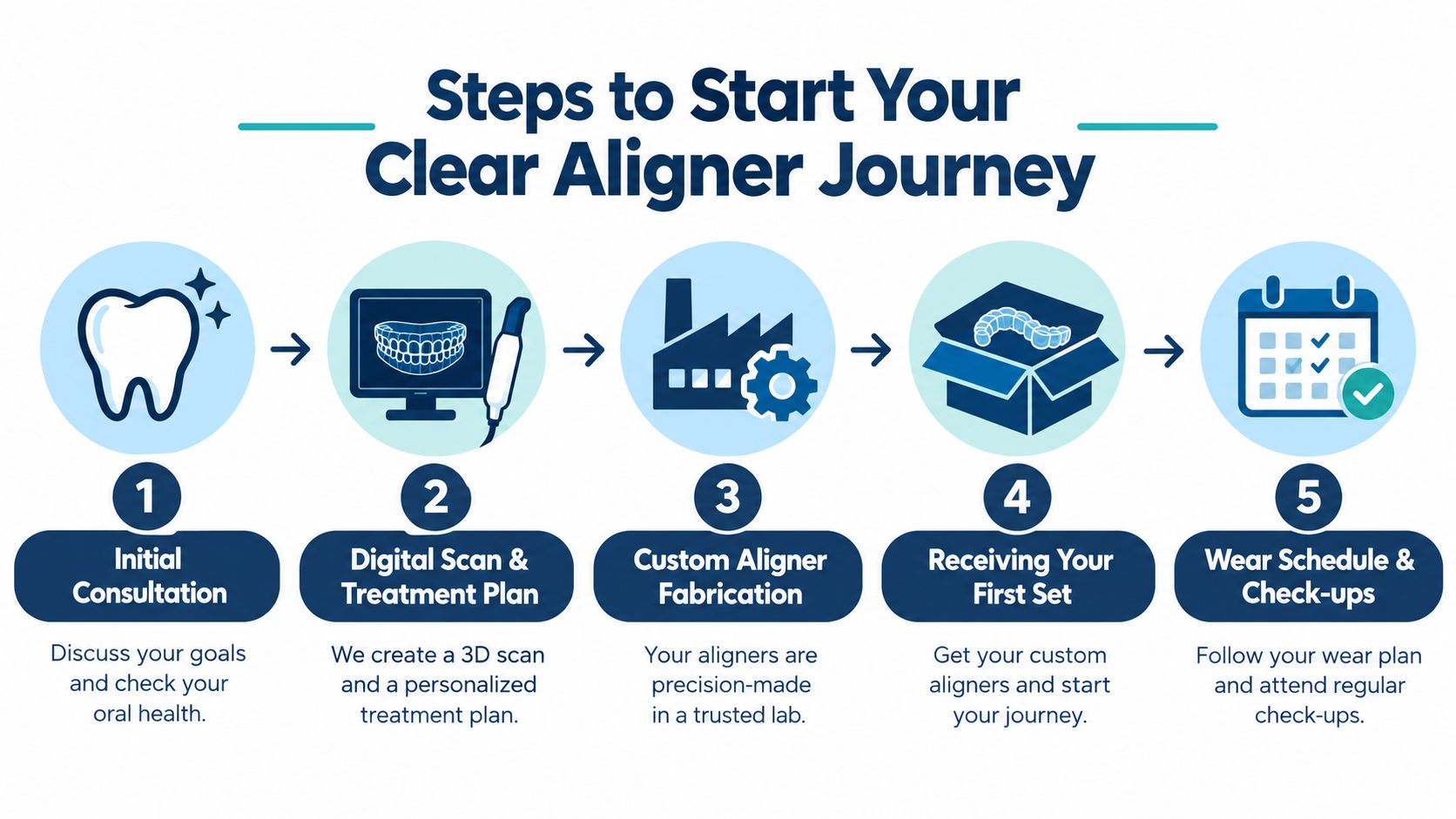
Starting treatment becomes easier when each stage has a clear purpose. Adults don't need to arrive with a diagnosis. They need an honest description of the concern, a discussion of treatment preferences, and enough information to decide whether aligners fit the case.
Begin with an examination
The first appointment reviews the teeth, bite, gums, existing dental work, and treatment goals. A smile that looks mildly crowded from the front may also involve a deeper bite issue or rotations that aren't obvious in a photograph.
A digital iTero 3D scan can replace messy physical impressions and create a detailed model of the teeth. At Stellar Orthodontics, the scan is also used to help show a digital preview of the planned smile. A preview is useful for discussion, but it isn't a guarantee. The final result depends on the approved plan, biological response, and patient follow-through.
Review the treatment plan
The orthodontic team evaluates how each tooth needs to move, how the upper and lower arches should fit, and whether attachments, refinements, or another appliance may be appropriate. Adults should ask practical questions at this stage:
- Bite correction: Will the plan address how the teeth meet, or only improve the visible front teeth?
- Daily routine: How will trays fit around meals, travel, meetings, and social events?
- Refinements: What happens if the first series doesn't deliver every planned movement?
- Retention: What retainer plan will protect the finished alignment?
A good plan connects the desired appearance with a stable, functional bite.
Receive and manage the trays
After approval, custom aligners are fabricated for the planned sequence. At delivery, the orthodontic team explains insertion, removal, cleaning, tray changes, and check-up timing. Adults should leave knowing what to do if a tray feels unusually sharp, gets lost, or no longer fits properly.
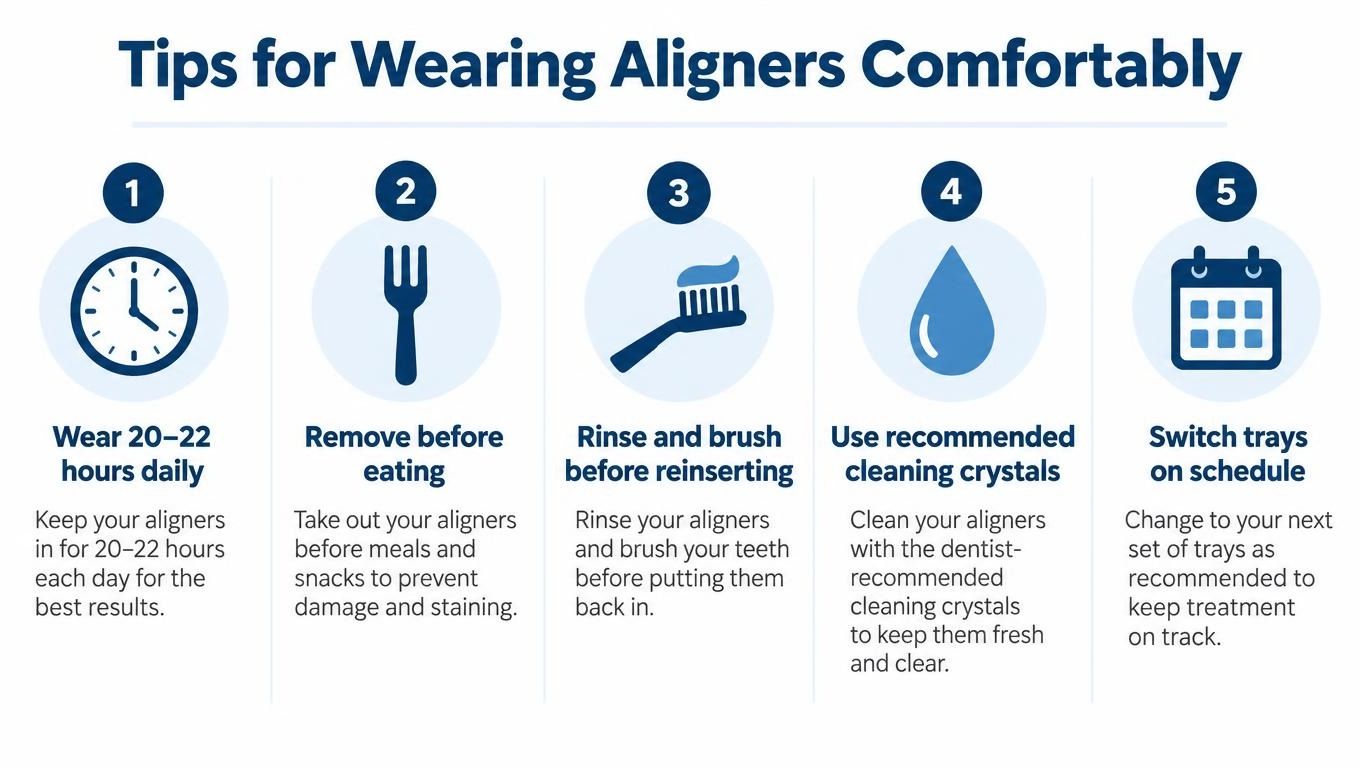
A comparative adult study reported aligner wear of 20 to 22 hours per day, tray changes every one to two weeks, and an estimated treatment duration of 12 to 18 months. Those figures come from the adult clear-aligner comparison study, but an individual plan can differ.
Tips for Wearing Aligners Comfortably
Clear aligners are removable, but treatment still demands discipline. The trays only guide teeth while they're in place, so repeated long breaks can interfere with the planned sequence. Adults who build the routine around existing habits usually find treatment easier to manage.
Make wear time automatic
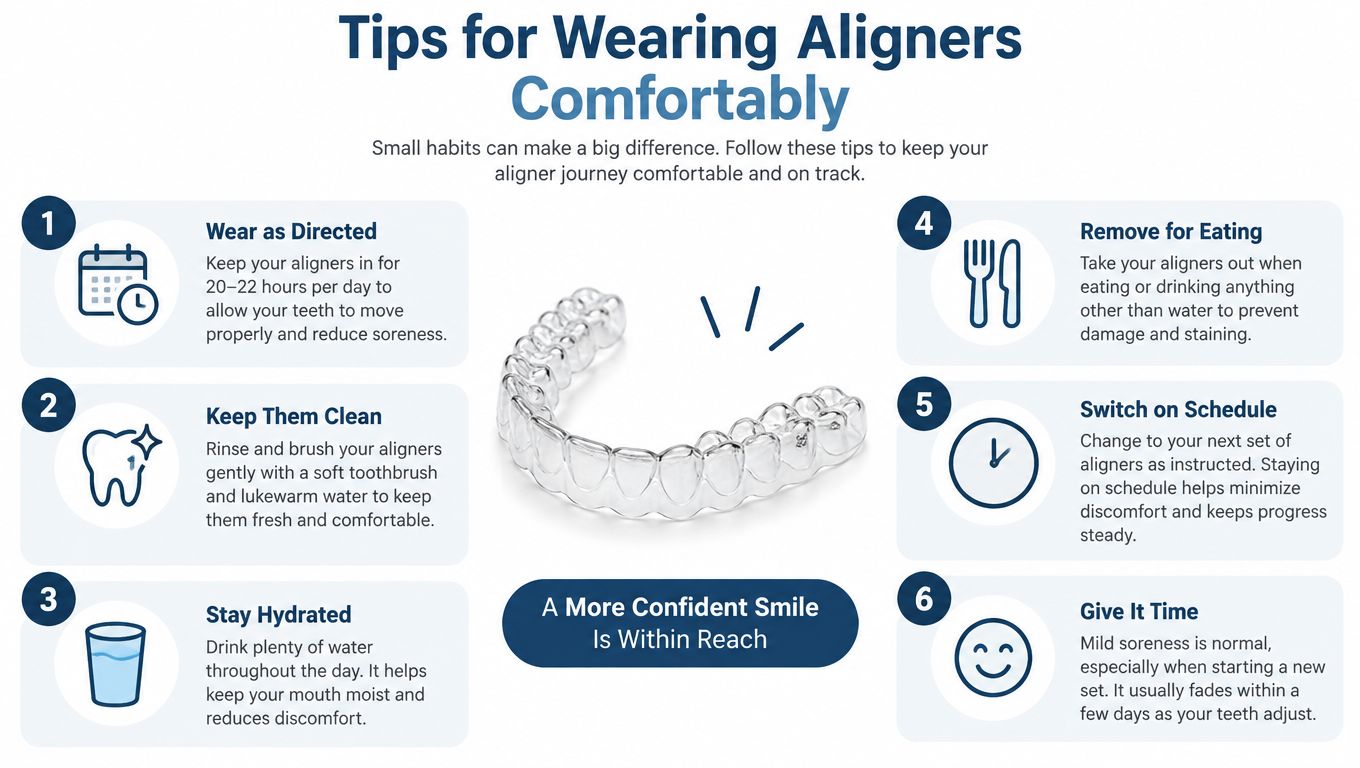
The practical target is 20 to 22 hours each day, as reported in the adult study cited above. Trays should come out for meals and should be placed in a case rather than wrapped in a napkin, where they can be thrown away accidentally.
A simple routine works well. Remove the aligners before eating, rinse the mouth and trays afterward, brush when possible, and reinsert them promptly. Water is generally the simplest drink to keep with the trays, while meals and other drinks should follow the orthodontist's instructions.
Expect a short adjustment period
New trays can create pressure or tenderness because they're guiding teeth toward the next planned position. Speech may also feel different at first, especially during longer conversations. Reading aloud privately and wearing the trays consistently can help the mouth adjust to speaking with them.
Sharp edges, persistent irritation, or a tray that doesn't seat correctly should prompt a call to the orthodontic office. Adults shouldn't file trays or force them into place without professional guidance.
Protect oral hygiene
Food trapped between teeth and trays can make cleaning more difficult. Brushing and flossing before reinserting the aligners supports a cleaner routine, while regular tray cleaning helps prevent unpleasant buildup.
The guide to cleaning Invisalign aligners offers practical care instructions. Manufacturer-recommended cleaning products or cleaning crystals may be appropriate, but abrasive household products can scratch the tray material.
Daily habit: The tray case belongs in the same place as the keys or wallet. A predictable storage habit prevents many avoidable losses.
Adults should also keep scheduled check-ups. Monitoring allows the orthodontist to confirm that teeth are tracking as planned and to respond early if a tray stops fitting properly.
Maintaining Your Results After Treatment
The final photograph isn't the end of orthodontic treatment. It marks the beginning of retention.
Teeth can shift after active treatment, including after clear aligners and fixed appliances. The tissues and bone around the teeth need time to adapt, and everyday forces can gradually influence tooth position. Adults often notice movement years after earlier orthodontic treatment because a retainer routine became inconsistent.
Retainers protect the finished alignment
A retainer holds teeth in their corrected positions while the mouth adapts to the new arrangement. The orthodontist determines the initial schedule and explains how that schedule changes over time. Retention usually becomes a long-term maintenance habit, not a temporary task that ends after a short transition.
Recent evidence gives a balanced picture. A review summarized an example in which Invisalign cases had a 12% relapse rate compared with 10% for braces, while also noting that 2025 meta-analyses found similar stability when retention protocols were followed, as discussed in the review of stability and relapse after orthodontic treatment.
The important lesson isn't that one appliance guarantees permanence. Stability depends heavily on following the retainer plan.
Treat the retainer like routine dental care
A retainer should be cleaned as directed, stored safely, and brought to appointments when requested. If it feels tight, cracks, becomes uncomfortable, or no longer fits, the patient should contact the orthodontic office rather than forcing it.
A before-and-after photo records the result. A retainer routine preserves it.
Adults considering treatment should ask about replacement procedures, cleaning, wear expectations, and what happens after missed wear. Those answers make the long-term commitment clear before active treatment begins.
The most realistic expectation is a new smile followed by ongoing maintenance. That isn't a flaw in aligner treatment. It's the normal responsibility attached to moving teeth.
Book Your Free Consultation in Delaware
A consultation gives adults a chance to discuss crowding, spacing, bite concerns, previous orthodontic treatment, and the lifestyle demands of clear aligners. It also helps determine whether aligners are appropriate or whether another treatment approach would provide better control.
Stellar Orthodontics has Delaware locations in North Wilmington, Middletown, Dover/West Dover, and Millsboro, giving families and adults access across New Castle, Kent, and Sussex County. The practice offers flexible monthly plans with $0 down, accepts most major dental insurance, and accepts Delaware state Medicaid plans for eligible patients under the practice's stated coverage guidelines.
Adults can book a free consultation at Stellar Orthodontics to discuss a digital scan, treatment goals, expected daily routine, and retention plan. The appointment is the right place to ask what a realistic before-and-after result may look like for a specific smile.
Stellar Orthodontics offers adult Invisalign consultations with digital 3D scanning and treatment planning across North Wilmington, Middletown, Dover/West Dover, and Millsboro. Adults considering a discreet way to improve alignment can visit Stellar Orthodontics to take the first step toward a clear, practical treatment plan.