
For mild-to-moderate cases without extractions, full Invisalign treatment commonly runs about 14 to 22 months. Some limited cases finish sooner, and complex cases can take two years or longer. Treat that span as a planning range, not a promise for one child or adult.
Parents looking up how long Invisalign braces take usually want one number. One average hides what sets the treatment timeline. The first series of trays is not the finish line. Daily wear and the kind of tooth movement usually matter more than whether a family picks clear aligners or braces.
A teen who takes trays out for lunch, sports, and a weekend trip can slip off a plan that looked tidy on a screen. An adult with a small spacing gap can stay nearer the shorter end. The ranges below are estimates to confirm in person, after a scan and an exam.
Table of Contents
- How Long Invisalign Takes for Common Cases
- What the Studies Show
- Timelines for Kids, Teens and Adults
- What Shifts Your Timeline Up or Down
- Keeping Wear Time on Track
- What Happens After the Last Tray
- Confirm Your Timeline at a Free Consultation
How Long Invisalign Takes for Common Cases
A systematic review of randomized trials reports a median treatment span of roughly 14 to 22 months for mild-to-moderate cases without extractions. That is a group estimate, not a promised finish date. For a family planning school, sports, or travel, it helps to know which kind of tooth movement sits behind the estimate.
The first tray series is only one part of treatment. The calendar can shift with the pace of tray changes, how consistently the aligners are worn, and whether extra refinement stages are needed. Traditional tray changes were about 14 days, though the orthodontist may choose a different interval for harder movements. Daily wear and case complexity often determine whether the planned schedule holds.
Ranges from the shortest case to the longest
| Case type | Typical Invisalign range |
|---|---|
| Limited, mild movement | Some cases finish in about 6 months |
| Mild-to-moderate crowding or spacing, no extractions | Commonly about 14 to 22 months |
| Open bite | See study estimate below |
| Deep bite | See case-series estimate below |
| Extraction cases | Often longer than limited, non-extraction treatment |
| Complex cases | Often 24 months or longer |
Limited movement is the short end of the range. Invisalign's published patient guidance says some cases may finish in as little as six months. The same guidance says treatment time depends on complexity, aligner type, and daily wear. A small twist in one front tooth is a smaller task than correcting a bite.
Mild-to-moderate crowding or spacing without extractions provides a useful baseline. For example, a teen with a little overlap and no planned tooth removal may fit this type of case. The review's median range describes patients as a group, not an individual schedule.
Bite correction can involve different movements, so estimates vary by diagnosis. A 2024 open-bite study reported an average of 18.2 months, with a range of 15 to 22 months, for patients whose open bite averaged 3.5 millimeters before treatment. A deep-bite case series reported an average of 21.1 months, with a range of 7 to 34 months. These are estimates from specific patient groups, not a forecast for every open or deep bite. The broad deep-bite range shows why another person's finish date may not apply.
Extraction cases may also take longer because closing a space after a tooth is removed requires careful control of tooth position. The first set of trays may not complete that work. Complex cases can take 24 months or longer when several types of movement need to be coordinated.
What a 12 to 18 month quote actually covers
A general quote of 12 to 18 months is a planning estimate, not a timeline that fits every patient. Limited cases may finish sooner, while complex crowding, spacing, bite correction, or additional refinements may extend treatment. Ask what the estimate includes, especially whether it covers refinements and follow-up after the first tray series.
Bring the estimate back to the specific teeth and movements being treated. A digital scan and clinical exam help an orthodontist turn a general range into an individual estimate.
What the Studies Show
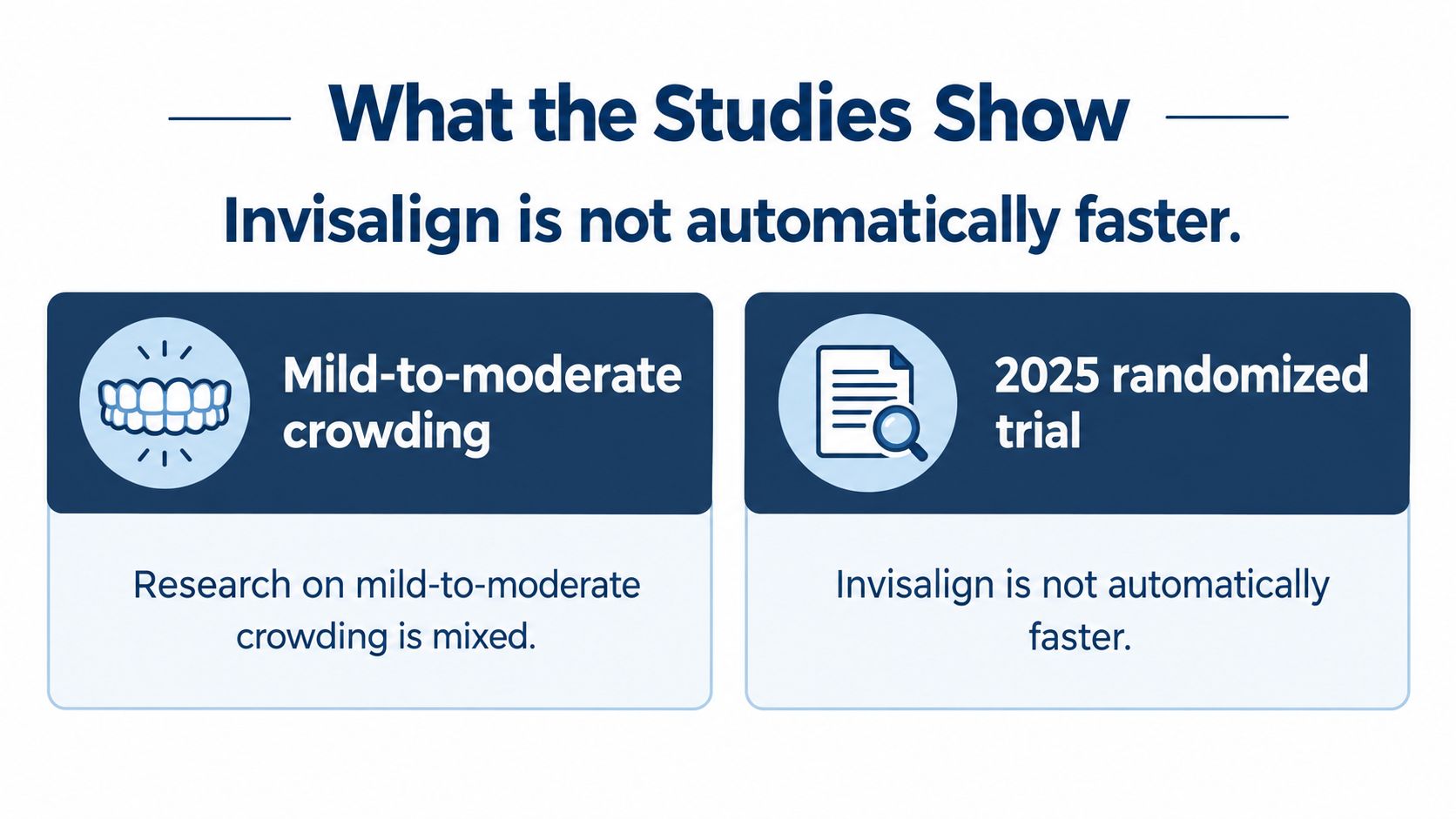
A randomized trial found that fixed braces finished sooner on average than clear aligners for mild-to-moderate malocclusions. In a 2025 randomized trial, aligner treatment averaged 18.2 ± 3.1 months, compared with 14.5 ± 2.8 months for braces, with similar improvement in the bite. That result describes one study group, not a guaranteed schedule for an individual patient.
Families may hear different stories from people who chose different appliances. The reason is that treatment studies often examine different types of cases, with different protocols. A result for mild crowding may not predict the timeline for a more involved bite correction.
A 2024 review of 10 eligible studies, including six randomized trials, found no statistically significant duration difference between aligners and braces for mild-to-moderate crowding. The review rated the evidence low-certainty, in part because study designs and treatment protocols varied. For families, the practical takeaway is that the appliance alone does not establish how many months treatment will take.
Evidence from extraction-based cases can point in a different direction, with fixed appliances finishing faster in some research. These findings do not establish one schedule for every patient. The teeth being moved and the goals of treatment matter.
Why the papers don't agree
Treatment protocols vary. One orthodontist may change trays on a shorter cycle, while another allows more time between changes. Case severity, attachments, and whether space is created between teeth can also affect the schedule. A trial involving mild crowding is not a direct comparison for a case that requires extractions.
Daily wear habits matter, too. Aligners only work according to their plan when patients wear them as directed, so missed wear can shift an estimated schedule. The first series of trays may also be followed by refinements, meaning that completing the initial set does not always mark the end of treatment.
For a mild case, aligners may fit a plan that relies on trays and consistent wear. When extractions or more demanding bite correction are involved, fixed braces may be expected to finish sooner in some cases. An orthodontist can estimate a patient's timeline after examining the teeth and treatment goals.
Timelines for Kids, Teens and Adults
A parent sits with two estimates: one for a 12-year-old, one for themselves. The month counts don't match, and that feels inconsistent. It usually isn't. Age changes the path more than it changes a single length.

Age changes the path. Growth, supervision, and whether care is staged can matter as much as the tray count.
Children around 7 to 10. An early look lets an orthodontist watch how the jaws are growing. Some plans are staged, so the calendar may include more than one phase rather than one continuous run of trays. A first phase is not a failed treatment. It is often a pause while more permanent teeth arrive. Parents comparing Invisalign and braces for kids should ask what is being watched now, and what can wait.
Teens from 12 to 17. A 2024 peer-reviewed study, described by Invisalign in its teen guidance, reported teen treatment averaged about 18 months with Invisalign versus about 24 months with conventional braces. That is one data point from the manufacturer, not a promise. Teens usually need an adult on wear and tray changes. School lunch, practice, and sleepovers are where hours disappear. A parent who checks the case at night catches a loose tray before a month of poor tracking piles up.
Adults. Growth is no longer part of the plan. The same drivers still apply: how far teeth must move, whether the bite needs work, and whether trays stay in. Clear ceramic braces are another option to talk through when a fixed appliance fits the bite better than a removable one. Adults often do well with aligners because they control their own schedule. They also stretch treatment when work lunches become a habit of leaving trays in a napkin.
Bring the child's age and the growth questions to the visit. The useful comparison is not "kids versus adults" in the abstract. It is this child's stage of growth next to this adult's bite.
What Shifts Your Timeline Up or Down
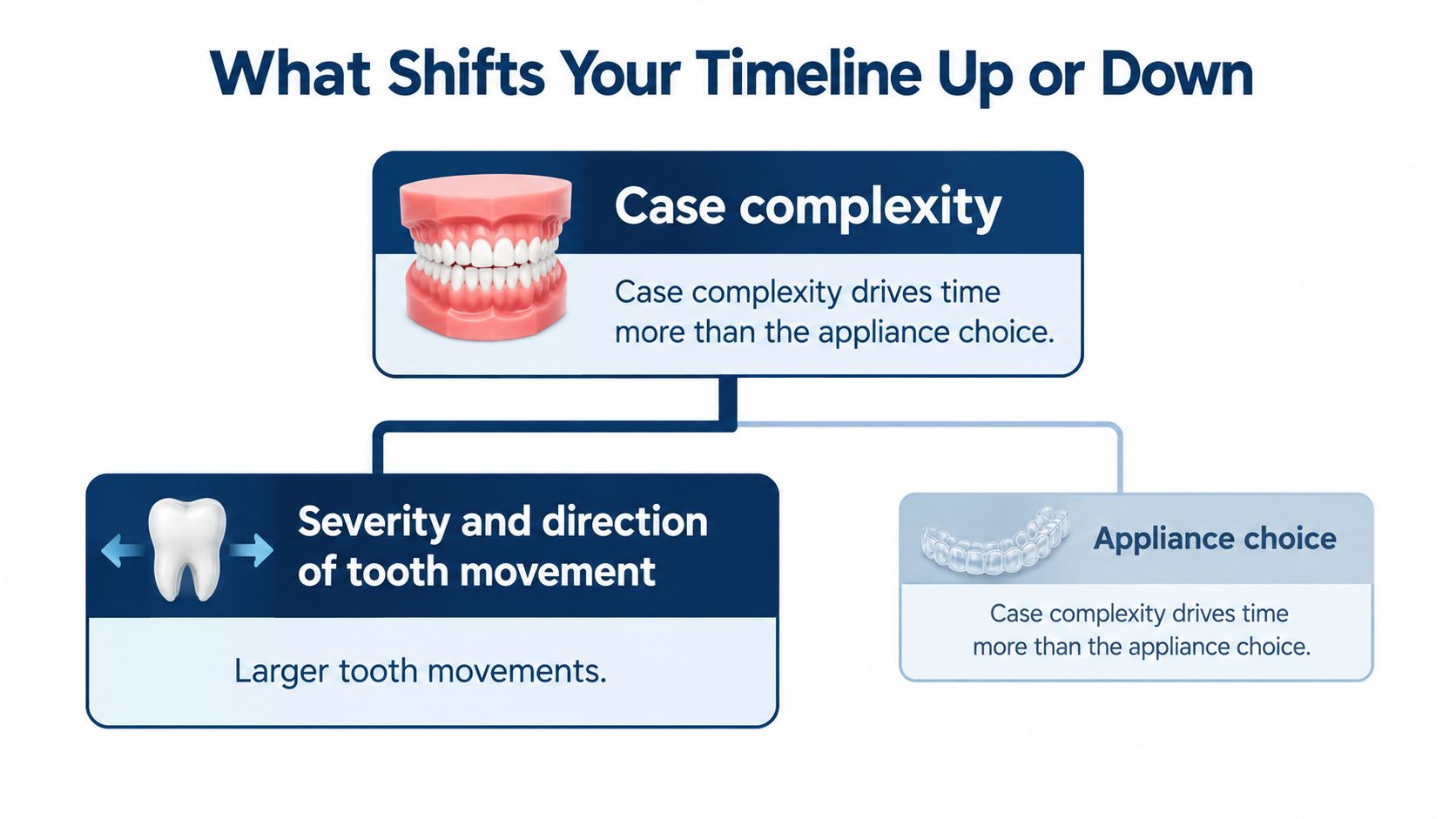
Case complexity drives time more than the appliance choice. The same schedule will not fit every patient: moving a tooth a short distance is different from correcting its rotation, position, and bite. The diagram shows why the planned movements matter more than the appliance alone.
Extraction cases show how much the details of a plan can matter. One randomized premolar-extraction study reported average treatment times of 16.9 months for aligners and 23.2 months for fixed appliances. Those figures describe that study's sample, not a timeline to expect for every patient. Tooth movement, anchorage, and the need to control roots can all affect how long treatment takes. Ask whether your estimate includes extractions or a major bite correction.
Some plans also use small tooth-colored attachments to help guide movement, or slight polishing between teeth to create space. These are planned steps, not signs that treatment has gone wrong. Learn more about how Invisalign attachments work, then ask which tools your plan may require.
The first series of trays may not be the finish line. If the teeth need further adjustment, the orthodontist may take another scan and prescribe refinement trays. Ask whether your estimate includes refinements, and how the office will decide if another series is needed.
Tray-change schedules vary by case. Many plans use a change interval of about 14 days, while others follow a different protocol. Your orthodontist can explain the schedule for your teeth and what to do if a tray does not fit as expected.
Growth can shape the plan for children and teens. A growing patient may need treatment in stages, while an adult's plan does not account for ongoing growth. Ask how growth affects the estimated schedule for your child.
Every timeline is an estimate to confirm in person. The number of trays printed at the start is not always the total treatment plan, and missed wear can extend it. The most useful estimate accounts for the specific movements, any additional stages, and the schedule your orthodontist recommends.
Keeping Wear Time on Track
A tray schedule works only when aligners stay in for the prescribed hours. Clear aligner plans commonly call for 20 to 22 hours of daily wear, but actual habits can differ. A recent review found that only 37% of patients reported wearing aligners for more than 22 hours a day. That gap can make a predicted finish date less certain.
Situations families actually hit
- School lunch: Trays come out to eat, then may sit in a napkin. Twenty extra minutes, five days a week, is more than an hour and a half gone before sports.
- Sports and mouthguards: Practice and a snack can turn a two-hour break into three. Keep the case in the sports bag so trays do not stay in a locker.
- Travel and social events: A wedding, tournament weekend, or vacation day can add hours out of the mouth. A case makes it easier to keep track of trays when routines change.
- Forgotten tray: Call the orthodontic office and follow its instructions. Skipping ahead or wearing an old tray for days can interfere with tracking.
- When wear slips for a while: If teeth no longer match the current tray, the orthodontist may recommend refinements or restarting a stage. It is a schedule adjustment, not a scolding.
How often someone checks
The American Association of Orthodontists says visits for adjustments or new aligners are commonly every six to 10 weeks. The orthodontist sets the check-in schedule for the individual case. Fewer visits can fit a school routine more easily, while longer gaps may let a poorly seated tray go unnoticed. Teens may need an adult to help spot fit problems and keep appointments.
Daily wear matters more than the number of trays in the box. Loose trays or nighttime-only wear can put teeth off schedule. Treatment length remains an estimate shaped by wear habits, tray fit, appointments, and contacting the office when something feels wrong.
What Happens After the Last Tray
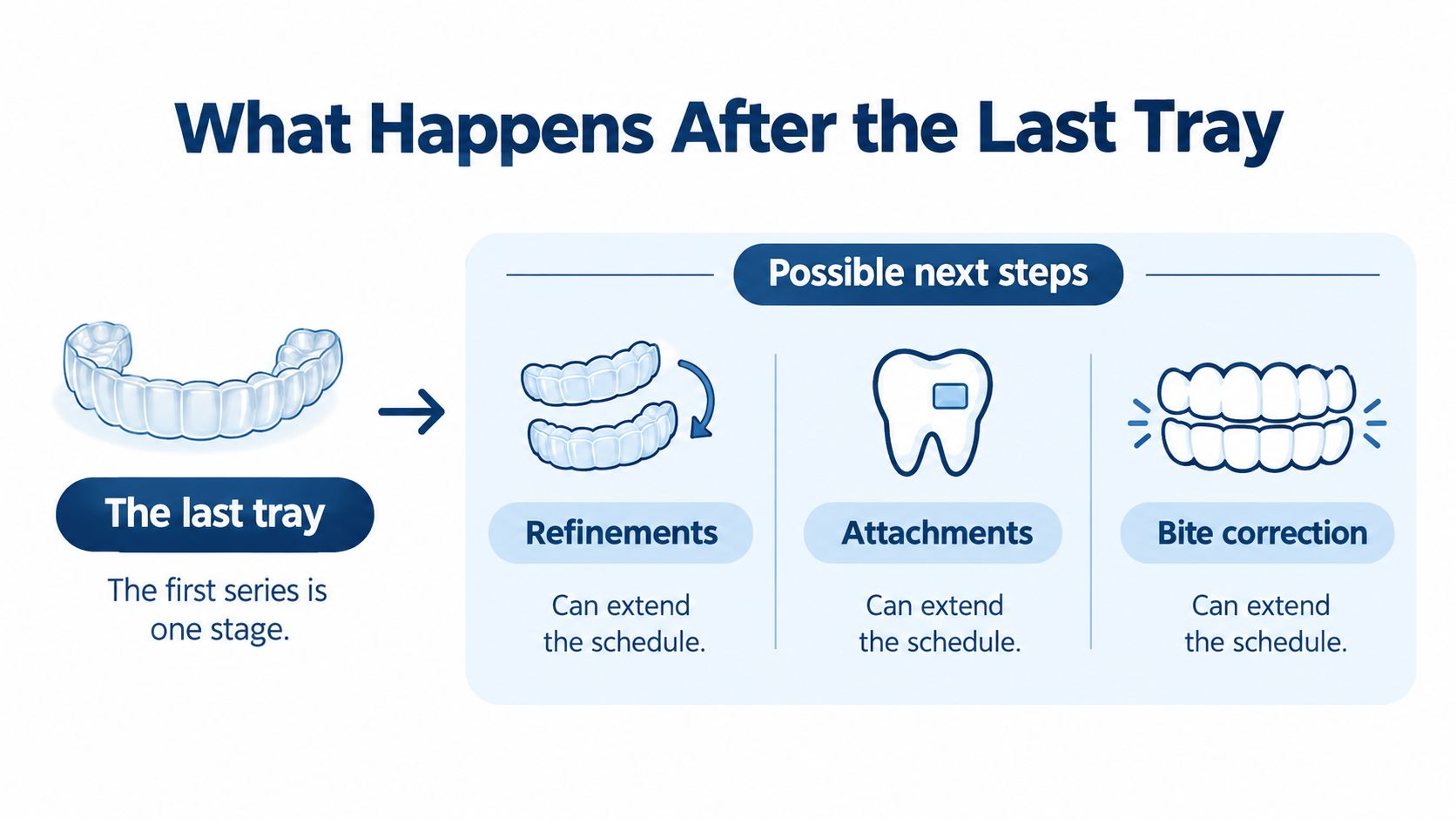
The last tray in the first box is not "done." That series is one stage. Refinements, attachments, and bite correction can all extend the schedule.
The American Association of Orthodontists explains that aligners move teeth only a fraction of a millimeter at a time, and that the number of trays and the total length vary by the case. Some, but not all, problems can be treated with clear aligners, and tooth-colored attachments may be used for particular movements. If a movement can't be made predictably with trays alone, the orthodontist may discuss a different approach.
A short video on what families often notice between visits:
The run, phase by phase
- Planning. A digital scan, an exam, and a simulation set the estimated path.
- Active series. Trays are worn on the prescribed schedule, one stage at a time.
- Refinements. If the planned movement isn't fully reached, new scans and trays may be added. What Invisalign refinements are is the question to settle before anyone treats the first box as the whole treatment.
- Finishing. Attachment removal and small finishing steps happen after the teeth are where they should be.
- Retention. Guidance on keeping the result usually follows. Active trays ending is not the same as teeth staying put without a plan.
The question for parents is practical. What happens if the first trays finish and the teeth are not fully corrected?
Confirm Your Timeline at a Free Consultation
Published ranges describe groups of patients. They don't describe one child or one adult. The only reliable timeline comes from an individual evaluation.
A free consultation at Stellar Orthodontics includes a clinical exam and a digital scan, which is what a patient-specific estimate needs. Offices are in North Wilmington at 2304 Concord Pike, Middletown at 818 Kohl Avenue, West Dover at 125-2 Greentree Drive, and Millsboro at 26670 Centerview Drive.
Bring a short list:
- Trays and refinements: How many are already in the estimate?
- Extractions or attachments: Are either likely?
- Daily wear: How will wear be tracked at home?
- Visits and the first series: How often are checks, and what happens if teeth aren't fully corrected after those first trays?
The estimate gets clearer after the scan and the exam, not from a chart online. Booking a free consultation is a low-pressure way to match a range to this mouth.
Stellar Orthodontics helps Delaware families turn a published Invisalign range into an estimate based on a scan, an exam, and the patient's bite. Free consultations are open in North Wilmington, Middletown, Dover/West Dover, and Millsboro. Visit Stellar Orthodontics to book a time and bring your questions about trays, wear, and what happens after the first series.