
What if a wide gap is the easy one to treat, and a small gap is the one that keeps reopening? That's the question most pages about Invisalign for gap teeth skip. Width matters, but it doesn't decide treatment on its own. The cause does. A gap, called a diastema in clinical language, can come from tooth size, missing teeth, gum health, habits, growth, or roots that angle apart under the gumline. Clear aligners can close many gaps, but only a diagnosis can show whether aligners alone will keep the result stable.
Table of Contents
- Can Invisalign Close a Gap Between Your Teeth
- How Long Invisalign Takes and What Happens Step by Step
- Gaps in Growing Teeth and When Timing Matters
- Invisalign, Ceramic Braces, Metal Braces or Bonding Compared
- Keeping the Gap Closed After Treatment
- Book a Free Consultation at Stellar Orthodontics
Can Invisalign Close a Gap Between Your Teeth
For many mild to moderate gaps, yes. Invisalign for gap teeth is a credible option when the teeth mainly need their crowns guided together and the bite is otherwise healthy. A gap from a missing tooth or from gum disease may need a different plan, or a combined one. A closed space only counts as finished when the roots and bite are also aligned.
A 2019 peer-reviewed literature review found clear aligners generally suitable for mild-to-moderate spacing, selected crowding, and limited tooth movements, and it pointed to a 2005 retrospective cohort study by Djeu and colleagues as the strongest early comparative evidence. Using the American Board of Orthodontics grading system, that study found Invisalign and conventional fixed braces similarly effective for space closure, marginal-ridge alignment, and root paralleling. The same review noted that much early aligner writing was case reports or product descriptions rather than large clinical trials, so the match between the gap's cause and the appliance still decides the result.
Why the Cause Changes the Answer
Aligners work like a fitted sleeve on the crown, the part of the tooth you see above the gum. They push there first. Two front teeth that sit a little apart can often meet if the crowns tip toward each other. Roots that angle away under the gum are a different job. The crowns can touch while those roots stay apart, and that closure is less stable.
Other causes change the plan in their own way. Teeth that are small for the arch can leave extra space even when they look straight. A thick labial frenum, the tissue joining the upper lip to the gum between the front teeth, can hold a midline gap open. Gum or bone changes let teeth drift apart over time. Tongue pressure can push teeth forward and apart.
Gap causes and their likely aligner fit
| Gap cause | Typical aligner fit | What the orthodontist checks |
|---|---|---|
| Small crown spacing, mild to moderate | Generally suitable | Bite, tooth position and hygiene |
| Tooth-size discrepancy | May need a different or combined approach | Tooth width and arch size |
| Missing or extra teeth | Needs professional evaluation first | X-rays and tooth development |
| Roots angled apart | May need attachments, elastics or fixed appliances | Root position on radiographs |
| Thick labial frenum | Evaluate before treatment, surgery often not needed early | Whether the gap persists after orthodontic treatment |
| Gum disease or bone loss | Requires periodontal assessment before aligners | Gum health and attachment levels |
A Simple Self-Check Before an Exam
Parents and adults can make the first visit more useful with a few notes. Older photos show whether a gap is new, growing, or long-standing. A short list of questions, plus habits such as thumb sucking or tongue thrusting, gives the orthodontist useful context.
A new or widening gap in an adult deserves an exam promptly, because spacing that appears later in life can signal gum or bone changes rather than a simple cosmetic concern.
A mirror check helps too. Note whether the front teeth look tipped rather than upright, and whether the gap has always been there or showed up recently. That exam is available at Stellar Orthodontics in North Wilmington, Middletown, West Dover, or Millsboro, where the cause is identified before any appliance is chosen.
How Long Invisalign Takes and What Happens Step by Step
Invisalign doesn't close a gap with one appliance. Treatment uses a sequence of custom-made trays, and each tray moves the teeth a small step toward the planned position. According to FDA guidance on braces and clear aligner options, patients generally wear each aligner for one to two weeks, while total treatment may take approximately six to 18 months. The actual timeline depends on the treatment plan and how the teeth respond, so the range is an estimate set at the exam, not a promise.
Adults often finish within that window. Growing children and teens follow a schedule shaped by their stage of growth, which the orthodontist builds into the plan. A small gap between two front teeth may close over several months of trays. A gap with tipped roots may need attachments and extra months, because moving roots is slower and less predictable than tipping crowns.
Parents comparing timelines for Invisalign for gap teeth can find more detail in this guide to how long Invisalign treatment takes, but the personal estimate always comes from the exam and scan.
Invisalign gap treatment phases and timing
| Phase | What happens | Typical duration |
|---|---|---|
| Consultation and 3D scan | Exam, digital scan and treatment plan preview | Single visit |
| Aligner wear | Each tray is worn and the teeth shift gradually | One to two weeks per tray |
| Full treatment | Sequence of custom trays moves the teeth | About 6 to 18 months per plan |
| Attachments or refinements | Added if roots need control or the plan changes | Placed during active treatment, timing set in the plan |
| Retention | Keeps the closed gap stable after active treatment | Ongoing, plan set by orthodontist |
The Steps From First Visit to Retainer
- Full orthodontic exam: The orthodontist checks the bite, gums, and teeth, because the plan has to account for more than the visible space. Gum problems or bite issues found here change what happens next.
- Digital 3D scan: A digital 3D iTero scanner is used during the consultation instead of a traditional impression tray. The scan captures tooth position precisely, so the trays can be planned from an accurate model.
- Treatment plan review: During this step, patients see their teeth in 3D on a screen and a visual preview of their final smile. This is the moment to ask how far each tooth will move and what could slow the plan down.
- Attachment placement: Some plans add small tooth-colored attachments so the trays can grip and guide teeth more precisely. Not every gap needs them, but root control often does.
- Tray wear at home: Trays are worn for the prescribed hours and changed every one to two weeks. Skipping wear hours is the most common slip, and it can slow the plan or make refinements necessary.
- Check-in visits: The orthodontist measures progress against the digital model. If the teeth move differently from the plan, the plan gets refined rather than forced.
- Retainer fitting: Once the gap is closed, a retainer holds the result while the tissues around the teeth settle.
Daily Habits That Protect the Timeline
Aligners are removable, so patients take them out to eat and clean their teeth afterward. That flexibility helps with meals and brushing, but it also creates responsibility. Inadequate brushing and flossing during treatment can contribute to tooth decay, swollen or bleeding gums, and other oral-health problems. Trays should go back in after eating, and teeth should be cleaned before the trays go back on.
Practical rule: A good checkpoint is simple to read. The gap is narrowing on schedule, the trays seat fully without gaps at the edges, and the bite still feels stable.
One safety point matters before anyone orders trays online. Clear aligners are prescription medical devices. The FDA page on clear dental aligners states that clear aligners are authorized for use under the supervision of a licensed dentist or orthodontist, and that it has not authorized direct-to-consumer aligners sold without a prescription and professional supervision. An in-person exam helps identify an uneven bite, unintended tooth movement, pain, or tooth loss before treatment starts. For Delaware families, that exam is the safe first step at any Stellar Orthodontics location.
Gaps in Growing Teeth and When Timing Matters
Does a small space between a child's front teeth mean those teeth should move now? Width is a poor guide. The cause of the gap decides whether clear aligners can close it in a predictable way, and whether waiting is safer.
A child's mouth works like a room still under construction. New permanent teeth arrive and push their neighbors into new positions. In many children, a front-tooth space is part of that normal shift. Close it while the mouth is still changing, and the same space can open again, which means a second round of treatment later. The more useful question for parents is whether this gap needs treatment now, later, or just observation.
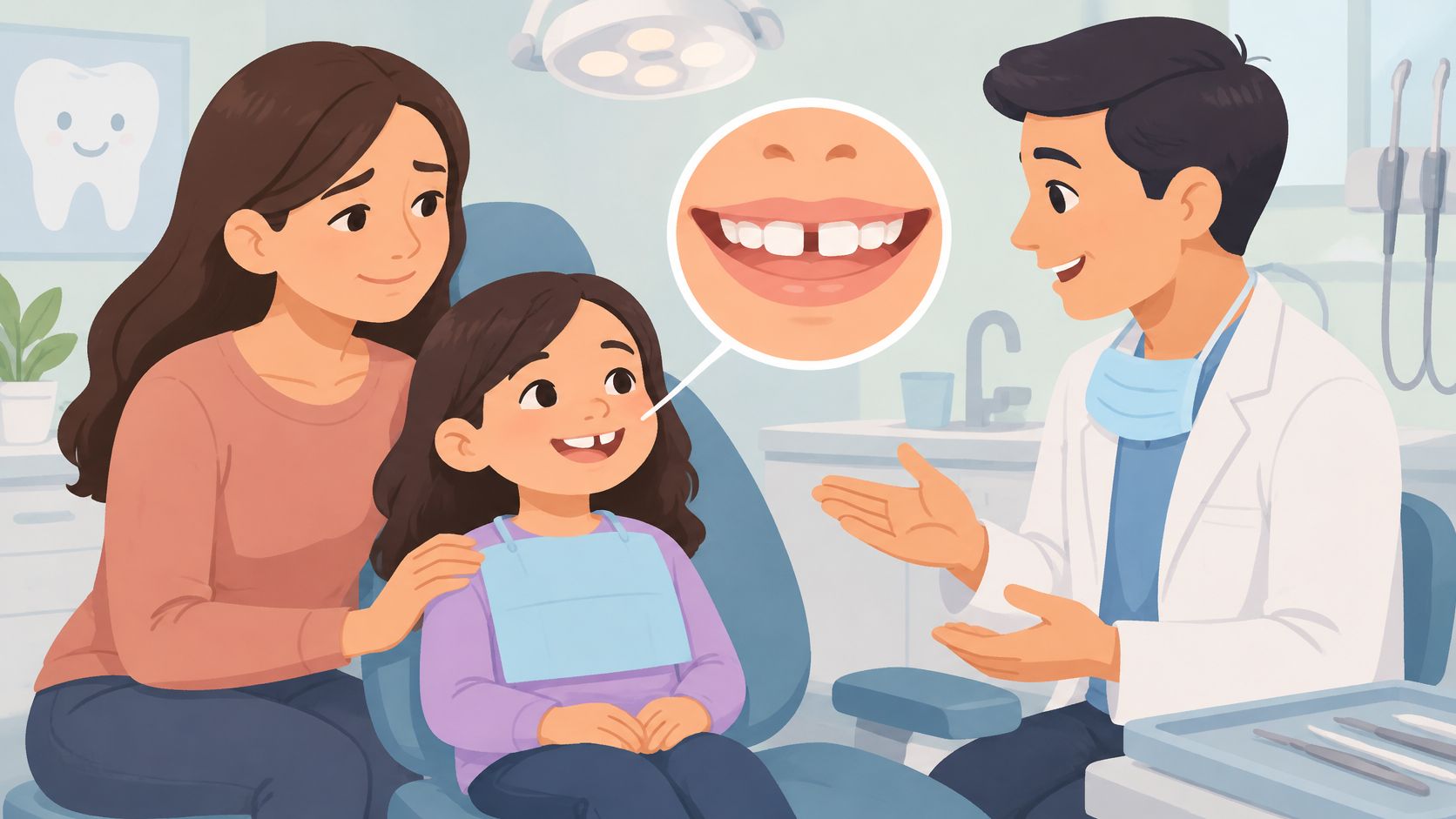
The image below shows the kind of visit where that timing question gets answered, with the child, parent, and clinician looking at the same teeth together.
Three Gaps That Look Alike but Aren't
A seven-year-old can show a space between the upper front teeth while the teeth beside them have not come in yet. As those neighbors erupt, they often nudge the front teeth toward each other. The orthodontist checks which permanent teeth are still on the way and may recommend observation rather than trays or braces.
An older child can have a look-alike gap for a different reason: a tooth never formed, or an extra tooth sits between the front teeth. That case needs imaging before anyone talks about aligners. Sliding teeth into a space without knowing what sits underneath can create a new problem instead of solving the old one.
A teen can have a midline gap tied to a thick frenum and a tongue habit. Closing the space is only half the plan. Constant tongue pressure can push the teeth apart again after they meet. Parents comparing early treatment with a watch-and-wait plan can read more about early orthodontic treatment pros and cons before they decide.
What the Evidence Says About Treating Early
A 2024 review of the maxillary labial frenum reported that early frenectomy is generally unnecessary unless the diastema persists after orthodontic treatment, and that delaying surgery can reduce scarring-related relapse risk. A visible frenum does not automatically put surgery first. Many parents expect the opposite.
Evidence on clear aligners in growing patients is thinner than advertising often implies. Reviews of that research find far more observational reports than randomized trials, and many of those reports use small groups with short follow-up. A separate look at mixed-dentition treatment reaches a similar caution: published work is not yet strong enough to set ideal rules for which children should be treated, or how.
That uncertainty is why timing belongs in a conversation, not a sales pitch. Is the gap part of normal development? Have the permanent teeth fully erupted? Could a missing tooth, an extra tooth, a frenum, a tongue habit, or a gum issue be holding the space open? For many Delaware families, timing, cause, and growth matter more than picking clear aligners over braces. Observation is sometimes the safest plan.
Invisalign, Ceramic Braces, Metal Braces or Bonding Compared
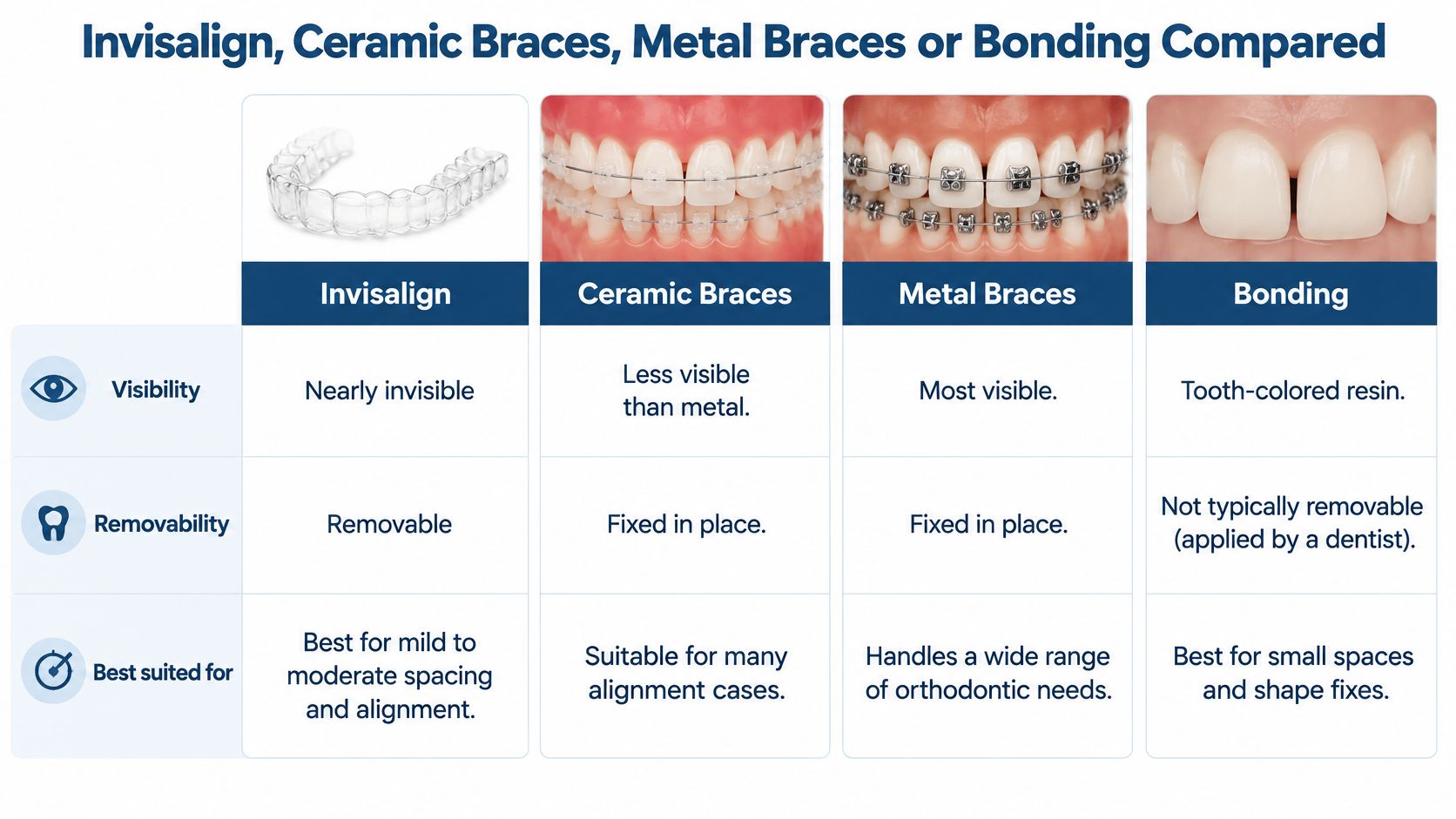
Four options can address a gap, and they don't work the same way. The chart below compares them on the three criteria most parents and adults ask about first, visibility, removability, and the cases each option suits.
Gap-closing options compared
| Option | Visibility | Removable | Best fit |
|---|---|---|---|
| Clear aligners (Invisalign) | Nearly invisible | Yes | Mild to moderate spacing, patients who wear trays reliably |
| Clear ceramic braces | Tooth-colored brackets | No | Patients wanting a less visible fixed option |
| Metal braces | Visible brackets | No | Complex bite issues, severe crowding or detailed rotation |
| Dental bonding | Tooth-colored composite | Not applicable | Small gaps, chosen with the dentist |
Where Each Option Earns Its Place
Clear aligners are nearly invisible and removable, which suits adults and teens who want discretion and easier brushing. Their limit is mechanical. A 2025 international Delphi consensus found 96% expert agreement that clear aligners produce tooth movement primarily through crown tipping. Predictable root movement needs coordinated force couples, attachments, and sufficient anchorage, and root translation, torque, and long-distance rotation are substantially less predictable with removable trays. If root parallelism is required, the plan may need optimized attachments, staged overcorrection, elastics, or conversion to fixed appliances.
Ceramic braces use tooth-colored brackets and stay fixed, so there's no tray to forget. They suit patients who want a less visible option without the daily discipline aligners require.
Metal braces are the most visible option and the most versatile. Complex bite issues, severe crowding, and detailed rotation often respond better to fixed appliances that control roots directly. For families picturing that first appointment, braces placement is a 60 to 90 minute appointment in which brackets are bonded to the front of each tooth and the first archwire is placed. Placement involves no injections, no drilling, and no pain, which reassures many nervous parents.
The short video below shows what orthodontic treatment looks like in practice, which helps families picture the difference between fixed and removable care.
Dental bonding works differently from the other three. It adds tooth-colored composite to widen a tooth and close a small space, rather than moving teeth at all. That's a restorative decision made with the dentist, not an orthodontic one, and it makes sense mainly when the teeth are slightly small and the bite is already sound.
The right choice among these options for Invisalign for gap teeth versus fixed treatment comes back to the cause of the gap, the bite, and the patient's priorities for appearance, removability, and budget. Those trade-offs are worth reviewing together at a free consultation, with the scan on screen.
Keeping the Gap Closed After Treatment
A closed gap isn't a finished result. That's the assumption worth challenging, because many patients relax exactly when the teeth are most likely to drift. Retention is a biologic and mechanical requirement, since periodontal fibers, bite forces, and unresolved causes can pull teeth apart again after active treatment ends. The fibers around a tooth act a bit like stretched elastic in the early months, and they need time to reorganize around the new position.
Research summarized in a review of clear-aligner biomechanics explains that aligners are removable and can lose anchorage or develop unwanted reciprocal tooth movement, particularly when treatment requires root control rather than simple crown alignment. For a midline gap, the plan should therefore include verification of root position on appropriate radiographs when indicated, assessment of the labial frenum and periodontal tissues, and a defined retention protocol after active treatment. If the roots remain divergent under a closed-looking gap, the space has a built-in reason to reopen.
Choosing Between Fixed and Removable Retainers
- Fixed bonded retainer: A thin wire bonded behind the front teeth provides continuous control of anterior spacing. It doesn't depend on memory or motivation, but it can trap plaque, so it suits patients who clean carefully around it every day.
- Removable retainer: A clear or acrylic retainer depends on consistent long-term wear, usually nightly for a long period set by the orthodontist. It allows thorough brushing and flossing, but it only works on the nights it's worn.
The choice between them should reflect hygiene, caries risk, periodontal status, occlusion, and the original cause of the diastema. A patient with high cavity risk may do better without a bonded wire collecting plaque. A teen who keeps losing removable appliances may do better with something fixed. Families who want the fuller picture can read about how long to wear retainers after braces before the final appointment arrives.
The Off-Track Problem Parents Should Know
Retention trouble often starts during active treatment, not after it. Poor aligner seating or inconsistent wear can leave teeth "off track", which makes the programmed gap closure inaccurate and can require refinements. A tray that doesn't seat fully delivers force in the wrong place, and each following tray builds on that error.
A retainer that suddenly feels tight after a few missed nights is information, not a nuisance. It usually means the teeth have already started to shift.
Before treatment ends, patients and parents should leave with three things confirmed. The retainer type, whether fixed, removable, or both. The wear schedule, written down rather than remembered. And the follow-up date, so the orthodontist can check that the gap stays closed and the retainer still fits. That short checklist protects months of careful tooth movement.
Book a Free Consultation at Stellar Orthodontics
A mirror shows how wide a gap looks. It does not show why the space opened. A free consultation is the visit that names that cause before anyone chooses aligners, braces, or a period of watching.
Stellar Orthodontics walks patients through Invisalign, braces, timing, and financing in plain language. The visit includes a full orthodontic exam, a 3D iTero scan instead of a traditional impression tray, and a printed treatment plan with transparent pricing before the patient leaves. Teeth appear on a screen in 3D, with a visual preview of the final smile. That preview is the moment to ask what opened the space, rather than judging the plan by width alone. The answer is what the printed plan is built around.
The consultation is free whether or not treatment starts, whether insurance covers any of it, and whether a child qualifies for Medicaid braces. Clear answers do not create an obligation. Families who do start can use monthly payment plans for braces and Invisalign.
A few questions make the visit more useful. What caused the gap? Is watching safer for a younger child? What timeline should we expect, including attachments or refinements if the roots need more control? What might insurance cover, and what would financing look like?
Families can book in North Wilmington, Middletown, West Dover, or Millsboro.
Book a free consultation to see the teeth in 3D and leave with a plan built around the actual cause of the space at Stellar Orthodontics.