
The aligner case comes home empty. A teen checks a backpack pocket, a parent checks the kitchen trash, and the missing tray still doesn't turn up. That's unsettling, but it isn't a treatment emergency. It's a triage decision, and a calm, prompt response usually keeps treatment on track.
Table of Contents
- The Moment You Realize an Aligner Is Missing
- Your First Five Actions
- Which Tray to Wear While You Wait
- Contacting Your Orthodontist and What to Say
- Replacement Options and What They May Cost
- Preventing the Next Lost Aligner
The Moment You Realize an Aligner Is Missing
A teenager returns from soccer, opens the aligner case, and finds nothing inside. Another patient finishes lunch and remembers wrapping a clear tray in a napkin, now gone with the rest of the table trash. These are the ordinary moments behind most Invisalign lost aligners, and they happen to careful families, not just careless ones.
Panic doesn't help, and neither does guessing. Lost Invisalign aligners are primarily a treatment-continuity issue rather than an automatic treatment failure, and the American Association of Orthodontists advises contacting the orthodontist when an aligner is misplaced because aligners are designed to be worn in a specific sequence. The right next step depends on the current stage, not on whichever tray happens to be closest at hand.

A Triage Mindset Instead of a Catastrophe Mindset
Each tray moves teeth a small, planned amount. Skipping, doubling, or swapping trays without guidance can disrupt that order. A deliberate response protects the progress already made.
A lost tray needs a decision today, not a disaster plan.
Parents need four quick answers. What should happen in the next hour? Which tray, if any, should be worn overnight? What details does the orthodontic office need? And how should cost and prevention be handled? Those answers start with a short search, then a phone call, then a clinician-directed interim tray. The situation is manageable when families act promptly and don't improvise the sequence.
Your First Five Actions
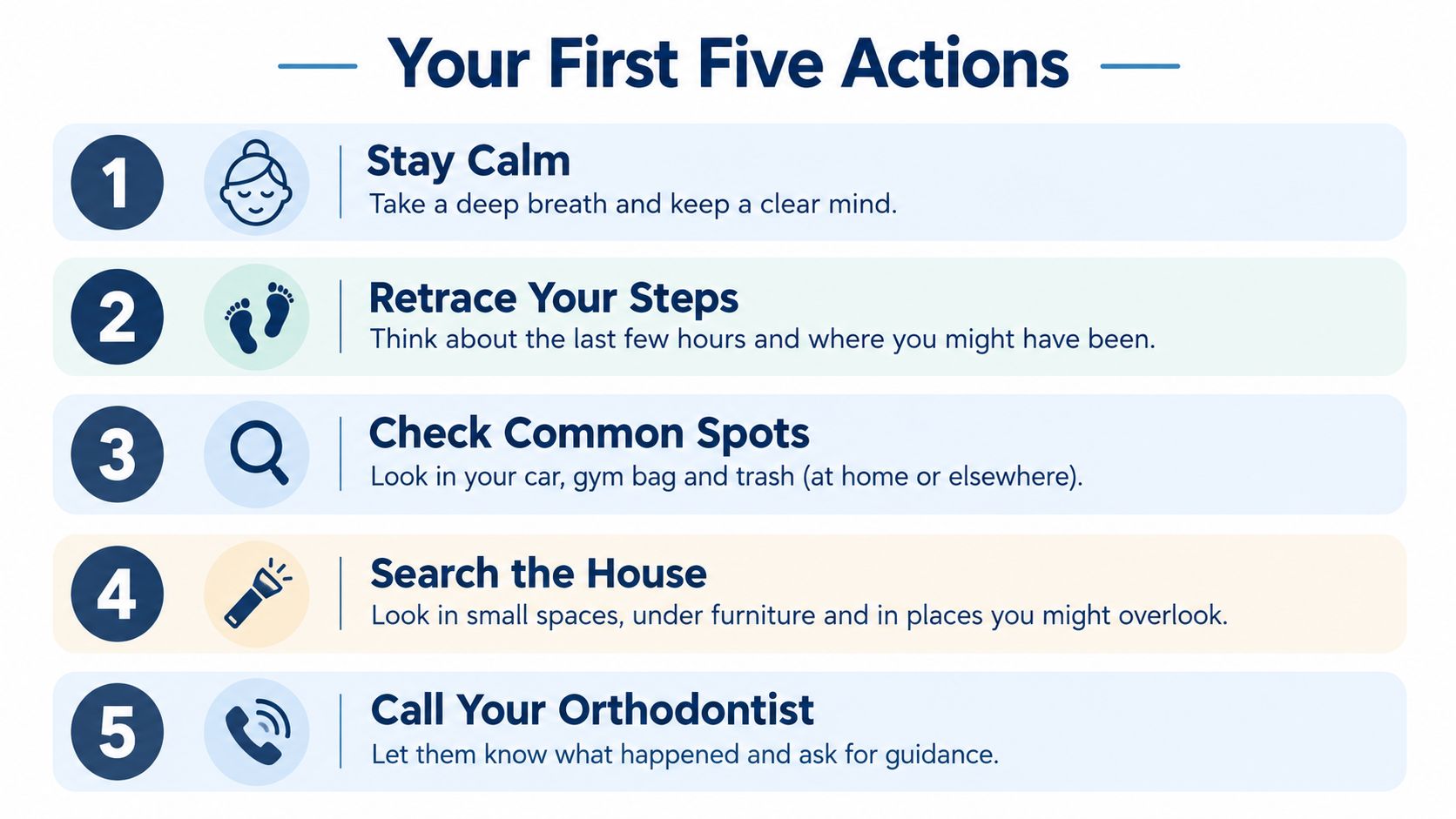
The first ten minutes matter because clear trays are easy to overlook and easy to throw away by accident. A focused search beats a frantic one.
The First Ten Minutes
- Stay calm: A missing tray is common during removable aligner treatment, especially with school, meals, and sports.
- Retrace recent steps: Rebuild the last few hours in order, from the last confirmed wear to the moment the loss was noticed.
- Check common spots: Look in lunch bags, gym bags, car cupholders, coat pockets, bathroom counters, and cafeteria trash if it can still be reached safely.
- Search slowly: Clear plastic blends into sinks, countertops, and bedding, so good lighting helps.
- Call the treating office: The next move is professional guidance, not an unsupervised tray change.
The video below is a useful visual refresher for families who prefer to watch before calling.
The Case Habit That Prevents Most Losses
Every time an aligner leaves the mouth, it should go directly into its protective case. A napkin looks harmless on a lunch table, but it also looks like trash to anyone clearing up. A loose tray in a pocket can bend, crack, or fall out.
The rule is simple enough for a child to repeat. Case open, tray in, case closed. If the tray can't be found, families shouldn't automatically jump ahead. Each aligner is shaped for a particular tooth position, so guessing can affect tracking. Call first.
Which Tray to Wear While You Wait
The central question isn't whether the previous or next tray exists. It's whether either one fits the teeth as they are right now. That depends on how long the lost tray was worn, how well it was seating, whether attachments are in place, and whether the next tray is already at home.
Patients shouldn't automatically advance after a loss, because each aligner is manufactured for a specific tooth position and increased pressure, rocking, incomplete seating, or visible gaps may indicate the tray is not tracking. A tray that won't seat fully shouldn't be forced.
Short-Term Tray Options After a Lost Aligner
| Option | Best Used When | Key Caution |
|---|---|---|
| Previous tray | The lost tray was worn only briefly and the orthodontist authorizes it as a temporary retainer | It may feel tight if teeth have already moved |
| Next tray | The lost tray had been worn sufficiently and the orthodontist approves advancing | It may rock or leave gaps if teeth aren't ready |
| Replacement tray | Neither neighboring tray is appropriate | The patient needs interim instructions while it is made |
Early in the Interval Versus Late in the Interval
A tray lost after only a short stretch of wear is different from one lost near the planned change date. Early on, teeth may not have completed the movement built into that aligner, so advancing can create a mismatch. Later, the orthodontist may judge that the movement is complete. Only the treating clinician can make that call with the treatment plan in view.
Practical rule: Keep the previous tray and the next unused tray, both labeled, until the orthodontist confirms progression.
Families should never heat, glue, trim, or try to reshape a damaged tray. They also shouldn't wear two trays to catch up. For Delaware children and teens moving between school, sports, meals, and sleepovers, labeled backup trays at home give the office real options when a call comes in. Without them, the safest choice may be a replacement and a short pause in progression.
Contacting Your Orthodontist and What to Say
A useful call includes facts, not just the words lost tray. Invisalign's patient instructions say to contact the treating doctor immediately if an aligner is lost or broken, and the doctor may direct the patient to wear the last aligner or begin the next one temporarily while a replacement is made. That decision depends on the treatment plan and the patient's circumstances.

Copy-Ready Message Template
Families can adapt this message for a call or patient portal note.
Hello, this is about a lost Invisalign aligner. The patient is on tray number [number], worn for [days]. It was last worn at [time and place] and has been missing since [time]. The previous tray is [available or not available], and the next tray is [available or not available]. Current symptoms are [none, tightness, rocking, or gaps]. Please advise which tray to wear tonight.
Weekends, Travel, and Delaware Offices
Losses rarely respect office hours. A child may lose a tray at a Dover soccer game on Saturday or during a family trip out of state. Families should still reach out promptly rather than waiting several days, and Stellar Orthodontics patients can contact any of the four Delaware locations for routing, whether the usual office is North Wilmington, Middletown, West Dover, or Millsboro. Dr. Robert Park, Dr. Can Nguyen, and Dr. Sonal Dave provide the clinical oversight behind that triage.
For urgent after-hours concerns, families can review the practice guidance for an emergency orthodontist in Delaware while awaiting a callback. The important detail is timing. A same-day message gives the orthodontist more options than a call made after several days without an aligner.
Replacement Options and What They May Cost
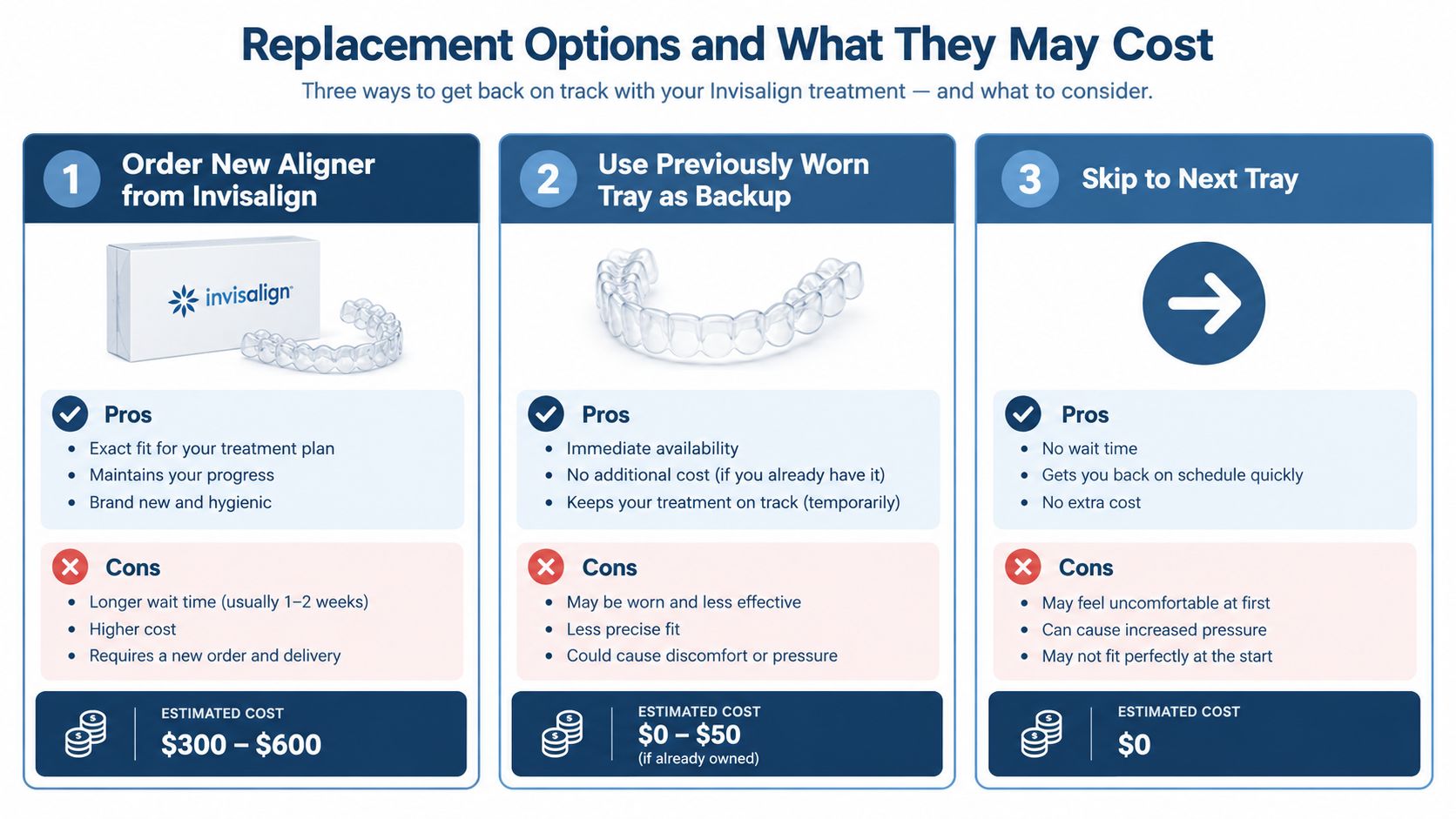
Once the orthodontist reviews the stage, three broad pathways usually emerge. A replacement tray can be ordered, a previous tray can be worn temporarily if authorized, or the schedule can be adjusted so the next tray starts only with professional approval. Each pathway has a different mix of wait time, fit, and cost.
Why Skipping Isn't Always Cheaper
Skipping the missing tray looks like the free option. It isn't automatically the smart one. If teeth haven't reached the position assumed by the next tray, poor tracking can follow, and correcting that may require more time, more visits, or revised aligners. A small, prompt decision can protect a much larger treatment investment.
Replacement aligners are not automatically free, because Invisalign's provider FAQ distinguishes quality-related warranty replacements from other circumstances and notes that warranty claims are subject to specified conditions and time periods. A lost tray may therefore be handled differently from a confirmed material or workmanship problem.
Questions to Ask Before Agreeing to a Fee
- Coverage in the treatment agreement: Does the original package include any replacement aligners?
- Warranty status: Is this a warranty matter or a lost-appliance replacement?
- Itemized charge: What exactly does the fee cover, including any shipping?
- Insurance and payment plans: Can insurance be checked, and can any balance be spread over time?
- Schedule impact: Does the replacement change the date for the next tray?
Families comparing overall treatment budgets can also review the practice overview of the average cost of Invisalign for adults. Delaware Medicaid and CHIP families should ask directly about plan-specific rules. Stellar Orthodontics accepts AmeriHealth Caritas Delaware, Highmark Health Options, and Delaware First Health plus CHIP, so the office can help check whether replacement coverage applies under a child's plan.
Preventing the Next Lost Aligner
Prevention is really about protecting daily wear time. The most widely cited benchmark is 20 to 22 hours per day, referenced by Invisalign's teen-treatment guidance for daily clear aligner wear, which makes every lost tray a measurable risk to the daily schedule. Hours spent searching, waiting, or going without an authorized tray count against that target.
High-Risk Moments Delaware Families Know Well
Losses cluster around transitions. Lunch at a Middletown middle school, a snack after a Millsboro travel baseball game, dinner at a Dover restaurant, or a sleepover in the Brandywine Valley all involve removal away from the usual bathroom counter. The tray leaves the mouth, conversation starts, and the case never comes out.
A Habit Checklist That Actually Works
- Case on the person: Attach the case to a keychain, lunchbox, or backpack so it's present at removal time.
- Label everything: Mark bags with the patient name and tray number, keeping previous and next trays separate.
- No napkins, ever: Paper wrapping is the classic route to the trash.
- One home spot: Keep backup trays in a single drawer or cabinet, not scattered across rooms.
- Clean and store promptly: Consistent care routines, including how to clean Invisalign aligners properly, reinforce the case habit.
Reduced wear has another consequence worth knowing. Families don't need the technical details, just the principle that frequent, prolonged removal makes treatment harder to keep on plan. Short, predictable routines beat relying on memory alone.
If a lost aligner has raised doubts about whether Invisalign fits a child's habits, or if a replacement has shifted a timeline, a free consultation can clarify the options. Stellar Orthodontics offers consultations with an iTero digital 3D scan and a personalized plan at North Wilmington, Middletown, Dover/West Dover, and Millsboro, so Delaware families can review aligners, braces, timing, and cost before committing.
Lost a tray or wondering whether clear aligners fit a busy Delaware family? Book a free consultation at Stellar Orthodontics for an iTero digital 3D scan, a straight answer on the next tray, and a personalized plan at North Wilmington, Middletown, West Dover, or Millsboro.