
Metal braces for adults are a well-established, routine treatment option, and roughly one in three orthodontic patients today is an adult. Adults considering them don't need to wonder whether they've missed some cutoff age for straightening teeth or fixing a bite.
Many adults reach this point in a familiar way. A lower front tooth has started overlapping its neighbor, a retainer stopped being worn years ago, or a dentist has mentioned that a bite problem is making certain teeth harder to clean. The appliance itself often isn't the hardest part of the decision. The practical questions matter just as much, including gum health, appointment schedules, work life, and what happens if a bracket breaks before the next visit.
Table of Contents
- Why More Adults Are Choosing Metal Braces
- How Metal Braces Actually Move Your Teeth
- The Real Pros and Cons of Metal Braces for Adults
- Metal Braces vs Ceramic Braces vs Invisalign
- What to Expect During Treatment
- Caring for Your Braces Day to Day
- Common Concerns Adults Have About Metal Braces
- Your Next Step and Questions Worth Asking
Why More Adults Are Choosing Metal Braces
A common starting point is an adult noticing a change that used to seem minor. Crowding may make floss snap between tight teeth, or an upper tooth may have shifted enough to show in every photo. Some adults had braces as teenagers and watched teeth drift after retainers were lost. Others never had treatment and are now addressing a bite that feels uneven when chewing.
Metal braces are fixed appliances. Small brackets attach to teeth, a wire connects them, and the orthodontist adjusts that system over time to guide teeth into planned positions. Because the appliance stays in place, progress doesn't depend on remembering to insert a removable tray after meals.
Adult Treatment Is Now Routine
Orthodontics is no longer mainly a teenage service. The American Association of Orthodontists adult orthodontics overview reports that approximately one in three orthodontic patients today is an adult. That figure matters because it changes the conversation. An adult asking about metal braces isn't an unusual case. Adult treatment is a normal part of orthodontic practice.
Adults seek treatment for varied reasons, and those reasons affect appliance choice.
- Crowding or spacing: Teeth may overlap, rotate, or leave gaps that trap food and plaque.
- Bite problems: Upper and lower teeth may not meet evenly, affecting chewing comfort and wear patterns.
- Relapse after earlier treatment: Teeth can shift over time, especially when retainers aren't worn consistently.
- Preparation for dental work: Alignment may be adjusted before other planned dental treatment, based on a clinician's assessment.
Who This Guide Helps Most
The clearest candidates aren't defined by age alone. Gum health, bone support, remaining teeth, bite complexity, and the ability to keep brackets clean all shape the decision. An adult with a complex bite and a busy schedule may prefer a fixed system that works continuously. Another adult may care more about a less visible appliance and accept different daily responsibilities.
Age by itself doesn't decide candidacy. The condition of the teeth and gums, plus the movement needed, matters far more.
Delaware adults who want a personalized answer can book a free consultation at Stellar Orthodontics in North Wilmington, Middletown, Dover/West Dover, or Millsboro. That visit turns general information into a specific plan based on an examination and digital records.
How Metal Braces Actually Move Your Teeth
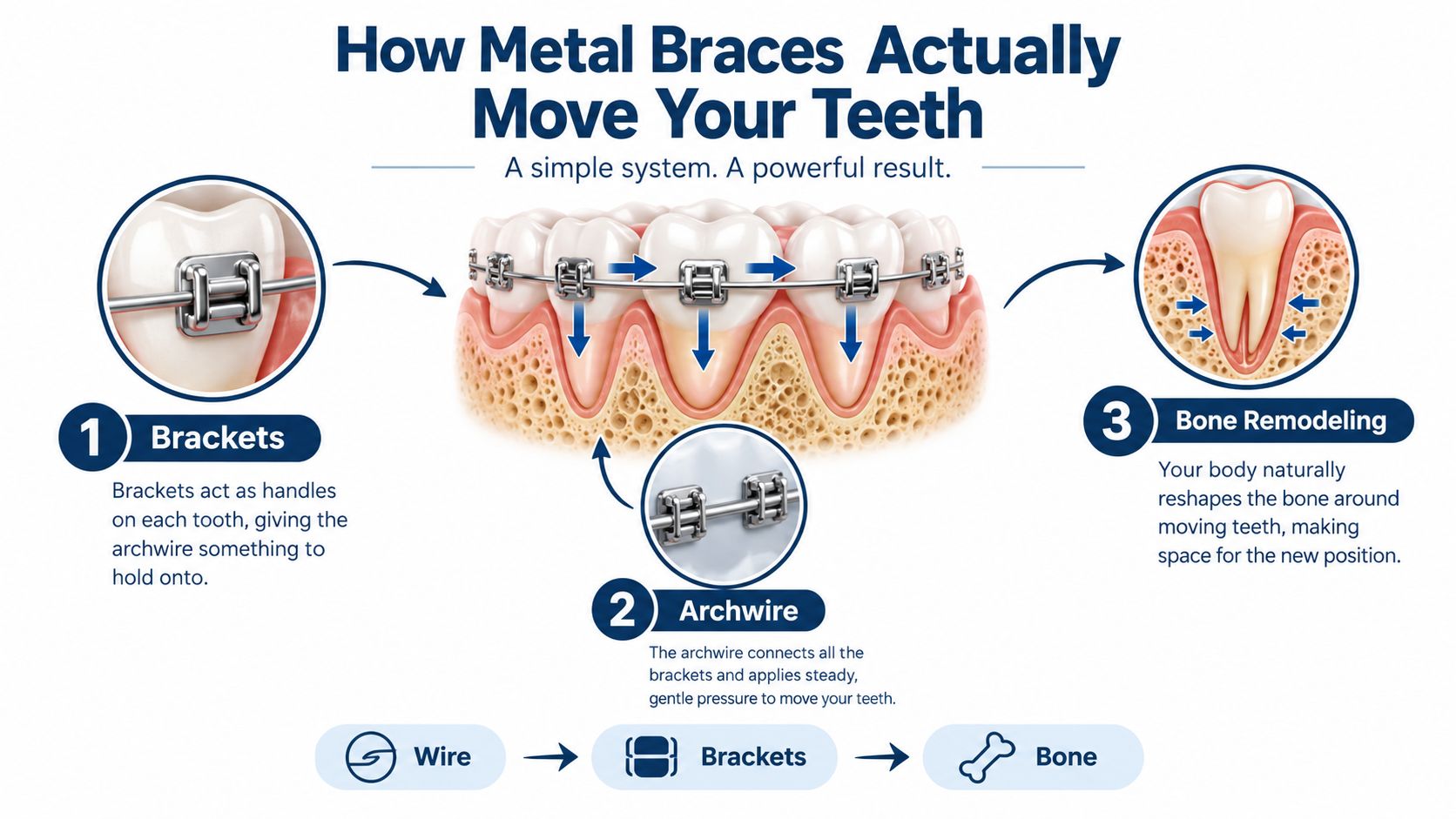
Metal braces can look complicated at first glance, but the basic idea is simple. Each tooth gets a small handle, a wire connects those handles, and gentle pressure tells the surrounding bone to reshape. Teeth don't slide through bone like objects through sand. Bone responds gradually, which is why treatment takes months rather than days.
The diagram below breaks the system into its working parts.
The Parts Working Together
Brackets are the small squares bonded to the front of most teeth. They hold the wire in a precise position so force reaches each tooth at a planned angle. Placement matters because a bracket positioned slightly differently can guide a tooth in a different direction.
The archwire runs through the brackets and connects them into one system. Early wires are usually more flexible and begin leveling crowded teeth. Later wires can be firmer and help refine root position and bite relationships. Elastics may be added between upper and lower teeth when the bite itself needs guidance, and bands may be used on some back teeth for support.
Why Stainless Steel Still Matters
The material behind this system has a long clinical history. A review of stainless steel in orthodontics notes that stainless-steel wires began entering orthodontic use in the 1920s, and W.H. Hatfield patented 18-8 stainless steel in 1924. That alloy was valued for resistance to corrosion and rust, qualities that matter in a wet environment like the mouth.
At adjustment visits, the orthodontist may change a wire, replace small ties, add elastics, or check whether a tooth is tracking as expected. Those small changes restart or redirect pressure. Soreness after an adjustment is a common short-term experience because teeth and surrounding tissues are responding to renewed force.
Pressure Needs Time and Consistency
Steady pressure works because bone remodels in response to it. Too little consistency, such as missed visits or repeated breakages, can interrupt that process. Metal braces remain relevant for adults because the fixed brackets give the orthodontist direct control over individual teeth, including rotations and bite movements that need close supervision.
The Real Pros and Cons of Metal Braces for Adults
Adults usually weigh metal braces differently from teenagers. Appearance in meetings may matter, but so does reliability. A parent coordinating work, school pickups, and appointments may value an appliance that cannot be left on a bathroom counter. Another adult who speaks to clients daily may find visibility harder to accept. Neither reaction is wrong. The better question is which trade-offs fit a particular life.
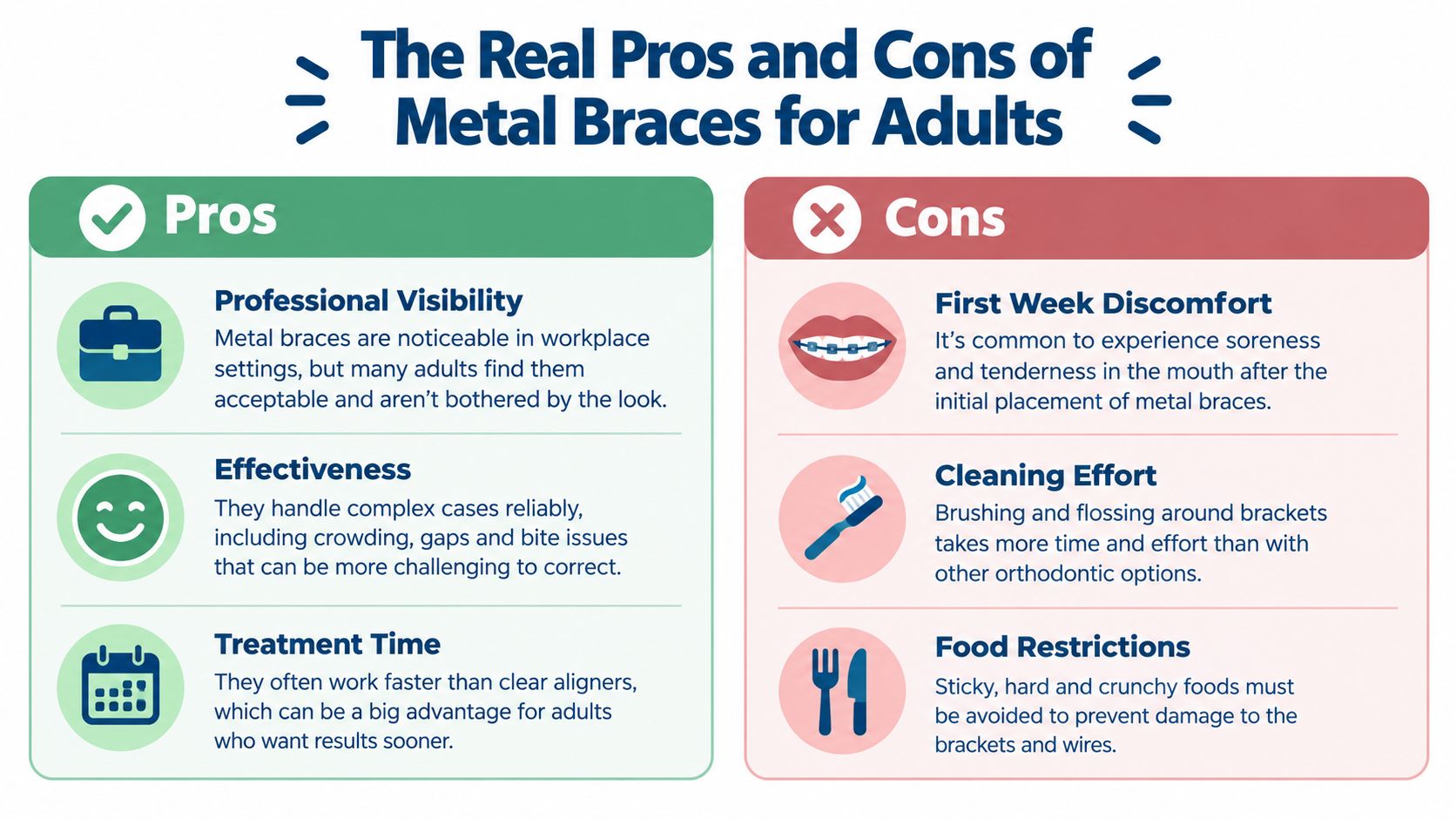
The comparison below summarizes the practical strengths and frustrations adults mention most often.
Where Metal Braces Hold Up Well
Strength and control are the standout advantages. Stainless steel brackets tolerate everyday chewing forces well, and fixed attachment lets the orthodontist address complex movements without relying on patient wear time. Teeth keep receiving guidance during workdays, travel, and family routines.
Cost predictability also appeals to many adults. Metal braces are generally positioned as the more budget-conscious fixed option, although an exact fee depends on case complexity and insurance details discussed at consultation. Adults who have already priced removable options often appreciate that metal treatment doesn't hinge on replacement trays or perfect daily discipline.
There's also a mental simplicity to a fixed appliance. Nothing needs to be removed before coffee, stored during lunch, or tracked down after a meal out.
The Downsides Worth Taking Seriously
Visibility is the obvious one. Modern brackets are smaller than older designs many adults remember, but they're still noticeable in conversation and photos. Some adults stop thinking about that quickly. Others feel self-conscious at work, and that discomfort deserves honest weight in the decision.
The first days after placement, and sometimes after adjustments, can bring tenderness. Cheeks and lips may need time to adapt, and orthodontic wax helps when a bracket rubs. Cleaning takes more effort because food collects around brackets and under the wire. Sticky, hard, and crunchy foods also need to be avoided to reduce breakage risk.
Plain truth: Metal braces trade visibility and extra cleaning time for durability and control that don't depend on daily willpower.
For many adults, especially those needing substantial bite correction, that trade feels reasonable. For others, appearance concerns point toward a different appliance.
Metal Braces vs Ceramic Braces vs Invisalign
Most adults aren't choosing between braces and nothing. They're choosing between three legitimate approaches that solve overlapping problems in different ways. Metal braces and ceramic braces are both fixed systems with brackets and wires. Invisalign uses removable clear aligners changed in sequence. The differences show up in daily life long before treatment ends.
Comparing Orthodontic Options for Adults
| Feature | Metal Braces | Clear Ceramic Braces | Invisalign Aligners |
|---|---|---|---|
| Appearance | Visible stainless steel brackets and wire | Tooth-colored brackets with a visible wire | Clear trays that are hard to notice at a distance |
| How it stays on track | Fixed in place, works continuously | Fixed in place, works continuously | Removable, depends on consistent wear |
| Treatment range | Handles mild through complex bite and alignment problems | Handles many cases, with material limits in some complex movements | Suits selected cases, with limits determined at evaluation |
| Durability | Strong and resistant to everyday damage | Sturdy but more brittle than metal | Trays can crack or be lost and may need replacement |
| Relative cost band | Often the lower-cost fixed option | Often higher than metal | Often higher, depending on case and tray needs |
| Cleaning routine | Brushing and flossing around brackets and wire | Same bracket cleaning, plus care with staining foods on ties | Teeth brushed normally, trays cleaned separately |
| Best-fit patient | Adults wanting reliability and broad case coverage | Adults wanting a fixed system with a subtler look | Adults prioritizing removability and discretion |
Reading the Table Like an Adult Patient
Ceramic braces appeal to adults who want brackets to blend with tooth color. The brackets themselves resist staining, while the small elastic ties holding the wire can pick up color from coffee or strongly pigmented foods. Those ties are replaced at adjustment visits, so discoloration doesn't accumulate for the entire treatment.
Aligners appeal for different reasons. They come out for eating and cleaning, which many adults find convenient. That freedom is also the weakness. A tray left in a case during a long work lunch isn't moving teeth, and inconsistent wear can slow progress. Adults who travel frequently or eat on unpredictable schedules should think about that pattern.
Metal braces make the strongest case when tooth movement is complex. Severe rotations, significant bite correction, and teeth that need to move in several directions usually benefit from the direct control of brackets and wires. Metal also suits adults who know they'd struggle to manage removable trays through busy days.
Lifestyle Fit Decides More Than Marketing
An adult in a client-facing role may reasonably choose ceramic brackets or aligners and accept the added cost or discipline. An adult who plays contact sports may lean toward metal durability, with a mouthguard fitted around brackets. Neither choice signals vanity or toughness. Both reflect priorities.
At a consultation, the useful conversation compares the actual bite against those priorities. Delaware patients can have that discussion at North Wilmington, Middletown, West Dover, or Millsboro, where metal braces, clear ceramic braces, and Invisalign can be weighed against the same set of records rather than guessed from a photo or mirror check.
What to Expect During Treatment
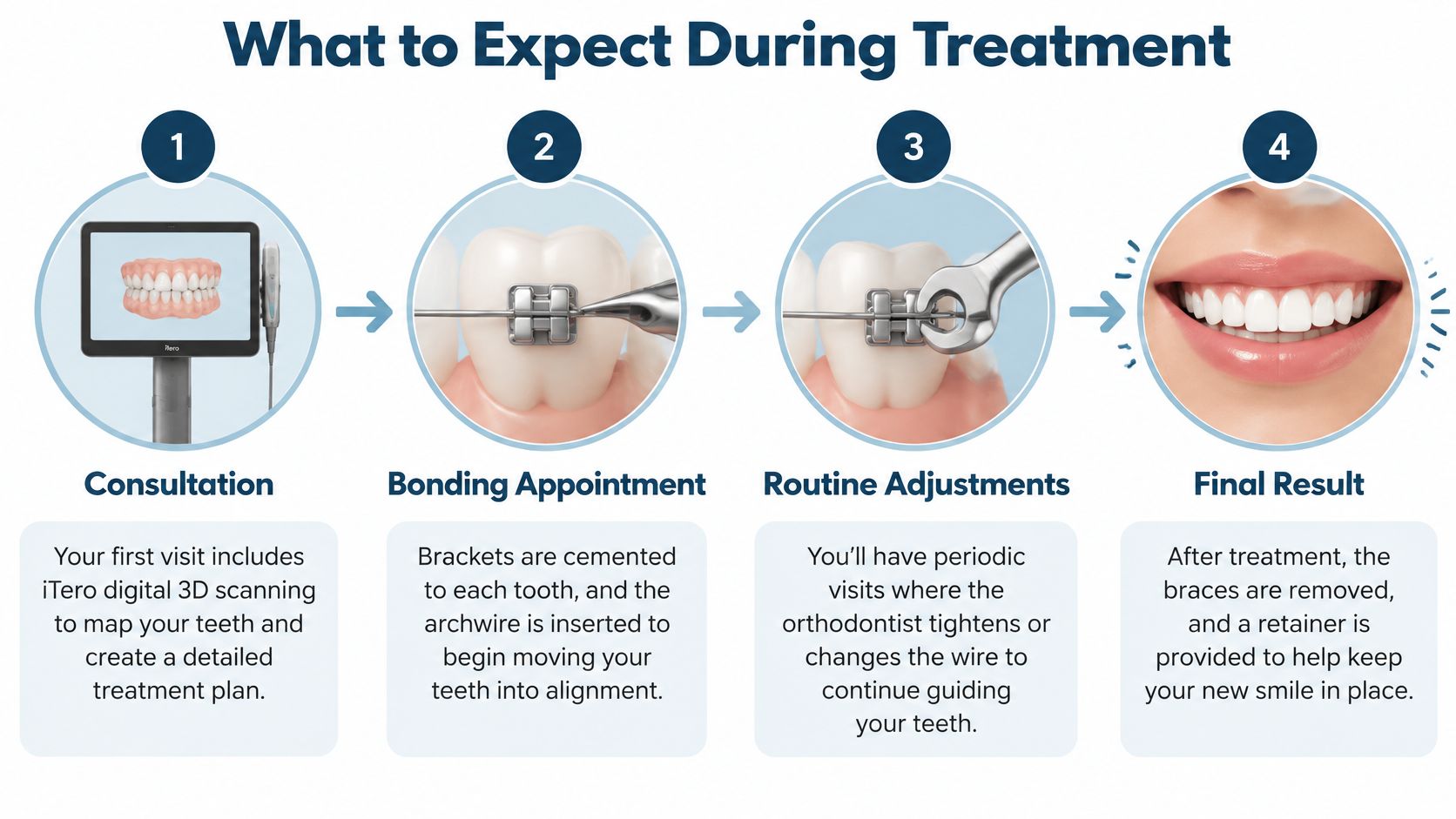
Adult treatment follows a predictable sequence, even though the details vary by case. Understanding that sequence helps adults plan around work and family commitments instead of bracing for surprises. The timeline below shows the usual path from first records to retainer.
Consultation and Bonding
The first visit includes an examination and iTero digital 3D scanning to map the teeth without traditional impression material. The orthodontist reviews crowding, spacing, bite relationships, and gum health, then explains whether metal braces fit the case. Adults should leave with an estimated timeline and a clear picture of visit frequency, not just a price.
Bonding is the appointment where brackets are attached and the first archwire is placed. Teeth are cleaned and prepared, brackets are positioned, and the wire is secured. The mouth usually feels crowded at first, and a soft-food plan for the following days makes the transition easier.
For overall expectations, AARP guidance on adult braces states that adult orthodontic treatment commonly takes about 10 to 24 months, with progress checks and adjustments typically scheduled every 6 to 12 weeks. Complex bite correction can take longer, while limited alignment goals may finish sooner within that range.
Adjustments and the Adult Calendar
Adjustment visits are working appointments. The orthodontist checks movement, changes wires or ties, reviews elastic wear, and looks for hygiene problems around brackets. Adults often ask whether longer gaps between visits are a problem. The honest answer is that spacing should match the treatment phase and the individual plan, so patients should ask whether a schedule reflects clinical need or office availability.
The short video below shows treatment activity in a way that's easier to picture before the first adjustment.
Missed appointments matter because planned changes are delayed. A hospital orthodontic patient guide explains that missed appointments or repeatedly broken appliances can extend total treatment time. That's why work travel, relocation plans, and emergency contact procedures deserve discussion before bonding day.
Adults should also ask how quickly a broken bracket gets repaired, what to do during travel, and how care transfers if a move becomes unavoidable. Those operational details protect the timeline as much as the wire does. With four Delaware locations, many patients can choose the office that best fits commuting and caregiving routines.
Caring for Your Braces Day to Day
Daily care is where adult patients have the most control. The appliance applies force, but food choices and cleaning habits decide whether teeth and gums stay healthy while that force works. A consistent routine also reduces emergency visits for avoidable breakage.
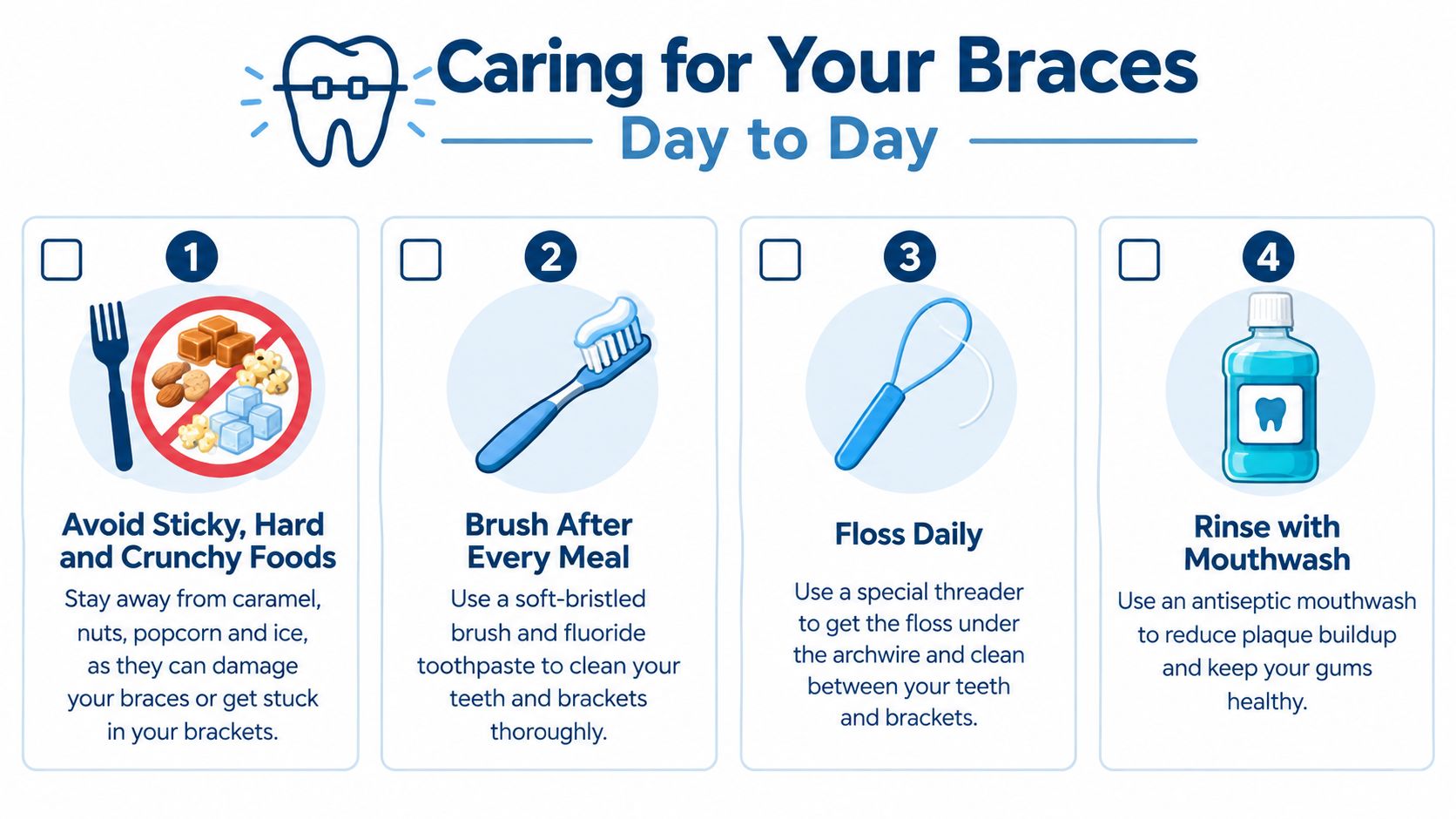
The checklist below covers the habits that matter most.
Eating Without Breaking Hardware
Brackets can handle normal chewing, but certain foods create force or pull that loosens them. Sticky candy, hard nuts, ice, and crunchy snacks are common culprits. Cutting firm foods into smaller pieces and chewing slowly lowers the risk without turning every meal into a negotiation.
Adults who want a fuller reference can review the detailed list of foods to avoid with braces before the first grocery trip after bonding. Restaurant meals get easier with practice. Softer entrées, smaller bites, and a quick water rinse afterward handle most situations.
Cleaning Around Brackets and Wires
Plaque gathers where brackets meet enamel and along the gumline. Brushing after meals with a soft-bristled brush and fluoride toothpaste helps, with extra attention angled above and below each bracket. Cleaning between teeth takes longer with a wire in the way, so tools matter.
- Floss threaders: These guide floss under the archwire so contact points still get cleaned.
- Interdental brushes: Small brushes fit around brackets and under wires where a regular brush struggles.
- Water flossers: A water stream can dislodge debris, working best as a supplement rather than a full replacement for floss.
- Fluoride rinse: A rinse recommended by the dental team can support enamel during treatment.
Handling Small Problems at Home
A poking wire can often be covered with orthodontic wax until the office advises next steps. A loose bracket that's still attached to the wire usually stays in place temporarily, but the office should be called for guidance. Sharp pain, swelling, or trauma from an injury deserves prompt attention rather than home troubleshooting.
Small mishaps happen to careful patients too. Prompt communication keeps a minor repair from becoming a longer delay.
Keeping wax and a travel toothbrush in a desk drawer or bag covers most everyday situations. The Stellar team can talk patients through urgent questions by phone, which helps adults decide whether a problem needs a same-day visit or can wait safely.
Common Concerns Adults Have About Metal Braces
Two worries stop adults more than any others. The first is that braces are somehow too late to help. The second is that gum problems automatically disqualify them. Both assumptions are too simple, and both deserve a careful answer rather than reassurance without evidence.
The Gum Disease Question
Healthy gums support orthodontic movement, so active inflammation needs treatment before braces begin. A systematic review on orthodontics and periodontal health found that orthodontic tooth movement produced no significant periodontal deterioration in adults without periodontitis or in adults with stable, treated periodontitis, though the underlying studies were small and low quality. That finding is encouraging, but its limits matter. It doesn't give every adult with gum disease a blanket clearance.
Candidacy depends on specifics a consultation examines directly.
- Periodontal stability: Treated, stable gum disease differs from active, untreated inflammation.
- Plaque control: Brackets make cleaning harder, so current hygiene habits predict risk during treatment.
- Gum thickness and recession: Thin tissue or existing recession may need monitoring or coordination with a dentist or periodontist.
- Movement planned: The amount and direction of tooth movement influences gum and bone response.
Adults with recession, bone loss, or a history of periodontitis should expect a periodontal examination as part of planning. Conservative force levels, hygiene coaching, and monitoring for attachment loss may be built into the plan. That screening process, not age or the metal material itself, acts as the gatekeeper.
Pain and Everyday Worries
Discomfort concerns are also common, especially for adults imagining teenage experiences with older, bulkier hardware. Tenderness after placement and adjustments is normal, and most adults manage it with soft foods and patience during the first days. Adults wanting a realistic picture can read more about what adult braces pain typically feels like before deciding.
Speech usually adapts quickly because brackets sit on the front of teeth rather than covering the palate. Professional appearance concerns are personal, and a consultation can compare metal against subtler options openly. The goal isn't to talk an adult into metal braces. The goal is matching the appliance to healthy tissue, a workable routine, and a bite that needs specific movement.
Your Next Step and Questions Worth Asking
Metal braces tend to fit adults who want a durable fixed appliance, need substantial bite or alignment correction, and prefer not to manage removable trays. That profile describes a large and growing group. A 2022 review of adult orthodontic growth reported that the average U.S. orthodontic practice treated 178 adult patients in 2018, up from 129 in 2012, a 27.53% increase. Adult treatment has become routine care, not an exception.
Questions That Reveal More Than Price
Price matters, and adults comparing fees can review the breakdown of adult braces pricing factors ahead of a visit. Still, the cheapest quote can hide scheduling or repair frustrations. These questions give a fuller picture.
- Estimated timeline: What treatment length does the examination suggest, and what could change it?
- Visit cadence: How often are adjustments planned for each phase of treatment?
- Emergency handling: How quickly are broken brackets or painful wires seen?
- Gum screening: Has periodontal health been checked, and is coordination with a dentist needed?
- Total cost clarity: What does insurance cover, and what payment options apply?
Stellar Orthodontics accepts most major dental insurance and offers flexible monthly payment plans, with free consultations including iTero 3D scans at all four Delaware offices. Adults can bring the questions above and leave with answers tied to their own teeth rather than general estimates.
Adults ready for a clear, personal answer about metal braces can book a free consultation with digital scanning at the North Wilmington, Middletown, West Dover, or Millsboro office that fits daily life best. Visit Stellar Orthodontics to schedule that visit and find out whether metal braces match the bite, gum health, and goals involved.