.png)
Children should have their first orthodontic evaluation around age 7, but that doesn't mean treatment starts at 7 or ends in the teen years. Orthodontic care often continues into adulthood, and in Delaware, Medicaid generally covers medically necessary orthodontic treatment for patients under 21.
That answer surprises many families. Some parents worry a second grader is too young. Others assume a missed middle school window means it's too late. Both ideas leave out how modern orthodontics works.
Orthodontics is less like a one-time event and more like a long road map. A child may need only monitoring at first. A teenager may be ready for braces or aligners during active growth. An adult may start treatment years later because crowding worsened, a bite feels off, or old relapse became hard to ignore. For Delaware families, the practical question often isn't just “What treatment works?” It's also “Who qualifies, when does timing matter, and will coverage apply?”
Table of Contents
- Understanding Orthodontic Care Across Your Lifespan
- Early Evaluations and Adolescent Treatment Paths
- Comparing Braces and Clear Aligner Options
- How Adult Orthodontics Differs Biologically
- Navigating Delaware Medicaid and Insurance Coverage
- Why Choose Stellar Orthodontics in Delaware
- Taking the Next Step Toward a Healthier Smile
Understanding Orthodontic Care Across Your Lifespan
A common family scenario goes like this. A parent brings in one child with a front tooth coming in crooked, then asks whether an older sibling missed the right time, and finally mentions wanting straighter teeth personally. That single visit captures the story of orthodontics for all ages.
Orthodontics no longer fits the old stereotype of being only for middle schoolers. A review cited in adult and child orthodontic trend reporting noted that adult orthodontic treatment increased by 40% between 1989 and 2012, and by 2022 an estimated 1 million Americans over age 18 were wearing braces. The same reporting says roughly one in four to one in three orthodontic patients is now an adult.

What changes from one life stage to the next
A seven-year-old usually needs evaluation, not a full set of braces. A teenager may be in the most active treatment phase. An adult often comes in with different concerns, such as previous shifting, worn teeth, missing teeth, or gum history.
The bigger point is that the goal isn't just a straighter smile. Orthodontic planning can also involve how teeth fit together, whether there's enough room for permanent teeth, and whether long-term maintenance will be realistic.
Healthy orthodontic care depends on timing, growth, gum health, and retention. Age matters, but age alone doesn't decide candidacy.
Why this matters for Delaware families
Families in North Wilmington, Middletown, Dover, West Dover, and Millsboro often juggle school schedules, sports, work, and insurance questions at the same time. Seeing orthodontics as a lifespan pathway helps make those choices less confusing.
Instead of asking only “Is this the right age for braces?” it helps to ask:
- What needs attention now: monitoring, active treatment, or retention
- What can wait safely: some issues are watched over time before treatment starts
- What affects candidacy most: healthy teeth, healthy gums, and realistic goals
Early Evaluations and Adolescent Treatment Paths
Parents often hear “age 7” and picture an early full treatment plan. That's usually not what the first visit means.
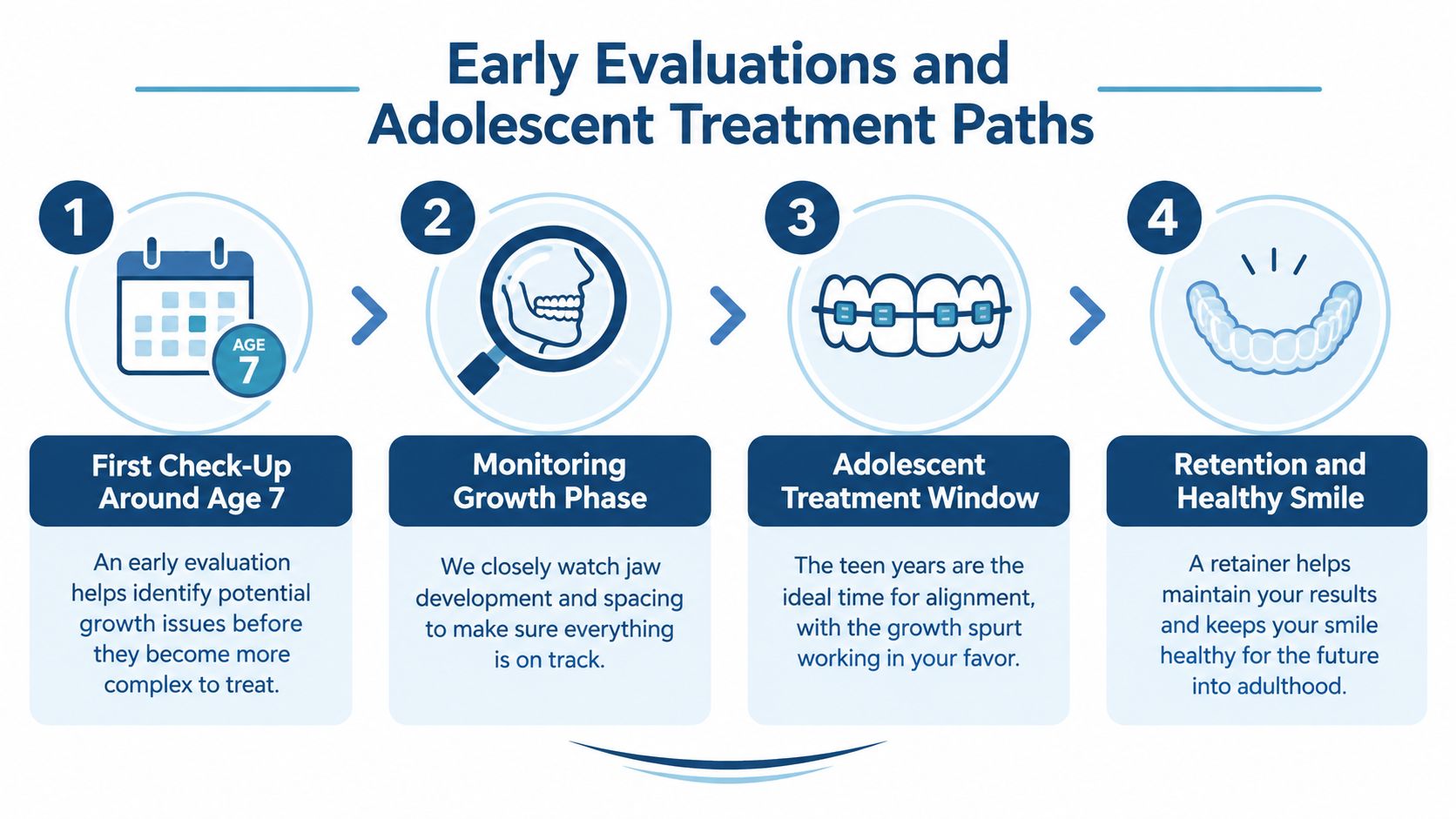
The American Association of Orthodontists says children should have their first orthodontic evaluation by age 7, and that visit is meant to be a check-up, not automatic treatment, as explained in this guidance on early orthodontic evaluation at age 7. At that stage, an orthodontist is looking for patterns: how the jaws are growing, whether permanent teeth have room, and whether a bite problem may become harder to manage later.
What the timeline often looks like
First check-up around age 7
This visit works like an early map review. It can show whether a child needs simple observation, limited early intervention, or no action at all for the moment.Monitoring through mixed dentition
Many children spend this phase being watched. Baby teeth and permanent teeth are sharing space, and growth can change the picture.Teen treatment
This is the stage many people picture first. Once more permanent teeth are in place, braces or clear aligners may be used to correct alignment and bite issues.Retention after active treatment
Teeth don't stay put on their own just because braces came off. Retainers are part of treatment, not an optional extra.
Why teens still make up most orthodontic patients
Even with growing adult demand, younger patients still make up the largest share of treatment. A large age-pattern review of orthodontic treatment found that 67.6% of people who self-reported orthodontics were under 18. The same source also cited a German national study showing 23.4% of children and adolescents ages 3 to 17 were in regular orthodontic treatment, including 25.8% of girls and 21.1% of boys.
Practical rule: Age 7 is the right time for a first look, not a promise that braces will start right away.
What families often get wrong
A parent may think, “If treatment isn't starting now, the visit wasn't necessary.” In reality, monitoring is useful. It gives the family a baseline and helps avoid guessing later.
Another common misunderstanding is that teen treatment is purely cosmetic. Straightening can improve appearance, but orthodontic planning also focuses on how teeth meet, how space is managed, and whether results can be maintained into adult years.
Comparing Braces and Clear Aligner Options
When families compare treatment choices, they often focus first on appearance. That makes sense, but the better first question is, “What kind of tooth movement does this case need?”
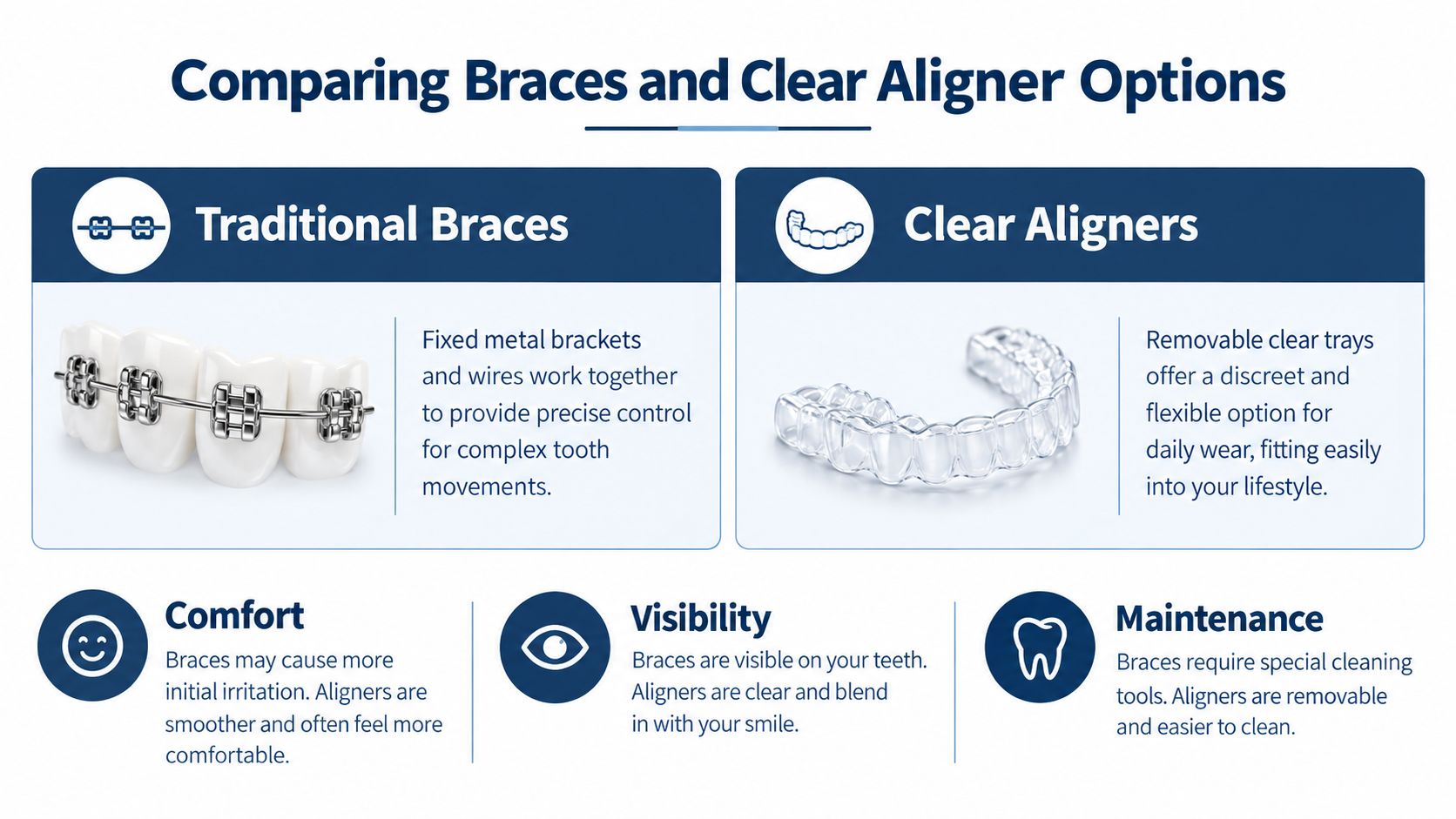
Braces and clear aligners both move teeth, but they do it in different ways. According to this review of orthodontic biomechanics in braces and aligners, braces use brackets and archwires to create force systems that can more directly produce tipping, translation, torque, rotation, extrusion, and intrusion. Clear aligners use a thermoplastic shell, and because that force often acts farther from the tooth's center of resistance, aligners tend to produce more tipping unless attachments and staging are used to improve control.
A simple way to picture the difference
Braces work more like handles attached to each tooth. That gives the orthodontist detailed control over how a tooth turns or shifts.
Aligners work more like a fitted tray guiding teeth from the outside. They can be very effective, but the plan has to account for which movements are predictable and which ones need extra help.
A more detailed side-by-side overview appears in this guide to clear aligners vs. traditional braces.
Daily life trade-offs
| Option | Often appeals to families because | Needs close attention because |
|---|---|---|
| Braces | They stay on full-time and don't depend on remembering to wear trays | Food choices and brushing around brackets take more effort |
| Clear aligners | They're removable and less visible in photos and daily life | They only work well when worn consistently and tracked carefully |
This short video gives a helpful visual overview of treatment differences.
Which option fits which patient
- A child or teen with more involved bite correction: braces may offer more direct control.
- A responsible teen or adult who wants a lower-profile option: aligners may fit well if the tooth movements are appropriate for that system.
- A patient focused on a less noticeable fixed option: clear ceramic braces can be part of the conversation too.
Treatment choice should match the biology and mechanics of the case, not just the mirror.
How Adult Orthodontics Differs Biologically
Adults often ask whether teeth still move well later in life. The answer is yes, but the body doesn't respond the same way it does in adolescence.
Neutral patient guidance from the British Orthodontic Society FAQs says teeth can be moved at any age if the teeth and gums are healthy. That's encouraging, but it isn't the whole story. Adults need treatment plans built around adult biology, periodontal health, and long-term stability.
Why adult movement may feel slower
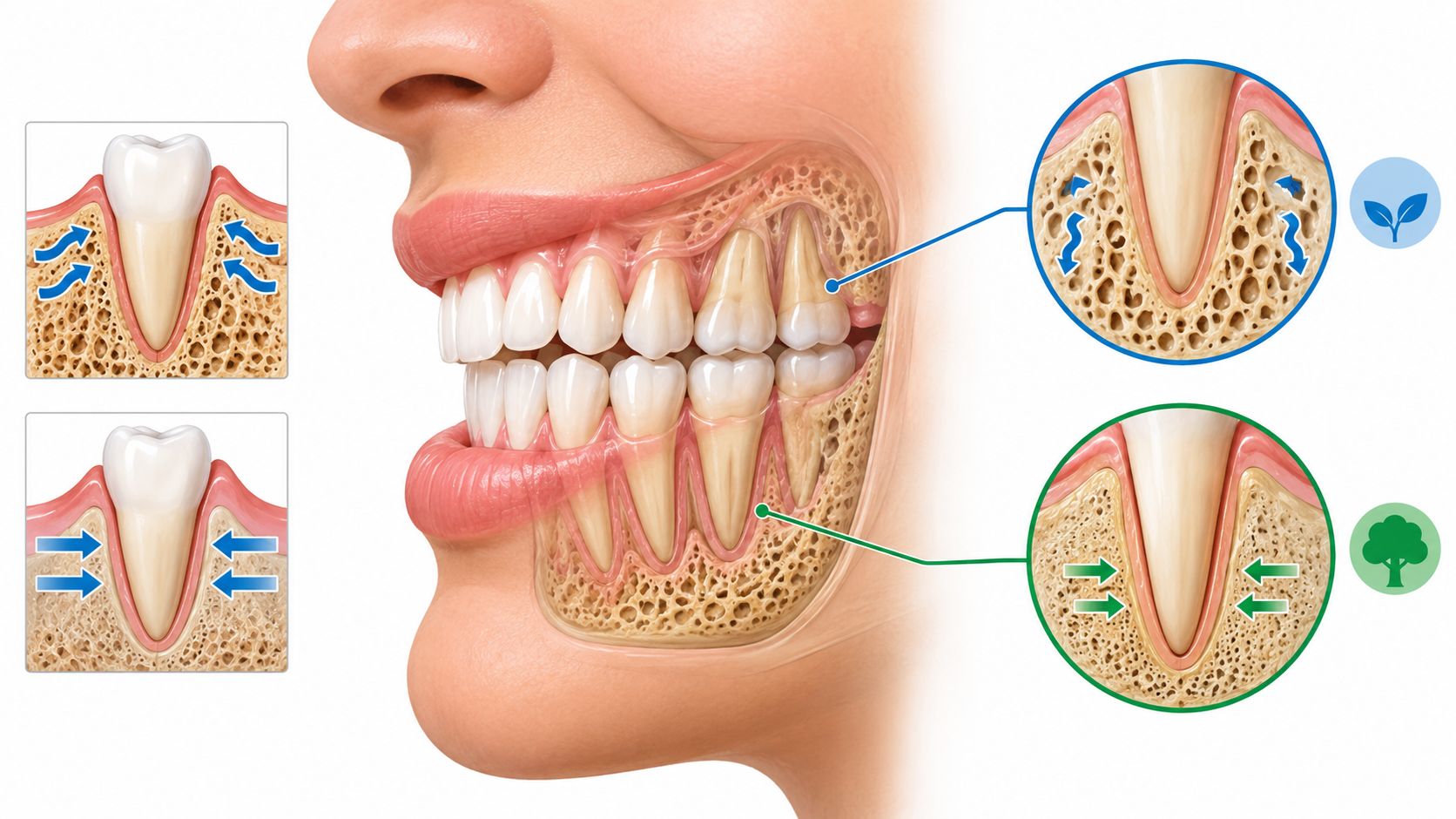
A review of age-related orthodontic tooth movement reports that adult tissues show slower remodeling, more inflammatory signaling, higher bone density, and reduced osteoblast and osteoclast activation. Those changes can slow tooth movement and may increase side effects such as root resorption and pain compared with younger patients.
That doesn't mean adults shouldn't seek care. It means expectations should be grounded in biology.
What this changes in real treatment
An adult plan often needs closer attention to gum support, bite forces, and maintenance. If someone already has recession, bone loss, or old dental work, the orthodontic approach may need to be more conservative.
Adults also ask more practical questions, and they should. Questions about treatment length, retainers, stability, and risks matter just as much as “Will it look discreet?” Bite-specific concerns also shape planning, especially in cases involving vertical overlap or deep bite patterns, as discussed in this explanation of how braces fix an overbite.
A healthy forty-year-old can be a better orthodontic candidate than a teenager with poor gum health and inconsistent home care.
Navigating Delaware Medicaid and Insurance Coverage
Many general articles fall short. They say orthodontics works at any age, but they don't explain how coverage changes by age, diagnosis, and state rules.
For Delaware families, Medicaid orthodontic coverage is generally tied to patients under 21 and medical necessity. A Delaware Medicaid orthodontic overview explains that coverage is generally available only for patients under 21, that the benefit ends at the 21st birthday, and that the program uses EPSDT rules for people under 21.
What “medically necessary” usually means
Cosmetic interest alone usually isn't enough for Medicaid approval. Delaware eligibility also depends on clinical standards and prior authorization.
This Delaware children's braces Medicaid eligibility guide notes that approval may require an HLD Index score of 26 or higher, or an auto-qualifying condition such as cleft palate, impacted anterior teeth, severe deep overbite, severe crossbite, or severe traumatic deviation, with prior authorization required.
A practical way for parents to think about coverage
A family may have two people in the same home with the same concern about crooked teeth but very different coverage outcomes.
- Child under 21 with a severe bite problem: Medicaid may cover treatment if the case meets Delaware's medical necessity standards and prior authorization is approved.
- Parent wanting straighter front teeth: Adult Medicaid orthodontic coverage is generally excluded in most places, according to this plain-language Medicaid orthodontic coverage summary.
- Teen with moderate crowding: the family may need a formal orthodontic evaluation to learn whether the case is considered medically necessary or cosmetic under plan rules.
Why families often get stuck
Coverage rules and office participation don't always line up neatly in online directories. Some families spend a long time trying to confirm who accepts which plan and what kind of case qualifies.
That's why the first useful step isn't guessing from a website list. It's getting a real orthodontic exam, records if needed, and a clear explanation of whether the case appears cosmetic, borderline, or medically necessary. For Delaware families sorting through options, this overview of Medicaid orthodontic coverage can help frame the right questions before that visit.
One practical local note matters here. Stellar Orthodontics accepts Delaware Medicaid plans for eligible children and teens under 21, along with many private insurance plans, and also offers flexible monthly payment options for families paying outside Medicaid.
Why Choose Stellar Orthodontics in Delaware
Once families understand age timing, treatment options, and coverage rules, location and access start to matter a lot. Convenience affects whether appointments stay on schedule, whether school and work disruptions stay manageable, and whether follow-up care feels realistic.
Stellar Orthodontics serves Delaware families through four offices in North Wilmington, Middletown, West Dover, and Millsboro. That spread matters for parents driving from the Brandywine Valley, the MOT corridor, Kent County, or Sussex County who don't want every adjustment or check-in to become a major trip.
What local families often need most
Some families need a child's first evaluation near home. Others need a teen to start braces during a busy sports season. Adults often want a practice close to work or school pickup routes.
The practice also offers free consultations and iTero digital 3D scanning, which can make the first visit easier to understand. Instead of relying only on verbal explanation, families can often see a clearer picture of current alignment and possible treatment direction.
Reasons the local setup helps
- Four Delaware locations: North Wilmington, Middletown, West Dover, and Millsboro make ongoing care easier to fit into real life.
- Care for different age groups: children, teens, and adults can all be evaluated within the same practice setting.
- Multiple treatment types: traditional metal braces, clear ceramic braces, and Invisalign clear aligners allow treatment to match both clinical needs and lifestyle preferences.
For many parents, that combination reduces friction. The easier it is to reach appointments and understand the plan, the easier it is to follow through.
Taking the Next Step Toward a Healthier Smile
A family doesn't need to decide everything in one day. The first goal is to learn where a child, teen, or adult falls on the orthodontic pathway.
A simple next-step checklist
Schedule an evaluation if a child is around age 7
That visit can confirm whether the right move is treatment, watchful waiting, or no concern at all.Ask the practical questions
Families should ask about timing, treatment length, retainers, stability, and whether a case looks medically necessary or cosmetic.Bring insurance or Medicaid details
Coverage questions are easier to answer when the office can review the patient's age, plan type, and clinical findings together.Think beyond the active phase
Braces or aligners are only part of the process. Long-term success depends on retention and follow-up.
What parents and adult patients should remember
Orthodontics isn't only for one age group, and it isn't always urgent the moment a concern appears. Some children need monitoring. Some teens need full correction. Some adults are excellent candidates once gum health and goals are reviewed carefully.
The right time for orthodontic care is the time when the diagnosis, the health of the teeth and gums, and the family's goals line up.
Families across North Wilmington, Middletown, Dover, West Dover, and Millsboro often feel better after one clear consultation because the guesswork is gone. Even when treatment doesn't start right away, they leave with a plan.
That's often the biggest relief of all.
Stellar Orthodontics offers free consultations, iTero digital 3D scans, and treatment options for children, teens, and adults across North Wilmington, Middletown, West Dover, and Millsboro. Families who want clear answers about age-appropriate care, braces versus aligners, or Delaware Medicaid eligibility can start with a no-pressure visit at Stellar Orthodontics.