
Which finishes faster, self-ligating braces or traditional braces? A parent comparing two quotes for the same child may see different bracket types and wonder whether one will mean fewer months in treatment.
Speed is three separate clocks, and most comparisons blur them: chair time at each visit, the number of visits, and total months in braces. These measure different things. The bracket design may affect what happens during an appointment, while the orthodontist's diagnosis and treatment plan guide the overall course. Keeping appointments as scheduled also matters.
A shorter visit does not necessarily mean fewer visits or a shorter treatment. For families, that distinction helps set realistic expectations around school, activities, and the time braces stay on.
Table of Contents
- Side-by-Side Look at Both Bracket Types
- Does Bracket Design Shorten Treatment Time
- Comfort and Chair Time During Treatment
- Cleaning, White Spots and Daily Hygiene
- Maintenance Between Visits
- Choosing by Situation and Budget
- Book a Free Consultation to Choose Your Braces
Side-by-Side Look at Both Bracket Types
How the two systems hold the wire
Braces use brackets bonded to the front of the teeth, an archwire that runs through them, and a way to hold the wire in place. The difference between traditional and self-ligating brackets is how that last part works.
Traditional brackets use ligatures, small elastic rings or thin steel ties that hold the archwire in its slot. At an adjustment, the ties are removed and replaced. Elastic rings can also add a bit of color to a child's braces.
Self-ligating brackets use a built-in clip or sliding door to hold the wire, without a separate tie. The bracket is still bonded to the tooth, the wire still runs through it, and the orthodontist still sets the schedule for changing the wire.
Passive and active designs do different jobs
Self-ligating brackets come in two types. Passive brackets have a door that does not press on the archwire, allowing the wire to slide through the slot. Active brackets use a spring clip that can press on the wire as well as hold it.
Some systems use one type throughout treatment; others let the orthodontist switch between types as treatment progresses. For the patient, both mean having brackets and a wire in place, with visits to check progress.
The history is long, and it doesn't prove speed
Self-ligating brackets have a long design history. The earliest widely recognized design, the Russell attachment, was developed by Jacob Stolzenberg in the mid-1930s. The concept returned commercially in the early 1970s with Jim Wildman's passive Edgelok bracket, followed by the active SPEED appliance in 1980, as a review in the International Journal of Orthodontic Research records.
That history shows how the bracket mechanism developed. It does not establish a faster finish or a better final bite. The review describes self-ligation as an alternative bracket mechanism within orthodontic treatment.
The comparison table families ask for
Traditional and self-ligating braces compared on key points
| Point | Traditional braces | Self-ligating braces |
|---|---|---|
| How the archwire is held | Elastic or wire ties | Built-in clip or sliding door |
| Chair time when the archwire is changed | Reference point | About 1.5 minutes less per wire change, according to a Cochrane review |
| Average total months, multicenter randomized trial | See the trial results in the next section | See the trial results in the next section |
| Discomfort in the first 7 days | No significant difference | No significant difference |
| Cavity and white-spot risk | Driven mainly by oral hygiene | Driven mainly by oral hygiene; studies generally find no significant difference |
| Long-term stability | No firm comparative evidence; results still depend on retainer wear | No firm comparative evidence; results still depend on retainer wear |
| Typical cost in Delaware | Quoted per case; private-pay and Medicaid rules differ | Quoted per case; generally a higher initial cost |
The chair-time difference applies to the wire change itself. The Cochrane review of randomized trials in children and adolescents with dental crowding found that tying and untying the wire took less time with self-ligating brackets, adding up to an estimated saving of more than 1.5 minutes per treatment episode. That is a measurable difference in one task, not a measure of the whole appointment.
Where the table runs out of answers
Long-term stability has no firm comparative evidence behind a claim of advantage for self-ligating brackets. Retainer wear remains part of keeping teeth straight after treatment.
Cost also depends on the case. A review of comparative evidence noted that self-ligating systems generally have higher initial costs, with only marginal potential financial benefit. Online prices for one bracket type may not apply to a particular patient, so a case-specific written quote is more useful.
Bracket design is one part of treatment; the orthodontist's plan determines how it fits the patient's needs. The table can help families identify questions to discuss at a consultation.
Does Bracket Design Shorten Treatment Time
Will self-ligating braces make treatment finish sooner? The research does not show a consistent advantage in total treatment length or appointment count. A bracket's closure mechanism can affect a small part of a visit, but the orthodontist's treatment plan usually matters more to the finish date.
What the trials measured
A multicenter randomized controlled trial reported average treatment times of 25.12 months for self-ligating braces and 25.80 months for conventional braces, with 19.97 versus 20.37 visits. Neither difference was statistically significant, and the investigators found no clinically significant difference in treatment efficiency between the systems.
Other comparisons point in the same direction. A 2025 narrative review reported 19.19 months for self-ligating brackets and 21.25 months for conventional brackets, a difference that was not statistically significant. A systematic review covering 16 studies, including two randomized controlled trials found no consistent difference in total treatment duration or final occlusal characteristics.
What moves the finish date
The table focuses on the factors that shape the overall timeline, rather than minutes spent at an individual visit.
| Factor | How it affects months | What to ask at the consultation |
|---|---|---|
| Bite diagnosis and crowding | Severe crowding or detailed rotations can add months | What is the plan, and its expected length, for this bite? |
| Extraction or non-extraction plan | An extraction plan can change the timeline | Is an extraction part of the plan? |
| Growth | Growth can affect the course of treatment | How is growth being factored into the plan? |
| Missed or late appointments | Delays can push the finish date later | How do we reschedule if a visit is missed? |
| Broken brackets or wires | Repairs may require additional visits and time | How are repairs handled, and are they covered? |
| Bracket system | Research has not found a consistent difference in total months | Which bracket system is used here, and why? |
| Appointment count | A shorter visit does not necessarily mean fewer visits | How many visits do you expect for this plan? |
At Stellar Orthodontics, most braces cases finish in 18 to 30 months. That range reflects differences between patients and their treatment plans. A straightforward crowding case in a growing child may take a different amount of time than a complex bite in an adult, even when the bracket system is the same.
Ask for an estimate based on the specific bite and plan. Bracket design alone does not guarantee a shorter course of treatment.
Comfort and Chair Time During Treatment
What the first appointment involves
Braces placement is a 60 to 90 minute appointment. The orthodontist bonds a bracket to the front of each tooth, then threads the first archwire through them. There are no injections, no drilling and no pain during the visit itself, so a parent can plan on a calm morning rather than a medical procedure.
The first few days afterward are the adjustment period. Teeth feel tender when biting, and the inside of the lips and cheeks need time to toughen up against the brackets. That happens with either system, in roughly the same way.
Most children adapt within a week and stop noticing the brackets during the day.
What the discomfort studies found
Comfort is where marketing gets furthest ahead of the evidence. A meta-analysis of 12 randomized trials involving 575 participants found no statistically significant difference in discomfort between self-ligating and conventional brackets at 4 hours, 24 hours, 3 days or 7 days after placement or adjustment, and the same evidence set includes a systematic review that found no significant pain differences at 4 hours, 24 hours, 72 hours and 7 days.
That result deserves to be stated plainly, because it removes a common selling point. Choosing self-ligating brackets to spare a child discomfort isn't supported by the trials.
What helps in the first week
Plan soft food for a few days: pasta, yogurt, scrambled eggs, soup, smoothies. Keep orthodontic wax on hand for any bracket that rubs. If a bracket comes loose or a wire starts poking a cheek or gum, call the office rather than waiting for the next scheduled visit, because a quick fix now prevents a longer repair later.
The practical difference between the systems is measured in minutes at wire changes, not in how the first week feels.
Cleaning, White Spots and Daily Hygiene
Self-ligating brackets have fewer parts for food to catch on. That sounds like protection against white spots, the chalky marks that can show up on enamel around braces. The evidence says the bracket isn't what protects the tooth.
This visual summarizes what the research shows about bracket type and enamel damage.
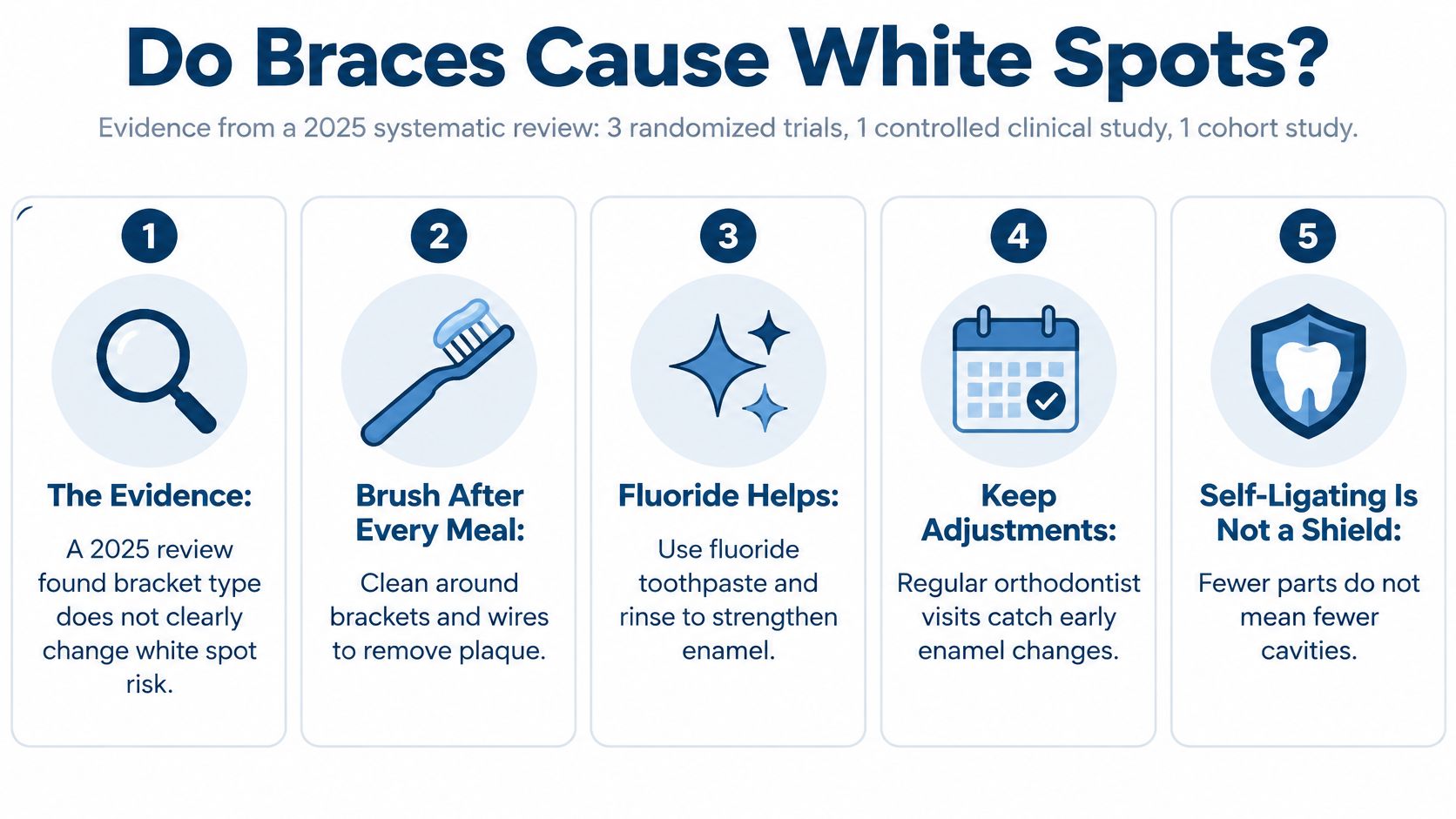
A 2025 systematic review of three randomized trials, one controlled clinical study and one cross-sectional study found that four of five studies showed no statistically significant difference in white-spot-lesion formation between self-ligating and conventional brackets. The review identified oral hygiene as the most critical factor affecting those lesions, not bracket type. Self-ligating brackets change how the bracket closes. They don't change the plaque that forms around any bracket, or what an afternoon of sipping a sugary drink does to enamel.
The practice's guide to preventing white spots on teeth with braces goes deeper on technique. The short version is a routine a teenager can keep:
- Brush after meals and before bed with fluoride toothpaste, including at school if the schedule allows.
- Clean around each bracket with a small-headed brush, angling the bristles under the wire.
- Use floss or an interdental cleaner under the wire once a day, with a threader if needed.
- Limit sugary drinks and snacks between meals, since frequency matters more than amount.
- Use fluoride as the orthodontist advises, whether that's toothpaste, a rinse or a gel.
- Keep every monitoring visit, because early enamel changes are easier to catch than to reverse.
For a visual walkthrough of braces care, the video below is a practical place to start.
No bracket choice guarantees protection against decalcification. Personalized hygiene coaching from the orthodontist and hygienist usually matters more than the choice between self-ligating and traditional brackets.
Maintenance Between Visits
How an adjustment works
At an adjustment visit, the orthodontist checks tooth movement and changes or adjusts the archwire to guide the next stage. With self-ligating brackets, opening and closing the bracket to change the wire can take less time. The visit schedule still depends on the treatment plan. See the guide to how often braces need to be tightened for more on why appointments are spaced as they are.
Problems that may need attention between visits
A loose or broken bracket can follow a hard bite. A wire that pokes the cheek or gum may need attention as teeth shift. A missed appointment can also delay progress, even when nothing hurts.
Call the office promptly about a broken bracket or poking wire rather than waiting for the next scheduled visit. Ask how repairs are handled and whether they are covered before treatment begins.
Ask before treatment starts: How are repairs handled, and what should we do if an appointment needs to be moved?
After the braces come off
At Stellar Orthodontics, braces are removed in a single appointment, and the covered services include the removal visit and a final cleaning. Custom retainers are worn full-time at first, with the wear schedule tapering over the first year.
Use this short checklist to stay on track during treatment:
- Keep scheduled adjustment visits.
- Call promptly about a broken bracket or a poking wire.
- Ask how repairs are handled before treatment begins.
Choosing by Situation and Budget
Bracket type is rarely the first decision, even when it's the first one families ask about. The diagnosis comes first, and the bracket gets chosen to serve it.
An orthodontist reviewing a case considers the bite, the crowding, the growth pattern and the goals before naming a system.
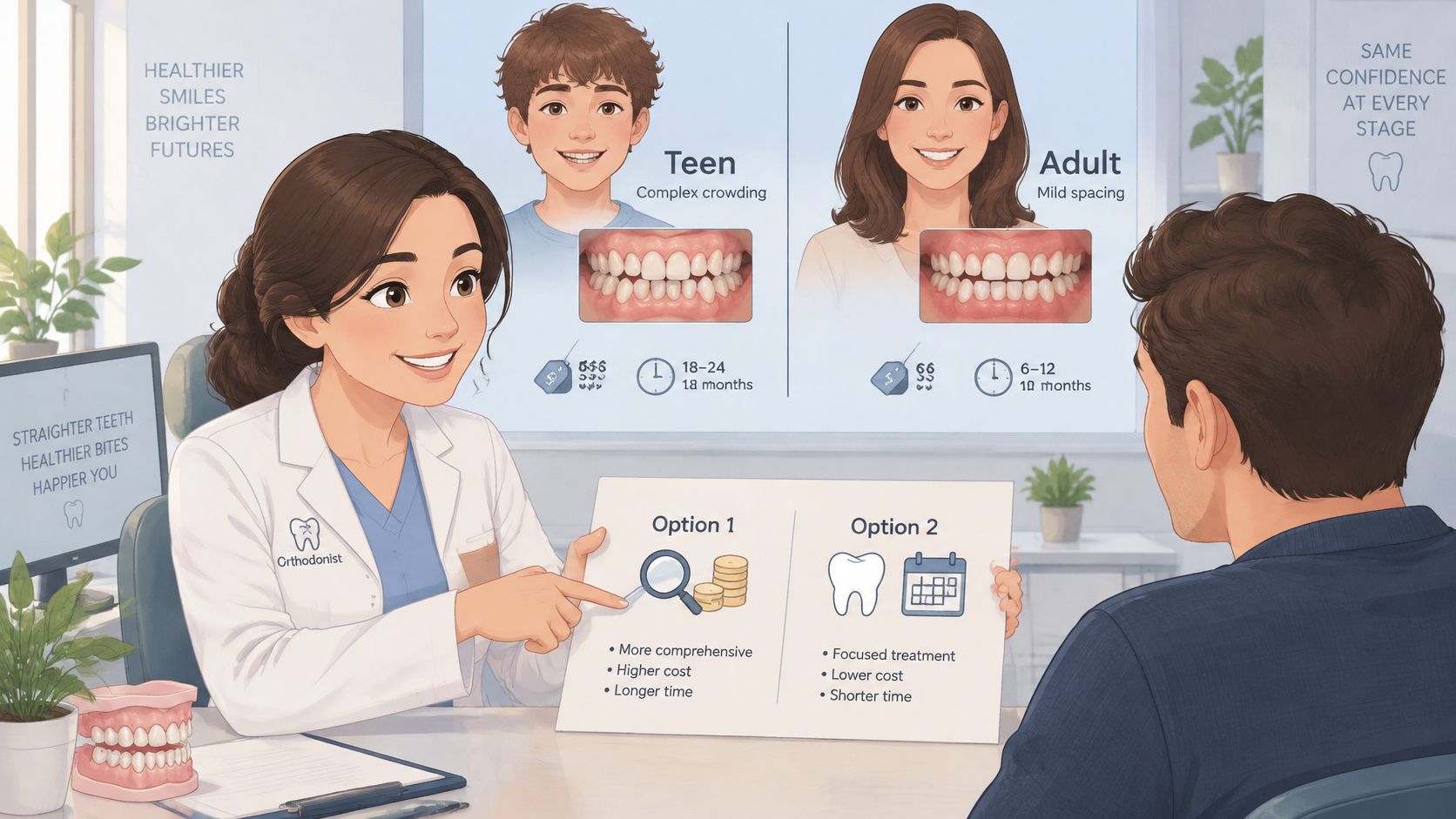
The diagnosis sets the order of decisions
Complex bite issues, severe crowding, or cases that need detailed tooth rotation may respond better to fixed braces, and the orthodontist picks the bracket type that fits that case. For many other patients, the choice opens up. Clear ceramic braces and traditional braces are equally effective, with the decision resting on a patient's priorities for aesthetics and budget. Clear aligners work for most mild to moderate cases, including many adults.
Which braces option usually fits each situation
| Situation | Often a good fit | Why |
|---|---|---|
| Complex bite, severe crowding or detailed rotations | Fixed braces, with the bracket type chosen by the orthodontist | Complex cases may respond better to fixed braces |
| Mild to moderate case, adult who wants a discreet option | Clear aligners or clear ceramic braces | Suitability is set by diagnosis at consultation |
| Wants tooth-colored brackets with a lower profile | Clear ceramic braces | Tooth-colored brackets with a lower profile than metal |
| Private pay with a set budget | Traditional metal braces, with payment plans if offered | Request an exact quote before deciding |
| Wants a removable option | Clear aligners | Removable, with cost and coverage confirmed at the consultation |
What budget and coverage look like
Cost varies by option and by plan, and payment plans may be available for some options. Ask Stellar Orthodontics for an exact quote for your child rather than comparing advertised starting prices, because the quote reflects the actual plan. The guide to braces cost in Delaware breaks down what drives the total.
A few coverage rules are worth knowing before the consultation. If pre-authorization is denied and a family chooses private pay, traditional metal braces in Delaware typically run $3,000 to $6,500. Invisalign and ceramic upgrades are private pay, and Delaware Medicaid generally does not cover Invisalign or clear aligners, which are an upgrade with monthly financing available. When a child qualifies, Medicaid coverage includes traditional fixed metal braces, all adjustments, repairs, removal and initial retainers, and Stellar Orthodontics accepts all three Delaware Medicaid plans plus CHIP.
When families weigh self-ligating braces vs traditional braces, the comparison happens on the same clinical points. The choice comes down to the case, the appearance a patient wants, and what the budget allows.
Book a Free Consultation to Choose Your Braces
A free consultation gives families a chance to discuss the treatment plan before deciding whether to proceed. At the visit, an iTero digital 3D scan can help the orthodontist assess the teeth and bite.
Use the appointment to ask three questions:
- Which bracket system does the orthodontist recommend, and why? Ask how the recommendation relates to your child's bite.
- How many months is treatment expected to take? Request a range based on your child's case.
- How are repairs, retainers and coverage handled? Ask what is included before treatment is scheduled.
The consultation is free whether or not your family proceeds, whether insurance covers treatment, or whether your child qualifies for Medicaid braces. Stellar Orthodontics offers free consultations at its four Delaware locations: North Wilmington, Middletown, West Dover and Millsboro. Families can choose the office that's most convenient for them.
Patients see the same orthodontist at each visit. If that orthodontist is away, another can provide continuity of care. Dr. Can Nguyen also continues education in Invisalign, digital treatment planning and self-ligating bracket systems.
Bring your three questions to the consultation. To find the nearest office for your ZIP code, contact Stellar Orthodontics and ask about scheduling.