
Phase 1 orthodontic treatment is early, targeted care during the mixed-dentition years, usually starting around ages 6 to 9, for a specific developing problem rather than for every child.
A dentist mentions crowding or a crossbite at a child's checkup, and suddenly a parent is wondering whether braces are necessary before the baby teeth have even fallen out. That concern is understandable. The useful question isn't just whether treatment can begin early, but what problem needs attention now and what would happen if treatment waited.
Table of Contents
- What Phase 1 Treatment Is and How It Differs From Phase 2
- When Early Treatment Makes Sense and When to Monitor
- Common Phase 1 Appliances and What They Do
- Benefits, Limits and Risks Parents Should Weigh
- How a Phase 1 Plan Unfolds From First Visit to Phase 2
- Confirm Whether Your Child Needs Phase 1 at a Free Consultation
What Phase 1 Treatment Is and How It Differs From Phase 2
At a checkup, a parent hears that their seven-year-old has a crossbite. Some upper teeth sit inside the lower teeth instead of outside them. The next step is an orthodontic evaluation to decide whether the developing bite needs attention now or can be monitored.
Phase 1 is a limited, interceptive stage of orthodontic care during the years when baby teeth and permanent teeth are present together. It targets a specific developing problem. The American Association of Orthodontists' braces guidance recommends an orthodontic checkup by age 7, when enough permanent teeth are often present to assess eruption, jaw development, and how the teeth meet. The Children's Hospital of Philadelphia describes the usual early-treatment window as ages 6 to 9.
Different jobs at different stages
Phase 1 works like adjusting a trellis before a vine grows across a fence. It can guide the developing structure or clear an obstacle. Phase 2 comes later, when more permanent teeth are in place, to align them and refine the bite.
Phase 1 versus Phase 2 at a glance
| Feature | Phase 1 (early) | Phase 2 (full treatment) |
|---|---|---|
| Typical age | About 6 to 9, while baby and permanent teeth are mixed | Often adolescence, roughly 12 to 16, as described in the Cochrane review of two-phase treatment |
| Main goal | Guide jaw growth, address a specific problem, or create space | Align permanent teeth and finish the bite |
| Typical length | Set by the diagnosis and treatment goal | A personalized course based on tooth movement and bite correction |
| When it is needed | When an evaluation identifies a specific developing problem | When further correction is indicated, usually after most permanent teeth have erupted |
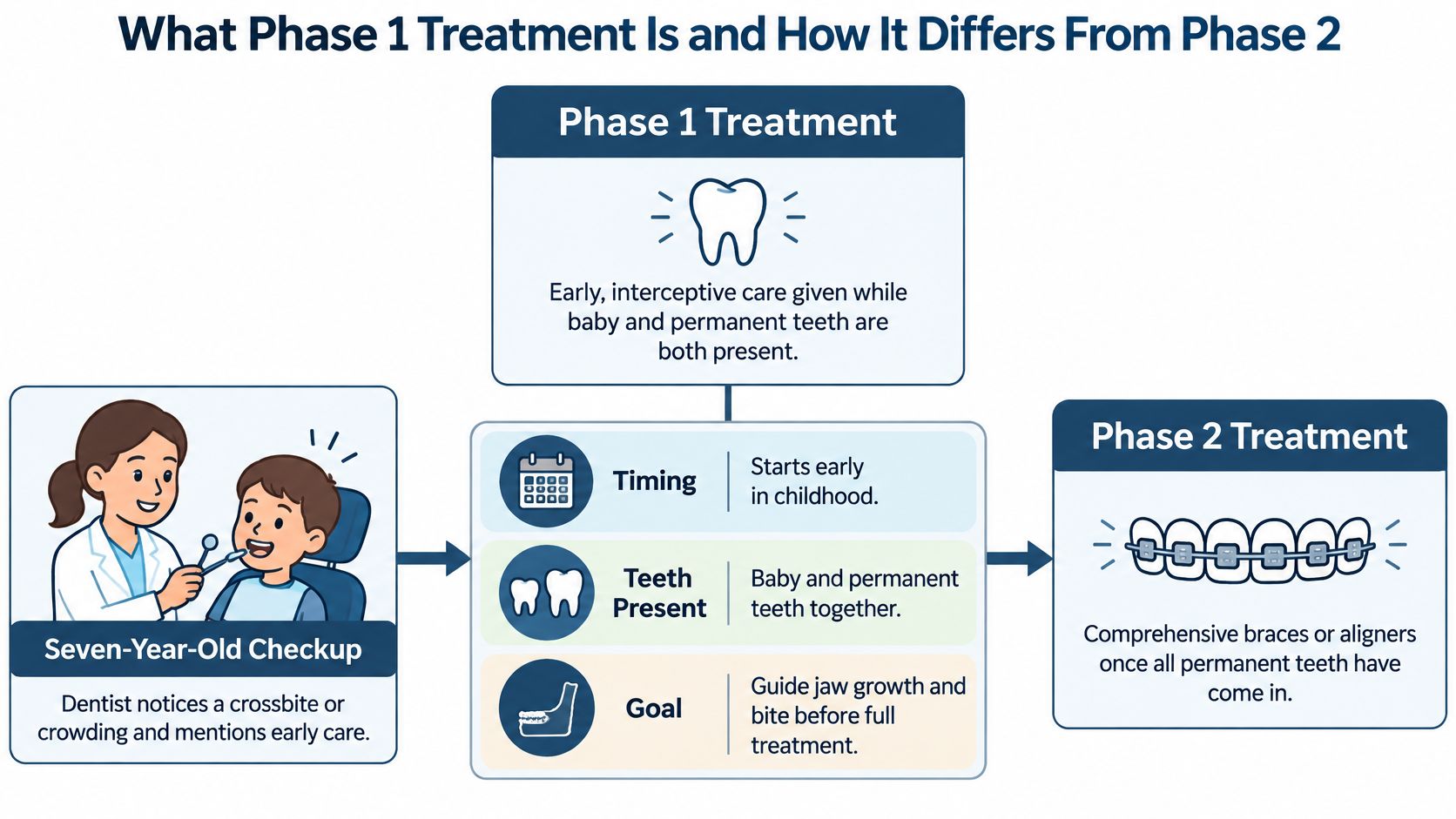
After active early treatment, a child may have a treatment-free observation period while more permanent teeth emerge. That pause lets the orthodontist follow development and decide whether Phase 2 is appropriate. An early evaluation is a screening milestone, not a commitment to immediate braces or two rounds of treatment.
When Early Treatment Makes Sense and When to Monitor
Early doesn't mean better in every case. A child's age, a crooked front tooth, or a crowded-looking smile doesn't establish a need for an appliance.
The American Academy of Pediatric Dentistry's periodicity guidance supports an examination and appropriate diagnostic records to identify problems and establish treatment priorities. Those findings help distinguish an issue that could benefit from intervention from one that can reasonably be watched.
Which developing problems are usually treated early
| Situation | Usually addressed early? | Reason |
|---|---|---|
| Posterior (back teeth) crossbite | Often yes | A persistent crossbite may not self-correct, so it warrants early assessment |
| Prominent upper front teeth | Sometimes | Early treatment may reduce trauma risk in appropriately selected children |
| Harmful habits such as thumb sucking | Sometimes | Habit appliances may help interrupt a habit contributing to the bite problem |
| Premature loss of baby teeth | Sometimes | A space maintainer can hold room for the permanent tooth |
| Blocked or misdirected eruption | Often yes | Early care may clear the path for the permanent tooth |
| Crowding alone | Usually monitored | Many children are watched until more permanent teeth erupt |
| Mild appearance concern with no functional risk | Usually monitored | Appearance alone doesn't establish a clear benefit from early treatment |
What separates treatment from observation
For a back-tooth crossbite, the orthodontist checks how the teeth meet and whether the child shifts the jaw to close comfortably. For a thumb-sucking habit, the discussion includes whether the habit remains active and whether it is affecting tooth position. These are different problems, even if both are described casually as a bite issue.
Early baby-tooth loss raises another question: is the remaining space likely to be lost before the permanent tooth arrives? A tooth erupting in the wrong direction requires assessment of its path and surrounding structures. An inadequate dental arch or a developing mismatch between the jaws also needs a diagnosis rather than an assumption based on appearance.
Crowding calls for the same care. The orthodontist considers available room, eruption patterns, and the teeth still developing beneath the gums before recommending treatment.
Observation should have a purpose: what is being watched, what change would trigger treatment, and when should the child return?
For families comparing developmental timing with the start of full braces, the guide to when children should get braces offers additional context. A sound early-treatment recommendation should name both the problem and a realistic goal, such as preserving space or correcting a crossbite.
Common Phase 1 Appliances and What They Do
An orthodontic appliance is a tool matched to a diagnosis, not a standard package every child receives. Some tools widen an arch; others preserve room, interrupt a habit, or move selected teeth.
Common Phase 1 appliances, their purpose and wear
| Appliance | Typical purpose | How it works | Wear pattern |
|---|---|---|---|
| Palate expander (rapid or fixed) | Widen a narrow upper arch | Attaches to back teeth and gradually widens the upper jaw | Fixed through expansion and the prescribed holding period |
| Quad-helix | Correct a posterior crossbite | A fixed wire appliance widens the upper arch | Fixed |
| Removable expansion plate | Expand the arch or correct a crossbite | A custom plastic plate applies controlled pressure over time | Removable; worn on the prescribed schedule |
| Headgear | Reduce prominence of upper front teeth | An external strap and facial bow connect to the teeth to apply directed force | Worn at home for prescribed hours |
| Functional appliance | Address the jaw relationship with prominent upper front teeth | Holds or guides the jaw into a prescribed position | Fixed or removable as prescribed |
| Space maintainer | Hold room after early baby-tooth loss | A spacer preserves the gap for a permanent tooth | Usually fixed |
| Habit appliance | Interrupt thumb or tongue habits | Creates a barrier or reminder that makes the habit harder to perform | Usually fixed |
| Limited braces | Move specific teeth | Brackets and wires move selected teeth | Fixed |
Functional appliances and headgear are among the approaches examined in the Cochrane review's supporting analyses. Neither is a universal solution for protruding teeth; selection requires an assessment of the bite, growth stage, and treatment objective.
What appliance wear looks like during a school day
With a removable expansion plate, the family follows a written wear schedule. If removal is prescribed for lunch, the child places it in a protective case rather than a napkin, cleans it as instructed, and reinserts it on schedule. Parents should clarify the plan for school meals, physical education, and sports before the appliance goes home.
A fixed expander stays attached during school and meals. Cleaning requires attention around the bands and wires, and any activation must follow the orthodontist's exact instructions. Parents shouldn't add turns or adjust the appliance themselves because progress seems slow.
Both routines need practice. A child should be able to explain where a removable appliance belongs when it isn't being worn and who to tell if a fixed appliance feels loose.
The guide to braces on children's teeth provides context for families considering limited brackets. Before any appliance is fitted, the team should explain its care, expected sensations, and the signs that require a call.
An appliance may remain in place after active movement ends to hold the correction or support eruption. Adjustments or replacement may also be necessary as the child grows.
Benefits, Limits and Risks Parents Should Weigh
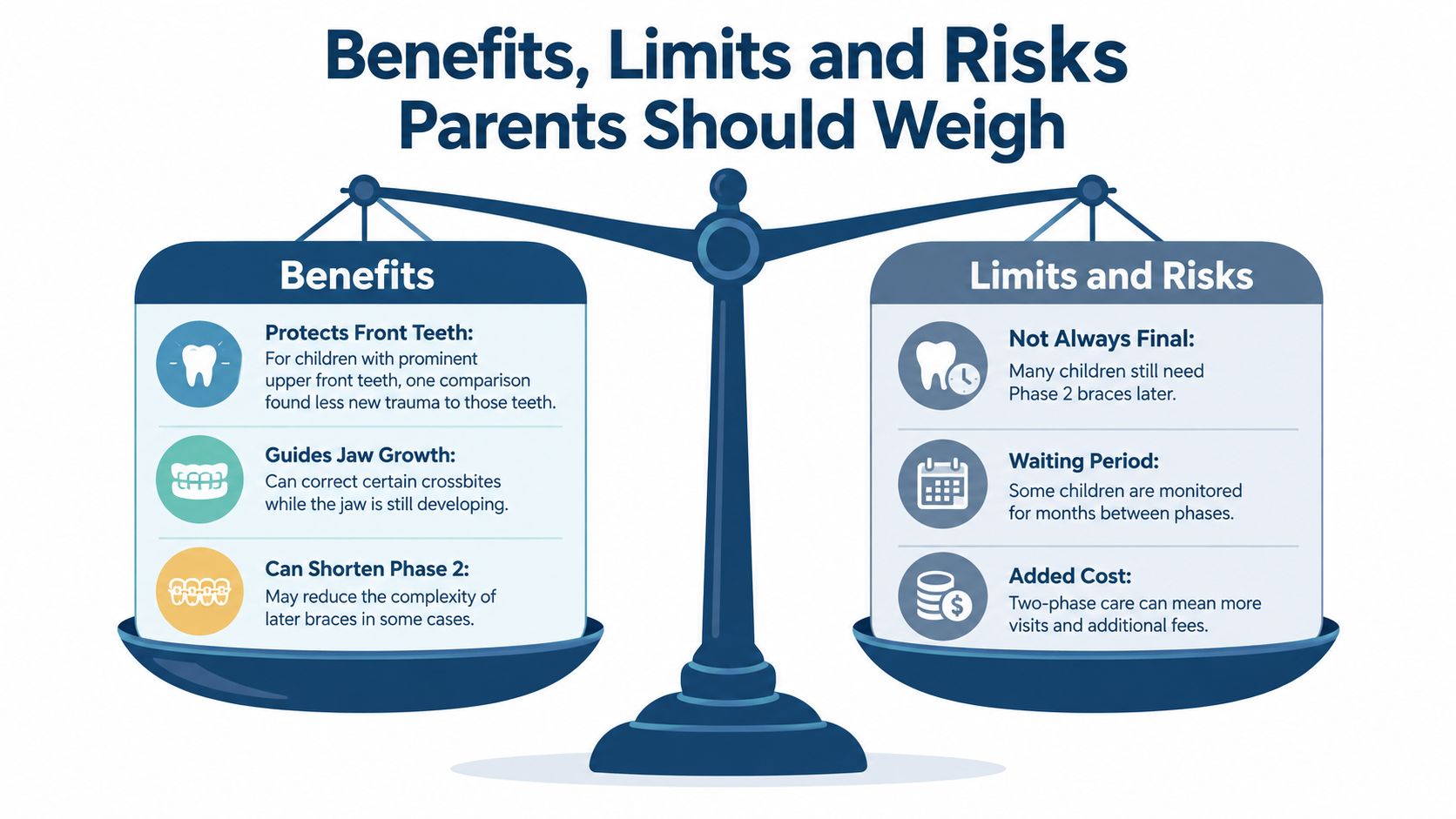
Early treatment is most useful when it addresses a developing problem while the child is still growing. For a child with prominent upper front teeth, reducing the chance of incisor injury may be a meaningful goal. The Cochrane review of treatment for prominent upper front teeth found less new incisor trauma in selected early-treatment comparisons, along with short-term reductions in overjet, the horizontal distance between the upper and lower front teeth.
Other focused goals may include correcting a posterior crossbite or creating or preserving space for erupting teeth. The Cochrane review of orthodontic crossbite treatment supports expansion appliances over no treatment for the children studied. A narrow-looking smile alone, however, does not establish that expansion is needed. Ask what specific bite or eruption problem the appliance is intended to address.
Benefits aren't guarantees
For children with prominent upper front teeth, research has not shown a clear overall final-result advantage from two-phase treatment over treatment during adolescence. Early care may address a particular concern sooner, but it does not necessarily make all treatment shorter, easier, or more comfortable.
A systematic review in the European Journal of Orthodontics found that functional limitations may be slightly greater during the first three months of orthodontic treatment. The evidence was rated very low certainty. Eating and speech may take adjustment, removable appliances depend on cooperation, and fixed appliances need careful cleaning.
These questions can help separate a targeted early plan from a watch-and-wait visit:
- Measurable goal: What change should this phase achieve?
- Progress checks: How will the orthodontist tell whether the appliance is working?
- Cooperation plan: What happens if the child struggles with wearing or cleaning the appliance?
- Later treatment: What is likely to remain for full treatment?
Key benefit figures from the research
The figures below describe particular study groups, not an individual child's expected outcome. The overjet measurements compare the end of the first treatment phase with no treatment.
| Outcome | Early or Phase 1 result | Comparison result |
|---|---|---|
| New trauma to upper incisors, headgear study | 24 of 117 children, as reported in the Cochrane review of treatment for prominent upper front teeth | 44 of 120 treated later; odds ratio 0.45, 95% confidence interval 0.25 to 0.80 |
| New incisal trauma, second comparison | 19% of children, as reported in the Cochrane review of treatment for prominent upper front teeth | 30% treated later |
| Overjet reduction, functional appliances | 4.17 mm average across 432 participants, as reported in the Cochrane review of treatment for prominent upper front teeth | Compared with no treatment |
| Overjet reduction, headgear | 1.07 mm average across 278 participants, as reported in the Cochrane review of treatment for prominent upper front teeth | Compared with no treatment |
How a Phase 1 Plan Unfolds From First Visit to Phase 2
Immediate objectives and long-term decisions belong in separate parts of the plan. The American Academy of Pediatric Dentistry's developing-dentition guidance recommends a thorough examination, diagnostic records, and a sequential short- and long-term plan. That structure helps parents see what an appliance is meant to change now, and what will be reassessed as their child develops.
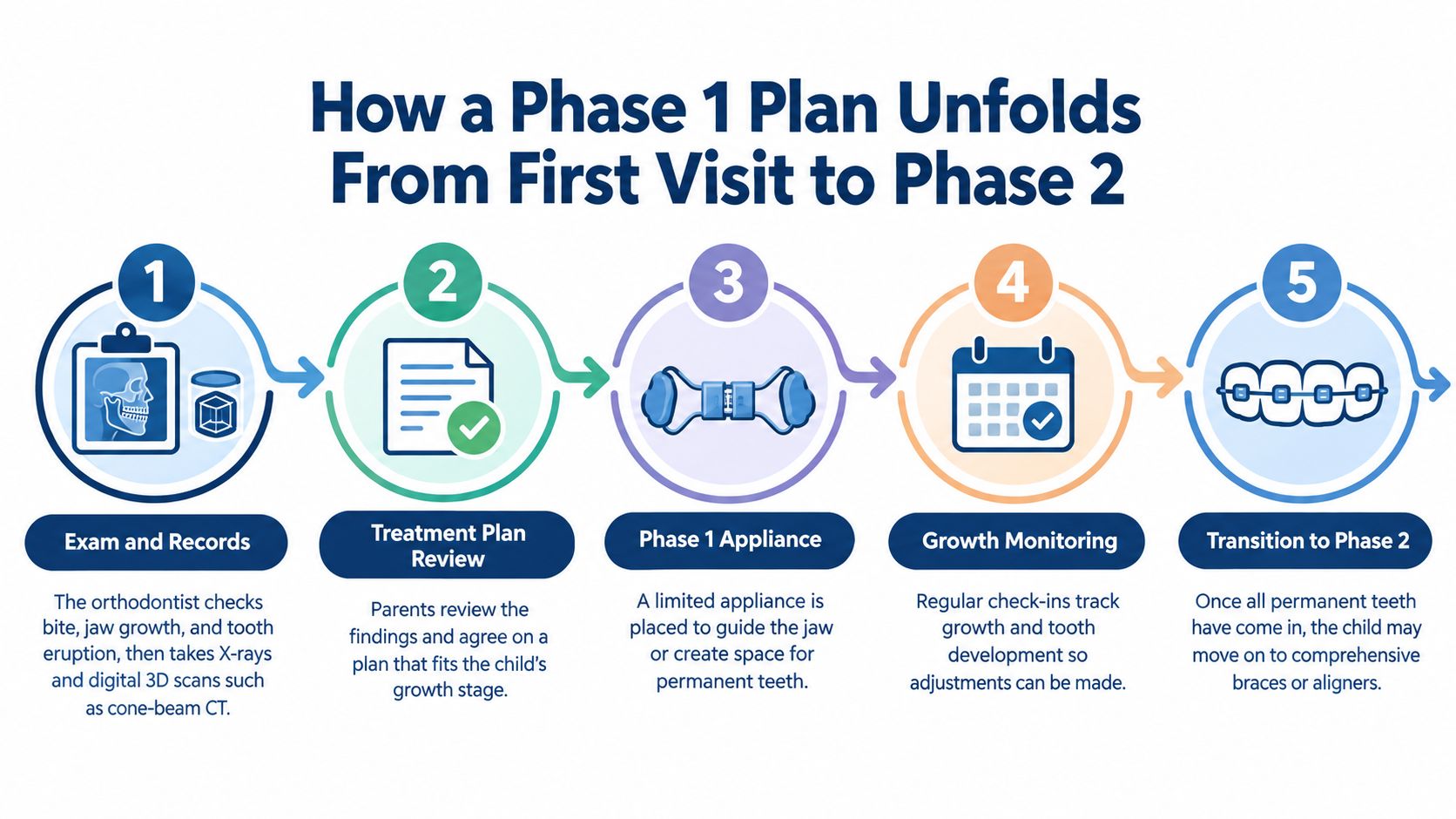
Exam and records establish what is happening. The orthodontist reviews the bite, jaw relationships, tooth eruption, and relevant history. Records may include photographs, X-rays, and digital models. An optical scan captures tooth surfaces; it is different from a radiographic scan, and additional imaging should have a clinical reason.
Diagnosis determines whether action is timely. The recommendation may be treatment now, monitoring during growth, or waiting for more teeth to erupt. Parents should understand the expected benefit and what waiting could mean for their child's specific concern.
Appliance placement turns the plan into a home routine. The team fits the selected appliance and demonstrates how to wear, clean, or activate it as prescribed. Asking the parent and child to show the routine before leaving can bring practical challenges to light early.
Active treatment checks progress against the goal. Appointments assess movement, fit, hygiene, and cooperation. Growth or tooth eruption can change how an appliance fits, so the plan may need adjustment.
Observation supports development after active treatment. Once the immediate goal is met, active tooth movement may stop. A retainer or another appliance may still be needed while an affected permanent tooth moves into an acceptable position.
A final review assesses what remains. After more permanent teeth arrive, the orthodontist evaluates alignment and bite together. Phase 2 is something to assess at the final review, not a default next step.
What families should leave knowing
A written plan should clarify whether the child has an active appliance, a holding appliance, or a monitoring visit. These terms explain why an appliance may stay in place even after its adjustment schedule ends.
Before leaving: Parents should know the purpose of the next appointment, the home-care instructions, and whom to contact about breakage or persistent discomfort.
The accompanying video offers another way to become familiar with orthodontic care.
Confirm Whether Your Child Needs Phase 1 at a Free Consultation
A checkup by age 7 is recommended by the American Association of Orthodontists, or sooner if a parent notices a concern. The visit may lead to one of three outcomes: no treatment, continued monitoring, or targeted early treatment for a developing problem.
A useful consultation connects what the orthodontist finds to what they recommend. Ask what specific problem Phase 1 would address, what could happen if you wait, and how progress would be judged. These questions help distinguish a need for early treatment from a watch-and-wait visit. For families asking what Phase 1 orthodontic treatment is, the answer should be specific to the child, not a default step.
Planning a Delaware consultation
Stellar Orthodontics provides free consultations with iTero digital 3D scanning at four Delaware offices, from North Wilmington and Middletown to West Dover and Millsboro. The practice accepts most major dental insurance, offers flexible monthly payment plans, and accepts AmeriHealth Caritas Delaware, Highmark Health Options, Delaware First Health, and CHIP for eligible children and teens under 21.
Insurance participation does not confirm coverage for a particular treatment. Before starting, check the child's benefits, any authorization requirements, and the expected family responsibility.
Bring dental records, insurance information, and notes about habits, chewing difficulties, or concerns from the child's dentist. Ask what goal treatment would address, how the orthodontist will track progress, and whether Phase 2 may be considered later. You can leave with a clear recommendation, a monitoring plan, or confirmation that no treatment is needed now. A consultation is a chance to understand the options, not a commitment to begin treatment.