
Braces can close many dental open bites, but a skeletal open bite may need growth modification, temporary anchorage devices, or surgery rather than braces alone. The important distinction is whether treatment needs to move teeth, address the jaw relationship, or do both.
If the front teeth meet after treatment, does that mean the underlying jaw problem has changed? Not necessarily, and that difference helps Delaware families understand both the possibilities and the limits of orthodontic care.
Table of Contents
- The Short Answer for Delaware Families
- What Kind of Open Bite Is Causing the Gap
- How Braces Move Teeth to Close the Gap
- What Changes Your Timeline and Final Result
- Open Bite Treatment for Kids, Teens, and Adults
- Keeping the Bite Closed After Treatment
- Book a Free Consultation at Stellar Orthodontics
The Short Answer for Delaware Families
Yes, braces can fix many open bites, especially when tooth position is the main problem. They aren't a guaranteed solution for every jaw pattern, and the appearance of the gap alone doesn't reveal which treatment will work.
An anterior open bite means the upper and lower front teeth don't meet when the back teeth are together. A parent might notice a visible space during a smile or when a child closes their teeth. The orthodontist's job is to determine why that space exists before recommending how to close it.
Three useful starting points
- Dental open bites: Braces can often bring the front teeth into contact when their position or eruption is the main concern.
- Skeletal open bites: A substantial jaw-growth discrepancy may require more than ordinary tooth movement.
- An individual evaluation: A free consultation at Stellar Orthodontics can help a family understand which category best describes the bite.
A child's thumb-sucking history, tongue posture, growth pattern, and tooth development can all influence the recommendation. Several contributors may exist together, so identifying a habit doesn't automatically rule out a skeletal concern.
What families need to understand
The practical questions extend beyond appliance choice:
- Type of correction: Is the treatment changing tooth position, the jaw relationship, or both?
- Treatment mechanics: Will braces alone provide the necessary movement?
- Timing and age: Is treatment appropriate now, or would observation be useful?
- Long-term care: What will help maintain the correction after active treatment?
- Local next steps: What should a Delaware family expect at a consultation?
There's no need for parents to diagnose the problem from photographs or compare their child's smile with online before-and-after pictures. The more useful question isn't only can braces fix an open bite, but what kind of correction does this particular bite need?
What Kind of Open Bite Is Causing the Gap
A dental open bite is like two doors that don't meet because their hinges are slightly off. A skeletal open bite is more like a door frame that's too tall: adjusting the doors may help, but the frame still affects how they fit.
In plain language, dental describes a problem centered on the teeth, while skeletal describes a problem involving jaw and facial proportions. A clinical review of anterior open bite distinguishes dental open bite associated with obstructed tooth eruption from skeletal open bite associated with facial development.
Open bite types and what braces can do
| Type of open bite | What is usually happening | What braces can do | What may be needed beyond braces |
|---|---|---|---|
| Dental open bite | Front teeth are held apart by tooth position or blocked eruption | Often close the gap by moving incisors into vertical contact | Eruption guidance or extractions in some cases |
| Skeletal open bite | Jaw growth pattern creates too much vertical height in the back | May improve the bite by moving teeth but cannot fully reshape the jaw | Growth modification, TADs, or jaw surgery in severe cases |
| Habit-related open bite | Thumb sucking or tongue thrust contributes to the gap; mouth breathing may affect tongue and jaw posture | Close the gap while contributing habits are managed | A habit appliance, myofunctional therapy, or airway evaluation when indicated |
| Mixed open bite | Tooth position, jaw growth, and habits overlap | Correct the dental part and improve tooth contact | A staged plan with habit care and long-term retention; surgery in some severe cases |
Why overlapping causes matter
These categories aren't always separate boxes. A child may have a vertical growth pattern and a sucking habit, or tooth-position concerns alongside persistent forward tongue posture.
That doesn't mean the child needs every treatment listed in the table. It means the orthodontist needs to distinguish the main cause from contributing factors and select an approach that addresses the relevant problems.
Mouth breathing also deserves careful interpretation. It isn't proof of an airway disorder, and braces aren't a substitute for evaluating a suspected breathing concern.
Expectation check: Closing a visible space and correcting an underlying jaw discrepancy aren't necessarily the same treatment outcome.
What the examination checks
The orthodontist looks at how the front and back teeth meet, facial proportions, tooth eruption, and tongue posture. A parent's account of thumb sucking, breathing patterns, and previous dental changes adds useful context.
Bite records and imaging, when needed, help distinguish a tooth-position problem from a broader jaw relationship. This distinction matters for informed consent: families should understand what the proposed treatment can realistically change before agreeing to it.
Only an examination can confirm the type of open bite. Stellar Orthodontics's free consultation includes an iTero digital 3D scan, which helps the orthodontist review tooth positions and explain the bite visually.
How Braces Move Teeth to Close the Gap
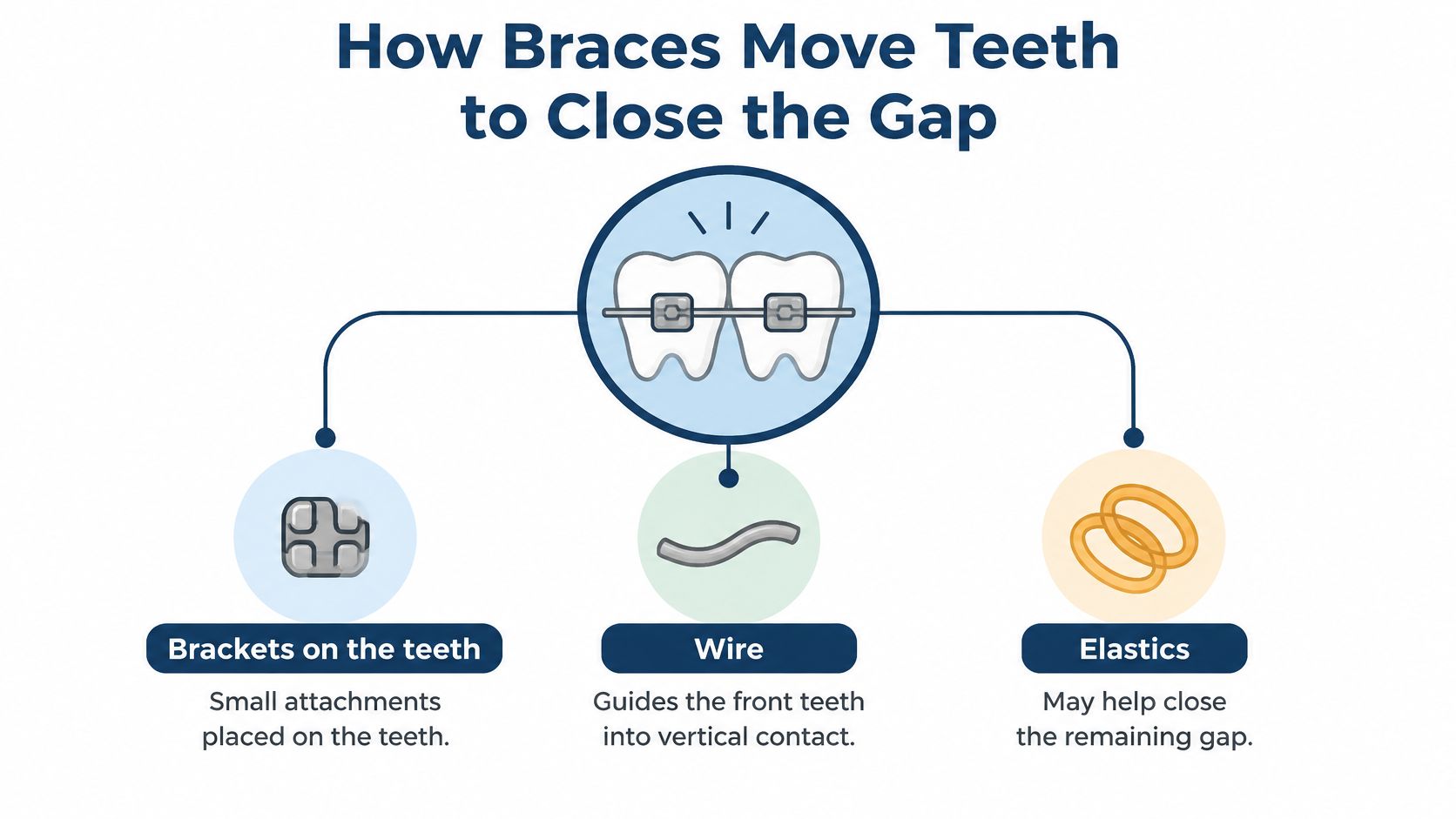
Braces use brackets attached to teeth and a connecting wire to guide controlled movement. For an open bite, the orthodontist plans the vertical relationship between the front and back teeth rather than straightening the visible smile.
The diagram illustrates the basic parts involved.
Moving front teeth versus controlling back teeth
Extrusion means moving a tooth farther into the mouth toward its biting partner. In a suitable dental open bite, the orthodontist may guide the incisors, or front teeth, into better vertical contact. Elastics may help provide the direction of force needed to finish that contact.
Intrusion means moving a tooth farther into its supporting bone. In selected cases, the orthodontist may intrude the back molars instead of relying mainly on front-tooth extrusion.
Reducing the height at the back can allow the lower jaw to rotate slightly upward and forward, helping the front teeth meet. Temporary anchorage devices, often called TADs, provide an additional anchor for these movements.
A systematic review of molar intrusion using skeletal anchorage explains this mechanism but also identifies limitations in the supporting evidence. TADs therefore deserve a case-specific discussion, not a promise that they can replace surgery for every skeletal open bite.
What a treatment sequence may include
- Records and diagnosis. Photographs, bite records, and cephalometric imaging when indicated help the orthodontist evaluate tooth positions and jaw relationships.
- Habit management when needed. The plan addresses persistent sucking or tongue-related contributors rather than moving teeth against continuing pressure.
- Braces or aligners. The orthodontist chooses an appliance suited to the required movements and the patient's circumstances.
- Additional mechanics. Elastics or TADs may provide forces that the main appliance cannot deliver alone.
- Retention. After active movement, the patient follows a plan designed to maintain the new bite.
Not every patient needs every step or appliance. A straightforward dental gap and a skeletal open bite may look similar in a photograph while requiring very different mechanics.
The distinction between dental movement and jaw correction is also explained in Stellar Orthodontics's guide to how braces address jaw alignment. The essential principle is that the plan must match the cause, not merely the visible space.
What Changes Your Timeline and Final Result
Families can influence attendance, appliance care, and prescribed wear time. They can't control their child's growth pattern or choose how complex the starting bite is.
That distinction makes a treatment estimate more useful. Most braces cases at Stellar Orthodontics finish in 18 to 30 months, but that general range isn't a personalized forecast for an open bite. Additional treatment stages, growth observation, or complex mechanics can extend the overall process.
Factors that affect open bite treatment
| Factor | Why it matters | What it means for the plan |
|---|---|---|
| Age and growth | Growing jaws respond differently from adult jaws | Children may benefit from earlier assessment; adult plans must account for limited growth |
| Cause of the open bite | A persistent habit may continue pushing teeth apart | Habit care may begin before or during tooth movement |
| Size of the gap and bite severity | A small dental gap presents different challenges from a severe skeletal pattern | A straightforward case may fit the general braces range; complex correction may take longer |
| Appliance choice | Fixed braces and removable aligners deliver movement differently | Complex bites may favor braces; many mild to moderate cases are suitable for aligners |
| Cooperation with elastics or aligners | Missing prescribed wear reduces the intended force | Consistent use helps protect the estimated schedule |
| Retainer routine | Teeth can move after active treatment | Long-term maintenance belongs in the original plan |
What success percentages actually mean
A systematic review of early open-bite treatment in mixed dentition reported 80–90% success in eight studies. The appliances, definitions of success, follow-up periods, and study methods differed, so those results aren't a universal prediction for an individual child.
The review also found that early approaches appeared most effective when they didn't rely entirely on patient cooperation. That supports a practical conversation about whether a proposed appliance fits the child's routine and ability to follow instructions.
Choosing a realistic estimate
Clear aligners work for many mild to moderate orthodontic cases, including many adults. Complex bite correction or detailed tooth rotation may respond better to fixed braces, although the examination determines which movements are needed.
Missed appointments can delay adjustments, and broken brackets can interrupt planned movement. Families should contact the office about appliance problems rather than waiting until the next scheduled visit.
Practical rule: A written estimated range, with the reasons it might change, is more useful than a single guaranteed removal date.
The plan should distinguish active tooth movement from observation, any additional treatment stages, and retention. That gives parents a clearer picture of the full commitment rather than just the time spent wearing braces.
Open Bite Treatment for Kids, Teens, and Adults
Age changes the available options, but it doesn't determine the diagnosis. The following hypothetical Delaware families illustrate why similar-looking gaps can lead to different recommendations.
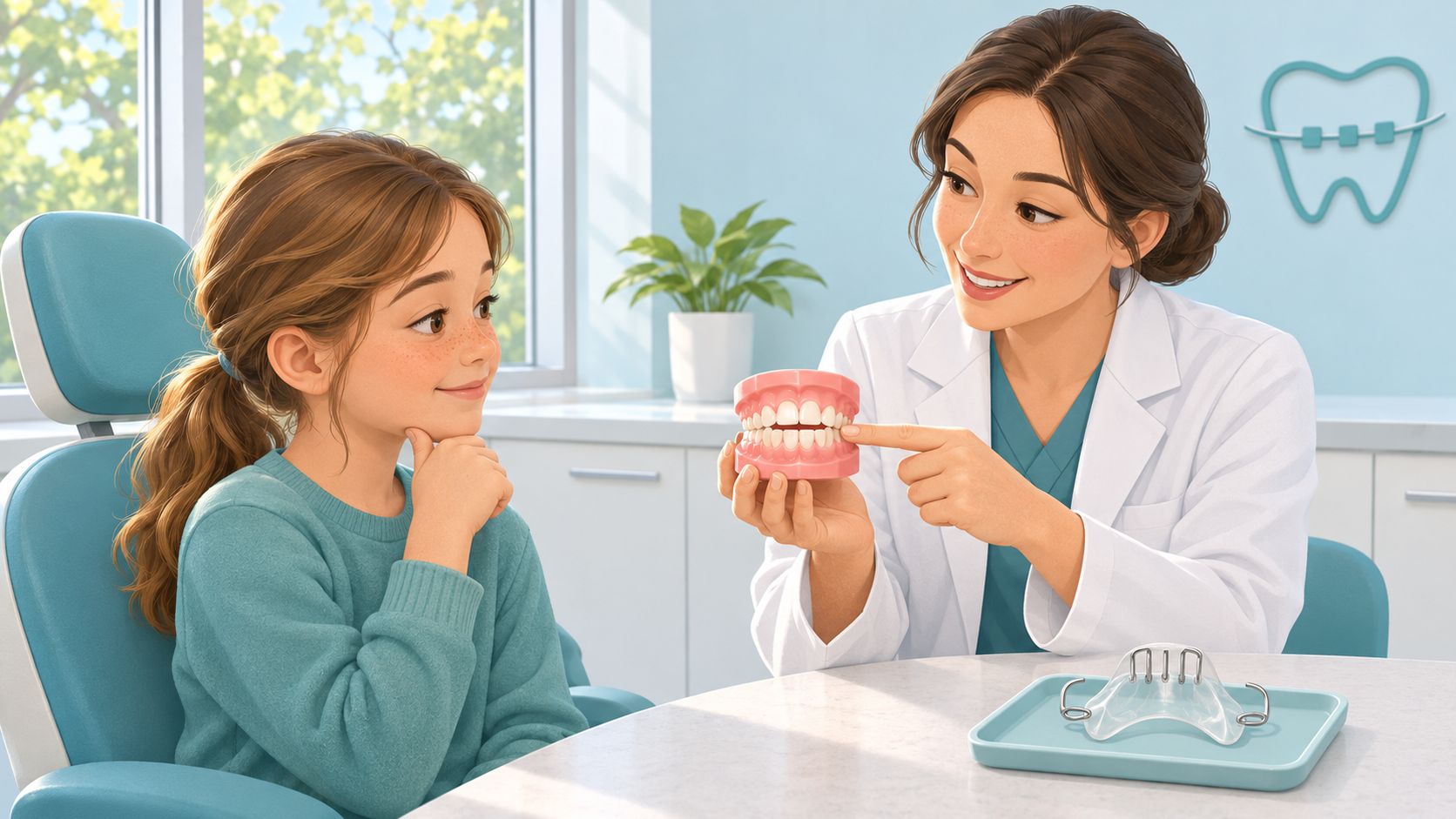
A model-based explanation can make those differences easier for children and parents to understand.
A younger child in Middletown
Consider a hypothetical 9-year-old with a small anterior gap and an ongoing thumb-sucking habit. The evaluation would check tooth eruption, the frequency of the habit, tongue posture, and whether the jaw relationship suggests an additional skeletal concern.
The family's decision might be to begin habit management and monitor development rather than start braces immediately. Phase 1 treatment would be considered only if the findings support a specific early goal.
Early evaluation around age seven can identify bite or growth concerns, but an evaluation doesn't mean every child should begin treatment. A Cochrane review of orthodontic and orthopedic treatment for childhood anterior open bite found weak evidence for the evaluated early approaches, with changes mainly involving the teeth and supporting structures rather than major jaw changes.
A teen in North Wilmington
A hypothetical 14-year-old has crowded front teeth and a dental open bite. The orthodontist would assess available space, tooth positions, the back-tooth relationship, and whether a habit is still contributing.
Fixed braces might align the crowded teeth and bring the front teeth into contact within an individualized treatment estimate. The family would need to understand whether elastics are part of the plan and how the teen's daily routine will support prescribed wear.
For families considering the appointment conversation, the following video provides an additional viewing option.
An adult in Dover or Millsboro
A hypothetical 35-year-old has a skeletal open bite and wants to understand whether nonsurgical correction is realistic. The assessment would focus on facial proportions, the degree of jaw discrepancy, tooth positions, and the patient's functional and appearance goals.
Braces might improve the dental relationship, while TADs or a surgical consultation could be appropriate for a more substantial skeletal concern. The decision is about the achievable correction and its trade-offs, not whether an adult can wear braces.
Stellar Orthodontics's guide to orthodontics for all ages offers additional age-related context. A consultation is information, not a commitment, and Delaware families can receive an evaluation at North Wilmington, Middletown, Dover/West Dover, or Millsboro.
Keeping the Bite Closed After Treatment
Closing the gap is the active correction. Keeping it closed requires a maintenance plan that accounts for tooth movement, oral function, and any remaining contributors.
Open bites have a recognized tendency to relapse, but the possibility of change shouldn't make treatment feel futile. A review discussing anterior open-bite stability reports 61.9% to 100% stability across included studies and notes that, in a molar-intrusion meta-analysis, 80% of post-treatment changes occurred during the first year. Those findings describe different study groups and treatment approaches, not a personal forecast.
What a retention plan may involve
The orthodontist selects retainers according to the movements performed and the contact that needs protection. A fixed retainer, a removable retainer, or a combination may be appropriate, but no single design is right for every open bite.
Follow-up visits allow the orthodontist to check tooth contact, retainer fit, and early changes. Families should understand the wear schedule and what to do if a retainer breaks or no longer seats properly.
- Fixed retainers: These stay attached to selected teeth and require cleaning and checks for loose bonding.
- Removable retainers: These need consistent prescribed wear and careful storage when out of the mouth.
- Scheduled monitoring: The orthodontist checks the bite as well as whether the appliance remains intact.
- Habit support: Persistent tongue posture or sucking concerns may need additional management.
Stellar Orthodontics's explanation of how long retainers are worn after braces can help families prepare for the maintenance stage.
Changes worth reporting
Parents and patients should contact the office if the front teeth begin separating again, the tongue regularly rests between them, or a retainer suddenly feels tight. A removable retainer that won't seat fully shouldn't be forced into place.
When tongue function contributes to the problem, the orthodontist may discuss a habit appliance or referral for myofunctional therapy. Persistent mouth breathing may warrant assessment rather than an assumption that retainer wear alone will address it.
Retention is part of treatment, not an optional extra after treatment has finished.
Before active care begins, families should understand how long retention is expected to continue and how follow-up will work. A clear maintenance routine makes the end of braces feel like a planned transition rather than the end of all orthodontic care.
Book a Free Consultation at Stellar Orthodontics
A free consultation at Stellar Orthodontics gives families a low-pressure way to understand whether the open bite is primarily dental, skeletal, habit-related, or mixed. The orthodontist who would treat the case runs the consultation, reviews the bite, discusses habits and goals, and uses an iTero digital 3D scan to support the assessment.
The visit is free whether or not the family proceeds with treatment, whether insurance covers treatment, or whether a child qualifies for Medicaid braces. Families don't need to settle those questions before learning what the bite may require.
What families can discuss
Every office offers the same treatments, including metal braces, clear ceramic braces, Invisalign, and Phase 1 care. The consultation helps determine which option is appropriate rather than assuming that the least visible appliance or earliest start is automatically best.
Three useful questions can keep the conversation focused:
- Expected correction: Will the proposed treatment close the visible gap through tooth movement, or also address the jaw relationship?
- Maintenance: What retainer and follow-up plan will be needed to maintain the result?
- Time and cost: What is the estimated treatment range and total cost, including any proposed additional stages?
Choosing a Delaware location
Appointments are available in North Wilmington, Middletown, Dover/West Dover, and Millsboro. Because the same treatments are available across the offices, families can choose a location that fits their travel and scheduling needs.
An early conversation can clarify whether treatment, monitoring, or further assessment makes sense. Asking early gives families more information and potentially more options, not an obligation to begin.
Stellar Orthodontics offers free consultations to help Delaware families understand what braces can realistically change about an open bite and what maintaining that correction may involve. Visit Stellar Orthodontics to book at North Wilmington, Middletown, Dover/West Dover, or Millsboro and discuss a plan suited to the patient's bite.