
If braces attach to teeth, how do they fix a jaw that seems out of place? That question gets to a distinction parents don't always hear clearly: improving the way the teeth meet isn't the same as changing the jawbones themselves.
For Delaware families considering orthodontic care, the answer starts with identifying what's causing the bite problem. Tooth position, jaw development, and remaining growth all influence whether a child needs braces, another appliance, observation, or a combination of treatments.
Table of Contents
- What Braces Change in a Bite and What They Don't
- How Braces Move Teeth Step by Step
- Why Gentle Pressure Moves Teeth Through Bone
- Treatment Timelines by Age and Bite Problem
- Growth Appliances That Go Beyond Standard Braces
- When Jaw Alignment Is Not Just a Braces Problem
- Book a Free Consultation to Check Your Child's Bite
What Braces Change in a Bite and What They Don't
How can braces improve a bite without changing the jaw itself? They move teeth into positions that help the upper and lower dental arches meet more steadily. In adults and children whose growth has finished, braces usually cannot reshape or reposition the jawbones.
Similar-looking bites can have different causes. A child with crowded front teeth may have jaws that fit together reasonably well. An underbite, by contrast, may reflect a mismatch between the upper and lower jaws.
Dental versus skeletal: A dental problem concerns where the teeth sit. A skeletal problem concerns the size or position of the jaws that hold them.
Braces can address crowding, spacing, deep overbite, underbite, and crossbite when tooth position is the main issue. A major mismatch between the jaws may call for growth guidance during childhood or corrective jaw surgery after growth ends. The American Association of Orthodontists' surgical-treatment guidance explains when surgery may be considered for significant jaw discrepancies.
Bite improvement is not jaw growth
A 2024 systematic review of 20 trials involving 1,470 patients found an average 82.6% reduction in Peer Assessment Rating, a measure of bite irregularity, with a final average score of 6.0 points. These figures describe improvement in how the teeth fit together, rather than growth or reshaping of the jawbones.
For parents, a practical clue is whether the teeth look crowded or misplaced, or whether a jaw seems out of proportion to the face. Appearance alone cannot diagnose the cause, but it can help guide questions at a consultation. If the main concern is excessive overlap of the front teeth, learn how braces fix an overbite.
How Braces Move Teeth Step by Step
Braces treatment follows a planned sequence rather than a single fitting. Before choosing wires or rubber bands, the orthodontist needs to understand the child's teeth, bite, and growth stage.
The process begins with records and gradually progresses toward more precise control of the bite.
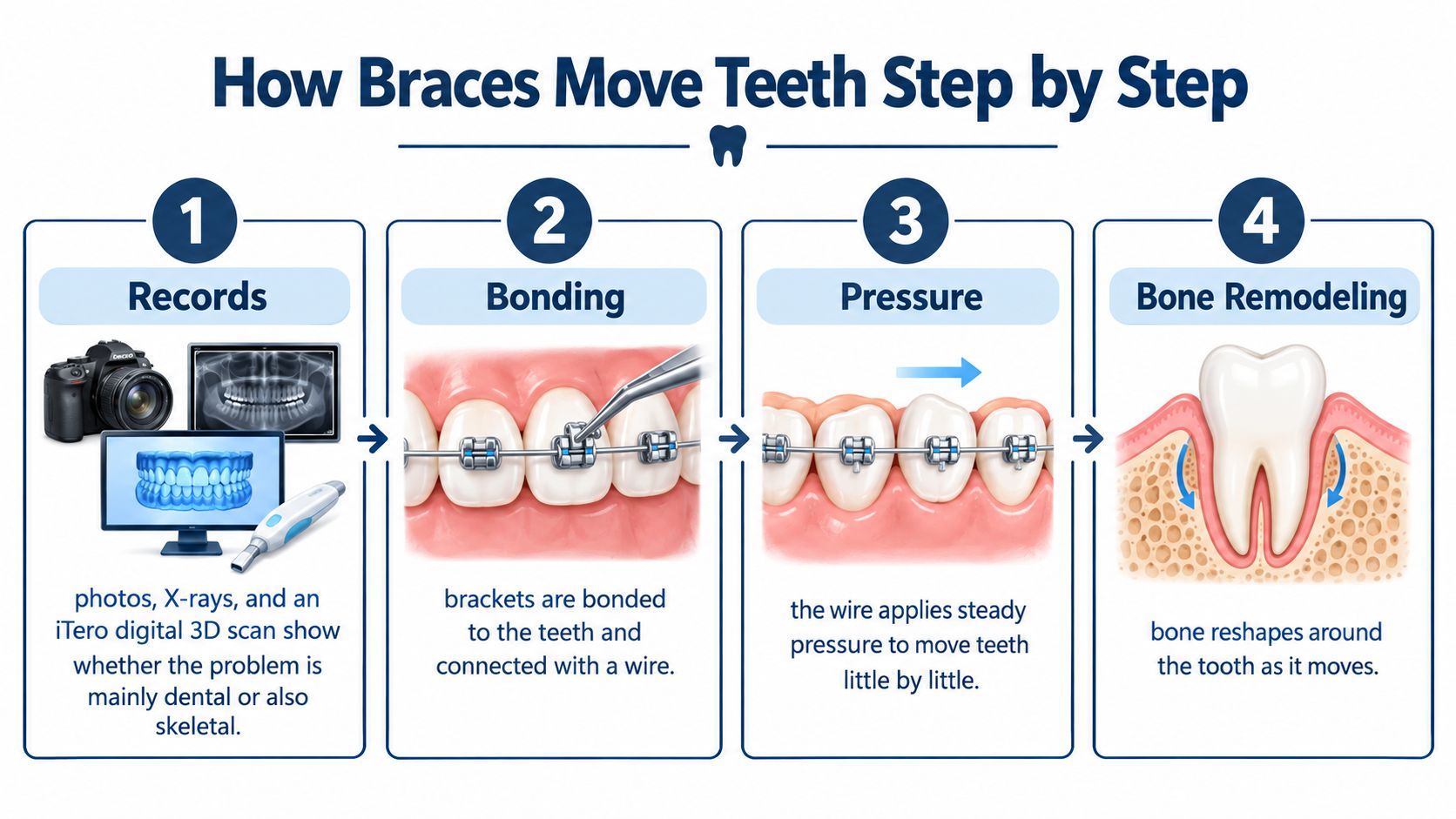
From diagnosis to bite correction
The clinical review of orthodontic treatment mechanics describes a progression from diagnostic records through alignment, root control, bite guidance, and retention. Each stage answers a different question about how the teeth should move.
Records establish the starting point. Photographs, X-rays, and an iTero digital 3D scan help document tooth positions and assess whether the problem also involves the jaws. Parents should mention chewing difficulties, previous dental treatment, and anything unusual about how the child closes their mouth, since a scan alone doesn't explain every symptom.
Brackets and a flexible wire begin alignment. Brackets are bonded to the tooth surfaces, not screwed into the teeth, and a light archwire starts leveling and aligning them. A child may feel sore for a few days after placement or an adjustment, so softer foods and the office's comfort instructions can help during that transition.
Stiffer wires add precision. Later, rectangular wires help control the angle of the roots and coordinate the upper and lower dental arches. Front teeth may already look straighter at this point, but parents shouldn't assume treatment is nearly finished, since root positioning and bite correction still need attention.
Elastics guide how the teeth meet. Small rubber bands can add force in specific directions for selected overbite, underbite, or crossbite corrections. They only work as planned when worn as directed, so a parent can help by keeping replacement bands available and checking that the child understands the attachment pattern.
Follow-up and finishing
Adjustment visits keep movement on course. Many families return about every 4 to 8 weeks, although the treating orthodontist sets the actual schedule for the appliance and treatment stage. At these visits, the team checks progress and may change wires or elastic instructions; between appointments, careful brushing around brackets and the gumline remains important.
Retention protects the finished result. Once the planned bite correction is complete, braces come off and a retainer holds the teeth in their new positions. Parents should leave with clear instructions about wear, cleaning, storage, and what to do if the retainer no longer fits properly.
A loose bracket or a child running out of elastics isn't a reason to improvise. Contacting the office helps the team decide whether an earlier visit is necessary, and doubling rubber bands without instructions isn't a substitute for consistent wear.
Braces treatment is a sequence of planned changes. Straight-looking front teeth are only part of the finish line.
Why Gentle Pressure Moves Teeth Through Bone
A tooth doesn't slide through a fixed tunnel in the jaw. Instead, the surrounding bone changes as the tooth moves, making room along its path while rebuilding support behind it.
The diagram shows what happens around the root.
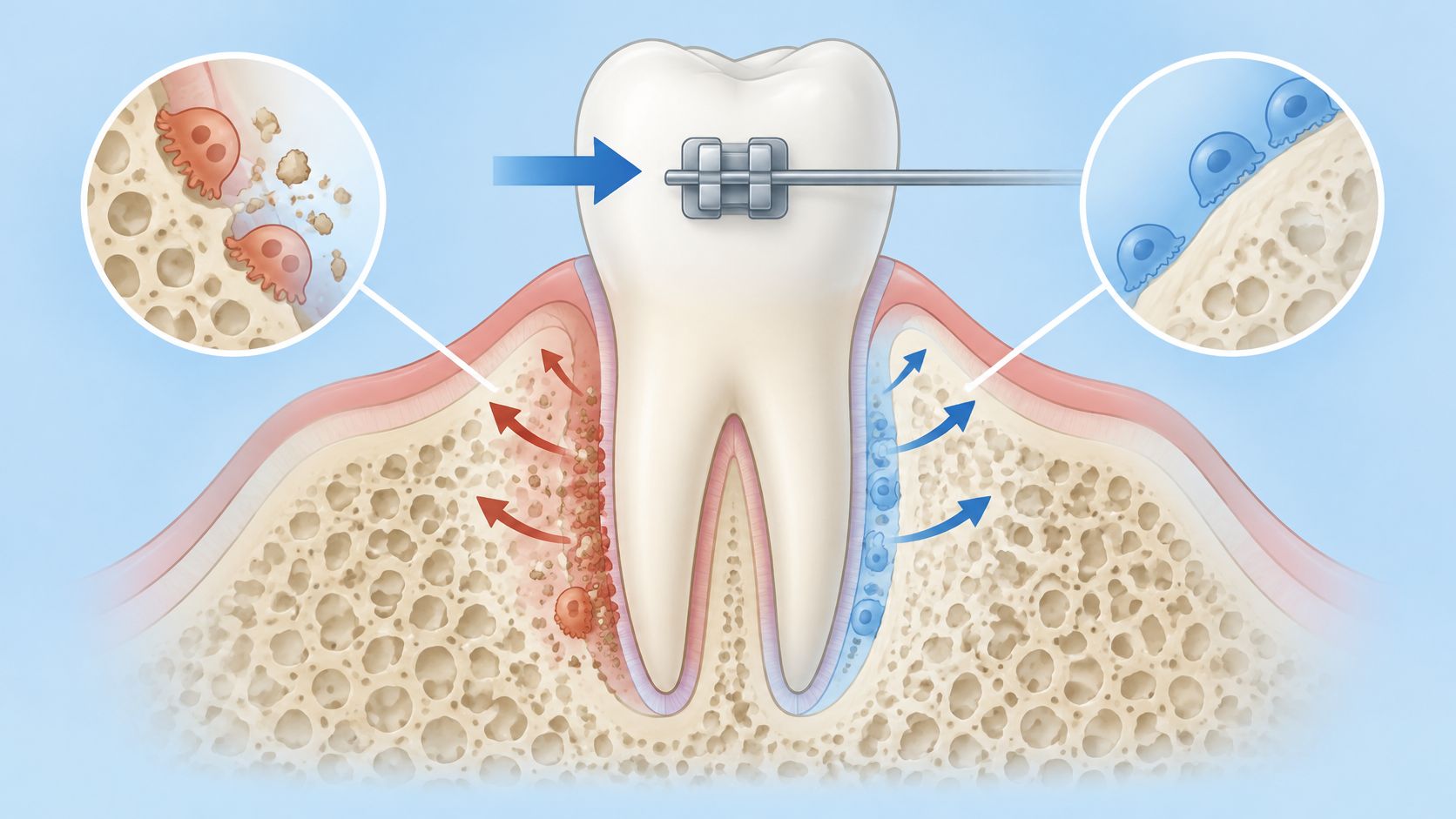
Pressure creates compression on one side of the root and tension on the other. Bone is removed on the compressed side and new bone forms on the tension side, allowing gradual movement through the supporting bone, as explained in the American Association of Orthodontists' braces overview.
Controlled force and a stable anchor
More force doesn't mean better movement. Excessive or prolonged force can contribute to external apical root resorption, meaning shortening at the root tip, which is one reason orthodontists control activation and monitor patients with risk factors.
Anchorage works like tug-of-war: pulling one group of teeth also creates a reaction at the supporting teeth. If the back teeth move forward when they were meant to stay put, the orthodontist may lose space needed for the planned correction.
Temporary skeletal anchorage devices, small mini-screws, can provide support that relies less on other teeth. A systematic review of skeletal anchorage reported approximately 0.60 mm greater maxillary movement and 0.35 mm greater mandibular movement than dental anchorage, with study-specific rates near 0.12 mm per month and 0.07 mm per month, respectively; it also describes broadly similar root-resorption risk with conventional and self-ligating brackets, based on low- to moderate-quality evidence.
Those movement figures aren't individual forecasts. The planned direction, anchorage method, and biological limits matter more than a universal speed target.
This animation provides another view of orthodontic tooth movement.
After active treatment: Retainers remain necessary because teeth and surrounding tissues can shift, particularly when an underlying skeletal discrepancy remains.
Treatment Timelines by Age and Bite Problem
The table shows how a child's growth stage and the type of bite problem can shape the treatment approach. The timelines are estimates, because the orthodontist must examine the teeth and jaw relationship before setting a schedule.
| Age group | Common problem | Typical approach | Typical active length |
|---|---|---|---|
| Ages 7 to 9 | Crossbite, narrow upper arch, early jaw mismatch | Expander or growth-guidance appliance, then monitoring | Expansion is one stage; the full phase needs an individual estimate |
| Adults with mild bite issue | Mild misalignment | Braces | Estimated after examination and treatment planning |
| Adults with major skeletal mismatch | Jaw size or position discrepancy | Braces to prepare teeth, then surgical planning | Estimated through coordinated planning with the surgeon |
The American Association of Orthodontists' explanation of two-phase treatment recommends an orthodontic evaluation by age 7. That visit helps identify whether a child may benefit from treatment while growing, or whether observation is the better choice for now.
How different children might be treated
A 9-year-old with a narrow upper arch and crossbite may need an appliance before braces. The orthodontist checks whether the bite problem comes from arch width, tooth position, a shift when biting, or a combination. Those causes can call for different steps and timelines.
A 12-year-old with a deep overbite and crowding may be ready for braces to address tooth alignment and bite depth together. Remaining growth may affect the plan, but age alone does not determine which mechanics are appropriate.
A 15-year-old finishing growth with mild crowding presents a different question: how much tooth movement is needed within the existing arches? An adult with a mild bite issue may also be treated mainly through tooth movement, without a growth-guidance phase.
Early evaluation can lead to monitoring rather than immediate braces. Observation is an intentional choice when the orthodontist wants to see how the bite develops.
A child with a major jaw mismatch may need monitoring or an appliance, followed by braces later. That possibility matters because early treatment may be one phase of care, not the entire plan.
Families in North Wilmington, Middletown, Dover/West Dover, and Millsboro can ask for a personal timeline at an in-person consultation. Useful questions include what active treatment involves, whether monitoring is expected, and which milestones might change the estimate.
Growth Appliances That Go Beyond Standard Braces
A palatal expander widens the upper arch by applying pressure across the roof of the mouth. It works differently from braces, which use brackets and wires to move individual teeth. For a growing child, an orthodontist can use an expander when the diagnosed problem involves a narrow upper arch, then use braces later if teeth also need alignment.
Expansion and forward guidance
For some Class III bite problems, a consensus on early Class III treatment describes rapid expansion before treatment that guides the upper jaw forward. The appropriate approach depends on whether the mismatch is dental, functional, or skeletal, as well as its severity. Expansion addresses the upper arch; it does not by itself straighten every tooth or determine the final jaw relationship.
For a Class II relationship, where the lower jaw sits relatively behind the upper jaw, functional appliances such as a Twin Block or MARA can guide the developing bite while growth remains. They can influence the relationship between the jaws, but they cannot give the orthodontist complete control over how the lower jaw grows. Growth timing matters: an appliance intended to guide development has a different opportunity to work while a child is still growing than after growth has largely finished.
For selected Class III relationships, a facemask used with expansion aims to encourage the upper jaw and upper teeth forward. That is a different job from an ordinary archwire, which mainly moves teeth within the arches. Even when both appliances appear in one plan, they address different parts of the problem.
What parents should clarify
Ask what the appliance is meant to change: upper-arch width, the developing jaw relationship, tooth position, or a combination. For removable parts, find out what wear at home involves and what to do if your child has trouble cooperating. Also ask what comes next, such as monitoring, another appliance, or braces.
The overview of Phase 1 orthodontic treatment explains why an appliance can be used before all permanent teeth have arrived. Early treatment can guide a developing bite, while later braces may still be needed to position individual teeth.
Growth appliances aren't interchangeable with braces. A removable appliance depends on consistent wear, and widening the arch does not automatically remove the need for later alignment. The right appliance matches the diagnosed bite problem and the child's stage of growth.
When Jaw Alignment Is Not Just a Braces Problem
The myth is appealing: correcting a bite will also fix jaw clicking, headaches, facial pain, or breathing problems. That isn't a promise orthodontic treatment can responsibly make.
A 2025 orthodontic review of occlusion and temporomandibular disorders found no conclusive evidence that orthodontic treatment can prevent, cause, or cure TMD, and described the relationship between bite and these disorders as weak and inconsistent.
Separate the treatment goals
Parents and clinicians should distinguish straight teeth, a better bite and jaw relationship, and relief of pain or breathing symptoms. Braces are well suited to improving tooth position and can improve the bite when the problem is mainly dental, but symptoms may need a separate diagnosis.
The illustration separates those goals rather than treating them as one guaranteed outcome.
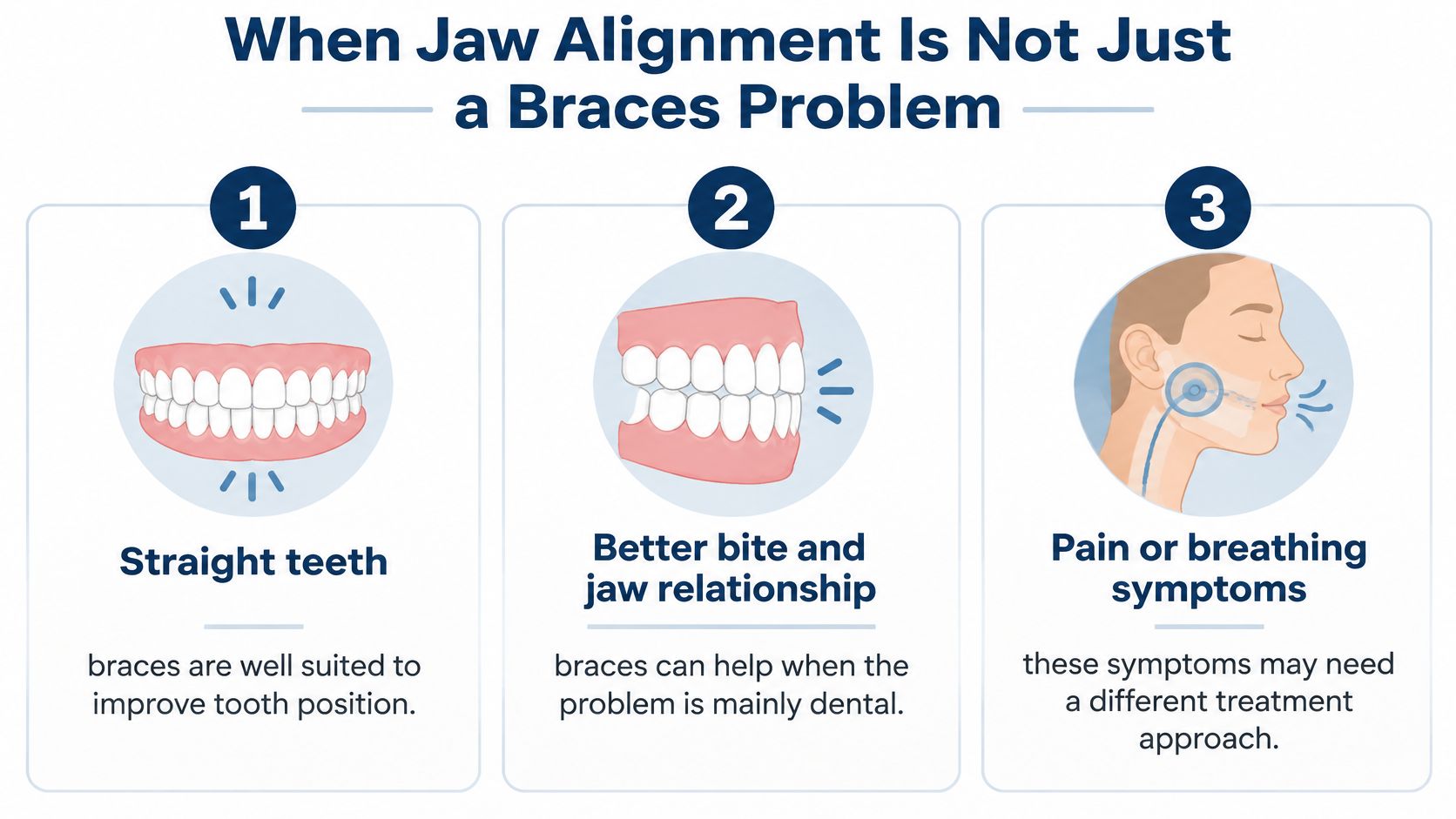
Even evidence for genuine early bite improvement needs careful interpretation. A 2024 Cochrane review of 29 studies involving 1,169 children found that early underbite treatment improved overjet by about 5.03 mm and ANB, an angular measure of jaw discrepancy, by about 3.05 degrees immediately after treatment, but long-term stability was uncertain.
Overjet describes the front-to-back relationship of the front teeth. Neither a better overjet measurement nor a change in jaw angle proves that a child will have lasting pain relief or better long-term airway health.
Clinicians still have limited ability to restrain or stimulate jaw growth predictably. For some children, observation is more appropriate than starting prolonged treatment with an uncertain benefit.
When another clinician should be involved
- Ongoing headaches or facial pain: A physician can evaluate causes beyond the bite.
- Snoring or breathing concerns: A physician or sleep specialist can assess whether a sleep-related breathing disorder needs investigation.
- Severe adult skeletal mismatch: An oral and maxillofacial surgeon can discuss whether surgical evaluation is appropriate.
- Clicking accompanied by pain: A clinician experienced in TMJ disorders can assess the joint and related muscles.
A good orthodontist will be direct about these limits. A treatment plan should identify what braces are intended to change and which concerns require additional care.
Book a Free Consultation to Check Your Child's Bite
A useful consultation begins with a short description of what the family has noticed. Crowding, teeth that meet awkwardly, facial imbalance, jaw pain, and snoring are all worth mentioning, even though they won't necessarily have the same cause or treatment.
Parents can bring existing smile photographs and any available previous dental X-rays. The office can advise whether those records are useful or whether updated imaging is needed.
Questions that make the visit more useful
- Dental or skeletal: Does the main problem involve tooth position, jaw development, or both?
- Treat or monitor: Is observation appropriate, or is there a reason to start an appliance or braces?
- Expected changes: Which parts of the bite can treatment improve, and what limitations remain?
- Personal timeline: What active stages, monitoring periods, and retention responsibilities are expected?
Free consultations at Stellar Orthodontics include access to iTero digital 3D scanning and are available at these Delaware locations:
- North Wilmington: 2304 Concord Pike.
- Middletown: 818 Kohl Avenue.
- Dover/West Dover: 125-2 Greentree Drive.
- Millsboro: 26670 Centerview Drive.
A parent doesn't need to identify the correct appliance before making an appointment. The purpose of the examination is to turn a concern about appearance or biting into a clear explanation of the problem and reasonable next steps.
Families can book a free orthodontic consultation at the location closest to home. Bringing questions about growth timing is especially helpful when the choice isn't whether braces are needed, but when and why treatment should begin.
Stellar Orthodontics offers free consultations to help families understand whether a bite problem comes mainly from tooth position or also involves jaw development. Visit Stellar Orthodontics to arrange a consultation at the nearest Delaware office and discuss what braces, growth guidance, or monitoring could realistically accomplish.