Clear aligners can correct many underbites caused by tooth position, especially mild-to-moderate cases where the front teeth tilt out of alignment. They can't move a lower jaw that has grown forward on their own, so the underlying cause and severity decide whether trays alone will fix the bite.
Why do so many online answers still treat "can clear aligners fix an underbite" like a simple yes-or-no question? Parents researching options for a child or adults checking their own bite in the mirror usually run into one of two extremes: blanket reassurance that trays fix everything, or a flat dismissal that only metal brackets or surgery can help. Neither extreme reflects what happens in an orthodontic exam room.
Splitting the question in two makes everything clearer. One half asks what the teeth are doing, and the other asks what the jawbones are doing. Once a family sees how those two pieces behave differently, the central question stops being whether aligners work in general and becomes which specific underbites aligners can handle reliably.
Table of Contents
- The short answer on aligners and underbites
- Why teeth and jaws are two different problems
- How clear aligners walk lower teeth back
- Aligners or braces for an underbite
- Does age change the answer
- Signs your underbite needs more than aligners
- Book a free consultation in Delaware
The short answer on aligners and underbites
Clear aligners can fix many tooth-driven underbites, medically called a Class III malocclusion, which means the lower front teeth sit in front of the upper front teeth when you bite down. When a pronounced lower jawbone drives the problem instead, plastic trays alone won't pull that bone backward.
Because real bites fall across a wide spectrum, looking at the exact pattern in front of you gives a far better answer than any blanket rule.
Which underbites clear aligners can correct
| Underbite type | Can aligners fix it alone? | What the plan usually involves |
|---|---|---|
| Single upper tooth tucked behind the lower teeth (anterior crossbite) | Possibly, depending on exam | Aligner trays with attachments, possibly a short refinement |
| Front teeth meeting edge to edge or reversed, mild to moderate Class III | Possibly, often with added movements | Aligners plus elastics and interproximal reduction, attachments on several teeth |
| Underbite with a small jaw-size mismatch in a growing child | Uncertain, needs growth assessment | Aligners or braces with a growth appliance and close monitoring |
| Marked lower-jaw prominence, facial asymmetry or a jaw that shifts on closing | Unlikely as a standalone fix | Braces or aligners with jaw surgery, temporary anchorage devices in selected cases |
| Underbite that keeps getting worse year on year | Usually not alone | Early evaluation, growth appliances or braces first, aligners later |
Reading this table works best when you treat the five rows as a sliding scale rather than rigid boxes. Most patients don't land cleanly on row one or row five. A teenager might have mostly tipped front teeth alongside a slight lower-jaw prominence, while an adult with a single trapped upper tooth might also have crowding that limits how far lower teeth can safely move.
Only an in-person orthodontic exam with a 3D digital scan and X-rays can place a specific bite accurately on that scale. Looking in the bathroom mirror shows where the front teeth meet, yet it hides the angle of the tooth roots, the thickness of the surrounding bone, and how the back molars lock together.
Key clinical lens: The most useful question at a consultation isn't whether clear aligners exist for an underbite, but how severe the bite is and which exact tooth movements are required to correct it.
Why movement predictability matters more than the brand of tray
The American Association of Orthodontists notes that clear aligners may not work as predictably for severe bite problems, significant tooth rotations, or large spaces, and that traditional braces can provide more precise control in those situations. For families weighing aligners for an underbite, that distinction puts the focus where it belongs: on whether the planned movements stay within what removable plastic trays can control reliably.
During an evaluation, parents and adult patients benefit from asking whether the underbite is classified as mild, moderate, or severe, and which specific shifts, such as jumping an anterior crossbite (a single upper front tooth trapped behind the lower ones) or uprighting tilted incisors, will do the heavy lifting. From there, separating tooth position from jaw structure shows why two bites that look similar in a photo can require completely different plans.
Why teeth and jaws are two different problems
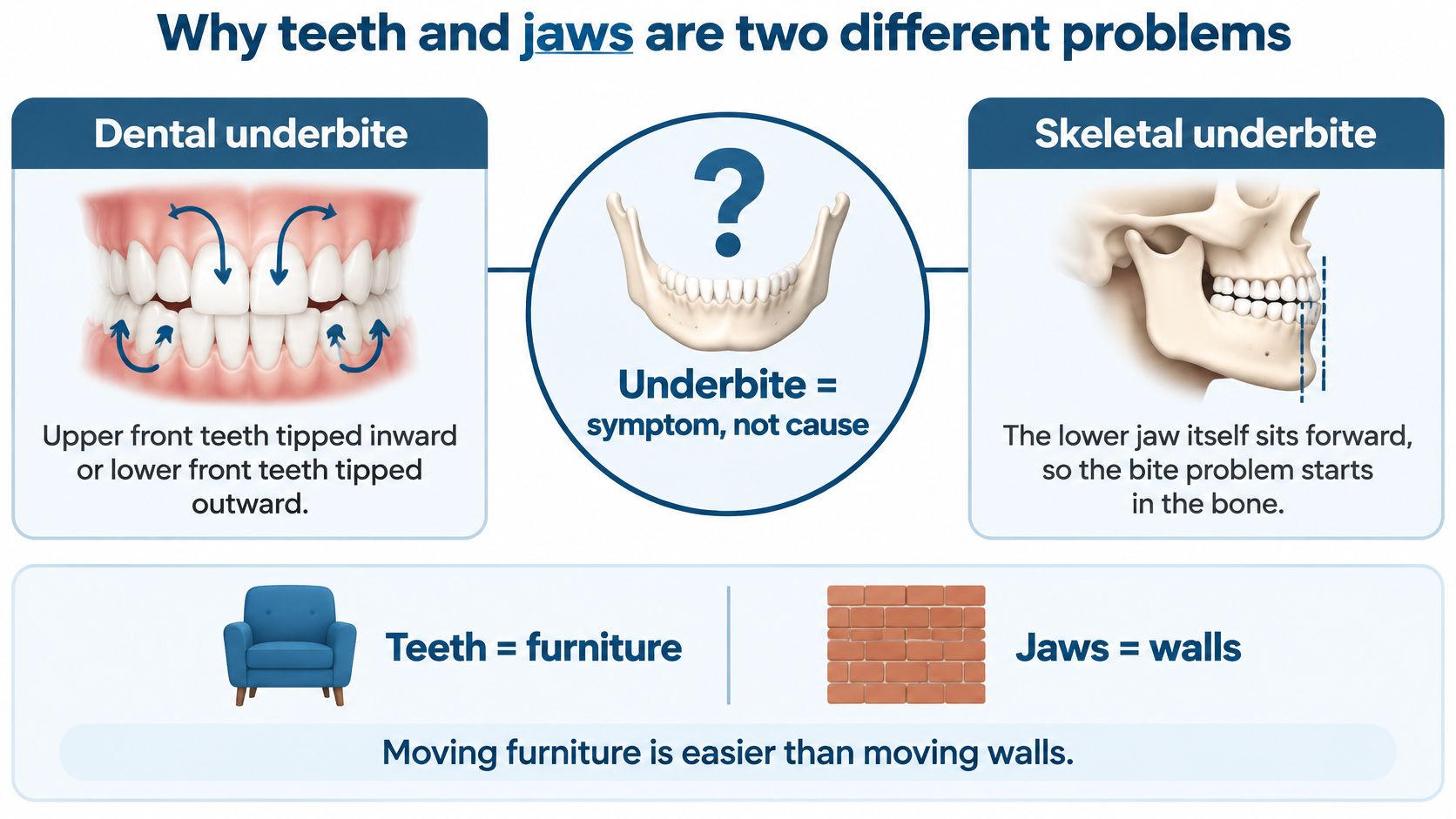
“Underbite” describes what the bite looks like, but it does not explain why the bite happened. A simple comparison helps: teeth are the furniture, and jaws are the walls. A room can look crowded because the chairs sit at odd angles, or because the walls themselves sit too close together. Orthodontic planning starts by finding which part of the picture is driving the bite.
A dental underbite means the furniture is out of place. The upper front teeth may tip inward toward the tongue, or the lower front teeth may lean forward toward the lip, while the upper and lower jawbones line up reasonably well. Clear aligners are designed to rearrange teeth, so this is the kind of problem they can often address when the movements stay within a moderate range.
A skeletal underbite means the walls are involved. The mandible, or lower jaw, may sit too far forward, the maxilla, or upper jaw, may sit too far back, or both may contribute. A removable tray can guide teeth through bone, but it cannot push an adult jawbone backward. That distinction is why two children or adults with a similar front-to-back overlap may need very different plans.
Here is a visual breakdown of how those two causes differ inside the mouth.
How an orthodontist separates the two in one visit
At an evaluation, the goal is to identify what is producing the reverse bite. A few checks during one appointment usually bring the picture into focus:
- Side-profile assessment: The relationship between the midface, upper lip, and chin shows whether the lower jaw visually dominates the profile or whether facial balance looks steady when the lips relax.
- Functional shift check: The patient relaxes the jaw and closes gently until the front teeth first touch. If the teeth can meet edge to edge before the lower jaw slides forward into a comfortable bite, that functional shift points to an interfering tooth position rather than jaw overgrowth alone.
- Lateral cephalometric X-ray: This side-view image lets the clinician measure the ANB angle, a geometric measurement of the front-to-back relationship between the upper and lower jawbones.
Many patients show a mix of both problems. The furniture may be tilted, and the walls may be slightly out of balance. The plan depends on which part creates most of the underbite.
Where aligner mechanics hit their anatomical boundary
Evidence published in the European Journal of Orthodontics explains why clear aligners have limits with a pronounced skeletal underbite. Trays apply force to teeth. They do not reshape the maxilla or mandible. In the 2025 randomized clinical trial described in that publication, adults with mild Class III malocclusion did better when lower-molar backward movement was paired with Class III elastics, small rubber bands angled to encourage upper teeth forward and lower teeth back, than with elastics alone. The investigators also noted a small sample and short follow-up.
The European Journal of Orthodontics also reports that clear-aligner Class III correction occurs mainly through dental tipping, meaning the teeth lean rather than the jaw changing position. A clinical report found that aligners may not achieve planned lower-molar retraction without skeletal anchorage, tiny temporary pins placed in bone to anchor tooth movement.
That mechanics explains why complex bites may need attachments, elastics, temporary anchorage devices, or fixed appliances. Fixed braces can give more control for detailed tooth movement and harder bite patterns. Persistent negative overlap, facial asymmetry, a pronounced jaw mismatch, or an underbite worsening during growth all call for a thorough orthodontic workup before choosing any appliance.
How clear aligners walk lower teeth back
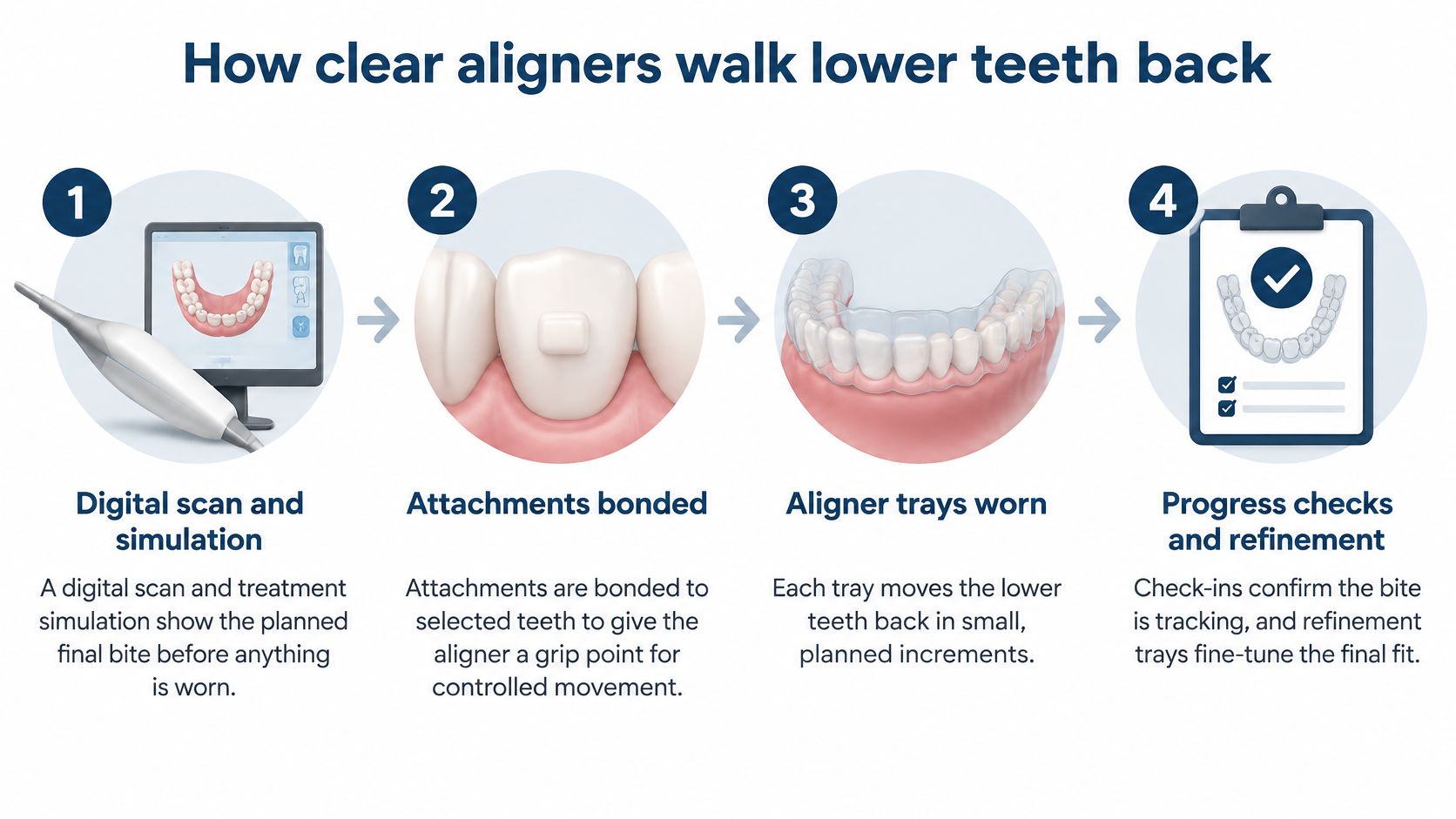
Clear aligners move an underbite in stages, like shifting a row of books one at a time to make space on a shelf. When an exam confirms that tooth position drives the bite, the goal is to create room in the lower arch and bring the lower front teeth behind the upper ones. The trays look simple, but the sequence depends on several small helper tools working together.
The graphic below maps the core phases from initial scan to final fine-tuning.
The five stages of an underbite aligner plan
- Digital scan and bite simulation: Everything starts with a 3D digital scan of the teeth and gums. Before a single tray is manufactured, the orthodontist maps each planned movement on screen to verify that enough bone and space exist to tuck the lower teeth safely behind the upper ones.
- Tooth-colored attachments: Smooth plastic slips over smooth enamel easily, so small composite bumps called attachments are bonded to selected teeth. They act like tiny door handles, giving each aligner the grip needed to guide teeth backward or rotate them without the tray lifting off.
- Mandibular molar distalization: To pull lower front teeth back, there has to be somewhere for them to go. Through mandibular molar distalization, sequential trays walk the lower back molars backward one step at a time, opening room along the dental arch.
- Retracting the front teeth with elastics and spacing: Once space opens, the trays guide the lower front teeth inward while Class III elastics add steady directional force between upper and lower arches. In selected cases, the orthodontist also performs interproximal reduction (gently polishing a tiny fraction of enamel between lower teeth) to create extra breathing room without extracting teeth.
- Progress checks and refinement trays: Every aligner moves teeth by only a fraction of a millimeter, and trays only deliver planned forces when worn almost full-time, coming out solely for meals and brushing. After the initial set finishes, a fresh scan identifies any teeth that lagged behind so refinement trays can dial in the final bite contact.
Watching how sequential movement works in real time helps illustrate how small tray changes add up across an arch.
What clinical measurements show about tipping versus sliding
A 2023 systematic review published on PubMed Central evaluated clear aligners paired with mandibular molar distalization for Class III correction and concluded the approach can work well when distalization is built directly into the plan. The authors emphasized that much of the published evidence consists of case reports and small studies rather than large randomized trials.
One adult case detailed in that review finished with balanced Class I canine and molar relationships alongside positive front-tooth overlap. When researchers measured exactly how the lower molars traveled, roughly 67.19% of the planned backward movement came from crown tipping (the visible top of the tooth leaning backward) while 37.87% came from root movement (the root shifting through bone), according to PubMed Central.
Put plainly, teeth tilt backward much more readily than they glide straight back upright. That single fact explains why attachments, rubber bands, careful monitoring, and refinement sets aren't optional extras in an underbite aligner plan. It also explains why every plan should name the exact retainer that follows active trays and spell out its wear schedule, since holding a newly corrected bite steady matters just as much as moving it there.
Aligners or braces for an underbite
Parents and adults who qualify for both options usually want the choice made concrete. Picture a removable retainer-like tray set against a fixed guide system: one is easier to live with day to day, while the other gives the orthodontist steadier control when the bite is harder to change.
Clinical data published on PubMed Central compared clear aligners with fixed braces in mild-to-moderate Class III patients, tracking treatment duration, cooperation, overjet correction, jaw-relationship changes, and refinement rates. A comparison shaped like this helps separate two questions families often mix together: which appliance changes the bite more efficiently, and which one fits daily life better.
Clear aligners versus braces for an underbite
| What is being compared | Clear aligners | Fixed braces |
|---|---|---|
| Average treatment time for mild to moderate Class III | 18 ± 3 months | 22 ± 4 months |
| Recorded cooperation or wear | 92% compliance | 75% compliance |
| Overjet correction achieved | 3.2 mm | 3.8 mm |
| Change in front-to-back jaw relationship (ANB) | 0.8° | 1.5° |
| Cases needing a refinement or extra phase | 10% | 5% |
| Removable for eating and brushing | Yes | No |
| Visibility | Nearly invisible | Brackets and wire visible, with a lower-profile ceramic option |
| Control of severe bites, large rotations or big spaces | More limited | Greater precision |
| Food restrictions | None beyond normal care | Avoid hard and sticky foods |
| Brushing routine | Remove tray, brush, reseat | Brush around brackets and wire with extra care |
| Speech in the first weeks | Mild lisp for a few days while the tongue adjusts | Brief adjustment to lip and cheek fullness, minimal lisp |
| Sports and mouthguard use | Remove trays and wear a standard sports mouthguard | Wear an orthodontic mouthguard fitted over brackets |
| Lost or damaged appliance | Order a replacement tray or step to the next tray if directed | Schedule a repair visit for a loose bracket or poking wire |
| Visit frequency | Periodic progress checks to verify tracking and hand out new trays | Regular adjustment visits to update wires and monitor bite changes |
| Best suited to | Mild to moderate, cooperative patients | Complex, severe or precision-demanding cases |
Source for the clinical figures in this table: PubMed Central.
Read the numbers as a pattern, not a winner-takes-all scorecard. In a comparative study on PubMed Central, overjet correction, meaning the change in front-to-back overlap, was statistically comparable at 3.2 mm with aligners and 3.8 mm with braces. Aligner patients averaged 18 ± 3 months with 92% compliance, while the braces group averaged 22 ± 4 months with 75% compliance. For a mild-to-moderate, tooth-driven underbite, that helps explain why aligners can be a reasonable option when trays are worn as directed.
The trade-off appears in jaw relationship and fine control. Braces produced a larger ANB jaw-relationship improvement, 1.5° versus 0.8° for aligners, and fewer cases needed another phase, 5% versus 10%. In plain language, the fixed system kept working in the background while patients ate, brushed, and spoke. That matters when the plan needs deeper jaw change or precise root positioning. Families comparing lifestyle factors can read more about clear aligners versus traditional braces.
Clear aligners offer convenience, easier brushing, and potentially shorter treatment for tooth-driven underbites, while fixed braces remain the stronger tool when root control and deeper jaw-relationship changes carry the plan.
How the choice breaks down by bite severity
- Mild tooth-related underbite: Either appliance can deliver a balanced finish. Daily habits, willingness to keep trays in consistently, and aesthetic preference usually decide the winner.
- Moderate Class III underbite: Clear aligners paired with elastics are a reasonable starting point for a cooperative patient, provided everyone understands upfront that a mid-course refinement or even a switch to brackets may be needed if stubborn teeth stop tracking.
- Marked skeletal jaw discrepancy: Fixed braces typically anchor the orthodontic phase, often coordinated with growth appliances in children or jaw surgery in adults. Clear aligners may still play a role before or after surgery, yet they shouldn't be treated as a standalone replacement for surgical jaw correction.
A useful way to approach the decision is to ask what is causing the underbite. If the lower front teeth sit too far forward, removable trays may have enough control. If the lower jaw itself sits ahead, or if the plan depends on detailed rotation and root movement, fixed braces usually give the orthodontist more command over the final bite. Ceramic brackets offer a lower-profile look, while metal braces remain a dependable option for both simple and complex bite issues.
Does age change the answer
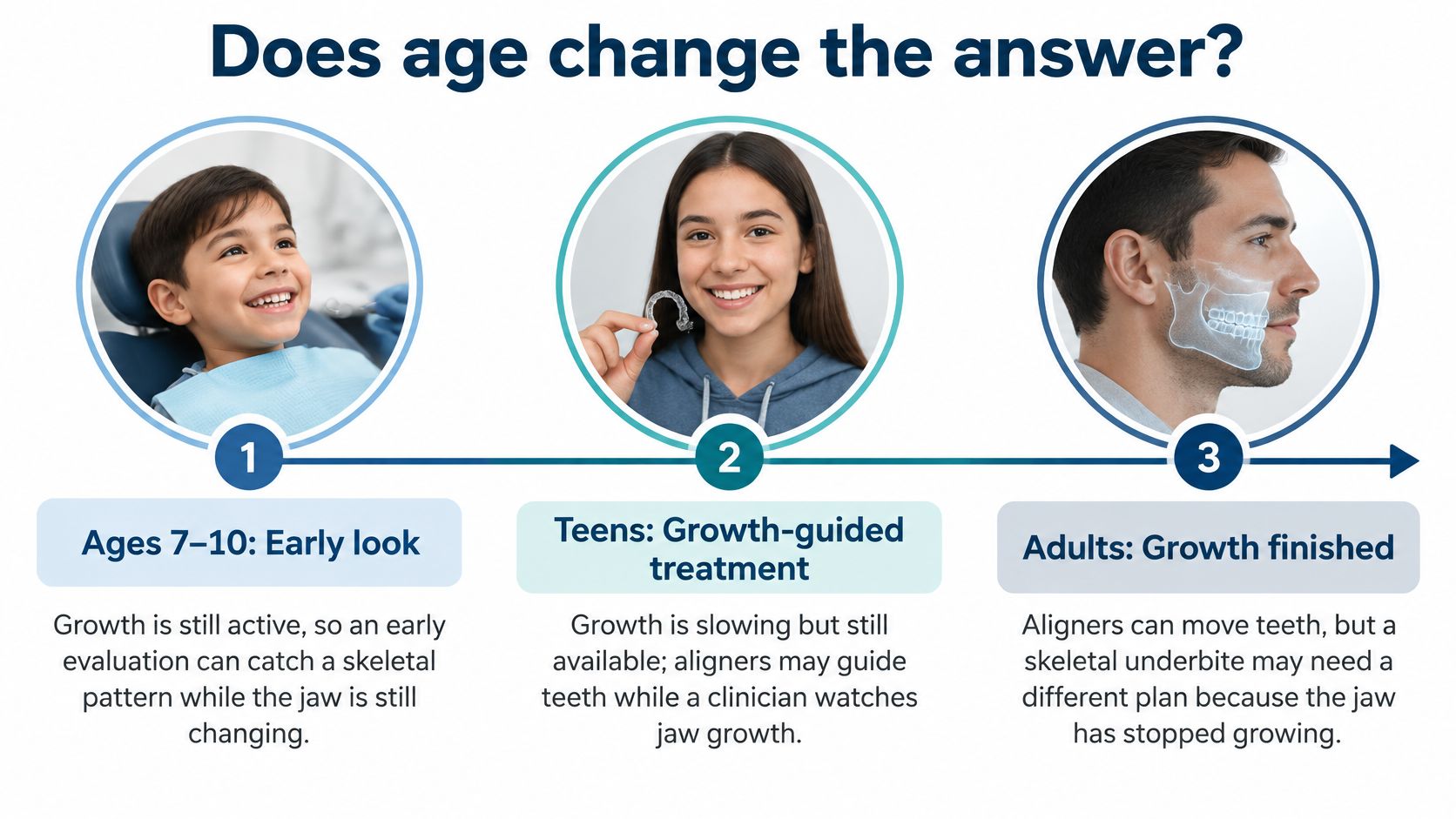
Growth status reshapes both what orthodontics can accomplish and how soon a family should book an evaluation. A developing jaw responds to guidance in ways a fully matured adult jaw can't, so the same appliance plays a different role at age eight than it does at age thirty-five.
The timeline below outlines how age shifts the treatment playbook across children, teens, and adults.
Young children in the elementary years
Catching an underbite while the upper and lower jaws are still actively growing gives an orthodontist the chance to evaluate whether growth guidance is possible before major growth spurts arrive. An early check isn't a guarantee that early treatment will prevent every future phase, yet it lets a clinician spot a worsening bite pattern early instead of waiting until options narrow.
Clear aligners can sometimes help selected growing patients, though careful case selection is essential. A published case report on PubMed Central documented an 11-year-old girl with a Class III malocclusion, a bilateral crossbite, and a functional lower-jaw shift who achieved both skeletal and dental improvements after one year of clear-aligner treatment. Even with that encouraging outcome, the authors emphasized that evidence for clear aligners in growing patients remains limited and depends heavily on the specific Class III pattern. Parents shouldn't assume an adult-style aligner plan translates directly to a child whose jaws are still changing.
Teens navigating school, sports, and growth
By the teenage years, jaw growth is slowing down, though some active development may still be present depending on the individual. Teeth still respond predictably to gentle forces, making mild-to-moderate dental underbites realistic aligner candidates for motivated teens.
Cooperation becomes the true wild card during middle and high school. Trays left in a cafeteria napkin or forgotten during away games stall progress fast, so parents should ask how wear will be monitored and whether built-in compliance indicators or fixed braces fit their teen's personality better.
Adults after jaw growth has finished
Once growth stops, jawbones stay fixed in size and position. For adults with a tooth-driven underbite, aligners can still align the arches and establish positive front-tooth overlap cleanly.
When a substantial skeletal discrepancy exists in adulthood, moving teeth alone can only camouflage the bite up to safe bone limits. In those cases, orthodontics works alongside orthognathic surgery (corrective jaw surgery). A retrospective clinical study published in Springer's Aesthetic Plastic Surgery evaluated 24 skeletal Class III patients who received non-extraction orthodontic care with either clear aligners or fixed appliances in conjunction with orthognathic surgery, illustrating a clear practical boundary: aligners can serve as the orthodontic partner before or after surgery, yet they don't reposition the jawbone independently. Families comparing options across life stages can read more about orthodontics for all ages.
Timing takeaway: Scheduling the first orthodontic exam at the right stage of growth matters far more than deciding between aligners and braces before anyone looks at an X-ray.
For Delaware families noticing an underbite in a child, teen, or adult, Stellar Orthodontics provides individualized growth and bite evaluations across its North Wilmington, Middletown, Dover/West Dover, and Millsboro offices.
Signs your underbite needs more than aligners
A parent sits at the kitchen table counting trays. The last one in the box is nearly done, yet when their child bites down, the lower front teeth still sit in front of the uppers. That moment, more than any X-ray or scan, is when families start asking whether plastic alone can finish the job.
Orthodontic care is dynamic by design. Watching how teeth and jaws respond mid-treatment tells the clinician whether to stay the course, refine the plan, or bring in stronger mechanics. The key is knowing which clues point to a simple adjustment and which ones reveal a problem that removable trays cannot solve.
Warning signs and the clinical steps they trigger
- Front teeth remain edge to edge or reversed near the end of trays: When only a tiny gap remains, a fresh digital scan for refinement trays and adjusted elastics often closes the distance. If the teeth have already tipped to their healthy bone limit, continuing to push with trays won't solve the problem, because the jaw position underneath hasn't changed.
- The bite looks straighter, yet the chin and profile still feel off: Improving front-tooth overlap doesn't automatically resolve an underlying jaw mismatch. Remember the split from earlier: aligners move teeth, not jaws. When facial imbalance or chewing strain persists after the teeth look better, an orthodontist re-evaluates the skeletal relationship and discusses whether a surgical consultation belongs on the table.
- The lower jaw slides sideways on closing: A lingering side shift signals an occlusal interference or skeletal asymmetry that removable plastic alone struggles to control, often pointing toward fixed braces or added anchorage.
- Trays stop seating flush or teeth stop tracking: Visible air gaps between the edge of a tooth and the plastic mean the tooth isn't keeping pace with the digital simulation. Clinicians respond by revising attachments, adjusting elastic patterns, adding temporary anchorage devices, or making a planned mid-course transition to fixed braces for tighter root control.
- Daily wear drops consistently below target: Invisalign is removable, which is exactly what makes it flexible for teens and adults, but that flexibility cuts both ways. If keeping trays in all day proves unrealistic around work, school, or meals, switching to fixed brackets removes the compliance hurdle and keeps the bite moving steadily.
Ongoing monitoring matters because the evidence behind aligner outcomes is still maturing. A 2025 systematic review in the European Journal of Orthodontics comparing clear aligners and fixed appliances reported comparable outcomes mainly in mild-to-moderate, non-extraction cases, while highlighting inconsistent clinical protocols and very low-certainty evidence for long-term stability. The same review noted a separate 2025 systematic review and meta-analysis concluding that overall clinical evidence for clear aligners across malocclusions remains low quality, even though aligners showed advantages in quality of life and possibly periodontal health. In practical terms: aligners perform well in the mild-to-moderate tooth-driven cases they were designed for, and the evidence thins out exactly where skeletal problems begin. For severe skeletal Class III cases, orthodontists sometimes coordinate care with corrective jaw surgery and use aligners or braces to detail the bite afterward.
Because long-term stability data remains very low certainty, clinical oversight shouldn't vanish the day the final tray comes off. Consistent retainer checks protect the correction over time.
Four questions to ask before starting treatment
Walking into a consultation with four direct questions sets honest expectations from day one:
- What are the predicted correction limits for this bite? Ask how much improvement aligners can realistically achieve without tipping teeth beyond healthy supporting bone.
- What signs would trigger a change in plan? Clarify upfront when the orthodontist would add elastics, switch to fixed braces, or pause to reassess.
- What retention will be required afterward? Find out which retainer style fits the bite and how long full-time and nighttime wear will continue.
- Could jaw surgery eventually be indicated? Even if surgery isn't likely, knowing whether skeletal growth or jaw structure could make it relevant later prevents surprises.
Changing course during orthodontic care is a normal, responsible clinical adjustment aimed at giving the bite a stable, healthy finish.
Book a free consultation in Delaware
Online tables and clinical averages narrow down the possibilities, yet only an individualized exam can answer "can clear aligners fix an underbite" for your specific smile or your child's developing jaw. A free orthodontic consultation is available at all four Delaware locations, North Wilmington, Middletown, Dover/West Dover, and Millsboro, and the orthodontist who would treat the case leads the appointment personally.
That last detail matters more than it might seem. The person examining the bite is the same person who will adjust it month by month, so the answer you get reflects real treatment judgment rather than a general screening.
Here is what happens during that first visit so families know exactly what to expect:
- Full orthodontic exam: The orthodontist checks how the front and back teeth meet, evaluates facial balance and jaw movement, and determines whether tooth position, jaw structure, or a mix of both drives the underbite.
- 3D iTero digital scan: A quick, mess-free scan captures an accurate digital model of the teeth without traditional putty impressions.
- Treatment options explained at the visit: Families compare appropriate paths, including Invisalign clear aligners, classic metal braces, and clear ceramic braces, and leave with a printed treatment plan and transparent pricing before making any decision.
That exam is where the teeth-versus-jaw question gets settled. A child whose lower teeth only lean forward has a very different plan from a teen whose lower jaw has outgrown the upper one, and the difference shows up clearly once the orthodontist can see how the bite fits together.
Choosing the office closest to home gives your family clear, pressure-free answers grounded in an actual exam rather than guesswork. There is no obligation to start anything. The goal of the visit is to replace uncertainty with a concrete picture of what the bite needs, what each treatment path involves, and what it would cost.
Ready to find out whether clear aligners, braces, or a growth-guided plan fits your family's underbite best? Stellar Orthodontics provides free consultations with a 3D iTero scan and personalized treatment options across North Wilmington, Middletown, Dover/West Dover, and Millsboro, led directly by the orthodontist who would oversee care. Schedule a relaxed, no-pressure visit by heading over to Stellar Orthodontics.