
Soreness after a tightening visit usually peaks within 24 to 48 hours and settles back toward normal in roughly 5 to 7 days; patients often describe mild to moderate pressure rather than constant severe pain.
Parents rarely get that much detail. The standard answer to how long do braces hurt after tightening is "a few days," which is accurate and almost useless, because it doesn't tell you which day to clear the calendar for or when a still-tender mouth stops being routine. Day two and day six feel completely different, and they mean completely different things.
What follows is the version a parent can plan around: a day-by-day timeline, the reason the second day tends to be the roughest, and a short list of symptoms that should end with a phone call to the orthodontic office rather than another dose of children's pain reliever.
Table of Contents
- How Long Braces Soreness Lasts After Tightening
- Why the Second Day Usually Hurts Most
- What Changes Soreness From One Visit to the Next
- Easing Soreness at Home Without Guessing
- Warning Signs That Warrant a Call to the Office
- Book a Free Consultation to Review Any Concerns
How Long Braces Soreness Lasts After Tightening
The honest window is two to five days of noticeable soreness, with most children back to baseline somewhere between day five and day seven. A 2021 peer-reviewed study of post-adjustment discomfort found that pain typically peaks about 24 to 48 hours after an orthodontic adjustment and generally returns to baseline within 5 to 7 days, and that participants reported mild to moderate discomfort rather than continuously severe pain. In that study, measured pain rose after the adjustment, reached its highest level around 8:00 a.m. on the second day, and was back to baseline by about the fourth day.
That gives a family the shape of the week. The first evening brings building tenderness, the middle of the week slides steadily downward, and by day four a parent can expect normal meals and normal conversation again, even if the teeth still feel tender to a firm bite.
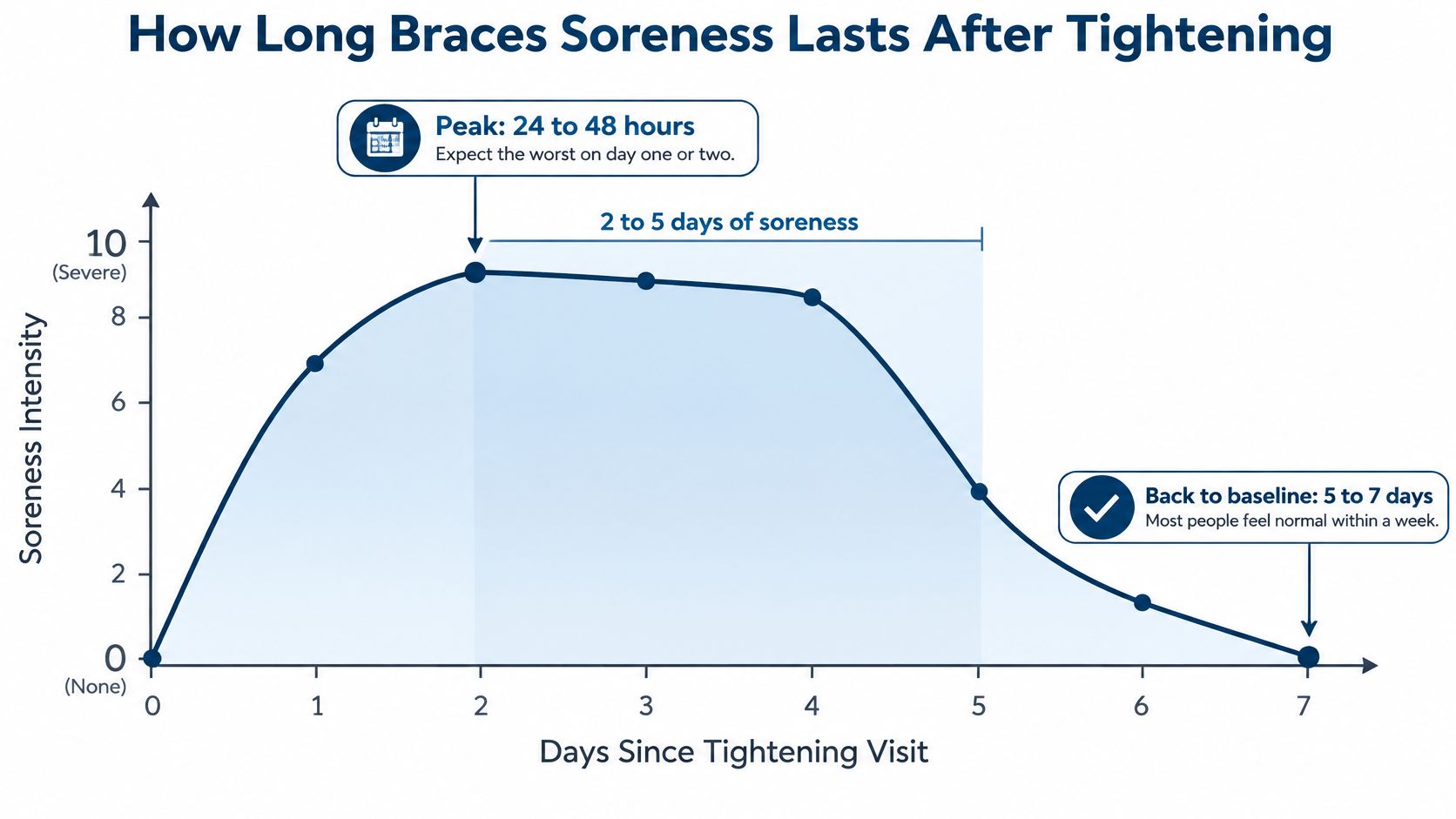
Families often ask why the range is so wide. The table below maps the same curve day by day, so the range stops feeling like a shrug and starts looking like a schedule.
Typical soreness by day after a tightening visit
| Time after tightening | Expected soreness | Reference from research |
|---|---|---|
| Evening of the visit | Tenderness begins and builds | Readings climb through the first evening |
| 24 hours | Usually the most intense point so far | Mean pain 6.8 out of 10 in a 2025 study of 92 fixed-braces patients |
| 24 to 48 hours | Peak window for most patients | Highest measured levels fell on the second morning |
| Day 3 | Clearly easing | Mean pain 4.3 out of 10 in the same 2025 study |
| Day 5 to 7 | Generally back to baseline | Most patients at or near baseline by this point |
| Day 7 | Minimal for most patients | Mean pain 2.1 out of 10 in the same 2025 study; soreness lasting a full week was uncommon |
A full week is possible. It just isn't the norm. In a 2025 survey of 194 orthodontic patients, 91.8 percent said their pain lasted several days, and the share reporting a full week stayed under one in ten.
Plan the week around days one and two. Soft meals, a lighter after-school schedule, and a child who knows the second morning is the hard one handle the whole experience better than any last-minute scramble.
Duration shifts with how much the wire was activated, your child's age and sensitivity, the type of appliance, and whether the visit was a routine wire change or a larger adjustment. A heavier activation earns a longer tail.
Why the Second Day Usually Hurts Most
A tooth isn't welded into the jaw. It hangs in a sling of soft tissue, the periodontal ligament, that cushions it inside the socket. Tightening the wire pulls the tooth against that sling, compressing the tissue on one side and stretching it on the other. The sling pushes back hard against that pressure.
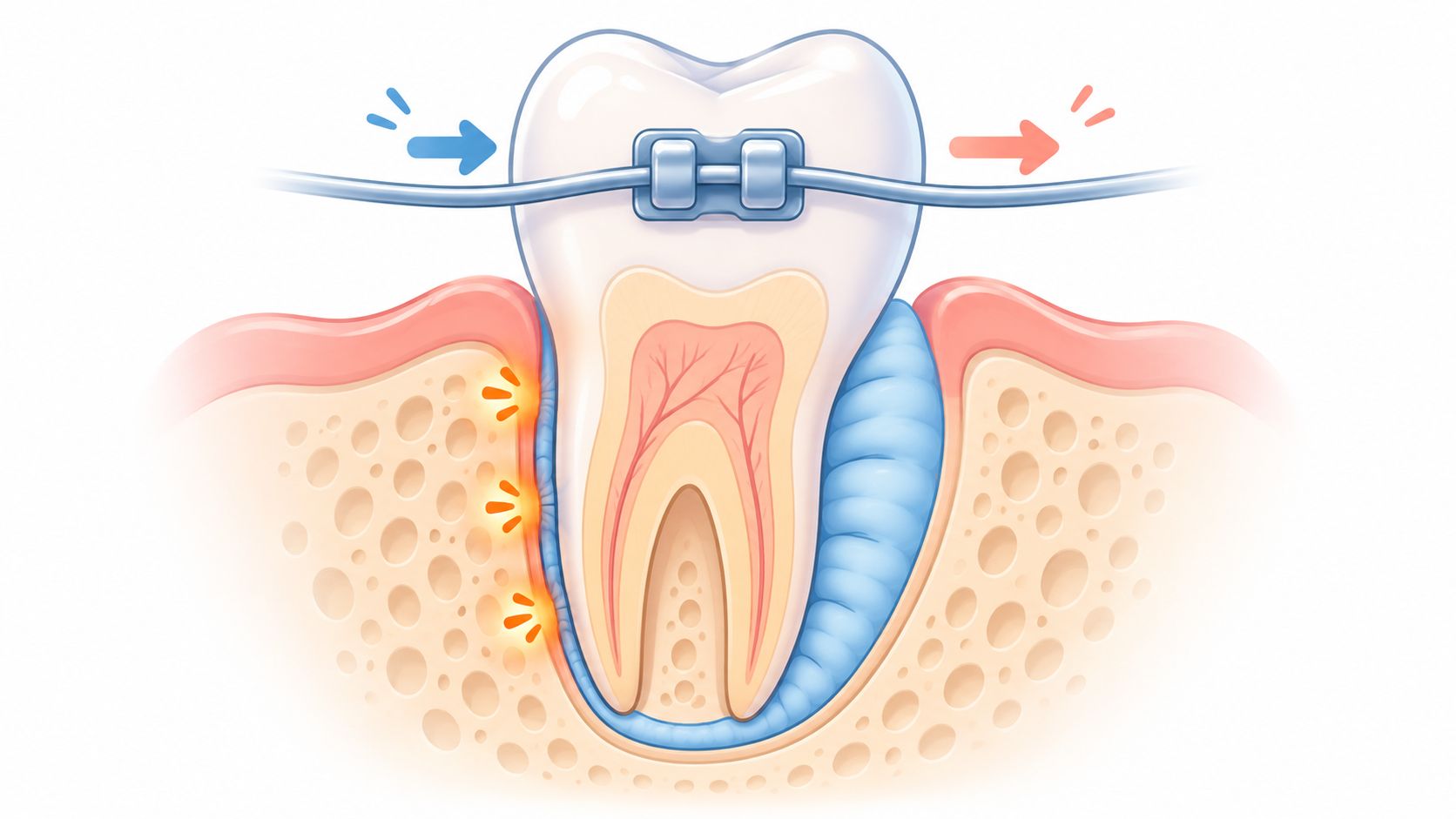
On the compressed side, local blood flow drops for a while. That small squeeze triggers the release of inflammatory mediators, and those chemicals are the actual source of the ache. The process is temporary and self-limiting, which is why the soreness fades without treatment even when nobody does anything special.
The delay explains the timing. Inflammation takes hours to build, so the mouth rarely hurts on the drive home. A multicenter randomized clinical trial tracked the sequence and found pain increased significantly at 4 and 24 hours, decreased by 72 hours, and was no longer significant at one week. That trial followed initial alignment rather than every possible tightening protocol, but the force-activating biology is the same, which makes the timeline a fair benchmark for a routine adjustment.
Here's the part parents notice first: biting hurts more than resting. Chewing loads the ligament that is already compressed, adding mechanical pressure on top of the chemical irritation. A child can sit comfortably through a movie and then wince at a strawberry.
Two takeaways make the biology useful. Expect chewing, not sitting still, to be the sore part, so soak the cereal and cut the apple into thin slices. And treat the pattern as reliable enough to plan around rather than something to endure blind.
Soreness is evidence that the tooth is responding to force. It is not proof that anything has gone wrong.
What Changes Soreness From One Visit to the Next
The first week of treatment tends to be the hardest soreness stretch, and the reason is simple: none of it has happened before.
Braces placement runs 60 to 90 minutes, with brackets bonded to the front of each tooth and the first archwire placed. There are no injections, no drilling, and no pain during the appointment itself. The discomfort arrives hours later, when the ligament starts responding to a force it has never felt. New brackets also rub cheeks that have never touched hardware, so the first appointment stacks several fresh irritations on top of each other. Later visits adjust a system the mouth already knows; the first one introduces it.
Routine changes versus bigger adjustments
A routine wire change, where the same wire is tied back in or a slightly thicker one goes on, usually follows the standard curve: sore that evening, worse the next day, easing by the third. A bigger adjustment behaves differently. A new wire size, fresh elastics, or expansion work means more activation, and more activation means a longer tail.
The archwire works like a dial. A small turn produces a short ache; a bigger turn produces a longer one.
Adjustments at Stellar Orthodontics come every 6 to 8 weeks, take about 30 minutes each, and keep the same orthodontist in front of your child at every visit. That interval is what sets how often the soreness cycle repeats across treatment, and how often braces need to be tightened covers the schedule in more detail.
Adults ride the same curve. A longitudinal study of adults in fixed braces found pain was most intense during the first 1 to 3 days after both appliance placement and later adjustment visits, so a grown patient should expect the same rhythm a child gets.
Watch a younger child's behavior more closely than their words. Kids who cannot describe a dull ache precisely will still push food away, skip brushing, or ask to stay home from school. Treat those signals as real. A quieter week after each visit, planned in advance, prevents most of the friction.
Expect most visits to follow the several-day pattern and a minority to stretch longer. Averages describe a population; individual weeks vary.
Easing Soreness at Home Without Guessing
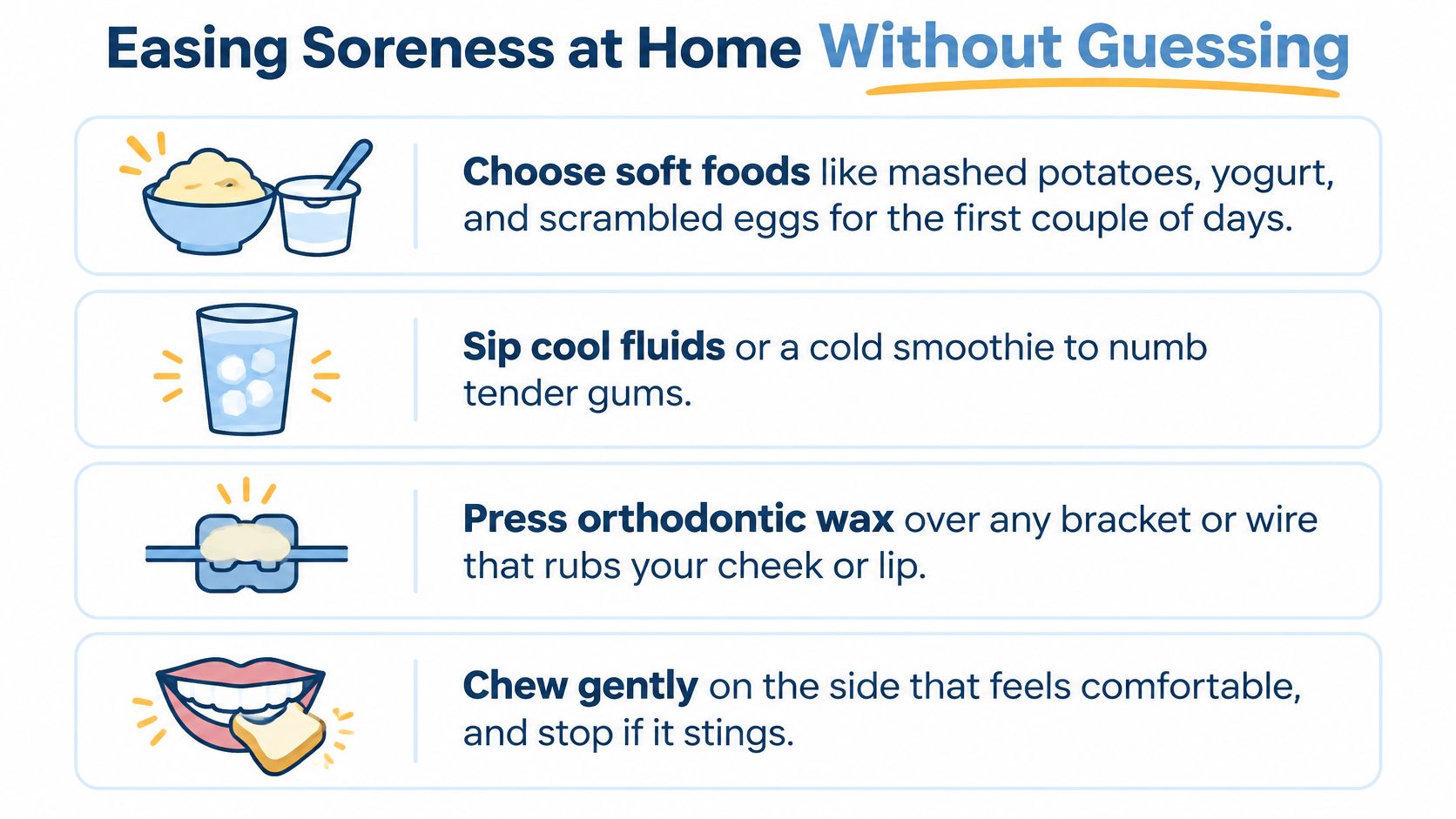
Start with the measures that carry no dosing question at all. Soft foods for the first day or two, such as mashed potatoes, yogurt, scrambled eggs, and soup, take the mechanical load off tender teeth. Cool fluids and cold smoothies numb the tissue briefly. Orthodontic wax pressed over a bracket or wire that rubs the cheek solves irritation that has nothing to do with tooth movement. Gentle chewing on the comfortable side keeps the ligament working without punishing it.
Chewing sugar-free gum is the least obvious option, and the evidence behind it is surprisingly concrete. A 2023 systematic review and meta-analysis of chewing gum for orthodontic pain reported a mean pain reduction of 0.50 points versus pharmacologic comparators 24 hours after initial archwire placement, with a 95 percent confidence interval from 0.10 to 0.90 points in favor of gum, and it also outperformed a control condition at the measured time points. Stick to your orthodontist's advice about chewing, especially if a bracket or wire is already loose.
For medication, a systematic review covering 37 randomized trials and 2,277 patients found orthodontic pain begins soon after activation, peaks around day 1, and eases across the first week, though low-level discomfort can linger, and over-the-counter analgesics can reduce it. Pick the product and dose from the label plus the orthodontist's or pediatrician's advice, and never give a child aspirin unless specifically directed. One caution applies to timing: because prostaglandins take part in both inflammation and bone remodeling, long-term NSAID use can slow tooth movement, so short courses are the sensible default.
In-office options exist too, and they're worth asking about rather than assuming. A 2025 clinical trial found low-level laser therapy reduced pain at selected time points, while a paracetamol-caffeine combination did not significantly reduce pain across the treatment course. Follow-up survey work connected to that research found most patients went without any medication once soreness began, which argues for deciding on a plan before the appointment instead of at 10 p.m.
Comfort options and the evidence behind them
| Option | What it addresses | What the evidence reports |
|---|---|---|
| Soft foods and cool fluids | Chewing discomfort | Practical advice for the first day or two; no separate trial data in the studies cited here |
| Orthodontic wax | Rubbing from brackets or wires | Eases mechanical irritation rather than tooth-movement soreness |
| Sugar-free gum | Pain while chewing and early discomfort | Outperformed both a control condition and pharmacologic comparators in pooled trial data |
| Over-the-counter pain reliever | Diffuse soreness | Can reduce orthodontic pain; follow the label and clinician advice; no aspirin for children unless directed |
| Low-level laser therapy | Pain at selected time points | Reduced pain at selected times in a clinical trial; an in-office option to ask about |
| Paracetamol-caffeine combination | Diffuse soreness | Did not significantly reduce pain across the treatment course in the same trial |
One more practical note for parents: brushing still matters on the sore days. Tender gums that collect plaque get more inflamed, not less. A soft-bristled brush, a slower two minutes, and lukewarm water make the job tolerable, and braces pain relief tips covers the daily routine in more detail.
Warning Signs That Warrant a Call to the Office
Which soreness can safely follow its normal course, and which needs a same-day call? The answer depends less on whether braces hurt and more on where the pain sits, how it changes, and whether something looks damaged.
Ordinary soreness feels like dull pressure spread across several teeth. It is strongest during the first 24 to 48 hours, then should gradually ease. A different pattern deserves attention: pain that sharpens in one spot, keeps worsening after day 3, or comes with facial swelling, fever, a loose bracket or band, or a wire cutting the cheek.
A gentle check at home can help describe the problem. With clean hands, look for a wire end and touch each bracket without pushing on it. A bracket that moves under a fingertip needs attention, while pressure across several teeth may only need softer foods and time. If the child cannot manage food or drink, call rather than waiting for the scheduled adjustment.
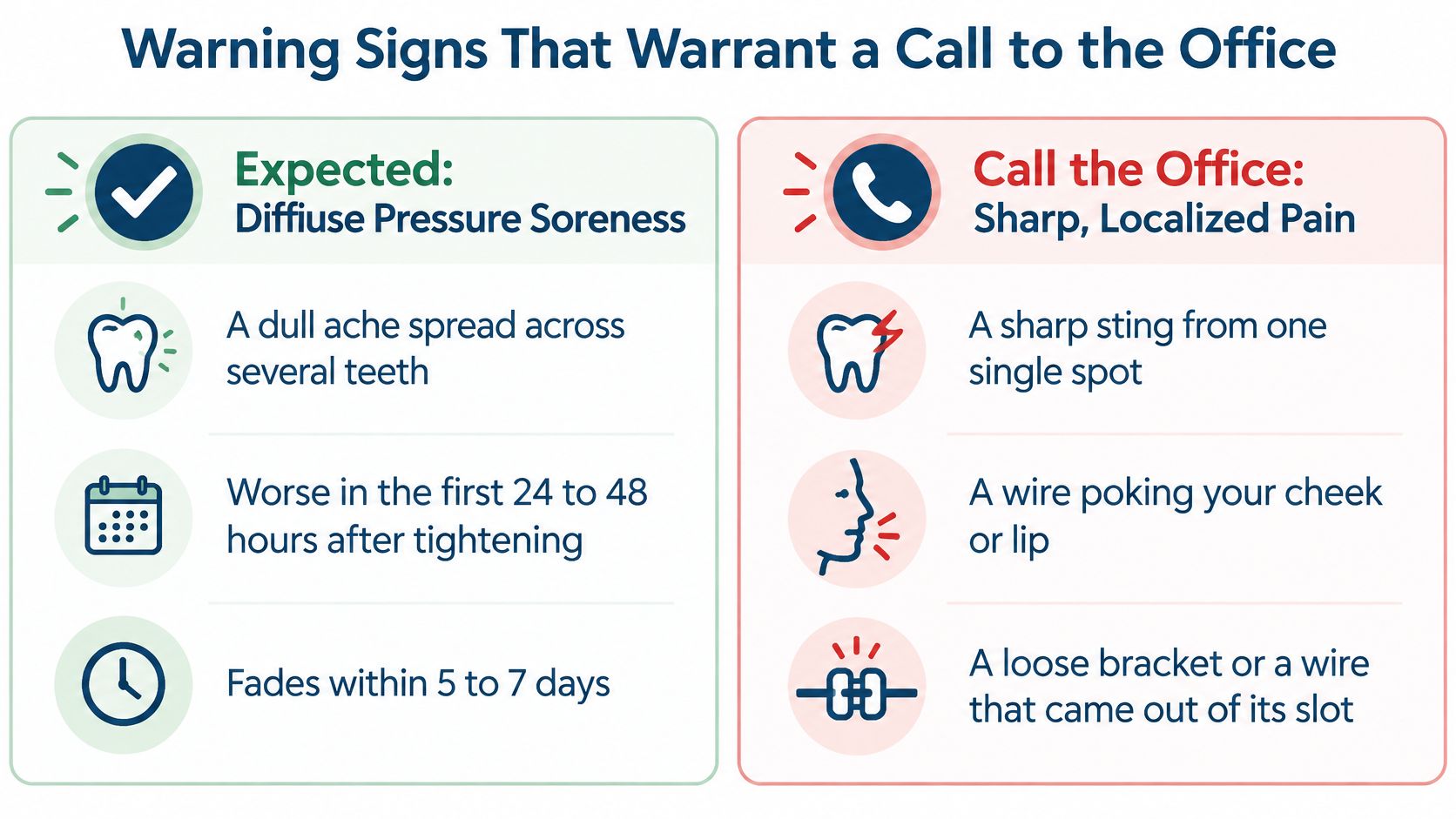
Expected soreness versus symptoms to report
| Symptom | Usually expected | Contact the office |
|---|---|---|
| Dull pressure across several teeth, worst in the first 24 to 48 hours | Yes | Only if it keeps worsening after day 3 |
| Harder chewing and preference for softer meals | Yes | Only if the child cannot eat or drink |
| Sharp pain at one specific spot | No | Yes, may signal a poking wire or loose bracket |
| Loose bracket or band | No | Yes |
| Facial swelling or fever | No | Yes |
| Pain that stays severe past about one week | No | Yes |
A short script for the call: where it hurts, when it started, whether it is improving or worsening, what your child can eat and drink, and whether anything looks loose, sharp, or swollen.
A specific change gives the office a clear reason to help: a bracket moves, a wire pokes, one area becomes sharply painful, swelling appears, or severe soreness lasts past about a week. Stellar Orthodontics schedules adjustment visits every 6 to 8 weeks, keeps them to about 30 minutes, and arranges care with the same orthodontist at each visit, so the clinician can compare the report with the current stage of treatment. For a mechanical or urgent concern, contact the practice through its emergency orthodontic care page instead of waiting for the next appointment.
Book a Free Consultation to Review Any Concerns
The decision tree is short. If soreness follows the expected pattern, stay the course with soft foods, gentle chewing, and the pain relief your orthodontist recommended, and keep the next adjustment on the calendar. If a warning sign from the table above appears, call the same day rather than waiting for the scheduled visit.
Soreness questions come up at every stage of treatment, from a child's first exam to a teen's wire change to an adult starting clear aligners. Stellar Orthodontics sees families at four Delaware locations: North Wilmington, Middletown, West Dover, and Millsboro, and every office offers the same treatments, including Invisalign, clear braces, and metal braces.
The consultation is free whether a family moves ahead with treatment or not, and whether insurance or Medicaid applies. The orthodontist who would treat the case runs the visit, which includes a full orthodontic exam, a 3D iTero scan, and a printed treatment plan with transparent pricing before anyone leaves. That is also where comfort questions get real answers: parents can ask how long soreness typically lasts after each adjustment, what the first weeks with braces feel like, and which symptoms should prompt a call between visits. Sometimes the exam shows a child does not need orthodontic treatment, and the team says so.
Bring a written list of what your child has felt, the dates each symptom started, and any questions that came up between visits. A short note on a phone is enough. It turns a vague worry into specifics the orthodontist can answer precisely.
Stellar Orthodontics helps Delaware families understand what normal soreness feels like after a tightening visit and what deserves a same-day call, with braces and Invisalign for children, teens, and adults at offices in North Wilmington, Middletown, West Dover, and Millsboro. Book a free consultation at Stellar Orthodontics and bring your questions about comfort, timing, and what the days after each adjustment really look like.