
Does a search for metal J brackets always lead to the same piece of braces hardware? Not necessarily. A parent may hear the term during an orthodontic visit, then find pictures of dental hooks, ordinary braces, and heavy steel shelf supports online.
For Delaware families considering orthodontic treatment, the useful distinction is what the part does, not just what someone calls it. A hook provides an attachment point, while a bracket holds the wire that helps guide tooth movement.
Table of Contents
- What Metal J Brackets Mean in Orthodontics
- How a Metal Bracket Holds the Wire
- How Wire Size and Slot Size Change Movement
- Nickel Sensitivity and Metal Braces
- Keeping Metal Braces Clean and Healthy
- Choosing Between Metal, Ceramic and Clear Options
- Your Next Step Is a Free Consultation
What Metal J Brackets Mean in Orthodontics
In orthodontics, people who say metal J brackets usually mean a small J-shaped metal hook, not a separate style of tooth bracket. The phrase isn't precise enough to identify an appliance without seeing it or hearing its purpose.
An orthodontic J-hook is a wire hook attached to a band or bracket. It gives the orthodontist an attachment point for rubber bands, also called elastics, or certain headgear arrangements. Not every patient needs this hardware, and a hook's presence doesn't tell a parent the whole treatment plan.
A standard metal bracket is different. It's the small block bonded to the front of a tooth, with a slot that holds the archwire.
Three meanings of metal J brackets
| Meaning | What it looks like | What it does | Where you meet it |
|---|---|---|---|
| Orthodontic J-hook | Small metal hook attached to a band or bracket | Anchors rubber bands (elastics) or headgear | Orthodontic office |
| Standard metal bracket | Small metal block bonded to the front of a tooth | Holds the archwire that guides tooth movement | Orthodontic office |
| Shelf J-bracket | Steel J-shaped support screwed to a wall | Holds up a shelf | Hardware store and home projects |
The hardware-store version has nothing to do with teeth. A steel J-bracket installation guide describes a wall-mounted shelf support secured to framing, rather than any dental appliance.
Most parents only need to distinguish the dental hook from the tooth-mounted bracket. If someone points to a small curved extension, the conversation probably concerns an attachment point. If someone points to the block on the tooth, the conversation concerns the bracket itself.
Practical rule: Ask the orthodontist to point to the part and explain what attaches to it. A name alone may leave too much room for confusion.
A parent shouldn't attach elastics to a hook because it looks suitable. The treating team should demonstrate the exact attachment points and explain when the prescribed elastics should be worn.
Writing down unfamiliar terms can help, especially during a busy appointment. A short note such as “J-hook, what connects to it?” gives the orthodontist a clear question to answer at the next visit. There's no expectation that families arrive already knowing the names of every component.
How a Metal Bracket Holds the Wire
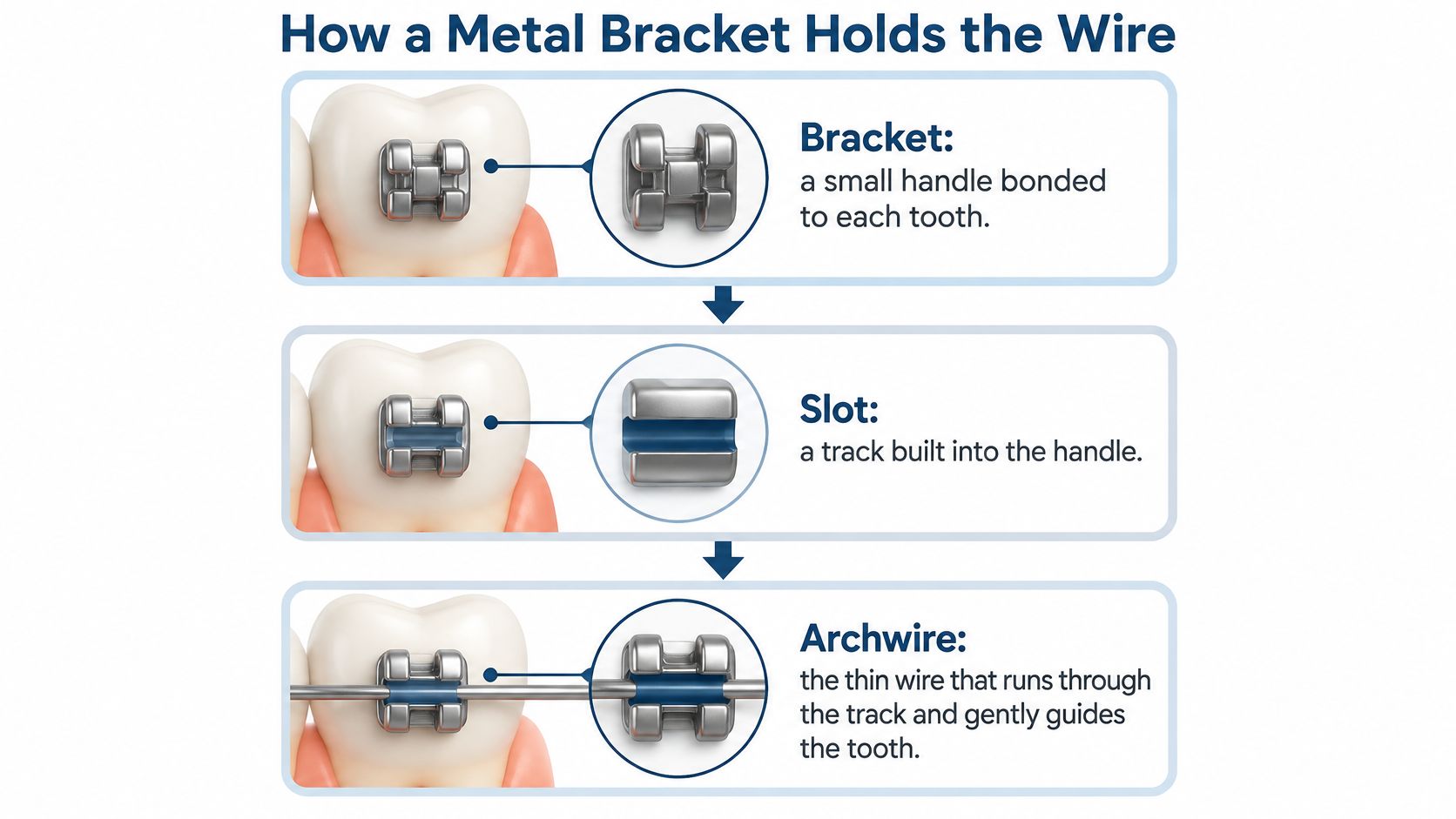
A metal bracket works a little like a small handle bonded to a tooth. The bracket's slot is a track built into that handle, and the archwire is the thin wire running through the track. Together, these parts let the orthodontist apply planned forces to the teeth.
The base is the surface bonded to the enamel. The slot receives the wire, while a small elastic tie or wire ligature can hold the archwire in place. In a self-ligating bracket, a built-in clip performs that holding function instead.
Why stainless steel remains familiar
Metal brackets developed through the fixed-appliance tradition associated with Edward Hartley Angle's 1899 system, while ceramic brackets appeared in the 1970s and self-ligating metal brackets reappeared in the mid-1970s, as described in the orthodontic biomaterials review.
That history represents more than a century of refinement, rather than a new or experimental approach. Stainless steel became the dominant metal format because it combines strength, formability, weldability, and corrosion resistance.
In practical terms, manufacturers can shape stainless steel into small components that hold a wire securely. Its usefulness doesn't mean every metal bracket is identical, or that a particular clip design automatically makes treatment faster. The orthodontist still has to choose the appliance and use it appropriately for the patient.
What happens at the bonding visit
For a typical placement appointment, the team cleans and prepares the teeth, positions the brackets, and bonds them to the front surfaces. The first archwire then passes through the bracket slots and is secured.
At Stellar Orthodontics, braces placement takes 60 to 90 minutes and involves no injections, no drilling, and no pain. That description concerns the placement procedure itself, rather than a promise that teeth will never feel tender afterward.
The guide to orthodontic bracket placement gives families a closer look at this process.
- Before placement: Parents can mention a child's worries about unfamiliar instruments or keeping the mouth open.
- During the explanation: The team can identify the bracket, wire, ties, and any hooks included in the plan.
- Before leaving: The patient should understand which parts stay in place and which, if any, require a home routine.
The handle-and-track analogy helps make the appointment less mysterious. The visible metal isn't one solid appliance, but a set of small parts with different jobs.
How Wire Size and Slot Size Change Movement
Torque is the turning effect created when a shaped wire twists against the bracket slot. It controls a tooth's inward or outward inclination and helps position its root. Parents often assume torque means a harder pull, yet it really describes the direction and precision of a turn, something quite separate from how quickly treatment will finish.
A thinner wire leaves more clearance inside a slot. Before that wire fully engages the slot's walls, it can rotate through some of that clearance, often called play. A fuller-fitting wire engages with less play.
Wire and slot combinations from lab studies
Laboratory testing shows how much play different wire and slot pairings allow.
| Slot size | Wire size | Reported result | What it means |
|---|---|---|---|
| 0.018-inch | 0.016 × 0.016-inch | About 31 degrees engagement angle, according to a review of torque expression in stainless-steel brackets | More room to rotate, so more play in the slot |
| 0.018-inch | 0.018 × 0.025-inch | About 4.6 degrees engagement angle in the same review | Thicker wire fills the slot more fully, with less play |
| 0.018-inch vs 0.022-inch slot | Rectangular wire | Greater moment in the 0.018-inch system, per a laboratory study of wire shape and slot size | Smaller slot expressed more torque in lab tests |
These are laboratory measurements, not predictions of a child's treatment speed or outcome. A smaller engagement angle says nothing about how many appointments a child will need.
A typical wire sequence shows the idea better than numbers do. Early in care, an orthodontist often places a thin round wire so crooked teeth can slide into line with gentle force. The loose fit helps here: the wire settles crowded teeth without binding against the slot walls. Once the teeth are roughly aligned, the next wire is thicker and often rectangular. It fills the slot closely, so when the wire turns, the bracket and tooth turn with it. The play that helped early on gives way to precise control.
Why the orthodontist changes wires
Each new wire has a job. Early wires focus on alignment. Later, thicker rectangular wires engage the slots more fully for controlled tipping and root-positioning mechanics. The treating orthodontist selects the sequence according to the teeth and the treatment plan, so two children of the same age may carry different wires at the same stage.
Manufacturing also matters. A study of bracket slot dimensions and built-in torque found measurable differences between advertised specifications and manufactured brackets.
Placement adds another consideration: a finite-element study of bracket position examined how positioning a bracket on different parts of the crown affects torque mechanics. Each bracket needs its own carefully chosen spot on the tooth.
Wire size is about fit for the job. The useful wire is the one that matches the treatment task at that visit.
Parents can ask what the next wire is intended to accomplish and why a change is appropriate. That question usually produces a more useful explanation than asking whether the wire is the strongest available.
Nickel Sensitivity and Metal Braces
Soreness after braces doesn't automatically mean a metal allergy. A bracket rubbing the cheek can create a friction sore, while allergy involves an immune response. The distinction matters because the next steps aren't the same.
Austenitic stainless steel used in orthodontic brackets commonly contains approximately 18% chromium, 8% nickel, and 0.15% carbon, according to a review of stainless-steel orthodontic brackets. Chromium helps form a protective surface layer, while nickel supports the steel's structure and mechanical properties.
Nickel can trigger a delayed contact-type hypersensitivity reaction in susceptible people. Known reactions to jewelry deserve attention, but they don't establish that every stainless-steel appliance will cause symptoms.
Sensitization isn't the same as a noticeable reaction
A systematic review of allergy in orthodontics reports one study with nickel sensitization in 14% of orthodontic patients, compared with 4% for titanium, and notes that most investigations found nickel-sensitive patients tolerated stainless-steel components without noticeable reactions. Nickel was the most frequently identified allergen, but other metals can also be involved.
That's why symptoms, history, and professional evaluation matter more than assuming the bracket material is responsible. An orthodontist may recommend further assessment, including possible patch testing, when the history or examination warrants it.
Signs after metal braces and what to do
| Sign after metal braces | Usual meaning | Next step |
|---|---|---|
| Sore spots or ulcers on cheeks or lips from brackets | Common friction irritation, often early in treatment | Tell the office at the next visit and ask about dental wax; contact sooner if severe or persistent |
| Persistent rash, redness or itching where metal touches skin | Possible contact reaction that needs evaluation | Call the office and list every metal contact |
| Swelling of lips, cheeks or tongue | Needs prompt professional assessment | Call the office right away; rapidly worsening or tongue swelling warrants urgent medical care |
| Trouble breathing or swallowing | Medical emergency | Call emergency services immediately; don't wait for an orthodontic appointment |
A useful pre-treatment checklist
- Describe previous reactions: Include earrings, watches, belt buckles, and piercings, even if the reaction happened long ago.
- Explain the pattern: Note whether symptoms stayed at the contact point or spread elsewhere.
- Ask about both components: Bracket alloys and archwire alloys may differ, so both belong in the discussion.
For documented nickel hypersensitivity, an orthodontist can consider nickel-free bracket alloys or ceramic alternatives after evaluation. Ceramic isn't medically superior for everyone, and a material change shouldn't replace a careful assessment of the symptoms.
Keeping Metal Braces Clean and Healthy
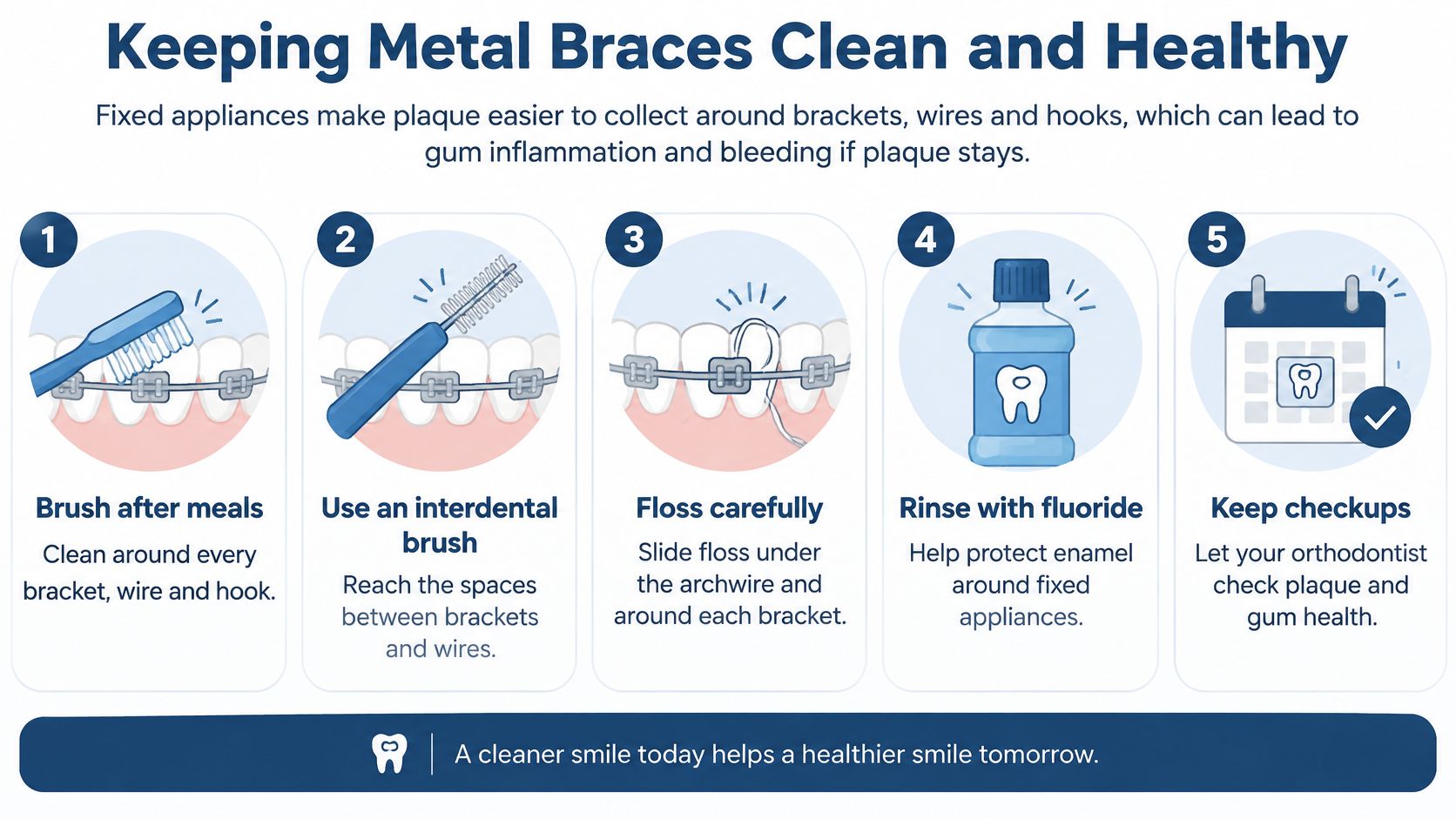
A child who brushes only the visible front of each bracket may look tidy and still have plaque along the gumline. Fixed appliances work like small shelves around the teeth. Food and plaque can settle above, below, and beside brackets, wires, and hooks. If plaque stays there, gums can become inflamed and bleed. Switching bracket material doesn't remove those cleaning challenges, so the routine matters with metal or ceramic brackets.
The most useful home care reaches the gumline and the edges of every attachment, not just the broad front surfaces of the teeth. Think of the mouth as a room with several corners. The bracket face is easy to see, while the spaces around the wire and hooks need more attention.
A practical cleaning routine
- Angle the toothbrush toward the gumline. Clean above and below each bracket so the bristles reach where plaque tends to remain. White spots can develop on exposed enamel around brackets when cleaning misses those areas.
- Work carefully around hooks and ties. Small attachments can hide food. Removable elastics should be handled according to the treating team's instructions.
- Clean beneath the archwire. A floss threader helps guide floss under it, while an appropriately sized interdental brush reaches accessible spaces without forcing the wire.
- Limit sticky and sugary snacks between meals. Sticky foods can cling to hardware, and frequent sugary snacks make tooth protection harder around brackets.
- Use fluoride toothpaste. Cleaning should protect the exposed enamel around brackets as well as remove visible food.
- Keep scheduled visits and report persistent symptoms. Swelling, bleeding, or sores that don't settle deserve attention rather than an assumption that braces always cause them.
The brushing-with-braces guide provides further help for families turning these steps into a workable daily habit.
What bracket material can't solve
In one longitudinal comparison discussed in a review of nickel allergy and periodontal health, gum status didn't differ between conventional and nickel-free groups during the first nine months. That does not mean nickel-free brackets alone guarantee healthier gums. A child struggling with floss threading, sore gums, or awkward hooks should tell the office early. Showing the difficult spot lets the team suggest a more manageable technique instead of repeating an instruction to brush better.
Choosing Between Metal, Ceramic and Clear Options
A teen who wants straighter front teeth and an adult who prefers a less visible option at work can leave with different appliances, even when their goals sound identical. The bite problem, the daily routine, and the family's priorities shape the recommendation more than the name of the product.
Metal, ceramic and clear options at a glance
| Option | Appearance | Material | Often considered for |
|---|---|---|---|
| Traditional metal braces | Visible metal brackets and wires | Stainless-steel brackets | Complex bite issues, severe crowding, detailed tooth rotation |
| Clear ceramic braces | Tooth-colored brackets with a lower-profile look | Ceramic brackets | Patients who prioritize a less visible look |
| Invisalign clear aligners | Nearly invisible removable trays | Clear plastic aligners | Mild to moderate cases, including many adults |
The table gives the short version. The rest of the decision comes down to how each option behaves day to day.
Metal braces cover the widest ground, from straightforward cases to the complex movements in the table. Plenty of patients in visible brackets have routine treatment; the material says more about versatility than difficulty.
Clear ceramic braces move teeth the same way metal braces do and are equally effective, so appearance and budget tend to decide between them. The ceramic-versus-metal braces comparison walks through those practical differences.
Clear aligners suit many mild to moderate cases, including many adults. Because the trays come out for eating and brushing, success depends on wearing them as prescribed and keeping track of them.
A decision path for families
- Match the appliance to the diagnosis: The exam shows whether the case fits within the ranges in the table or calls for fixed braces.
- Set appearance priorities: Some patients are comfortable with visible brackets; others place greater importance on a tooth-colored or clear option.
- Be honest about removable-tray habits: A patient who regularly misplaces a phone or a retainer case may struggle to keep aligners safe and worn on schedule.
- Ask the orthodontist to explain the recommendation: The reasoning should connect the appliance to the actual bite findings, not to appearance alone.
Coverage is worth checking before deciding. When Delaware Medicaid pre-authorization is approved, it covers traditional fixed metal braces, while clear ceramic braces are generally an upgrade paid privately. Stellar Orthodontics can confirm how a family's plan applies to the proposed treatment.
A quick mental test helps. If the patient would lose a removable tray within a month, fixed braces remove that worry entirely. If the patient needs a discreet option for presentations or photos, a lower-profile choice earns its place.
Your Next Step Is a Free Consultation
The main takeaways are straightforward: J-hooks and standard brackets have different jobs, wire-and-slot choices influence control, and sensitivity and cleaning deserve attention alongside appearance. Families don't need to master the terminology before arranging an evaluation.
At Stellar Orthodontics, a free consultation includes iTero digital 3D scanning to help plan care. Delaware families can choose among these locations:
- North Wilmington: 2304 Concord Pike.
- Middletown: 818 Kohl Avenue.
- Dover/West Dover: 125-2 Greentree Drive.
- Millsboro: 26670 Centerview Drive.
Stellar Orthodontics offers a free Medicaid braces evaluation at all four offices, along with monthly payment plans for braces and Invisalign. An evaluation gives families an opportunity to discuss suitability and coverage without assuming that every treatment will qualify.
For a useful appointment, families can prepare:
- A metal-reaction history: List any metals or jewelry associated with symptoms.
- Material questions: Ask about the planned bracket and wire alloys.
- Appointment questions: Include concerns about placement, cleaning, hooks, or elastics.
Stellar Orthodontics offers free consultations to help Delaware families understand braces hardware and compare appropriate treatment options. Families with questions about metal J brackets can visit Stellar Orthodontics to book a free consultation at the most convenient office.